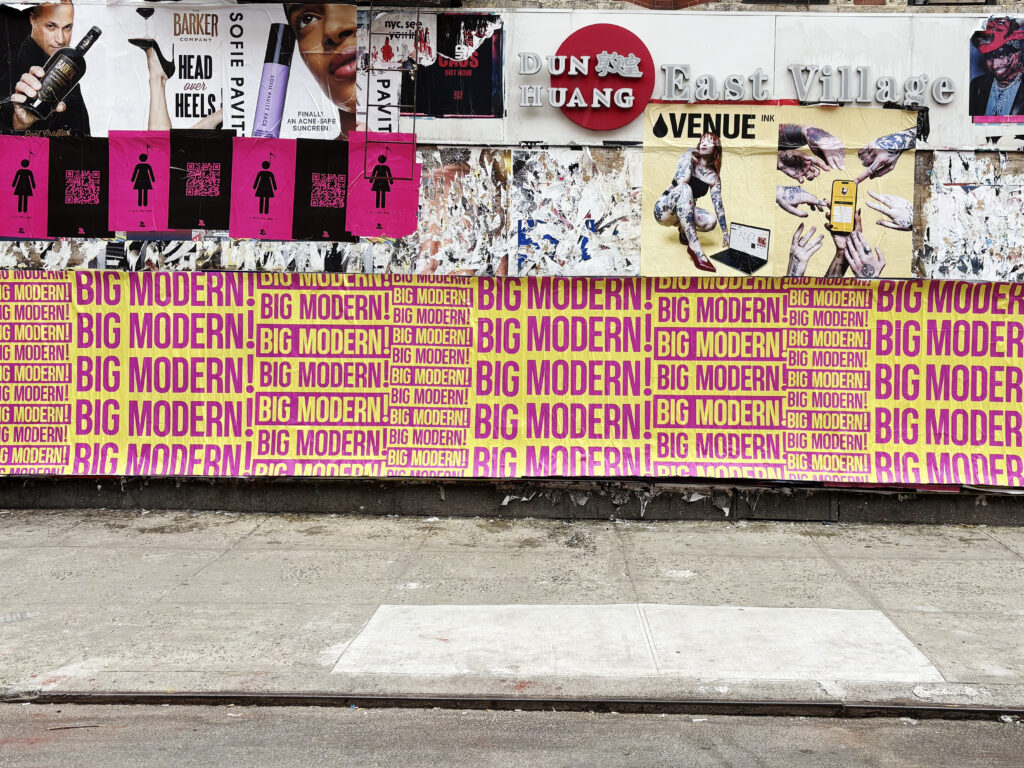
June 8, 2026 Guerrilla Marketing Agency, Hyperlocal Campaigns, Local Advertising, Wheatpasting & Poster Campaigns

⚽ World Cup 2026 matches begin June 11 at Hard Rock Stadium. Miami’s streets are the most watched they’ve ever been.
Every city has walls. Miami made its walls mean something.
That is not hyperbole, it is the specific, traceable story of how a derelict garment district north of downtown became one of the most internationally recognized outdoor art spaces on earth, and how that transformation shaped the entire culture of street-level advertising in the city. Wheatpasting in Miami does not happen in a vacuum. It happens against the backdrop of a visual tradition that began with a developer’s gamble on blank warehouse walls in 2009 and has been building ever since into one of the richest street art cultures in the world.
Understanding that history is not a nice-to-have for brands planning wheatpaste campaigns here. It is the prerequisite for running campaigns that actually land, that feel like they belong in the city’s visual conversation rather than like they were dropped in by an agency that Googled “Miami street advertising” and booked the Wynwood Walls entrance wall sight unseen. The brands that win in Miami’s street art environment win because they understand the culture they’re activating in. The brands that look out of place look out of place for the same reason: they didn’t do this work.
This piece is that work. A history of how wheatpasting developed its cultural legitimacy in Miami, what the different neighborhoods mean in the context of that history, where the next generation of the city’s visual culture is forming, and what the World Cup 2026 moment means for brands activating in this specific cultural context. If you’re here for pricing and locations, the landing page has that. If you’re here to understand Miami’s street art culture before you put your brand into it, keep reading.
Miami has always been a visual city. The Art Deco architecture of South Beach, preserved through a long preservation fight in the 1980s that was itself a form of cultural battle over what the city’s visual identity would be, established the principle that the built environment here is worth protecting as aesthetic heritage. Neon signs. Pastel facades. Decorative friezes. South Beach was the first neighborhood in the U.S. to be listed on the National Register of Historic Places as an Art Deco district, and that designation reflected a community consensus that visual character is inseparable from cultural identity.
In Little Havana, the visual tradition ran deeper and older. The hand-painted signs on Cuban restaurants. The vibrant murals on community buildings along Calle Ocho. The street vendors and their handwritten boards. Little Havana’s visual culture was never curated or gallery-sponsored, it emerged organically from a community that brought its aesthetic traditions from Cuba and rebuilt them on SW 8th Street over fifty years. That visual culture predates Wynwood by decades. It is the original Miami street art tradition.
In the 1990s and early 2000s, Miami had a thriving underground street art scene that operated without institutional support. Artists tagged and stenciled and pasted on the walls of Overtown, Liberty City, and the emerging warehouse district that would eventually become Wynwood. This was not the celebrated, commercially engaged street art of the post-2009 period. It was the rawer, grittier, permission-less expression that characterizes street art in every city before the galleries arrive. But it laid the cultural groundwork. It established the precedent that Miami’s walls were legitimate canvas, and that the city’s visual culture extended beyond architecture into the streets.
The transformation of Wynwood as a visual culture destination begins with Tony Goldman and a specific decision he made in 2009. Goldman, a New York-based developer who had done significant work on the revitalization of SoHo and South Beach, owned a collection of warehouse properties in what was then a largely derelict garment and meatpacking district roughly bounded by NW 20th Street to the south, NW 29th Street to the north, and I-95 to the west.
The district had some interesting bones, large, flat-walled warehouse buildings with the kind of blank vertical surfaces that muralists dream of, but very little else going for it in conventional real estate terms. Goldman’s idea was to transform those blank walls into an outdoor art gallery by inviting world-renowned muralists to paint them. Not tagging. Not stencil work. Large-scale, gallery-quality paintings executed on warehouse walls that were visible from the street at the scale of billboards. The Wynwood Walls, as the resulting compound at NW 2nd Ave and NW 26th St came to be known, opened to the public during Art Basel Miami Beach 2009 with works from fourteen internationally recognized artists.
The effect was immediate and lasting. For the first time in Miami, large-format outdoor visual art had institutional backing, international credibility, and a specific geographic address that tourists, journalists, and the art world could come to see. The Wynwood Walls became a destination. The surrounding blocks, energized by that destination status, began filling with galleries, studios, coffee shops, and the organic street art activity that tends to follow cultural concentration wherever it forms.
What Goldman did, fundamentally, was establish the cultural permission for large-format visual art on Miami’s walls. Before the Wynwood Walls, a brand putting large-format printed posters on walls in that neighborhood was operating in legal and cultural ambiguity. After the Wynwood Walls, the same action was participating in an internationally recognized visual art tradition. That permission structure is what makes wheatpasting in Miami work differently than it does anywhere else. The city said yes to walls as canvas. And that yes has compounded ever since.
NW 2nd Avenue through Wynwood’s core is the spine of the neighborhood’s evolution from industrial district to art destination. Understanding what that street was before 2009 gives you a better sense of what it is now, and why the walls along its length are among the most valuable wheatpaste advertising surfaces in the country.
In its pre-Goldman years, NW 2nd Ave through the 20s was a working industrial street. Loading docks. Garment warehouses. Light manufacturing. The buildings along it were the kind of utilitarian concrete and block structures designed for function, not aesthetics, high ceilings inside for rack storage, blank facades outside with roll-up metal doors and service entrances at regular intervals. The walls facing the street were exactly the kind of large, flat, somewhat sheltered surfaces that make excellent paste surfaces. They just happened to face a street that nobody was looking at.
Post-2009, NW 2nd Ave between NW 20th St and NW 29th St, the core strip, became what it is now: the highest-concentration pedestrian gallery street in Miami. Every major brand that has activated in Wynwood has had a presence on this corridor. The loading dock walls on NW 29th St east of NW 2nd Ave, which in the garment district era were purely functional, now see regular documentation by tourists who recognize them as part of the art corridor’s northern extension. The walls are the same concrete they always were. The cultural context around them is entirely different.
The NW 22nd St side-street approach between NW 1st and NW 2nd Ave is worth noting as its own micro-zone. Less saturated than the main strip, higher dwell time, people move slower on side streets, they pause more, they engage more closely with what’s on the walls. Foot traffic on this block consistently outperforms its surface area-to-position ratio would suggest, because the pedestrians who turn off NW 2nd Ave to explore the side streets are by definition the more engaged, curious half of the Wynwood audience. They are the people looking for things to photograph, not just walking through. That is the audience you want encountering your wheatpaste campaign.
Cultural districts don’t emerge from murals alone. They emerge from infrastructure, the coffee shops, bars, galleries, and community events that give people reasons to be in the neighborhood at all hours and in all moods. Wynwood’s cultural infrastructure is as important to its outdoor advertising value as its visual aesthetic, and it’s worth understanding specifically because it determines foot traffic patterns in ways that matter to wheatpaste placement strategy.
Panther Coffee opened on the corner at NW 24th St in the early Wynwood years, and it became something specific to the neighborhood: an informal headquarters for the creative class that was colonizing Wynwood from Miami’s various art, design, and media worlds. By the time Wynwood was fully established as a destination, the Panther Coffee corner had become the gathering point for the neighborhood’s resident creative community, the people who were there not for the Instagram photographs but because they worked there, lived there, or had been coming for years. These are the most culturally influential members of the Wynwood audience. They are the ones whose opinions about brands and campaigns and what belongs on those walls matter most to the social ecosystem that amplifies or ignores wheatpaste advertising in the neighborhood.
The Wynwood Art Walk, held on the second Saturday of each month for most of the neighborhood’s art-destination years, established a reliable rhythm of concentrated foot traffic that brands and artists have been activating around ever since. Art Walk nights in Wynwood generate some of the highest pedestrian densities of any recurring event in Miami outside of major festivals, and the audience, specifically the locals who come regularly rather than the tourists who stumble in, is the most brand-aware and culturally discerning street advertising audience in the city. Campaigns installed before Art Walk nights and photographed during the event are consistently among the highest-performing in terms of organic social media documentation.
“The people who photograph your Wynwood wheatpaste campaign on an Art Walk Thursday night are not the same people as the Saturday afternoon Instagram tourists. The Thursday crowd is the local creative class. Their opinion of what’s on those walls shapes the neighborhood’s cultural consensus in ways that tourist photography never quite does.”
The commercial activation of Wynwood followed a predictable trajectory that mirrors the development of every significant cultural district: artists first, culturally aligned brands second, mainstream brands third, and then the flood that comes when a neighborhood’s prestige becomes common knowledge. Each stage of that wave left a residue in the neighborhood’s visual culture and a set of expectations about what belongs there and what doesn’t.
The first brands in Wynwood after the Goldman moment were the ones with genuine cultural connections, record labels, streetwear companies, independent spirits brands, art-adjacent consumer goods, whose presence in the neighborhood felt like a natural extension of their brand identities. These campaigns worked not because of media budget or placement density but because they were contextually appropriate. The creative felt right for the walls. The brands felt like they were part of the same cultural conversation that Wynwood was having with itself.
The second wave was larger and less selective. As Wynwood’s national and international profile grew, Art Basel coverage, travel magazine profiles, the explosion of Instagram travel photography that put NW 2nd Ave on feeds everywhere, brand interest in the neighborhood grew in proportion. By the mid-2010s, major consumer brands from every category were running Wynwood activations. Some of them understood what they were activating in. Many of them clearly did not.
The third wave was the flood: every brand with a millennial-targeting mandate, a “street cred” brief, or a South Florida regional activation budget showing up in Wynwood simultaneously. This is when the saturation became real. The NW 2nd Ave core strip during peak years became the most brand-competitive outdoor advertising environment in the U.S. outside of Times Square, with the critical difference that Times Square audiences expect commercial saturation and Wynwood audiences were still calibrated to a cultural quality standard that commercial flooding violates.
The aftermath of the brand wave is the current state: a Wynwood that is simultaneously the highest-prestige and most brand-saturated wheatpaste zone in Miami, where the quality bar for campaign creative is among the highest in the country and where the penalty for mediocre or contextually inappropriate creative is genuine audience dismissal rather than just visual noise.
The line between brands that win in Wynwood and brands that don’t is not a line between big budgets and small ones. It’s a line between campaigns that feel like they belong there and campaigns that feel like they bought a media spot. The Wynwood audience, and particularly the local Wynwood creative community, makes this distinction immediately and without charity.
Brands that win share a set of characteristics. Their creative is visually ambitious, it would hold its own against the painted murals surrounding it rather than looking diminished by the comparison. Their campaign has a point of view. Not just a logo and a tagline, but an aesthetic statement that suggests someone at the brand actually understood the visual context they were activating in. Their placement is intentional, they are on the walls that make sense for their creative and their audience, not simply on the cheapest available surface in the highest-traffic zone.
Brands that don’t win share a different set of characteristics. Generic creative that would look identical in Dallas or Denver, nothing about it responds to Miami’s visual culture or Wynwood’s aesthetic language. Placement that signals pure budget constraint, one poster on a side wall that nobody walks past, chosen because it was available rather than because it was right. An obvious disconnect between the brand’s positioning and the neighborhood’s identity, a buttoned-up financial services brand with literal-minded creative on the core NW 2nd Ave strip, surrounded by murals that took a week to paint, reads as a corporate intrusion rather than a cultural participant.
The practical implication: before you brief a Miami wheatpaste campaign, look at Wynwood’s walls. Actually look at them, spend an afternoon on NW 2nd Ave and the surrounding blocks, see what’s there, understand the visual standard you’re entering. If your campaign creative can hold that conversation, it belongs in Wynwood. If it can’t, put it in a different neighborhood where the visual standard is different, or invest in better creative before you invest in placements.
Little Havana’s relationship with public visual art is older and more organic than Wynwood’s, and it is rooted in a fundamentally different cultural tradition. Where Wynwood’s murals are gallery-driven, internationally sponsored, and curated by an institution with global art world credibility, Little Havana’s murals and street art emerged from the community itself, from the Cuban exiles and their descendants who rebuilt their visual culture on Calle Ocho over fifty years and who have been painting their own story on the neighborhood’s walls since long before anyone called it a street art destination.
Calle Ocho, SW 8th St between SW 12th Ave and SW 27th Ave, is the main cultural corridor, and the visual environment along its length is a living document of the community’s identity. The murals near the Tower Theater on SW 8th and SW 16th Ave tell stories of Cuban history and exile experience. The walls adjacent to Maximo Gomez Park at SW 15th Ave, the famous Domino Park where Cuban elders have been playing dominoes since the 1970s, carry decades of community visual identity. This is not art as cultural destination marketing. This is art as community autobiography.
For brands wheatpasting in Little Havana, this context is not optional information. It is the cultural ground you are walking onto. Campaigns that demonstrate awareness of this tradition, bilingual creative at minimum, ideally creative that reflects some genuine engagement with Latin culture rather than generic visual content, find a community audience that is far more receptive than campaigns that treat Calle Ocho as simply a high-foot-traffic street rather than a culturally specific place. The Versailles Restaurant vicinity near SW 35th Ave is practically the political and cultural center of the neighborhood, the gathering point for community conversation going back to the exile generation. Brand presence in this zone is read by the community through a very specific cultural lens.
Little Havana during Viernes Culturales, the Cultural Fridays event on the last Friday of each month, is a different neighborhood from its weekday self. The foot traffic through Calle Ocho on those Friday evenings concentrates the neighborhood’s cultural community with an intensity that the neighborhood’s regular pedestrian baseline doesn’t approach. For campaigns targeting the Latin Miami consumer, Viernes Culturales installation timing and presence is roughly the equivalent of Art Walk Saturdays in Wynwood, a window of concentrated, culturally engaged audience exposure that the rest of the month doesn’t replicate.
There is a dynamic in Miami’s street art culture that is almost exactly mirroring what happened in Wynwood between 2009 and 2015, and it’s happening right now in Overtown and Allapattah, directly adjacent to Wynwood’s western and southern borders.
Overtown is Miami’s historically African American neighborhood, with roots in the jazz and R&B culture of the pre-integration era when Black musicians performing in South Beach hotels had to stay in Overtown because Jim Crow didn’t allow them to stay where they played. The neighborhood carries that history alongside the development pressures that have come with its proximity to downtown Miami and the Brightline station at NW 1st Ave. The Brightline connection is accelerating foot traffic growth in Overtown’s blocks north of the station, and the neighborhood’s arts scene is expanding with new galleries and creative venues along NW 3rd Ave between NW 8th St and NW 14th St.
The RISE building arts complex in the NW 1st Ave area and the NW 11th St arts zone are the specific zones where the pre-gentrification creative energy is most concentrated, exactly the kind of raw, community-connected cultural activity that preceded Wynwood’s transformation by a few years. Brands with the foresight to establish wheatpaste presence in Overtown before the neighborhood’s development fully materializes will occupy the position that early-Wynwood brands occupied in 2010: first in a cultural neighborhood before the saturation, building the association with an emerging community story rather than arriving after the crowds have already shown up.
Allapattah, directly west of Wynwood along NW 20th St corridor and near the Rubell Museum, is going through a similar but slightly different version of this story. The Rubell family’s decision to relocate their contemporary art collection to Allapattah, in a massive former warehouse on NW 29th St near NW 23rd Ave, had the same catalytic effect that Goldman’s Wynwood Walls had in 2009: institutional cultural credibility landing in an industrial neighborhood and establishing the permission for the commercial and creative activity that follows. Allapattah already has its early Wynwood characteristics: interesting walls, below-market creative rents, growing galleries, and foot traffic that is not yet at tourist-destination levels but is building steadily toward them.
These neighborhoods are not Wynwood yet. That’s exactly the point. The brands establishing wheatpaste presence here now are building the same kind of early cultural equity that the most successful Wynwood brands built in 2010 and 2011. They are doing it at a fraction of the cost and with a fraction of the competition.
The FIFA World Cup 2026 arrives in Miami at a moment when the city’s street art culture has been building toward international significance for fifteen years. Hard Rock Stadium’s multiple match schedule starting June 11 will bring an international creative community to a city whose visual culture they already follow, and that intersection creates a wheatpasting opportunity unlike any the market has seen.
Here is the specific dynamic: Wynwood is already on the radar of the international creative and cultural audiences that follow World Cup football. Art Basel’s years of annual attention from European and Latin American cultural tastemakers have put the neighborhood on the global creative map. When fans from France, Brazil, Argentina, Mexico, and Germany arrive in Miami for their matches, Wynwood is on their itinerary not just as a tourist attraction but as a place they have been following on social media for years. They are coming to see it with eyes already prepared to find it meaningful.
That specific audience, international, culturally engaged, with a pre-existing relationship to Miami’s visual culture, is the highest-value audience for wheatpaste campaigns that the city generates. They document everything. They share globally. A poster on the NW 2nd Ave corridor during World Cup week goes to social media feeds in twenty countries, tagged with location, shared among followers who also follow Miami’s art scene and will recognize the neighborhood as a culturally significant context. This is not typical tourist photography. This is cultural documentation by an internationally connected audience whose networks are the exact pipelines that brand stories travel through to reach global creative tastemakers.
Calle Ocho in Little Havana during the World Cup takes on an additional dimension. The Latin football nations, Brazil, Argentina, Colombia, Mexico, Uruguay, whose fans are arriving in significant numbers have a cultural and community connection to Little Havana that goes beyond tourism. This is a neighborhood whose residents are their cousins, their community, their cultural kin. Calle Ocho during World Cup match days will be the street party zone for Latin football culture in Miami in a way that is deeply rooted rather than tourist-manufactured. Brand presence on those walls during that period is presence in one of the most culturally specific and culturally resonant outdoor advertising environments Miami has ever generated.
Everything in this piece points toward the same conclusion: running a wheatpaste campaign in Miami that actually works, that generates the social amplification, the cultural credibility, and the brand impression quality that the best campaigns achieve here, requires understanding the visual culture context before you enter it. This is not a market where generic execution gets the same results as informed execution. The cultural literacy bar is real.
Creative quality is the first gate. The walls you’re competing with in Wynwood were painted by artists who showed at Art Basel. Your poster does not need to match that standard, it’s a different medium and a different format, but it needs to demonstrate that your brand understands what visual quality looks like in this environment. Bold, high-contrast, compositionally confident creative with a clear visual statement is the minimum. Creative that looks like it was generated in an afternoon from a template library and approved because it meets the brand guidelines is the thing that gets ignored, scrolled past, and sometimes specifically photographed by local creatives as an example of how not to do it.
Neighborhood fit is the second gate. The cultural character of each Miami neighborhood is specific and readable to the people who live there. A campaign in Little Havana that shows no awareness of the neighborhood’s Latin cultural identity is not a neutral campaign, it is a campaign that actively signals cultural disengagement to the most important audience in that zone. A campaign in the Design District that has the visual language of a streetwear brand is not wrong, exactly, but it is contextually out of place in a way that dulls its impact.
Concentration is the third gate. Spread across too many neighborhoods, a campaign becomes invisible in each one. Five well-placed posters in the right three blocks of Wynwood, the alley between NW 1st and NW 2nd Ave from 25th to 27th St, the NW 22nd St side-street approach, and one key surface on the main NW 2nd Ave corridor, creates the sense of intentional presence that Wynwood’s audience reads as brand investment. One poster in each of eight neighborhoods creates the sense of a brand trying to be everywhere and succeeding nowhere.
The brands that navigate all three of these gates successfully are the ones that feel like they belong in Miami’s visual culture rather than like they temporarily rented a spot in it. That distinction is visible to Miami’s audiences. It shapes how their campaigns are received, how they are photographed and shared, and ultimately how much value they generate from the city’s extraordinary organic amplification ecosystem.
American Guerrilla Marketing has been running wheatpaste campaigns in Miami long enough to have watched the Wynwood brand wave arrive, crest, and settle into its current state. We have seen the campaigns that worked and the ones that didn’t. We know the walls that the Wynwood creative community photographs and the walls that they walk past without looking. We know the Calle Ocho surfaces that hold paste after June rains and the ones that need prep time. We know which blocks in Allapattah have the early-Wynwood energy that attracts the engaged creative audience and which blocks are too far from the emerging foot traffic corridors to justify placement.
That knowledge is what we bring to every Miami campaign brief. Not just logistical execution, though we do that at a professional level, but the cultural and strategic insight that comes from years of on-the-ground presence in a city’s visual advertising ecosystem. When we advise a client on which neighborhoods to activate in, which creative approach will work in which zones, and how to time a campaign relative to Art Walk nights or World Cup match days, we are drawing on a body of practical knowledge that planning documents and market reports don’t capture.
For the World Cup 2026 window specifically, we are positioned and ready. Our Miami crew has been mapping the fan movement corridors, tracking which Wynwood and Calle Ocho surfaces will carry the highest World Cup period traffic, and coordinating with our national network for brands running multi-city tournament campaigns across Miami, New York, Los Angeles, Dallas, and other host cities. See our wheatpaste advertising page for campaign formats, and our cities page for national multi-market coordination capabilities.
Miami’s walls have been building toward this moment since 2009. The city’s visual culture is more internationally connected, more socially amplified, and more compelling to a global audience than at any point in its history. If your brand belongs in this conversation, and for the right brands, it absolutely does, the time to enter it is now, while the World Cup window is still open and the campaign slots are still available.
Wheatpasting in Wynwood traces directly to the neighborhood’s transformation beginning around 2009, when developer Tony Goldman began commissioning world-renowned muralists to paint the blank warehouse walls of what was then a derelict garment district. The large-format art that went up on those walls established the cultural template that made Wynwood receptive to wheatpasting as both an art and advertising form. Artists began pasting alongside painted murals as the neighborhood gained cultural momentum, and brands followed. By the early 2010s, the NW 2nd Ave corridor between 20th and 29th Street had become one of the most active wheatpasting zones in the United States, with cultural credibility built on the Goldman-era foundation that gives street-level visual advertising a level of prestige it holds almost nowhere else.
Miami’s street art culture has created a visual literacy in the city’s residents and visitors that is unmatched in most U.S. markets. People here know what belongs and what doesn’t. A wheatpaste campaign with strong creative that feels contextually appropriate to its neighborhood generates social sharing and organic amplification that extends its reach far beyond the physical placement. A campaign that feels like it was drop-shipped by a brand that doesn’t understand Wynwood’s aesthetic language gets ignored or noted specifically for its out-of-place quality. The authenticity bar is real and it has cultural consequences for how the campaign is received.
For cultural authenticity with a creative and art-world audience, Wynwood is the only answer, specifically the NW 2nd Ave corridor and the blocks immediately surrounding the Wynwood Walls compound at NW 2nd Ave and NW 26th St. For Latin cultural authenticity, Little Havana’s Calle Ocho corridor between SW 12th and SW 27th Ave, and specifically the blocks around the Tower Theater and Maximo Gomez Park, is the highest-context neighborhood in Miami. For brands that want to be associated with an emerging creative movement rather than an established one, Overtown’s NW 3rd Ave arts corridor and Allapattah near the Rubell Museum are the neighborhoods that mirror what Wynwood looked like in 2010, before the saturation, and offer proportionally higher cultural return for brands willing to be early.
Three things determine whether a Miami wheatpaste campaign feels authentic or awkward. First, creative quality: Wynwood’s visual environment is set by world-class muralists and internationally exhibited artists. Generic, templated poster design reads immediately as corporate and out of context. High-contrast, visually bold, and compositionally confident creative is the minimum bar. Second, neighborhood fit: match the creative and brand positioning to the neighborhood’s cultural character. Third, commitment: concentrate enough placements to feel intentional, five posters in the right three blocks of Wynwood reads as a real campaign, while one poster scattered among dozens of others reads as an afterthought.
Miami has two premium campaign windows and one underrated one. December, specifically the two weeks surrounding Art Basel Miami Beach, is the highest-prestige window for Wynwood and Design District placements, driven by the international art world visitor influx. June through July is the World Cup 2026 window this year, already the most valuable summer campaign window Miami has seen in a generation. The underrated window is October and early November: tourist crowds have thinned, Miami’s resident population is back at full engagement, and competition for campaign logistics is lower than the peak windows. For brands targeting Miami residents rather than tourists, October campaigns in Brickell, Coconut Grove, and Midtown often outperform December or summer campaigns dollar-for-dollar.
American Guerrilla Marketing has active operations across Miami. With the FIFA World Cup 2026 starting June 11, there has never been a better moment for street-level presence in the 305.
Ready to Run Your Campaign?
Call us or email us. We’ll tell you exactly what we can do in your market and what it costs.
American Guerrilla Marketing — Los Angeles
Street-level campaigns in Los Angeles and nationwide. Wheatpasting, LED trucks, street teams, and more.
(646) 776-2770
June 8, 2026
June 8, 2026
June 8, 2026
June 8, 2026
June 8, 2026