July 23, 2026
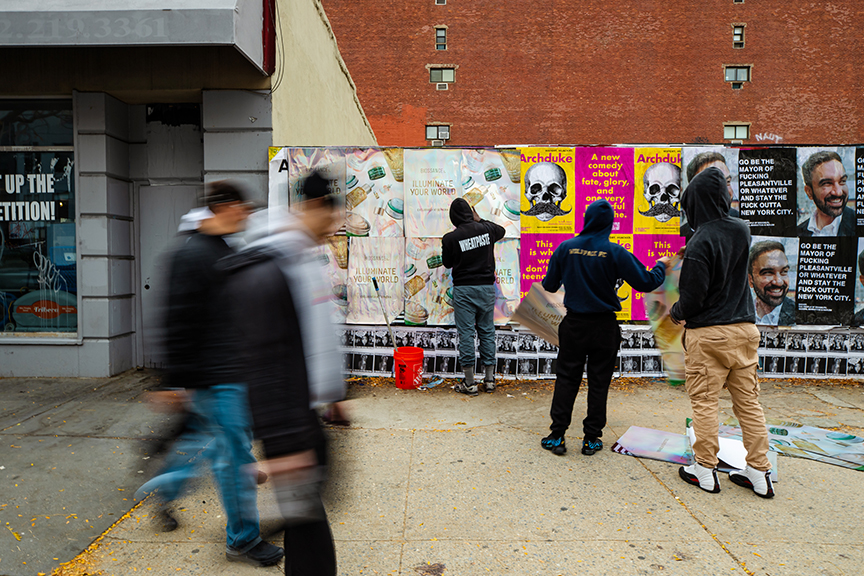
Most guides to street poster advertising in Canada operate at the level of “Toronto has good postering” or “Vancouver is a strong market.” That is not useful information if you are trying to plan a campaign. What you actually need to know is which specific streets produce the best results, what surfaces take paste well, which neighborhoods have the right foot traffic for your audience, and how the urban geography of each Canadian city differs from the US markets most agencies default to.
At American Guerrilla Marketing, we run poster campaigns across Canada’s major urban markets. This guide is a working field document—a breakdown of where street poster advertising actually runs and why, city by city, neighborhood by neighborhood. If you are a brand trying to understand the Canadian street landscape before commissioning a campaign, this is the document you need.
We cover Toronto, Vancouver, Montreal, Calgary, Edmonton, and Ottawa. Each city has its own geography, its own postering culture, and its own best surfaces. None of them are the same, and treating them as interchangeable will cost you campaign performance.
Before going city by city, it helps to understand what makes the Canadian urban context different from the US markets where most street marketing agencies built their experience.
Canadian cities are denser at street level than most American cities of equivalent population. Toronto, Vancouver, and Montreal all have extremely high walkability scores—residents walk and use transit at rates that put most US cities to shame. In Toronto, the TTC moves over a million daily riders through a network of subway, streetcar, and bus routes that deposit pedestrians directly onto the commercial streets where poster campaigns run. In Vancouver, the Canada Line, Expo Line, and extensive bus network feed walkable corridors like Commercial Drive and Main Street. In Montreal, the Metro system combined with a genuinely walkable grid means street-level visibility reaches an audience that is actually on foot, not driving past at 40 miles per hour.
That density matters enormously for street poster advertising. A campaign that runs in Kensington Market in Toronto reaches an audience that moves through the neighborhood at walking pace, has time to read, and is already predisposed to notice visual culture on the walls around them. That is a fundamentally different impression than a highway billboard at 65 km/h.
Field note: In Canadian cities with strong pedestrian and transit culture, street-level poster placements consistently outperform the reach calculations that outdoor media buyers use for billboard equivalencies. The audience quality—attentive, on foot, culturally engaged—is the variable that changes the math.
Canadian postering culture also has its own geography. Each major city has developed specific streets and neighborhoods where poster campaigns concentrate—partly because of foot traffic, partly because the physical surfaces in those areas accommodate paste well, and partly because years of creative and arts marketing have established those blocks as the places where people expect to see and look for visual culture on walls.
Toronto is Canada’s largest city and its most complex street poster market. The city’s postering geography centers on a cluster of west-end neighborhoods bounded by the Entertainment District to the east, Parkdale to the west, the Annex to the north, and Ossington to the spine. Understanding Toronto postering means understanding these neighborhoods as distinct environments, not as one undifferentiated “downtown.”
Queen Street West between Spadina and Dufferin is Toronto’s highest-density postering corridor. The stretch from Ossington west to Dufferin—sometimes called “West Queen West”—runs through a neighborhood defined by independent galleries, vintage shops, music venues, and the kind of foot traffic that comes with a densely packed creative quarter.
The physical infrastructure here is excellent for poster campaigns. Construction hoarding along Queen produces large flat surfaces that paste holds well and that face the sidewalk directly. The walls of the Silver Dollar Room, the Garrison, and the various independent retail buildings between Ossington and Dufferin have been postering surfaces for decades—the layers of previous campaigns and the texture of the brick and hoarding create surfaces that take new paste reliably. When a music tour comes through Toronto, Queen West from Ossington to Dufferin is almost always the primary postering corridor, and the campaign sits alongside the existing visual language of the street in a way that reads as native to the environment rather than imposed on it.
East of Ossington toward Bathurst, the character of Queen shifts slightly—more foot traffic from the Bathurst streetcar stop, more evening-oriented venues, and the approach to the CAMH campus and the smaller retail corridor around Trinity Bellwoods. The fencing along Trinity Bellwoods Park on Queen has historically been a postering surface, though availability varies. The stretch from Bathurst to Spadina is higher traffic during daytime hours and captures a broader cross-section of the neighborhood’s daily pedestrian flow.
Kensington Market is a distinct environment within Toronto’s postering landscape. The neighborhood runs roughly from Augusta Avenue to Kensington Avenue, with Baldwin Street forming the northern commercial boundary and College Street forming the south. The visual density of the market—vintage shops stacked against produce vendors against small restaurants—creates a surface environment unlike anywhere else in the city.
Augusta Avenue is the main commercial spine of Kensington, and the walls along Augusta between Nassau and Baldwin have been postering surfaces for as long as the market has been a cultural destination. The building at the corner of Augusta and Nassau has one of the most prominent poster-facing walls in the neighborhood—large, flat brick, high visibility from foot traffic moving both north and south. The small lanes running east-west off Augusta toward Kensington Avenue proper carry more intimate scale postering that reaches the slower foot traffic moving through the market stalls.
What makes Kensington distinctive as a postering environment is the audience’s relationship with visual culture. Market regulars expect and engage with what is on the walls in a way that is different from a commercial street. A poster campaign in Kensington reaches an audience that has already opted into the visual environment of the market—they are here because they like this neighborhood, its shops, its aesthetic, its feel. That attention translates to significantly higher dwell time per impression than comparable placements on higher-traffic commercial streets.
Field note: Kensington Market’s surfaces include brick, wood panel, and corrugated metal—materials that take paste differently. Our Toronto team scouts each surface before committing to placement to assess paste hold and visibility. The market’s visual density also means placement height and adjacent material matter more here than on a clean commercial wall.
Toronto’s Entertainment District—roughly the area bounded by Front Street to the south, Spadina to the west, University to the east, and Queen to the north—has its own postering geography that functions differently from the west-end neighborhoods. Here, the audience is event-driven: concert-goers, sports fans heading to Scotiabank Arena or Rogers Centre, club-goers on King Street West, festival attendees during TIFF week or OVO Fest.
The laneway network in the Entertainment District offers a series of poster surfaces that reach audiences in transit between venues, transit stations, and parking. The laneway running parallel to King Street between Peter and Spadina faces the service entrances and side walls of buildings that house some of Toronto’s highest-volume nightlife venues. Foot traffic through these laneways during event windows is substantial—this is not a hidden back-alley run, it is a throughway that thousands of people use each week.
King Street West between Peter and Portland has construction hoarding at almost any given moment due to the ongoing development of the neighborhood, and construction hoarding is among the highest-quality postering surfaces in any urban environment—fresh flat panels, clean paste hold, no visual competition from previous campaigns. We time campaigns on King West hoarding placements around development project timelines when possible.
College Street from Bathurst to Shaw, running through Little Italy, is a postering corridor with a different audience profile than Queen West or Kensington. The neighborhood draws a mix of university students from adjacent campuses, residents of the dense low-rise housing in the area, and restaurant and bar patrons who move through in the evenings. The foot traffic is lower volume than Queen West but more neighborhood-native—these are people who walk College regularly rather than visiting for a specific event.
The physical posturing surfaces on College Street in Little Italy include the walls of established Italian restaurants and shops that have been in place for decades, plus the standard array of utility infrastructure and hoarding that characterizes a working commercial street. The area tends to hold campaigns longer than higher-traffic corridors because the surface turnover rate is lower—there are not as many competing campaigns cycling through the same walls.
Vancouver’s postering geography is more spread out than Toronto’s, reflecting the city’s different urban structure. Where Toronto concentrates its creative activity in a dense cluster of west-end neighborhoods, Vancouver distributes it across several distinct corridors on the east side of the city, with Gastown serving as the historic commercial-meets-creative anchor near downtown.
Commercial Drive from Venables to Broadway is Vancouver’s most established street posturing corridor. “The Drive,” as it is universally called by Vancouver residents, runs through a neighborhood with one of the highest pedestrian activity rates in the city outside of the downtown core. The commercial strip along Commercial Drive serves a dense residential population that walks to shops, cafes, and venues in the neighborhood rather than driving.
The surfaces along Commercial Drive are a mix of older brick commercial buildings, wood-panel storefronts, and utility infrastructure. The walls of the long-established independent businesses on the Drive—particularly the stretch from Grant Street to Broadway—carry the kind of accumulated visual culture that tells you a neighborhood is genuinely receptive to street-level creative. A campaign that runs on Commercial Drive is reaching an audience that has voted with their feet to be in a neighborhood with this visual character.
The Skytrain’s Commercial-Broadway station, where the Expo and Millennium lines intersect, deposits enormous daily foot traffic at the south end of the Drive. Campaigns that run on the walls and surfaces in the three to four blocks immediately north of Broadway Station reach that transit-fed pedestrian flow as it disperses into the neighborhood.
Main Street from Broadway to King Edward is Vancouver’s second major postering corridor and one that has grown significantly in creative density over the past decade. The stretch is anchored by a concentration of independent retailers, breweries, coffee roasters, and creative businesses that have established Main Street as the other pole of Vancouver’s east-side cultural geography alongside Commercial Drive.
The physical surfaces on Main Street are generally high quality for poster campaigns—newer commercial builds interspersed with older brick storefronts, clean utility poles, and consistent hoarding from ongoing development. The audience on Main Street skews younger and more design-aware than Commercial Drive, making it the preferred corridor for fashion, music, and consumer product campaigns targeting the 20-35 demographic.
The alley network running parallel to and off Main Street between Broadway and King Edward is accessible to foot traffic and carries supplementary postering surfaces that extend the reach of a Main Street campaign without duplicating the primary corridor placements.
Gastown is Vancouver’s oldest neighborhood and one of its most visually distinctive—the cobblestone streets, the heritage building facades, and the concentrated mix of tourists, creative industry workers, and evening venue-goers create a unique postering environment. Water Street from Cambie to Carroll carries the heaviest tourist foot traffic in the neighborhood, but the cross streets and laneways running north off Water toward Cordova and the waterfront carry the neighborhood’s more residential and creative-industry daily foot traffic.
The laneways of Gastown—particularly Blood Alley and the unnamed lanes running between Water Street and Cordova—have hosted street art and poster campaigns for years. The brick walls of Gastown’s heritage buildings offer one of Vancouver’s highest-quality surface materials for paste-based campaigns. Old brick holds paste better than most urban surfaces and weathers in a way that keeps the image sharp longer than smooth concrete or newer cladding materials.
Mount Pleasant, the neighborhood centered on the Main Street corridor between Broadway and King Edward, has an alley network that functions as its own distinct posturing geography. The lanes running east-west off Main through Mount Pleasant are used by residents for cycling, dog walking, and weekend foot traffic in a way that makes them genuinely pedestrian-facing rather than purely service-oriented. Campaigns in Mount Pleasant laneways reach a neighborhood audience that is highly engaged with local visual culture and likely to share what they see on social media.
Montreal operates as Canada’s most visually rich postering market. The city has a deep tradition of street-level visual culture—murals, posters, public art—that makes the audience unusually receptive to poster campaigns by North American standards. The city’s French-language culture also creates a distinct bilingual consideration for campaign creative that runs here.
The stretch of Saint-Laurent Boulevard between Sherbrooke and Mont-Royal is the spine of Montreal’s street poster culture. “The Main,” as Saint-Laurent is called by Montrealers, divides the city east-west and runs through the heart of multiple creative and residential neighborhoods. The blocks between Sherbrooke and Rachel, then Rachel up to Mont-Royal, carry the highest concentration of poster surfaces and the most visually engaged foot traffic in the city.
The walls of the long-established bars, restaurants, and cultural venues along Saint-Laurent are some of the most storied posturing surfaces in Canada. The building at Saint-Laurent and Prince Arthur, the wall facing the intersection of Saint-Laurent and Roy, the surfaces around Casa del Popolo and Bar Le Ritz—these are locations with decades of poster campaign history. When a Montreal band releases an album or a touring act comes through the city, these surfaces are where the campaign runs.
The Plateau-Mont-Royal neighborhood—the residential grid east of Saint-Laurent, north of Sherbrooke, bounded by Mont-Royal Avenue to the north—has one of the highest foot traffic densities of any residential neighborhood in Canada. The neighborhood’s laneways are its most distinctive feature: the “ruelles” of the Plateau are semi-public pedestrian spaces used by residents for everything from community gardening to children’s play to impromptu outdoor dining. Poster campaigns placed at the entrances and along the accessible stretches of Plateau laneways reach a captive, neighborhod-native audience at the point of slowest foot traffic speed.
Mile End, the neighborhood north of the Plateau centered on Bernard Avenue and the stretch of Saint-Laurent north of Mont-Royal, has developed its own postering culture distinct from the more commercial Saint-Laurent corridor to the south. The designated postering walls in Mile End—the surfaces on Bernard Street between Saint-Laurent and Esplanade, and the walls along the commercial stretch of Saint-Viateur—are maintained by the neighborhood as formal visual communication spaces.
The Miles End audience is sophisticated, culturally informed, and engaged with arts and music culture. Campaigns that run in Mile End reach one of the most educated and culturally active urban audiences in Canada—this is the neighborhood of independent record stores, literary cafes, and the dense concentration of creative industry workers that has defined Mile End for thirty years.
The Village—the LGBTQ+ neighborhood centered on Sainte-Catherine Est between Papineau and Amherst—carries a distinct postering culture tied to the neighborhood’s event calendar and community identity. During the summer season, when the Village pedestrianizes Sainte-Catherine Est and the street becomes one of Montreal’s most active outdoor public spaces, poster campaigns on the walls and surfaces surrounding the pedestrian zone reach extremely high foot traffic. The Village audience is not only local—it draws visitors from across Montreal and beyond who come specifically to the neighborhood for its nightlife, events, and community atmosphere.
Calgary’s postering geography is more concentrated than Toronto or Montreal, which reflects the city’s different urban structure. Calgary is a younger city with lower overall pedestrian density, but it has developed specific corridors that function as genuine street poster markets.
17th Avenue SW from 1st Street to 10th Street is Calgary’s primary street poster corridor. The Beltline neighborhood surrounding 17th Avenue is the densest residential and commercial neighborhood inside the ring road, and 17th Avenue itself is Calgary’s equivalent of a commercial village strip—independent restaurants, bars, boutiques, and entertainment venues line both sides of the street for nearly a kilometer of continuous commercial frontage.
The foot traffic on 17th Avenue is high by Calgary standards, particularly in the evening and on weekends when the restaurant and bar programming draws residents from across the city. The physical surfaces along 17th Avenue include construction hoarding from ongoing Beltline development, older brick commercial buildings, and utility infrastructure that provides supplementary posturing placement options. Campaigns on 17th Avenue reach a young professional and creative audience that is difficult to reach through traditional outdoor media.
The approaches to Calgary’s downtown core—particularly the blocks along 8th Avenue SW and 9th Avenue SW between 1st Street and 4th Street—carry substantial weekday pedestrian commuter flow from transit connections at the CTrain stations on 7th Avenue. Poster campaigns on the surfaces around these approaches reach the city’s office worker population during commute windows, which is the primary audience for consumer product launches, entertainment campaigns, and financial services brands.
Edmonton’s postering geography is anchored by Whyte Avenue in the Old Strathcona neighborhood, which functions as one of Canada’s most walkable commercial strips relative to the city’s overall size and urban character.
Whyte Avenue from Gateway Boulevard to 109th Street is Edmonton’s most concentrated street-level marketing corridor. Old Strathcona is Edmonton’s creative and arts neighborhood—the University of Alberta is three blocks north, the Fringe Theatre and the Citadel anchor the cultural programming, and the dense commercial strip of independent bars, restaurants, and shops along Whyte Avenue generates foot traffic that is unusually high for a city of Edmonton’s overall density.
The surfaces along Whyte Avenue are well-established for poster campaigns. The walls of the commercial buildings on the north and south sides of the street, the laneway behind Whyte Avenue running parallel to the commercial strip, and the utility infrastructure at key intersections all provide posturing surfaces that face pedestrian traffic moving along the avenue. During the Edmonton Fringe Festival in August—one of the largest fringe theatre festivals in North America—Whyte Avenue poster campaigns reach a massive concentrated audience of arts-engaged visitors from across Western Canada.
The alley behind Whyte Avenue, running parallel between Whyte and 83rd Avenue, is an established postering run that reaches the foot traffic accessing the rear entrances of Whyte Avenue venues. During the Fringe, this alley sees extremely high pedestrian volume as attendees move between venues, making it one of the highest-density impression surfaces in the city for that two-week window.
Ottawa operates as Canada’s capital city with a downtown structured around government and tourism, but it has two neighborhoods that function as genuine street poster markets with attentive, culturally-engaged audiences.
The ByWard Market area—the blocks around York Street, George Street, and William Street between Sussex Drive and Dalhousie—is Ottawa’s entertainment and nightlife hub. The concentration of restaurants, bars, clubs, and market vendors generates consistent evening and weekend foot traffic from university students, young professionals, and visitors from suburban Ottawa who come to the Market for its entertainment programming.
The physical posturing surfaces in ByWard are a mix of older commercial buildings along York and George Street, plus the walls of market stall structures on William Street. The neighborhood’s visual culture is less developed than Toronto or Montreal, which means a well-placed poster campaign in ByWard stands out more cleanly against the existing visual environment—there is less competition for the eye.
Bank Street from the Queensway to Fifth Avenue, running through the Glebe, is Ottawa’s most walkable neighborhood commercial strip. The Glebe is a high-income, highly educated residential neighborhood that generates consistent pedestrian traffic along Bank Street for shopping, dining, and transit connections. Campaigns on Bank Street in the Glebe reach an audience that is demographically significant despite Ottawa’s overall lower density compared to Toronto or Montreal—the Glebe’s residents are attentive, literate, and engaged with brands in ways that the aggregate Ottawa market data does not always capture.
Field note: Ottawa runs tend to perform particularly well for federal government affairs campaigns, association events, and professional conference activations. The city’s political and policy audience concentrates in the areas around ByWard Market and along Bank Street in ways that make targeted postering unusually efficient for those campaign types.
When a client comes to us with a Canada campaign—a music tour, a consumer product launch, a streaming platform release, an apparel drop—we do not run the same playbook in every city. The street geography of each Canadian market is distinct enough that a cookie-cutter approach produces results in some markets and near-zero returns in others.
For music campaigns, our standard Canada run typically covers Toronto (Queen West, Kensington, Entertainment District), Vancouver (Commercial Drive, Gastown, Main Street Mount Pleasant), and Montreal (Saint-Laurent Sherbrooke to Mont-Royal, Mile End, and one additional neighborhood based on the artist’s specific audience). Calgary and Edmonton are add-on markets for Western Canada reach, and we run them through Whyte Avenue and 17th Avenue respectively. Ottawa is a specialized market that we add for national political, policy, or advocacy campaigns or for events that have specific Ottawa audience activation goals.
Surface scouting precedes every campaign. Our teams in each city review the specific surfaces available in each neighborhood before confirming placements—construction hoarding changes, venues open and close, walls that were available six months ago may not be available today. We do not assume availability; we confirm it.
| City | Primary Corridor | Secondary Corridor | Best Surface Type |
|---|---|---|---|
| Toronto | Queen St W (Ossington to Dufferin) | Kensington Market | Construction hoarding, brick walls |
| Vancouver | Commercial Drive | Main Street (Broadway to King Edward) | Heritage brick, wood panel storefronts |
| Montreal | Saint-Laurent (Sherbrooke to Mont-Royal) | Mile End (Bernard St) | Commercial building walls, designated postering walls |
| Calgary | 17th Avenue SW (1st to 10th St) | Downtown core approaches | Hoarding, older brick commercial |
| Edmonton | Whyte Avenue | Whyte Avenue rear laneway | Commercial building walls, utility infrastructure |
| Ottawa | ByWard Market area | Bank Street, the Glebe | Commercial building walls, market stall structures |
Our standard format for Canadian poster campaigns is 24×36 inch single-sheet posters, produced on 100lb gloss text stock. This size provides adequate visibility from pedestrian distances on streets where the average passerby is moving at three to five kilometers per hour. For higher-traffic corridors or walls with greater standoff distance, we scale up to 27×39 or larger multi-sheet panels. The format choice depends on the surface available and the viewing context.
Print quality matters more in Canadian markets than some agencies acknowledge. The audience on Commercial Drive or in Kensington Market has a refined visual sensibility—they look at design all day, they notice when production is cheap, and they respond differently to a well-printed campaign than to a mediocre one. We use full-bleed print with registration that holds even on slightly uneven surfaces, and we do quality review on every print run before it ships to field teams.
For campaigns targeting the Quebec market specifically, we produce bilingual versions of campaign creative as standard—French primary on one variant, English primary on a second. This is not just a sensitivity consideration; it is a practical one. French-language Montreal is a different posturing environment than English-language Toronto, and creative that reads as natively French in its construction performs better with the Plateau and Mile End audience than an English campaign with translated text appended.
Canada’s climate introduces campaign planning variables that agencies working primarily in US markets often underestimate. Paste-based campaigns face a specific challenge in Canadian winters: cold temperatures affect paste viscosity and adhesion, and freeze-thaw cycles can cause early detachment from brick and wood surfaces that have absorbed moisture.
The practical implications for campaign planning are straightforward. We schedule paste-based campaigns in Canadian markets outside of January through March where possible, targeting the spring, summer, and fall windows when temperatures support full paste cure and adhesion. If a winter campaign is required, we adjust paste formulation for cold-weather application—a thicker mix that cures more slowly but holds better at low temperatures—and we focus placements on indoor-facing surfaces and protected walls where temperature fluctuation is less extreme.
Summer in Toronto and Montreal is poster campaign peak season. The combination of outdoor festival culture, high pedestrian activity, and warm-weather paste cure creates ideal conditions for street-level campaigns. The Toronto festival calendar alone—Caribana, Pride, OVO Fest, TIFF, Canadian National Exhibition—generates weeks of concentrated high-foot-traffic windows through which a well-placed poster campaign delivers exceptional impression volume.
Montreal’s summer is even more festival-dense. Jazz Fest, Just For Laughs, Osheaga, and the various neighborhood festivals in the Plateau and Mile End create summer conditions where street poster campaigns operate at peak efficiency. We often recommend running Montreal campaigns in June through September to capture the full summer activation window.
Street poster advertising in Canada refers to paste-based and affixed poster campaigns placed on walls, fences, construction hoarding, and urban surfaces in high-foot-traffic neighborhoods. The format is distinct from traditional billboard advertising—it operates at street level, within walking distance of pedestrians, in the neighborhoods where target audiences spend time.
Toronto and Montreal are the strongest street poster markets in Canada by volume and audience quality. Toronto’s west-end neighborhoods (Queen West, Kensington Market, Little Italy) and Montreal’s Saint-Laurent and Plateau corridors offer the highest concentration of engaged pedestrian audiences. Vancouver is the strongest market on the West Coast. For Western Canada, Edmonton’s Whyte Avenue and Calgary’s 17th Avenue are the primary corridors.
Toronto’s postering geography is more concentrated—the best surfaces are clustered in a relatively small area of the west end, which makes saturation easier. Vancouver’s best corridors are more spread out across the east side and Gastown, and the audience profile differs neighborhood by neighborhood more than in Toronto. Both cities are strong markets; the right approach depends on your campaign’s target audience and geographic goals.
24×36 inch single-sheet posters are the standard for most street-level placements in Canadian markets. Larger formats (27×39, multi-sheet) work better on high-visibility walls with greater standoff distance from foot traffic. Size selection should be driven by the specific surfaces available in the target neighborhood and the viewing context.
Cold Canadian winters—particularly January through March—affect paste adhesion and can accelerate poster detachment from brick and wood surfaces. We adjust paste formulation for cold-weather campaigns and focus winter placements on protected surfaces. The spring, summer, and fall windows are ideal for paste-based campaigns across all Canadian markets.
Yes. We run national Canada campaigns covering Toronto, Vancouver, and Montreal as a standard three-city package, with Calgary and Edmonton as Western Canada add-ons and Ottawa for specialized campaign types. Each city has field teams that know the specific surfaces and corridors in their market. We coordinate all cities from a single campaign brief and deliver unified reporting.
Saint-Laurent Boulevard between Sherbrooke and Mont-Royal is the primary corridor. Mile End (Bernard Street and the Saint-Viateur stretch) is the best secondary market for creative and music campaigns. The Plateau laneways reach a dense residential audience. The Village (Sainte-Catherine Est) is the strongest market for LGBTQ+-targeted campaigns and summer activations.
French-language Montreal is a distinct creative environment. Campaign creative that reads as natively French—not just translated English copy—performs better with the Plateau and Mile End audience. We produce bilingual variants as standard for Quebec campaigns, with French-primary creative for the Montreal poster run and English-primary for Toronto and Vancouver.
For most Canadian campaigns, three to four weeks of lead time is the minimum. That window covers creative approval, print production, shipping to field teams, and surface scouting. For summer campaigns in Montreal or Toronto timed around festival dates, we recommend six to eight weeks to ensure availability of the highest-demand surfaces in peak season.
Ready to Run Your Campaign?
Call us or email us. We’ll tell you exactly what we can do in your market and what it costs.
American Guerrilla Marketing — Los Angeles
Street-level campaigns in Los Angeles and nationwide. Wheatpasting, LED trucks, street teams, and more.
(646) 776-2770
Related Services
Explore similar advertising solutions offered by American Guerrilla Marketing.
July 23, 2026
July 23, 2026
July 23, 2026
July 23, 2026
July 23, 2026