Poster size is a decision most designers make by default — reaching for the format they’ve always used or the one their print shop suggests, without understanding the real-world implications at street level. That’s a problem, because the size you choose determines everything downstream: how the creative needs to be designed, what surfaces can accommodate it, whether it can be installed solo or requires a crew, what it costs to print at campaign volume, and whether it reads clearly at the actual viewing distances your audience encounters it from.
This is a technical reference, not a size chart. The goal is to give designers and campaign planners the specific knowledge to make size decisions correctly — not just “24×36 is the most common” but why that’s true, when it’s the wrong choice, and what the specific design and production implications are at each format. The information here comes from planning and executing street campaigns across every major U.S. market, at every format size from 11×17 to multi-sheet large-scale configurations.
Why 24×36 Became the Standard (and Why It Deserves To Be)
The 24×36 inch format is the professional standard for street advertising for three convergent reasons, each of which matters independently and all of which matter together.
Viewing distance legibility: At 15 to 40 feet — the range of viewing distances typical for a poster on a pedestrian corridor wall — 24×36 is large enough to accommodate a clear hierarchy: a readable headline, a secondary image or message, and essential supporting information. At closer distances (record store bulletin boards, indoor spaces), smaller formats work. At greater distances (stadium-adjacent locations seen from across the street), larger formats are needed. For the majority of street advertising placements, 24×36 hits the sweet spot.
Single-installer logistics: A 24×36 poster can be installed by one person. The format is manageable when rolled or folded, applies paste without requiring a second person to hold, and can be positioned, smoothed, and top-coated in a single workflow. Larger formats require two installers — which doubles labor cost and scheduling complexity. The 24×36 format maximizes visual impact while maintaining single-installer logistics.
Print efficiency: 24×36 falls within the standard output range of most large-format digital printers, is produced at commodity pricing, and runs efficiently on standard roll stock. Print costs per unit at campaign volumes (100-500 units) are substantially lower than for non-standard or very large formats. The format is also standard at offset poster printers for high-volume campaigns where gang-print pricing makes long runs practical.
The Primary Formats: A Technical Breakdown
11×17 (Tabloid Format)
The smallest format routinely used in street advertising. Appropriate for very close viewing distances (under 10 feet), indoor or semi-indoor placement, and high-density small-format campaigns where 24×36 is too large for available surface inventory. At typical street viewing distances above 15 feet, 11×17 struggles to carry any meaningful body copy — headline-only design becomes a requirement.
Use cases: Indoor bulletin board campaigns, telephone pole campaigns in residential areas, supplementary format in mixed-size campaigns.
Print cost per unit: Low (can be produced at most instant print locations). Volume pricing at commercial printers brings cost to near-zero at 500+ units.
Design requirements: Maximum simplicity. If the primary communication at street level is not a single image and a short headline, 11×17 is the wrong format.
18×24
Intermediate format between tabloid and the professional standard. Works for many of the same use cases as 24×36 with lower print cost and slightly easier installation logistics. At street viewing distances above 25 feet, 18×24 is at the legibility limit for most typographic content.
Use cases: Narrow wall sections that can’t accommodate 24×36, indoor retail campaigns, campaigns with close viewing distances, budget-constrained programs where smaller format allows higher location count within fixed print budget.
Design requirements: Strong image hierarchy. Body copy must be minimal and set at not less than 36pt for legibility at 20 feet.
24×36: The Professional Standard
The format that the street advertising industry has converged on because it optimizes across logistics, legibility, print efficiency, and wall inventory fit. This is the default format for professional wheatpaste campaigns, event advertising, and guerrilla marketing programs run by AGM and most other professional agencies.
Use cases: General-purpose street advertising, wheatpaste campaigns, event promotion, brand awareness programs.
Design requirements:
- Minimum headline size: 72pt at 15-foot viewing distance, 120pt at 30 feet
- Body copy (if used): 36pt minimum for 20-foot viewing distance
- High contrast between text and background: dark on light or light on dark, never medium values on each other
- Bleed: 0.25 inch minimum on all sides for print production safety
- Safe zone: Keep all critical elements 0.5 inch from edge
27×40: The One-Sheet
The standard film industry poster format. Used in street advertising contexts where the creative system is derived from film marketing, where the specific dimensions fit the available wall inventory better than 24×36, or where the client has an existing one-sheet production and wants to use it in street contexts without resizing. Slightly more prominent vertical presence than 24×36 on the wall. Same single-installer logistics.
48×72: The Jumbo Format
A 4×6 foot single-sheet format for high-impact placements at large-wall locations. Requires two installers, more paste volume, and wall inventory that can accommodate the full dimension. On the right wall at the right location, a 48×72 single-sheet poster creates dominant visual presence that a cluster of 24×36 posters cannot match.
Use cases: Premium wall locations in high-foot-traffic corridors, campaign hero placements where one location is meant to anchor the visual environment.
Design requirements: Viewing distances are typically greater for large-format walls. Scale typography accordingly — 120pt headline minimum is a reasonable baseline for typical 48×72 placement viewing distances of 20-50 feet.
Multi-Sheet Campaigns: Billboard Scale from Standard Sheets
The 4-Up Configuration: Jumbo Scale from Standard Sheets
A 2×2 grid of four 24×36 sheets produces a 48×72 inch installation — the same visual impact as a single 48×72 sheet but at standard sheet pricing. The trade-offs are two-installer logistics, visible grid seams, and the requirement for a wall large enough to accommodate the full configuration. The seams are the primary visual compromise — they are visible on close inspection but less apparent at street viewing distances.
Design approach for 4-up: extend the composition across all four sheets as a single image, with the primary visual element in the center away from the cross seams. Allow 0.25-0.5 inch bleed on interior edges — installation gaps and slight misalignment are unavoidable and bleed bridges those gaps better than hard-edge artwork that reveals misalignment.
Larger Configurations
6-up (2×3), 8-up (2×4), and larger configurations produce increasingly billboard-scale installations at corresponding labor costs. These formats are used for flagship campaign installations at premium locations — major pedestrian intersections, high-visibility building sides, transit station walls — where maximum visual impact justifies the additional installation complexity.
Design Specifications at Each Size
Typography: The Minimums That Actually Matter
The typography rules for street advertising are different from the rules for print design. In print, readability is measured at arm’s length — 12-14 inches. On a street poster, readability is measured at 15, 25, or 40 feet depending on the location. Type sizes that look comfortable on screen or in print proofing frequently fail on the wall.
The working formula: font size in points should be approximately 2x the intended viewing distance in feet for essential headline text. At 25 feet, that means a 50pt minimum — but in practice, 72pt or larger is recommended to account for variable viewing angle, print quality variation, and the cognitive load of reading in a pedestrian environment where the viewer is moving and processing multiple stimuli simultaneously.
High Contrast: Non-Negotiable
Street posters must read in direct sunlight, in shade, at oblique angles, and with varying levels of dust, weathering, and visual noise in the background. The only reliable approach is high contrast: very dark text on very light background, or very light text on very dark background. Medium values on either end produce posters that read poorly in the field regardless of how legible they appear on screen.
Color Reduction for Print Efficiency
At campaign volumes (200+ posters), color complexity affects both print cost and color consistency across the run. Designs with 2-3 dominant colors at high saturation print more consistently and at lower cost per unit than complex photographic color designs. For brands whose identity is built around specific Pantone colors, spot-color printing on offset equipment at volume produces the most consistent color fidelity.
Format Selection by Location Type
Narrow Corridor Walls (Under 3 Feet Wide)
11×17 or 18×24 vertically oriented. No choice — the wall won’t accommodate wider formats without crowding or cutting.
Standard Urban Building Walls (8-20 Feet Wide)
24×36 as default. Room for multiple 24×36 placements side by side in single-layer or staggered configurations. In premium locations with high foot traffic, consider 27×40 for additional visual impact at comparable logistics cost.
Large Wall Surfaces (20+ Feet Wide, 10+ Feet Tall)
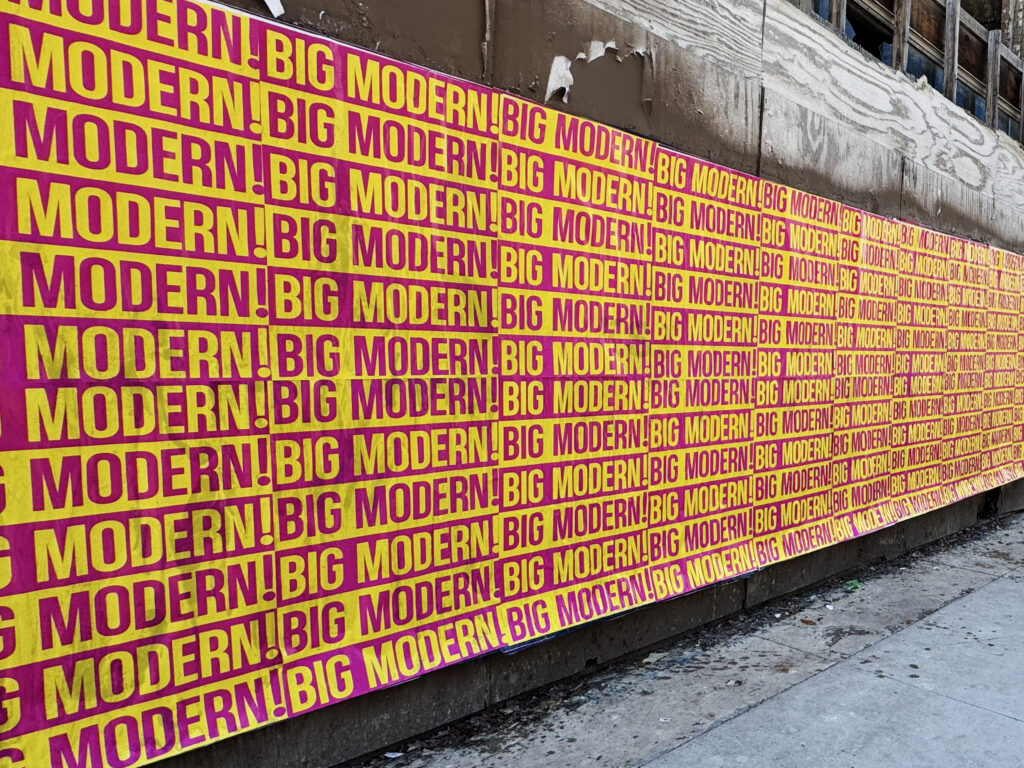
Multi-sheet configurations are appropriate. 4-up, 6-up, or larger depending on wall dimensions and campaign budget. A large wall with a single 24×36 poster looks timid and is frequently lost in the visual environment. Fill the wall at the configuration that makes the placement dominant.
FAQ
What is the most common street advertising poster size?
24×36 inches is the professional standard for street advertising posters. It is large enough to be clearly readable at typical pedestrian viewing distances, small enough to be installed by a single installer, and produced efficiently at most commercial print shops.
When should you use 18×24 instead of 24×36?
18×24 works well for narrow wall sections that can’t accommodate 24×36, for indoor or semi-indoor posting where viewing distances are closer, or for campaigns where budget requires a smaller print format. At street viewing distances above 20 feet, 18×24 is at the legibility limit for body copy.
What is the 27×40 poster format used for?
27×40 is the standard movie one-sheet format. It is used in street advertising when the campaign creative is derived from film marketing or when the tall, narrow format fits the specific wall inventory better than 24×36. Same single-installer logistics as 24×36 with a slightly more prominent vertical presence.
How large does a 4-up multi-sheet poster installation get?
A 4-up configuration using four 24×36 sheets in a 2×2 grid produces a 48×72 inch installation — four feet wide and six feet tall. This is the most common multi-sheet format for street advertising. It requires two installers but produces a dramatically stronger visual impact than single-sheet formats.
What minimum font size is readable on a 24×36 street poster?
At 15 feet viewing distance, minimum readable font size is approximately 36pt for body copy, 72pt for a headline. At 30 feet, minimum headline size increases to 100-120pt. Design for the typical viewing distance in your specific location.
What paper weight should street advertising posters be printed on?
60-70 lb uncoated offset paper is the professional standard for wheatpaste street posters. Avoid coated stock as paste cannot penetrate the coating and adhesion fails. Bond paper (lighter than 60 lb) tears too easily during installation.
How do you design a poster that reads well as a multi-sheet installation?
Design the overall composition to work as a single visual unit when assembled, with the primary focal element centered away from the grid seams. Allow 0.25 inch bleed beyond the intended seam lines on each sheet — installation gaps are unavoidable and bleeded artwork bridges those gaps better than hard-edged artwork.
Frequently Asked Questions
What is standard poster sizes?
American Guerrilla Marketing provides standard poster sizes services across 50+ U.S. markets. Every campaign is planned, scouted, executed, and GPS-documented by our field teams. We work with regional brands and Fortune 500 companies on campaigns that require real street-level execution and documented proof of performance.
How does AGM approach poster sizes?
Our process starts with a market consultation to understand your goals, target audience, and budget. We then scout locations, handle any required permissions or permits, coordinate production and installation with our local crews, and provide a full GPS-tagged photo report after the campaign runs.
What markets does American Guerrilla Marketing cover for poster sizes?
We operate in 50+ U.S. markets including New York, Los Angeles, Chicago, Miami, Houston, Atlanta, Seattle, Denver, Boston, and dozens of secondary markets. Contact us to confirm availability and pricing for your specific market.
How much does a poster sizes campaign cost?
Campaign pricing depends on market, format, quantity, and duration. We work with budgets ranging from targeted single-market runs to national rollouts across multiple cities. Use our RFP Builder or contact us directly for a custom quote based on your specific campaign requirements.
How do I get started with poster sizes through AGM?
The fastest way to get started is to submit your campaign details through our RFP Builder at americanguerrillamarketing.com, or contact us directly at [email protected] or (646) 776-2770. Our team typically responds within one business day with availability and initial pricing.