
November 22, 2026
Mobile Billboard Truck Near Me: Timelines and Permissions
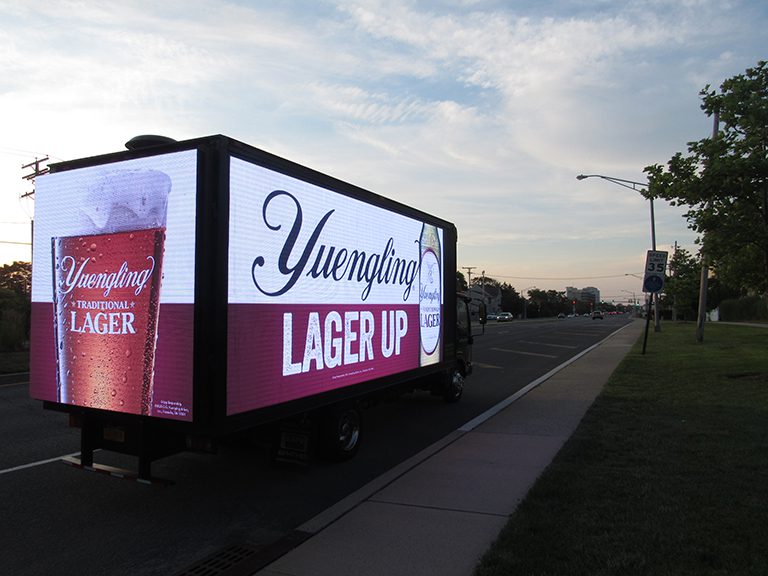
The phrase people type is “mobile billboard truck near me”. What they usually mean is “can someone get a truck onto my streets, this month, without a mess”. Those are two different questions, and the second one is the one worth answering.
Here is the thing that surprises buyers most: proximity is not the constraint. Whether a truck is garaged in your metro or driven in from two states away changes the mobilisation, not the campaign. What actually governs whether your run happens on the dates you want is permission, artwork, route approval, and in some cities a local registration step that nobody warned you about.
I have scheduled truck runs in Los Angeles, Chicago, Atlanta, Dallas, Houston, Phoenix, Miami, Boston, Philadelphia and both sides of the Hudson. The jobs that went smoothly had one thing in common. The client came to us with dates far enough out that we could sort the local side before the artwork was even final.
The jobs that went badly came in on a Thursday wanting wheels turning Monday in a city with a registration requirement and a permit queue.
This page covers the real timeline, what “near me” is actually buying you, where local rules bite, how a day on a truck is actually spent, and the runs I turn down.
What “near me” really buys you
There are three things proximity genuinely helps with.
Deadhead time. A truck garaged inside the metro starts its billable window at the first route point. A truck driven in has to arrive, and somebody is paying for that movement in time if not in a line item. On a one-day run that gap matters. On a two-week run it is noise.
Local knowledge. A driver who has worked a city knows which left turns are hopeless at 5pm, which corridors have a low bridge or a height restriction, where a vehicle can sit without drawing a complaint and where it absolutely cannot, and which blocks have construction that will eat twenty minutes. This is the single most valuable thing proximity provides, and it is not about the truck at all. It is about the person driving it.
Recovery. If a screen panel fails or a tyre goes, a local base means a faster fix. Out of market, a hardware failure can end a day.
What proximity does not buy you: better rules, faster permissions, or a shortcut around a city that wants to see paperwork. Those are the same whether the truck came from down the road or from three states over.
So when someone asks whether we have a truck near them, my honest answer is that we run these nationwide and the right question is whether we can run their city well, not whether the vehicle sleeps nearby.
The honest timeline
Here is how the lead time actually breaks down, assuming a standard LED truck run in a mid-size to large US metro.
Artwork. For a digital screen, this is the fastest part. Static creative or a short looping video, built to the screen ratio, is a day or two of turnaround if the client has brand assets ready. The common delay is not production, it is approval. Legal and brand sign-off inside a client organisation is routinely the longest single item in the whole schedule.
Route planning. Two to four working days to do properly. That means mapping corridors against dayparts, checking height and weight restrictions, identifying where the truck can pause and where it must keep moving, and building a loop that does not waste half the hours repositioning.
Local permissions and registration. This is the variable that wrecks schedules. Some cities have nothing specific and the vehicle simply operates as a vehicle. Others require a local advertising vehicle registration, a business licence, or a sign permit tied to the vehicle. Some have restrictions on where a mobile ad vehicle may operate, how long it may stop, or whether it may idle. Timelines for these range from same-week to several weeks.
Scheduling and crew. Driver assignment and shift planning, a day or two once the route is settled.
Add it up. A clean, well-run first campaign in a new city is realistically two to four weeks from first conversation to wheels turning. Repeat campaigns in a city we already run drop to around a week, because the local side is already handled.
Can it move faster? Sometimes. If the city has no special requirement, the artwork is ready, and the dates are flexible by a day or two, we have put trucks out inside a week. I will not promise that before I know the city, and anyone who promises it before asking which city you are in is not checking anything.
Permissions, ordinances and the grey area
I need to be careful here, because mobile advertising rules are genuinely a grey area and I am an operator, not a lawyer.
Mobile billboard regulation in the United States is a patchwork. There is no single national rule. Individual cities and counties have taken very different positions. Some have specific ordinances aimed at advertising vehicles. Some regulate it through sign codes. Some regulate the parking and stopping of commercial vehicles in a way that effectively shapes what a truck can do. Some have nothing on the books at all, and the truck is simply a vehicle obeying vehicle rules.
Enforcement is just as inconsistent as the rules. A corridor that sees mobile units daily and a corridor two miles away that generates a complaint within an hour can sit inside the same city limits.
What that means in practice is that nobody can give you a blanket answer about whether a mobile billboard is permitted. It depends on the specific municipality, the specific route, whether the vehicle is moving or stationary, and often on whether it is parked on public or private ground.
How we reduce risk. We check the local position for every city before we quote a route, and we build the route around what that city actually allows. We keep trucks moving where stationary display is restricted. Where we want a stationary dwell, we arrange it on private property with the owner’s permission rather than assuming a public kerb will be fine. We document permissions. We brief drivers on what to do if approached, which is to be polite, produce documentation and move if asked rather than argue the point.
And when a client wants a route through a jurisdiction where the position is clearly unfavourable, I tell them, and we move the route. That conversation is cheaper than the alternative.
What a day on the truck actually looks like
A standard run is a driver and an eight to ten hour operating window. Most of the value is concentrated in a much smaller part of that.
Pre-trip is thirty to forty-five minutes. Vehicle check, screen power-up, content load and verification, confirming the loop plays correctly on every panel. Screens fail in ways you only see when they are running, so this is not a step to skip.
Morning drive, roughly seven to nine thirty, is dense but fast. Traffic is heavy and attention is low. People are driving, not looking. It produces volume of exposure with poor dwell. I treat it as support, not the core.
Midday, roughly eleven to two, in a business district or retail corridor is good. Foot traffic, slower vehicle movement, people out of their offices.
Late afternoon into evening, roughly four to seven, is the strongest general window in most cities. Congestion means a truck sits in the same sightline for minutes at a time, and that is where a digital screen earns its keep. Stop-and-go traffic is not a problem for this format. It is the point.
Evening near venues and entertainment districts is the best window of all when the timing matches an event. People are on foot, moving slowly, in a good mood, and looking around.
Between windows the truck repositions. A well-built route minimises dead repositioning. A badly built route spends three of the ten hours getting places.
Real numbers I will stand behind: a well-planned city loop in a dense core covers a defined corridor set repeatedly rather than sprawling. Repetition inside a target corridor beats mileage across a metro. I would rather pass the same four high-value corridors many times than cover forty miles of road that nobody your campaign cares about is sitting on.
Weather, light and the physical truth
Digital screens are bright, but daylight is brighter than people think. A screen facing directly into low morning or late afternoon sun loses a lot of its punch for the viewer sitting behind that sun. Route direction matters for this. On east-west corridors we pay attention to which way the truck is facing at which hour.
Overcast days are better for screen contrast than brilliant sun. Dusk and after dark are best, by a wide margin. If the campaign goal is visual impact and the content is video, I push clients toward evening hours.
Rain reduces outdoor foot traffic and puts pedestrians under hoods and umbrellas, looking down. Vehicle audiences hold up fine in rain. So a wet forecast shifts the value of a route from pedestrian corridors toward congested vehicle corridors.
Extreme heat is a hardware question. Screens and the electronics driving them generate heat, and a long August afternoon in Phoenix or Houston is harder on the equipment than a mild day anywhere else. We plan for that rather than pretend it does not exist.
Snow and ice are a scheduling question. If a city is going to be a mess, the truck will be in traffic but so will everyone’s attention, and routes that depend on pedestrians are worthless. We would rather move a date than burn a day.
Where the format wins and where it is wasted
It wins in dense, congested, slow-moving environments. Downtown cores, entertainment districts, stadium and arena approaches, campus edges during term, event-adjacent streets, retail corridors with foot traffic and kerbside parking.
It wins when you need geographic precision that fixed media cannot deliver. Targeting the streets around a specific set of locations, a specific neighbourhood, or the approach routes to a specific venue is something a truck does better than almost anything else.
It wins for time-bound campaigns. A launch week, an event, a date-specific push. Fixed outdoor media is sold in longer cycles and cannot be redirected mid-run. A truck route can be changed the night before.
It is wasted on open highway. A truck at speed in light traffic is a vehicle nobody reads. It is wasted in low-density suburban areas where people drive quickly between destinations. It is wasted when the content is dense, because a screen in traffic gets a few seconds of a few words.
And it is wasted when the goal is sustained neighbourhood presence over weeks. A truck is there and then it is gone. That is the format’s nature.
What we talk clients out of
One truck, one day, no plan. A single day with a vague route produces a feeling, not a result. If it is worth doing it is worth doing across enough days to see which corridors and which hours actually worked.
Highway routes. Clients love the idea of interstate exposure because the traffic numbers look big. At highway speed in free-flowing traffic, nobody reads your screen. I say no to pure highway routes and redirect to congested surface corridors.
Dense creative. Three lines of body copy and a phone number on a moving screen is wasted production. Brand, one idea, one action. If it cannot be understood in two seconds it will not be understood at all.
Buying only morning drive because it sounds efficient. Morning drive has the worst attention of any window. Evening and event-adjacent hours are where this format works.
Treating the truck as the whole campaign. This is the big one. A truck is a spike. It creates a burst of visibility during a defined window and then it leaves. If the brief is to make a neighbourhood feel like your brand lives there, the truck alone cannot do it.
That is where I usually point people toward Wheatpasting & Poster Campaigns. Posters hold corridors around the clock for weeks with no vehicle and no driver, and they keep working after the truck has gone home. The combination I recommend most often is a poster run across the target corridors for the sustain, with truck days scheduled for the moments that matter, launch day, event day, the weekend with the most foot traffic. The truck brings the spike, the posters hold the ground.
How to brief us so the timeline holds
Give us the city and the specific area, not just the metro. “Chicago” and “the blocks around a venue in the West Loop on a Saturday night” are different jobs with different route plans.
Give us the dates, and tell us which ones are hard and which are flexible. Flexibility of one or two days is often the difference between a good route and a compromised one.
Tell us what the campaign is for. Awareness before a launch, driving traffic to specific addresses, event presence, recruitment. The goal changes the corridor choice completely.
Tell us whether creative exists and whether it has been approved. Not drafted, approved. This is the item most likely to slip.
Tell us if there are areas you do not want to be seen in. Clients occasionally have reasons, and it is much easier to build that in than to redraw a route.
Do that and we can give you a realistic date range in the first conversation rather than an optimistic one we both regret.
What you should get back afterwards
A route record, not a vibe. Where the truck actually went, with timings. Hours operated by corridor and daypart. Photographs from the route in real conditions, including the ones that show traffic rather than an empty staged street. Notes on what changed on the day and why, because something always changes.
And an honest read on which corridors and hours performed, so the next run is better planned than the last.
If an operator hands you a handful of glamour shots and no route record, you have no way to know what you bought.
I also want the uncomfortable notes in there. The corridor that was closed for a street fair nobody told us about. The hour lost to a bridge lift. The block where the screen washed out because we were pointed into a low sun at the wrong time of day. Those details are not failures of the campaign, they are the texture of running vehicles in real cities, and a client who sees them plans the next run with their eyes open.
One more thing worth saying about repeat runs. The second campaign in a city is always better than the first, because by then we know which turns to avoid, which corridor fills at which hour, and where the driver can safely pause. If you expect to be back in a market, tell us at the start. We will build the first route so that it teaches us something useful rather than just covering ground.
Frequently asked questions
Do I need a mobile billboard truck based in my city?
No. Proximity mainly affects mobilisation time and how fast a hardware failure can be fixed. What matters far more is whether the driver knows the city’s corridors, restrictions and traffic behaviour, and whether the local permission position has been checked before the route is built. We run campaigns nationwide rather than only where a vehicle is garaged.
How far in advance should I book a mobile billboard run?
Two to four weeks is realistic for a first campaign in a city, mostly because local permission checks and client-side creative approval take longer than people expect. Repeat runs in a city we already operate in can move in about a week. Rush turnarounds are sometimes possible, but only after we know the city’s requirements.
Are mobile billboard trucks permitted everywhere?
No, and it is a grey area. Rules vary by municipality and county, some cities have specific ordinances, others regulate through sign or parking codes, and enforcement is inconsistent. We check the local position before quoting a route, build routes around what each city allows, and arrange any stationary dwell on private property with the owner’s permission.
What time of day works best for a mobile billboard?
Late afternoon into evening, roughly four to seven, is the strongest general window because congestion keeps the truck in the same sightline for minutes. Evening near venues and entertainment districts is better still. Morning drive produces exposure but poor attention. After dark is when a digital screen has the most visual advantage.
How long is a typical mobile billboard operating day?
Eight to ten hours including a thirty to forty-five minute pre-trip for vehicle checks, screen power-up and content verification. Within that window, value concentrates in the congested and pedestrian-heavy hours. A well-built route minimises dead repositioning time between those windows rather than spreading thinly across a whole metro.
Can a truck route be changed after the campaign starts?
Yes, and that flexibility is one of the format’s real advantages over fixed outdoor media. If a corridor underperforms or an event shifts, we can adjust the loop for the following day. Changes that cross into a different jurisdiction need the local position checked first, so those take slightly longer to action.
Request a campaign quote
Tell us the city, the corridors or venues you care about, your dates, and what the run is supposed to achieve. We will come back with a route plan, an honest timeline including whatever the local permission position requires, and a straight answer about whether a truck is the right tool or whether a poster run across those same corridors would serve you better.
We run these nationwide, we plan routes around how a city actually moves, and we report where the truck really went.
Request a campaign quote.

Ready to Run Your Campaign?
Call us or email us. We’ll tell you exactly what we can do in your market and what it costs.
Related Services
Explore similar advertising solutions offered by American Guerrilla Marketing.
American Guerrilla Marketing — Los Angeles
Street-level campaigns in Los Angeles and nationwide. Wheatpasting, LED trucks, street teams, and more.
(646) 776-2770
Related Articles
-
Mobile LED Billboard Truck for Sale: Works and Fails
November 22, 2026
-
Mobile Billboard Dwell Time Strategy vs the Alternatives
November 22, 2026
-
Mobile Billboard Truck Rental: How It Actually Works
November 22, 2026
-
What to Expect From LED Billboard Truck Rental
November 22, 2026
-
Glass Truck Advertising Explained: How It Actually Works
November 22, 2026