
November 22, 2026
Mobile Billboard Dwell Time Strategy vs the Alternatives
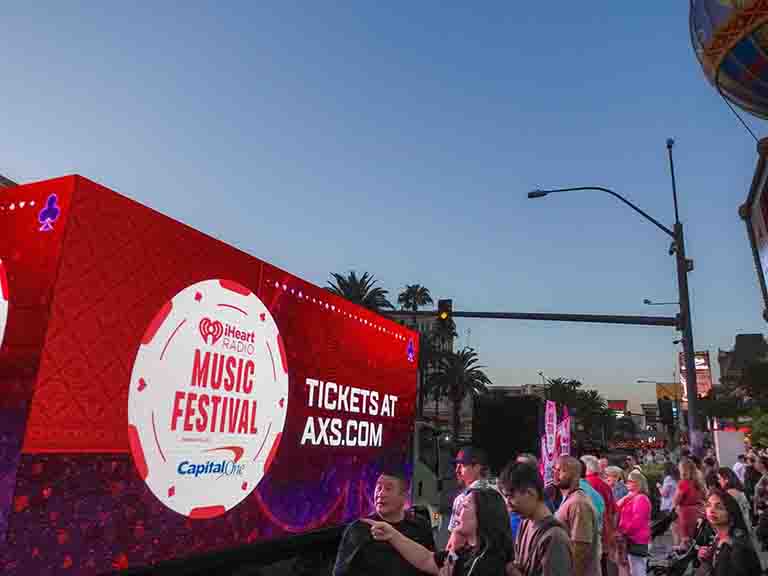
Most people who call us about an LED truck want to talk about miles. How many miles will the truck cover, how many neighbourhoods will it touch, how far can it get in an eight hour shift. It is the wrong first question, and I say so on the call.
The right question is how long the screen will sit in front of a human being who is not moving.
That is dwell time. It is the single variable that separates a mobile billboard campaign that people remember from one that burns a shift driving past windshields at forty miles an hour. I have ridden enough of these shifts to know the difference is not subtle.
Here is the problem buyers run into. They compare a mobile billboard to a static billboard and assume the trade is reach for mobility. A static board sits still and collects impressions all day. A truck moves and collects impressions everywhere. So moving more must be better.
It is not. A static board earns its keep because drivers sit in front of it in traffic. Dwell is baked in. A truck that is also moving at traffic speed cancels its own advantage, because the audience and the screen are travelling together at the same pace and neither of them is looking.
What a truck can do that a board cannot is park itself in the exact place where people are already standing still, at the exact hour they are standing there, and then leave when they do.
This page is about building a route around that idea, and about being honest regarding when a different format from our side of the business would serve the brief better.
What dwell time actually means on a mobile billboard route
Dwell time on a truck route has two halves and buyers usually only count one.
The first half is vehicle dwell. That is how long the truck itself is stationary or crawling. Parked at a curb with permission, held in a queue at a stadium egress, idling in a stop and go corridor at rush hour. Our GPS logs capture this cleanly because speed data is already in the feed.
The second half is audience dwell. That is how long any individual person has the screen in their field of view. Those are different numbers and the second one is what matters.
A truck parked for ninety minutes outside a convention centre does not give one person ninety minutes of exposure. It gives a rolling crowd of people somewhere between four seconds and two minutes each, depending on whether they are walking past, waiting for a rideshare, or standing in a smoking cluster by the doors.
The rideshare queue is the gold. People in a rideshare queue are stationary, bored, facing outward toward the street, and holding a phone. If your screen is in that sightline, you have genuinely bought attention rather than rented proximity to it.
So when we plan a route, we are not plotting a path. We are plotting a sequence of stationary audiences and the windows when they exist.
How we build a route around stationary audiences
The planning starts with a list of what we call holds. A hold is a specific place, a specific time window, and a specific reason people are standing there.
Venue egress is the most reliable hold in the business. A show lets out, and for roughly twenty to forty minutes there is a dense, slow moving, outward facing crowd on a predictable set of sidewalks. We know which doors feed which streets because crews have watched them.
Transit mouths are second. Subway and rail entrances in Manhattan, Chicago and Boston produce a rhythm you can set a watch to during the commute peaks, and the crowd pauses at the top of the stairs to orient. That pause is dwell.
Queue lines are third. Club lines, box office lines, sneaker drops, brunch waits, festival will call. People in a line cannot leave and have nothing to do.
Bridge and tunnel approaches are fourth, and they are the one case where being in slow traffic genuinely works. Approaches to the Lincoln Tunnel, the Bay Bridge toll plaza, the I-5 crawl through downtown Seattle at five in the afternoon. The traffic is stopped, the truck is stopped, and the car behind us has nowhere to look but the screen.
Everything between the holds is transit. We treat transit as overhead, not as inventory. If a route plan is thirty percent holds and seventy percent transit, I will push back and ask what we are paying for. A good urban route in a dense core can get closer to half and half. A sprawling market cannot, and the honest answer there is that the format works differently.
Markets where this works and markets where it does not
Dense, walkable, event heavy cores are where dwell strategy pays. Manhattan below 96th Street. Downtown and River North in Chicago. Downtown Austin around Sixth Street and the Convention Center. The Strip corridor in Las Vegas. Back Bay and Fenway in Boston. South Beach. Downtown Nashville around Broadway.
In those places the holds are close enough together that the truck spends its shift parked or crawling rather than commuting between opportunities.
Then there are markets that look big on paper and punish a dwell strategy. Greater Phoenix, most of the Dallas metroplex outside the immediate downtown and Deep Ellum area, suburban Atlanta, the Inland Empire. The distances between stationary audiences are long and the roads in between are fast. You can still run a truck there, and it can still work, but the plan has to be built around a small number of long holds rather than a dense circuit.
I tell clients in those markets to pick two or three anchor locations and commit to them rather than trying to cover the metro. A truck that holds a stadium lot and a single entertainment district all night will outperform one that drives a two hundred mile loop touching everything.
Where I will actively talk a client out of a truck is a sprawling market with no event anchor and a brief that is really about saturation. If what you want is for a neighbourhood to feel covered, our Wheatpasting & Poster Campaigns side does that better and holds for weeks instead of hours. A truck is a spike. Paper is a presence. Pretending one is the other wastes a budget.
The crew reality on a dwell heavy shift
A standard LED truck shift runs with a driver who is also the operator. On dwell heavy routes in tight cores we often add a second person, and that second person is not decoration.
The reason is simple. A parked truck in a city needs someone watching the street side while the driver watches the traffic side. Someone needs to walk the block and confirm the sightline is actually open before the truck commits to a spot, because a delivery van parking in front of you kills a forty minute hold instantly. Someone needs to talk to the venue security who walks over to ask what you are doing.
Shift lengths vary by brief. Daytime commercial routes usually run through the business day and the afternoon peak. Nightlife and venue routes typically start in the late afternoon, hold through the dinner and show window, and run until the bars empty. On weekend nightlife work we are frequently out past two in the morning, because the two to three in the morning bar close crowd is one of the densest stationary audiences in any American downtown.
Crews brief before the shift with a hold list, a backup for each hold, and a hard rule that the truck does not block a travel lane, a bus stop, a hydrant, a crosswalk or an accessible ramp. That rule is not negotiable and it is the thing that keeps a shift from ending early.
Operators log arrival and departure at each hold. Those timestamps become the dwell record that goes into reporting, and they are the reason I can tell a client their truck actually spent four hours and ten minutes stationary rather than claiming it.
Screen behaviour, weather and what actually fails
LED screens are bright and they hold up in daylight, but the format is not weatherproof in the way a printed panel is.
Heat is the real enemy. Direct summer sun on a south facing screen in Phoenix, Houston or Las Vegas pushes the panel and its drivers hard, and sustained stationary operation in that heat with no airflow is worse than driving, because driving at least moves air across the housing. On brutal summer afternoons in those markets we shift the hold schedule later and put the long stationary blocks after sundown. The screen looks better then anyway, because contrast against a dark street is where LED wins.
Rain is mostly fine for the hardware and bad for the audience. Nobody stands outside a venue in a downpour. They move straight to the car. A rainy night collapses dwell even though the truck is doing exactly what it was asked to do, and I would rather tell a client that in advance than explain it in a report.
Cold is kind to the screen and hard on the crew. Winter nights in Chicago, Minneapolis and Boston cut sidewalk dwell sharply because people do not linger. Indoor adjacent holds matter more then, meaning the spots right at the doors where people are waiting for a ride rather than walking a block.
Wind is the one people forget. Any truck with a tall flat side is a sail. In high wind we reposition away from exposed waterfront and open plaza spots.
Glare and angle also matter. A screen that is perfectly readable head on washes out at a sharp angle, so a hold that puts the truck parallel to a sidewalk gives pedestrians a worse view than one that angles the screen toward the crowd. Good operators park for the sightline, not for the convenience of the curb.
Permissions, ordinance and the grey area
This is where I have to be careful and honest, because the rules around mobile advertising vehicles are not uniform and I am not going to tell anyone what is permitted in their city.
What is true is this. Mobile billboard operation sits in a grey area that varies considerably by municipality. Some cities have specific ordinance language about vehicles whose primary purpose is advertising display. Some regulate it through parking and standing rules instead. Some have nothing specific at all and treat the truck like any other vehicle. Enforcement is inconsistent even inside a single city, and it changes around major events.
Standing still is where the exposure concentrates. A truck in motion is usually treated as a vehicle in traffic. A truck parked on a public street for a long hold draws more attention, and that is exactly what a dwell strategy asks it to do.
The way we reduce risk is by moving dwell onto ground where someone has given us permission. Private lots. Venue partner spaces. Event grounds where the organiser has contracted us. A surface lot behind a bar where the owner said yes. That changes the conversation entirely, because the question stops being about public right of way and becomes a private arrangement.
We also build every route with alternates. If a hold becomes a problem, the operator moves rather than argues. Arguing on a sidewalk at midnight has never once improved a campaign.
For event adjacent work we ask clients early whether they have any relationship with the venue or organiser, because an official relationship unlocks far better positions than we can get from the street. Clients often have more leverage than they realise and have never thought to use it.
What we talk clients out of
Full metro coverage on a single truck. One vehicle cannot saturate a large market in a shift. It can own a corridor. Pick the corridor.
Driving past a competitor’s location all day. Buyers love this idea. It produces almost no dwell, invites friction, and spends the shift on an audience that is already inside somebody else’s door.
Long copy. A screen that a person sees for six seconds while walking cannot carry three lines of body text and a QR code. We push toward one idea, a large mark, and a short call to action. If the brief needs explanation, the explanation belongs on a format people hold or stand in front of.
Running the truck all day for a night audience. If the campaign is about nightlife, the daytime hours are mostly transit and heat. Concentrate the shift.
Rotating through ten creative versions. Operators can run a playlist, but a crowd at a single hold sees one or two slots. Heavy rotation just means most people see a random one. Pick the strongest.
Treating the truck as the whole campaign. This is the big one. A truck produces a concentrated spike of attention in a defined window. It is excellent at making a launch night, a game day or a conference feel owned. It is poor at making a city feel like a brand has been there for a month. When a client wants both, we pair the truck with Wheatpasting & Poster Campaigns in the same corridors, so the paper holds the street between truck shifts and the truck turns the volume up on the nights that matter. That combination has a far better shape than either one stretched past its strengths.
Comparing dwell against the alternatives honestly
Against static billboards, a truck trades permanence for placement precision. The board accumulates. The truck chooses. If your audience is defined by where they are at a specific hour, the truck wins. If your audience is simply everyone who drives a given road for a month, it does not.
Against transit advertising, the truck trades captive interior exposure for street level scale. Interior transit cards get extraordinary dwell from a seated rider. A truck gets less dwell per person across far more people.
Against Projection Advertising, which we also run, the comparison is interesting. Projection delivers enormous apparent scale after dark on a building face and produces much longer dwell, because people stop and photograph it. It is also entirely dependent on darkness, a clean surface and permission for the surface. A truck works in daylight and can move. On night only briefs in dense cores I will sometimes steer a client toward projection instead and say so plainly.
Against Street Teams, the truck trades conversation for reach. A person hands something over and talks. A screen does not. Where a brief needs sampling or sign ups, the truck is support, not the lead.
The honest summary is that dwell strategy makes a truck competitive with formats that are structurally better at holding attention. It does not make it superior to them. It makes it the right choice when timing and location precision matter more than duration.
How we measure dwell and report it
Reporting on a dwell strategy should answer three questions. Where did the truck stop, for how long, and what was happening there.
GPS gives the first two directly. Speed and position data lets us separate stationary minutes from transit minutes and produce a per hold breakdown rather than a route line.
The third question needs a human. Operators log conditions at each hold, including crowd density, weather, and whether the planned sightline held. That context is what makes the numbers mean anything, because ninety stationary minutes in an empty lot and ninety in a venue egress are the same number and completely different outcomes.
We also capture photography from the holds, which serves both as proof and as the thing clients actually circulate internally.
What we will not do is attach a hard impression figure to a dwell block and present it as measured fact. Crowd counts on a public sidewalk are estimates. We will give ranges and explain the basis, and we will mark anything uncertain as exactly that. I would rather hand over a conservative number a client can defend than a flattering one they cannot.
Frequently asked questions
Is dwell time more important than miles covered on a mobile billboard route?
For most campaigns, yes. Miles measure effort, not attention. A truck moving at traffic speed travels alongside its audience, so nobody gets a real look. Stationary minutes in front of a stationary crowd produce the exposure people actually remember. We plan routes as a sequence of holds and treat the driving between them as overhead rather than inventory.
Where does a parked LED truck get the best dwell?
Venue egress sidewalks after a show, rideshare and taxi queues, transit entrances during commute peaks, ticket and club lines, and stopped traffic at bridge or tunnel approaches. The common factor is people who cannot leave and are facing outward. Open plazas and fast arterial roads look impressive on a map and deliver far less actual viewing time.
Does weather change a dwell focused route?
Heavily. Rain empties sidewalks even though the truck operates normally, so a wet night collapses audience dwell. Extreme summer heat in southwestern markets pushes us to move long stationary blocks to after sundown, which also improves screen contrast. Deep cold shortens how long anyone lingers outdoors, so holds move tight to doors and pickup points.
Is parking a mobile billboard truck for long periods permitted?
It varies by municipality and sits in a grey area. Some cities address advertising vehicles directly, others handle it through parking and standing rules, and enforcement is inconsistent. We reduce exposure by placing long holds on private lots, venue partner ground or event property with permission, and by building alternate positions into every route so operators relocate rather than argue.
How many crew members run a dwell heavy shift?
Often two rather than one. The driver manages the vehicle and traffic side while a second crew member checks sightlines before committing to a spot, watches for vehicles that would block the screen, and handles anyone who comes over to ask questions. On tight downtown routes with many short holds that second person is the difference between hitting the schedule and losing a window.
Should a mobile billboard be the whole campaign?
Rarely. A truck creates a concentrated spike of attention inside a defined window, which suits launches, game days and conferences. It does not create the sense that a brand has lived in a neighbourhood for weeks. Pairing truck shifts with Wheatpasting & Poster Campaigns in the same corridors holds the street between shifts and gives the campaign a far better shape.
Request a campaign quote
If you have a date, a city and a crowd you are trying to reach while they are standing still, we can build the hold list around it and tell you honestly whether a truck is the right lead format or a supporting one. Request a campaign quote and tell us the market and the window. We will come back with a route built on dwell, not mileage, and we will say so if a different format from our side would serve the brief better.

Ready to Run Your Campaign?
Call us or email us. We’ll tell you exactly what we can do in your market and what it costs.
Related Services
Explore similar advertising solutions offered by American Guerrilla Marketing.
American Guerrilla Marketing — Los Angeles
Street-level campaigns in Los Angeles and nationwide. Wheatpasting, LED trucks, street teams, and more.
(646) 776-2770
Related Articles
-
Mobile LED Billboard Truck for Sale: Works and Fails
November 22, 2026
-
Mobile Billboard Truck Rental: How It Actually Works
November 22, 2026
-
What to Expect From LED Billboard Truck Rental
November 22, 2026
-
Glass Truck Advertising Explained: How It Actually Works
November 22, 2026
-
What to Expect From Mobile Billboard Truck Advertising
November 22, 2026