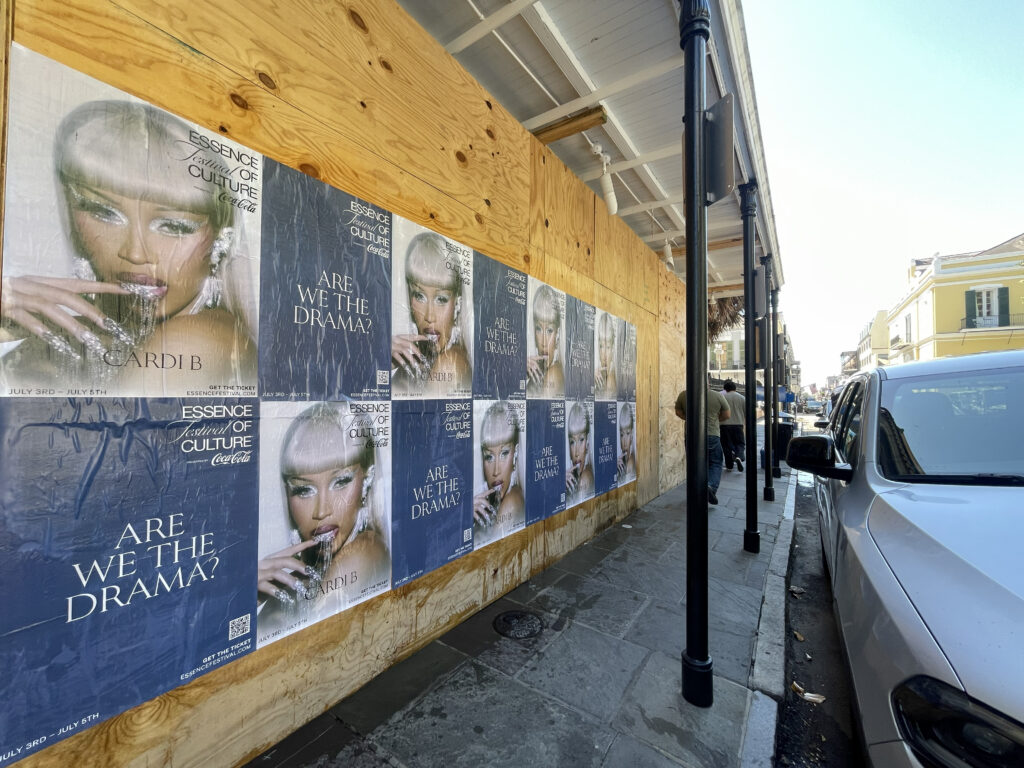
Let’s say you have an album dropping in six weeks and you want to do something on the streets. You’ve seen the photos, Frank Ocean’s color posters on the Bowery wall, Bad Bunny’s campaign hitting multiple cities at once, Kanye’s cryptic artwork appearing on walls in Williamsburg before anyone knew what album it was for. You want that. The question is how to actually make it happen, and how much it costs at different levels.
Most articles about guerrilla marketing for musicians give you a list of tactics. Wheatpaste your album art. Put up posters near venues. Use QR codes. Fine, but that’s like telling someone to “cook” without explaining the difference between braising and pan-frying. The tactics are just categories. What you actually need to know is how specific decisions, which walls, which neighborhoods, what the creative shows in the teaser versus the reveal, determine whether a campaign gets documented and shared or just weathers into the wall without anyone noticing.
Music campaigns often overlap with our Governors Ball brand activation guide and our music festival guerrilla marketing playbook.
This is a field guide. It covers what the best music street campaigns actually did, where they did it, why those choices worked, and what you can replicate at different budgets. If you’re managing your own release or managing an artist who’s about to drop, this is the practical version of the conversation we have with clients before a campaign launches.
What Real Music Street Campaigns Actually Look Like
The wheatpaste campaign is native to music in a way that no other advertising format is. Concert promotion built the format, every punk show, hip-hop showcase, and rave that needed promotion without a budget put paper on walls. The format carries that history. When an album cover appears on a brick wall in Williamsburg or a warehouse wall in Wynwood, it reads as belonging to music culture rather than to the advertising industry.
That’s worth something. Not because it’s nostalgic, but because it positions the music differently in the mind of every fan who encounters it. An album recommended by a Spotify algorithm says: “This algorithm thinks you might like this.” An album cover on the walls of the neighborhood where you spend your Saturday afternoons says: “This music belongs to this place and this culture.” Those are fundamentally different associations, and the second one tends to produce the kind of fan loyalty that sustains a career rather than a single release cycle.
There’s also a documentation dynamic that makes street campaigns especially valuable in 2026. Fans photograph and share street art, particularly when it’s their city or their neighborhood. A well-placed campaign that generates organic social documentation gets seen by people who never walked past the poster. The street presence is the anchor; the social documentation is the amplification. The best campaigns are designed so both happen naturally.
For street-level formats that artists use most, see flyposting advertising and wheatpaste street art.
Here’s what that looks like in practice, using campaigns that actually ran.
Six Real Campaigns, with Location Details
Frank Ocean, “Blonde” Teaser Campaign (2016)
Frank Ocean had been publicly absent for four years when his team started placing wheatpaste across major cities in the weeks before Blonde dropped. The posters contained only color swatches, the visual language of the album before anyone knew what the album was. No name. No title. No date.
In New York, the campaign concentrated in the neighborhoods where Ocean’s audience was most densely present: the Houston/Bowery wall in the Village (the single most photographed street wall in downtown Manhattan), Spring Street between Thompson and Sullivan in SoHo, and scattered placements through the Lower East Side around Orchard and Rivington. In Los Angeles, the campaign went to Melrose Avenue between La Brea and Fairfax, the streetwear and culture corridor that functions as LA’s equivalent of SoHo, where exactly the kind of culturally engaged young adult audience most likely to care about a Frank Ocean release spent time.
The color-swatch choice was strategically exact: it said “something visual is coming” without saying what, which is a much harder ask than it sounds. People search the things they’re curious about. Within hours of the first sightings, the posts were up and the searches were running. The mystery drove search volume that seeded the algorithm before a single note was released publicly.
What you can take from this: the teaser phase works only if you actually hold back information. If you put up a cryptic poster but include the album title in the caption when you seed the social documentation, you’ve defeated the purpose. The mystery needs to run through every touchpoint simultaneously.
Kanye West, “My Beautiful Dark Twisted Fantasy” (2010)
The Karl Lagerfeld-designed MBDTF artwork was striking enough to function as advertising before anyone knew what it was for, and Kanye’s team understood this. The campaign went up in music-adjacent neighborhoods: the blocks near Halcyon Records in DUMBO, Bedford Avenue at N 6th Street in Williamsburg (the center of Brooklyn’s indie music scene at the time), and the Bowery/Houston area in Manhattan. These weren’t the highest-traffic locations in New York. They were the highest-influence locations for the specific audience the album was targeting.
The teaser wave was artwork only. No Kanye name. No album title. The people who frequented these neighborhoods and record stores and venues were exactly the people who would spend time figuring out what they were looking at, and those were the same people who would write about it, tweet about it, and create the cultural conversation that primed the album’s release to land as an event rather than a drop.
Note the gap between that approach and what most artists actually do: most campaigns announce the album name and release date from the first poster. That’s efficient for information delivery and terrible for generating cultural conversation. Information that’s already complete doesn’t invite participation. Incomplete information does.
Bad Bunny, Community-First Placement Strategy (2020–Present)
Bad Bunny’s street campaigns are among the most strategically sophisticated in contemporary music marketing, and the sophistication is in the placement logic, not the creative budget. The campaign goes where the community actually is: Jackson Heights, Queens, specifically the stretch of Roosevelt Avenue between 74th and 82nd Streets, which is the Dominican and Puerto Rican cultural center of New York. Little Havana Miami along Calle Ocho between SW 12th and SW 27th Avenues. Boyle Heights in Los Angeles. Pilsen in Chicago.
None of these are the highest-foot-traffic locations in their respective cities. All of them are where Bad Bunny’s actual community lives. The result is that the campaign isn’t received as advertising, it’s received as an expression of belonging. A Puerto Rican artist putting his campaign on the walls of a Puerto Rican neighborhood creates an entirely different dynamic than a brand placing paid media in a demographic. The community receives it, documents it, and shares it because it’s theirs. The organic amplification from those communities is more valuable per impression than anything a media buy would deliver.
The lesson for other artists: before you pick a high-traffic wall in a trendy neighborhood, ask where your actual fans live. The answer is usually more specific, and more valuable, than any generic “cultural corridor.”
Beyoncé, “Lemonade” Street Components (2016)
The street advertising for Lemonade was deliberately minimal and deliberately selective. A few cryptic prints in specific locations in New Orleans, the album’s visual and thematic heart, and scattered pieces in NYC. The scarcity was the point. With a Beyoncé release, you don’t need to cover every wall in every city. A few sightings in the right places, documented and shared by the right people, generate more conversation than a thousand posters in generic locations. Each documented sighting felt like an event because there were so few of them.
This is counterintuitive but consistently true: for artists with existing audience scale, scarcity in street presence creates more cultural energy than saturation. The campaign that’s everywhere is wallpaper. The campaign that appears in exactly three places, unexpectedly, in neighborhoods that mean something specific to the work, rewards the people who find it in a way that mass coverage doesn’t.
Tyler, the Creator, Fairfax and Leimert Park (Various)
Tyler’s street advertising work has consistently prioritized the Fairfax district in Los Angeles and Leimert Park, two neighborhoods with genuine cultural resonance for his audience rather than generic “cool” districts. The Fairfax corridor, particularly around Supreme’s LA store and the surrounding streetwear blocks, has been home to Tyler-related posters across multiple album cycles. Leimert Park, the historically Black arts and cultural district in South LA, reflects the community connection his later work has leaned into.
The consistency matters. When an artist runs campaigns in the same neighborhoods across multiple releases, those neighborhoods start to feel like the artist’s territory. The walls carry accumulated recognition. A Tyler poster on Fairfax reads differently to someone who’s seen Tyler posters on Fairfax before, the history reinforces the current campaign rather than starting from zero.
Drake, “Nothing Was the Same” City-Specific Variations (2013)
The Nothing Was the Same campaign used city-specific variations, the Toronto rollout hit specific Toronto neighborhoods that carried cultural meaning for Drake’s origin story, while the NYC rollout concentrated in Williamsburg and the Lower East Side, the neighborhoods most relevant to the indie/hip-hop crossover audience the album was reaching. The art direction adjusted slightly by market, acknowledging that what resonates on a wall in Williamsburg isn’t identical to what resonates in downtown Toronto.
This approach is more expensive than running the same creative everywhere, you need separate design work, potentially separate print runs, and market-specific deployment logic. But it creates more authentic local presence in each market, which generates more organic documentation and sharing. People in Toronto shared the Toronto version because it was specifically for them, not a New York poster that happened to be in Toronto.
Budget Tiers: What You Can Execute at Each Level
Here’s the honest version of this conversation, which most resources gloss over. What actually gets done at different budget levels, with the real numbers.
Entry Level: One Market, One Neighborhood
This is the entry point for a campaign that looks and performs like a campaign rather than a DIY paste-up. At this level, you’re covering one tight neighborhood, say, the Wythe Avenue hotel corridor in Williamsburg between N 6th and N 9th, or the Troutman Street main strip through the Bushwick Collective, with 5–10 professionally installed locations. Print is included for a standard 24×36 format. Documentation is included.
What this accomplishes: genuine street presence in a concentrated area that your fanbase actually occupies, professional quality that reflects well on the release, and documentation photos you can use across social and press. What this doesn’t accomplish: multi-neighborhood reach, multiple city presence, or the saturation effect that makes a campaign feel like an event rather than a placement.
Best for: local and regional independent artists with an established fanbase in one market, or artists doing a city-specific release event who want meaningful street presence around it.
Single Market, Multiple Neighborhoods
This is where single-market campaigns start feeling like real campaign presence. With a mid-range campaign budget, you can cover two to three neighborhoods in a major market simultaneously, say, Bedford Avenue in Williamsburg plus the Jefferson Avenue corridor in Bushwick plus the Flushing Avenue warehouse corridor, with 12–20 locations across those areas. The cross-neighborhood coverage creates the impression of a campaign rather than a placement, and if the neighborhoods are chosen correctly, you’re reaching different facets of your audience in contexts that mean something to each.
At this budget, you also have room to upgrade some locations to larger format, 36×48 rather than 24×36 at anchor walls, which creates the presence statement that makes single larger placements worth more than multiple smaller ones in the same position.
Best for: independent artists with label funding or strong merchandise/touring revenue, label-supported independent releases, artists executing a significant single or album campaign in their home market.
Multi-Market Campaign Saturation
Two-market campaigns, typically NYC and LA, or NYC and Miami depending on genre, at this budget level can hit 20–35 total locations across multiple neighborhoods in each market. This is where a campaign starts feeling national. When posters are documented on walls in both Williamsburg and Wynwood in the same week, the documentation creates a story about a campaign that’s everywhere, which amplifies the social documentation in both markets.
Coordination is the variable that determines whether this works or falls apart. Simultaneous installation across two markets requires professional agency coordination, it’s not something you can manage from a single contact in each city. The timing needs to align, the documentation needs to arrive in a usable format, and the installation quality needs to be consistent across markets. This is where working with an agency that operates in multiple markets with established crews pays back clearly.
Best for: major label release campaigns, well-funded independent releases, artists executing a coordinated national push around a significant album or single.
$15,000+: Full Multi-City Campaign, Simultaneous Launch in 5+ Markets
The major label version. Five or more cities going up on the same night, NYC, LA, Miami, Chicago, Atlanta, potentially more, with coordinated documentation that can be packaged and released the following morning across all platforms simultaneously. The cultural moment created by a single-night multi-city saturation is qualitatively different from a rolling market-by-market approach. The documentation tells a story about omnipresence that matches the scale of a major release.
At this level, the campaign also has budget for market-specific location premiums, the Houston/Bowery wall in NYC, the NW 2nd Avenue corridor in Wynwood, the Panther Coffee corner at NW 24th Street in Miami, the Flushing Avenue warehouse corridor for J train visibility in Brooklyn. These are the locations that carry cultural authority in each market, and they require the kind of operational knowledge and crew relationships that only established agencies have.
Best for: major label campaigns, globally recognized artists executing album launches, campaigns where the street advertising component is intended to generate press coverage as much as direct audience impressions.
| Budget Level |
Markets / Neighborhoods |
Approximate Locations |
Best For |
| $1,500–$3,000 |
1 market, 1 neighborhood |
5–10 |
Local/regional independent artists |
| $3,000–$6,000 |
1 major market, 2–3 neighborhoods |
10–20 |
Label-funded indie or significant single campaign |
| $6,000–$15,000 |
2–3 markets, multi-neighborhood |
20–35 |
Multi-city album launch, national push |
| $15,000+ |
5+ markets simultaneously |
50–100+ |
Major label campaigns, global artist launches |
Which Cities, Which Neighborhoods, and Why It Matters
The wrong location is worse than no location. A wheatpaste campaign in a neighborhood where your audience doesn’t spend time generates zero cultural resonance and zero documentation. Here’s specific guidance by genre and by market.
New York City
NYC is the most media-influential market for music campaigns, coverage that starts in New York spreads nationally more reliably than coverage that starts anywhere else. But “New York” is not a targeting strategy. The specific walls that matter depend on your audience.
For hip-hop and R&B: 125th Street between Adam Clayton Powell Jr. Blvd and Malcolm X Blvd in Harlem is essential, the commercial spine of one of the most culturally significant neighborhoods in American music history. The Bedford-Stuyvesant and Flatbush corridors in Brooklyn are high-priority for Brooklyn-adjacent artists. The Flushing Avenue warehouse corridor in Bushwick is visible from the improved J train, which means daytime visibility from a transit audience that includes a meaningful portion of Brooklyn’s music community.
For indie, alternative, and crossover: the Kent Avenue warehouse corridor between N 8th and N 9th in Williamsburg is lower competition than Bedford Avenue at N 6th and hits a strong music/creative demographic. Bedford Avenue at N 6th itself is high-competition but high-influence. The Bushwick Collective main strip along Troutman Street between St. Nicholas and Irving Avenue commands the attention of anyone walking through, it’s the most visually saturated street in Bushwick, which means your campaign needs to be distinctive to cut through, but the audience concentration justifies it.
For broader cultural reach with a premium placement: the Houston/Bowery wall in the Village is the single most photographed street surface in downtown Manhattan. It’s been documented by every major photography account in New York. Appearing on it carries an implicit endorsement of cultural significance that follows the documentation everywhere it goes.
Miami
Wynwood is the obvious and correct choice for most Miami campaigns. The NW 2nd Avenue corridor between NW 20th and NW 29th Street is the cultural heart of the district, the Wynwood Walls are at NW 2nd Ave and NW 26th Street, and the loading dock walls on NW 29th Street east of NW 2nd are lower-competition alternatives that still command strong audience attention from the art crowd. The Panther Coffee corner at NW 24th Street is a natural gathering point with high dwell time, people stand and look at things near coffee shops in a way they don’t while walking through.
For Latin music campaigns specifically, Calle Ocho in Little Havana, SW 8th Street between SW 12th and SW 27th Avenues, is the right location. South Beach along Collins Avenue between 10th and 14th Streets reaches a different, more tourist-adjacent audience, but it’s useful for campaigns seeking broad Miami exposure rather than specific cultural community targeting.
Los Angeles
The Fairfax district, particularly the stretch between Beverly Boulevard and Melrose Avenue, is LA’s equivalent of SoHo, with the highest concentration of streetwear and music culture adjacency in the city. Melrose Avenue between La Brea and Fairfax specifically. Leimert Park for campaigns with Black cultural community relevance. Boyle Heights for Latin music campaigns where Jackson Heights is the NYC analog.
The Rest of the Country
Chicago’s Wicker Park for indie and alternative. Atlanta’s Old Fourth Ward and Little Five Points for hip-hop. Nashville’s East Nashville for Americana and country-adjacent genres. Each market has neighborhoods where the cultural audience concentrates, and campaigns that find those neighborhoods outperform campaigns that default to generic downtown placements every time.
How to Design Artwork That Works as Street Advertising
Most album artwork is designed for screen display at two inches by two inches. Street posters live at 24 by 36 inches, viewed from 10 to 30 feet away, competing with decades of accumulated visual texture on a brick wall. These are not the same design problem, and treating them as interchangeable is one of the most common ways a campaign fails before the paste goes on the wall.
Design at Scale, Not at Thumbnail
The central test: print a rough proof at 11×17 and tape it to a wall. Walk ten feet back. Does it communicate the essential message in under two seconds? If not, it won’t work at street scale. Most digital-native artwork fails this test because the detail and information density that looks good on a phone screen becomes visual noise at a distance. The best street poster designs are almost always the most minimal versions of the artwork, the thing that’s left when you strip away everything that doesn’t survive at distance.
High Contrast Is Not Optional
Brick is warm and textured. Concrete is grey and porous. Both surfaces absorb and mute colors in ways that a screen doesn’t. Designs that look high-contrast on screen can go flat against a wall. Test your palette against actual surface textures before finalizing. Dark backgrounds with light type outperform light backgrounds with dark type in most outdoor contexts, the wall bleeds into light-background designs in a way it doesn’t with dark backgrounds.
Type Size Minimums
On a 24×36 poster, artist name should be at a minimum of 100 points. Album title: 60–80 points minimum. Release date and any supporting information: 36 points minimum. These numbers feel enormous in a design file. They feel appropriate on a wall. Body copy, paragraphs of text, has no place on a street poster. A single strong line of copy is usually better than four good lines.
The Teaser Version
For the teaser phase, design a completely separate version that contains no text at all, or at most one cryptic visual element. Frank Ocean’s color swatches are the obvious model, but the principle extends to any genre: a single image, a symbol, or a visual motif from the album’s world, executed at street scale with no contextual information. This version is designed to generate questions, not answer them. Design it accordingly.
Timing: The Window That Determines Whether Your Campaign Works
Timing is probably the most underestimated variable in music street campaigns. A perfect campaign run at the wrong time underperforms a mediocre campaign run with precise timing. Here’s the framework.
Phase 1: Teaser (3–4 Weeks Before Release)
Cryptic visual presence, no identifying information beyond enough visual material to generate curiosity. Installation should happen overnight, silent, undocumented by the artist or team at the time of installation. The discovery experience matters. Let people find it, photograph it, and post it before you acknowledge it exists.
The teaser phase typically runs for 7–10 days before the announcement phase begins. Letting it run longer than two weeks risks the mystery dissolving, people answer the question and move on, before you can convert the curiosity into release awareness.
Phase 2: Announcement (10–14 Days Before Release)
The full campaign: artist name, album title, release date, and wherever possible a QR code linking to a streaming preview, pre-save, or exclusive content. This is the campaign’s main visual statement. If the teaser was doing its job, the announcement lands with all the curiosity it generated behind it. Install the announcement wave on the same walls where the teaser ran, the spatial continuity rewards people who’ve been following the campaign.
The morning after the announcement installation, release the documentation photos across social and send them to relevant press. The photos confirm the campaign is running, extend its reach to audiences outside the physical market, and create a visual narrative around the release.
Phase 3: Release Week (Days Before and Immediately After Drop)
Maintain and, if budget allows, refresh placements through the release window. The goal during release week is to create the experience of omnipresence, anyone walking through the relevant neighborhoods should be encountering the campaign. This is the week that streaming platform algorithms are paying attention to activity volume, and street presence that drives branded searches and playlist additions matters more in this window than at any other point.
Phase 4: Sustain (Optional, Weeks 2–4 Post-Release)
For albums with longer promotional cycles, a sustain phase with fresh placements, featuring a key single, a streaming milestone number, or a tour announcement, extends the physical conversation past the initial release moment. Not every campaign needs this phase, but for artists building cumulative cultural presence, sustained street visibility across multiple album cycles is how street presence becomes brand equity rather than a single-campaign tactic.
Working With a Street Advertising Agency for Music
American Guerrilla Marketing has executed music street campaigns across every genre and every budget tier described in this guide. From a $1,800 neighborhood campaign for an independent Brooklyn artist dropping a debut LP to multi-city simultaneous launches for major label releases, the operational requirements and the creative judgment involved are both things we bring to every campaign.
What distinguishes professional execution from DIY at every scale:
Location knowledge. The wall on Bedford Avenue at N 6th Street is not interchangeable with the wall on Kent Avenue two blocks over, different audience concentration, different competition level, different visual context. We make these distinctions by market because we’ve been operating in these neighborhoods for years, not because we looked at a map. The warehouse walls on Flushing Avenue in Bushwick are invisible from the street but command attention from the improved J train during morning and evening rush, that’s the kind of operational knowledge that comes from being on the ground, not from demographic targeting software.
Professional documentation. Every campaign we run is photographed with professional documentation that’s delivered as a usable press and social package. Not phone photos taken in the dark, but properly lit, composed campaign photography that reflects the quality of your release and works across every platform where you’ll use it.
Multi-market coordination. If your album is dropping in NYC and Miami in the same week, the installation needs to happen on the same night across both markets for the simultaneous cultural moment. That requires established crews in both cities, coordinated logistics, and the operational infrastructure to confirm completion and deliver documentation on the same timeline. That’s what a professional agency does.
Explore our music and entertainment campaign services or reach out directly to plan your next release campaign.
Frequently Asked Questions
How much should an independent artist budget for street advertising?
A meaningful independent artist campaign, one that creates genuine street presence in a single market, starts around $1,500 for a focused single-neighborhood saturation of 8–12 locations. If you can stretch to $3,000, you can cover two or three neighborhoods in the same market and hit the key cultural corridors for your genre. The goal isn’t coverage, it’s concentration. Eight posters on the right eight walls in Williamsburg will outperform forty posters scattered randomly across Brooklyn every time.
When should you start a wheatpaste campaign relative to an album release date?
The standard professional window is a two-phase approach: teaser placements 3–4 weeks before release (cryptic imagery, no album title or release date), and the full announcement campaign 7–10 days before release. The teaser phase builds curiosity; the announcement campaign converts that curiosity into action. For campaigns in multiple markets, coordinate the teaser wave so all cities go up on the same night, simultaneous presence across markets creates a bigger cultural moment than a rolling approach.
Which cities should a music campaign prioritize first?
It depends on your fanbase, not on the cities with the most foot traffic. An artist with a dense core fanbase in one market should saturate that market first. Generally, NYC and LA are the most media-influential markets, campaigns that run in both cities generate more press coverage than the same spend in secondary markets. After those two: Miami, Chicago, and Atlanta cover most genres well. For genre-specific work, community geography matters more than general market size, Bad Bunny’s campaign in Jackson Heights outperforms a generic NYC campaign at the same budget because the community is there.
How do you design album artwork that works as street advertising?
Design for ten feet, not ten inches. Your album cover needs to communicate its identity instantly from across a street, fine details disappear at that distance. High contrast is non-negotiable. Bold, readable typography at a minimum of 100 points for the artist name on a 24×36 poster. Limit the palette to two or three dominant colors. If your artwork is intricate or subtle at screen size, create a street-specific alternate version designed for visibility at scale, the street version can be bolder and more minimal than the official cover art.
Should you announce the wheatpaste campaign or let people discover it?
For the teaser phase: let them discover it. The discovery is the point. Announcing a teaser campaign before it goes up defeats the purpose, you’ve given the audience the answer before they had a chance to ask the question. For the announcement phase, release the documentation photos the morning after installation. The sequence: install silently at night, document professionally, release documentation the next morning. This creates the cleanest separation between the mystery phase and the announcement phase, and it gives every market’s fan community the experience of discovering it in their city first.
The Street Is Still the Most Credible Place to Launch Music
Streaming algorithms have made music discovery more efficient and less meaningful at the same time. The recommendation that comes from “because you liked X” is a pale shadow of the discovery that comes from seeing something unexpected on a wall in your neighborhood and being curious enough to search for it. The second experience creates a story, I saw this on a wall in Williamsburg, before anyone was talking about it, that the algorithm-delivered experience can’t replicate.
The artists whose street campaigns have worked best understood something simple: the wall is not a billboard. It’s a conversation with the people who live there. The campaigns that treated it as a conversation, as an expression of cultural belonging rather than a paid placement, generated disproportionate organic response. That principle doesn’t require a major label budget. It requires knowing where to go and why.
When you’re ready to take your release to the streets, American Guerrilla Marketing is the team that has been executing music campaigns in every major market for over a decade. We know the walls, we know the neighborhoods, and we know what makes the difference between a campaign that gets documented and shared and one that just weathers away.
Ready to Launch Your Music Street Campaign?
American Guerrilla Marketing executes wheatpaste and street poster campaigns for music artists in every major U.S. market. From album launches to world tours, we handle strategy, installation, and documentation.
Get a Campaign Quote →