American Guerrilla Marketing
Nationwide Service
Media planning, media buying, billboard advertising, & guerrilla marketing
Sterling Heights is Metro Detroit’s most densely trafficked suburban commercial market. Dodge Park Road and Metro Parkway move tens of thousands of vehicles daily past commercial corridors where a well-placed projection advertising campaign reaches commuters, shoppers, and residents at street level, night after night.
Most outdoor media planning for the Detroit metro concentrates on the urban core — Eastern Market, Midtown, Corktown. Those are excellent markets for certain campaign objectives. But the majority of the Metro Detroit population doesn’t live or work in the city’s arts districts. They live in the suburban municipalities that extend north of Detroit along Gratiot, Van Dyke, and Mound Road — and Sterling Heights, with more than 130,000 residents and one of the highest commercial densities in Macomb County, represents the suburban market’s commercial heart.
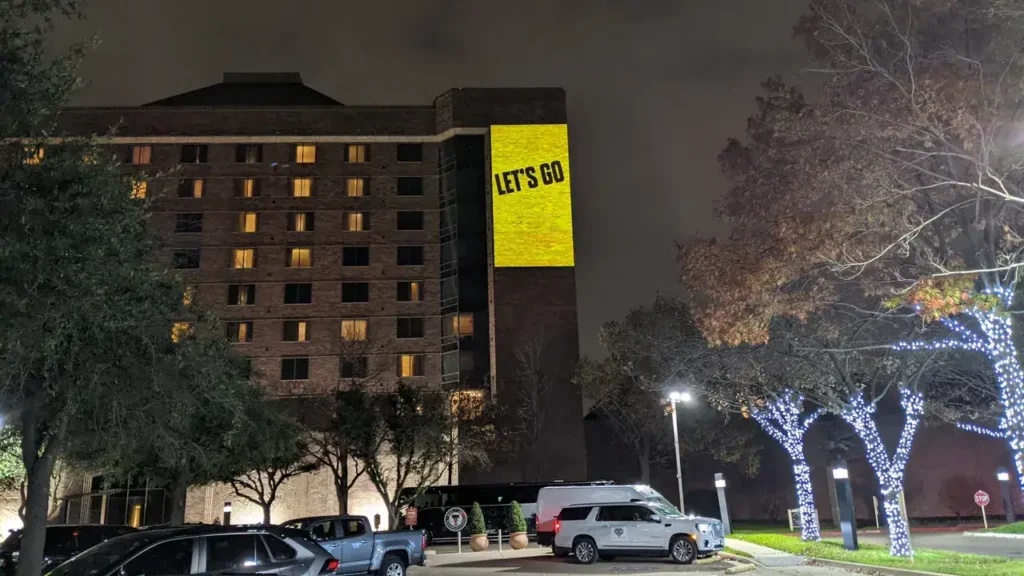
Projection advertising in Sterling Heights operates on a different logic than urban core campaigns. Rather than concentrating on foot traffic in a compact pedestrian zone, Sterling Heights campaigns target the vehicle and commuter audience that moves through Dodge Park Road and Metro Parkway — high-volume commercial corridors where a building projection on a prominent commercial or industrial facade commands visibility from approaching vehicles as well as pedestrians at adjacent commercial developments. The reach calculation for a Sterling Heights projection includes everyone in a vehicle who passes within line-of-sight distance of the projection surface during the operating window — a number that can be substantial on a busy Metro Detroit commercial corridor.
Sterling Heights also has genuine industrial and commercial building inventory that suits projection. The city’s Macomb County location, at the intersection of several major regional traffic arteries, means that its commercial corridors include the kind of large-format commercial and light industrial buildings with unobstructed exterior walls that are among the most visible projection surfaces in the suburban environment. Unlike traditional suburban retail architecture — facades dominated by illuminated signage systems and glass storefronts — these commercial and industrial buildings have the flat, uncluttered wall planes that allow a projection to register clearly against ambient light conditions.
For automotive brands, consumer goods companies, retailers entering the suburban Metro Detroit market, and entertainment properties targeting the suburban family and professional demographic, Sterling Heights offers genuine scale in a market that has been underserved by unconventional outdoor media. American Guerrilla Marketing brings the full technical platform — 20,000-lumen commercial projector, generator, electronics bundle, mobility unit, two-person direct crew — to the Sterling Heights market without compromising the equipment specification that produces results in urban core markets.
The suburban commercial market is the bulk of the Metro Detroit audience. Sterling Heights' corridors are where those consumers spend their evenings. Let's put your campaign in front of them.
Select a city to explore Guerrilla Projections opportunities.
Dodge Park Road is one of Sterling Heights’ primary commercial arteries, anchoring a stretch of retail, commercial, and light industrial development that draws vehicle traffic from the surrounding residential neighborhoods and commuter routes. The corridor’s commercial buildings include several with usable exterior wall surfaces on the building faces and end gables that face approaching vehicle traffic from multiple directions. A projection on a prominent Dodge Park Road commercial building operates in one of Sterling Heights’ highest vehicle-traffic environments, with an audience that includes both passing commuters and destination shoppers at the adjacent commercial cluster. The corridor’s evening traffic volume remains strong as dinner-hour shoppers and restaurant patrons circulate through the commercial zone.
Metro Parkway (16 Mile Road) runs east-west across Sterling Heights and anchors the city’s entertainment and restaurant zone, connecting major commercial developments with the surrounding residential fabric. The Metro Parkway corridor draws evening and weekend traffic from across the Sterling Heights and Macomb County market — families, couples, young professionals who fill the restaurant and entertainment destinations along the strip. Buildings along Metro Parkway include commercial structures with street-facing walls and, in several cases, large side walls visible to approaching traffic from the intersection approach directions. A projection in the Metro Parkway entertainment zone reaches the city’s leisure and dining audience during the hours they’re most active and most likely to notice and respond to unexpected visual media.
Sterling Heights’ downtown district has developed programming and community events that draw residents to a walkable downtown environment distinct from the suburban commercial corridor context. The arts area includes civic and cultural programming spaces with building facades that face pedestrian-accessible plazas and streetscapes. Projections in the downtown arts area target the community-engaged Sterling Heights resident audience — people who are present specifically because they’re participating in city life rather than passing through on a commercial errand. This is the right context for community-oriented campaigns, civic announcements, and advocacy-driven projection media that want to reach engaged Sterling Heights residents in a community setting.
Campaigns optimized for the vehicle audience moving through Dodge Park Road and Metro Parkway. Content designed for high-speed visual processing — bold, clear imagery that reads from 200 feet approaching a traffic signal — reaches the commuter and shopper audience in Sterling Heights at the moment they’re at rest or moving slowly through a commercial intersection.
Consumer brands opening in Sterling Heights or the broader Macomb County market use projection campaigns to announce their presence to the suburban consumer audience in their own commercial environment. A building projection on a prominent Dodge Park Road surface the week before a new location opens creates advance awareness in the exact geographic market where the new customers live and shop.
Sterling Heights is in the heart of Metro Detroit’s auto industry employment and consumer base. Automotive brands — new model launches, dealership events, auto technology companies, EV brands building awareness in the Detroit metro — find the Sterling Heights commercial corridor audience a highly relevant target. An auto brand projecting in Sterling Heights is speaking directly to the Michigan working population that has the closest cultural relationship with the auto industry.
Sterling Heights’ position in the Metro Detroit market means it shares sports audience loyalty with Detroit’s professional teams. Campaigns tied to Red Wings, Lions, Tigers, or Pistons game events — or to major sporting moments relevant to the Metro Detroit market — use Sterling Heights commercial corridor projections to reach the suburban fan base that won’t be downtown on game night but is absolutely present at their local commercial strips.
City of Sterling Heights programs, community organizations, and civic institutions use downtown arts area projections to create visible moments during community events, public health campaigns, and civic engagement initiatives. The downtown arts area’s pedestrian audience is the city’s most community-engaged population — the right audience for civic and community-purpose projections.
Tell us about your campaign goals, target audience, and preferred locations. Our team will help you plan a high-impact guerrilla projection campaign tailored to your needs.
Award Winning Personalized Service
You will get thoughtful, devoted, and individualized attention from our experienced, qualified, and professional personnel. Being one of the most illustrious agencies in Brooklyn, New York, American Guerrilla Marketing has been awarded the Best of Brooklyn title.
Nationwide
Industry City, Brooklyn, New York 11232
American Guerrilla Marketing
Hours
Mon - Fri: 9 AM - 5 PM
Sat & Sun: Closed
Automate your campaign with AGM’s Request for Proposal Builder. Simply answer a few quick questions about your campaign goals, markets, and timeline, and the system will generate a tailored presentation with recommended strategies, quantities, and pricing. Click the RFP Builder to instantly receive your customized proposal.
When American Guerrilla Marketing executed the Mizzou × Cotton Bowl building projection campaign for the University of Missouri’s Cotton Bowl appearance, the campaign operated in the entertainment corridor around AT&T Stadium in Arlington, Texas — concentrating high-energy brand projections on building facades in the zone where tens of thousands of fans and pedestrians were already moving. The brand domination of that physical environment during a concentrated event window is what projection advertising does better than any other outdoor media format.
Sterling Heights presents a different application of the same logic. Rather than a single concentrated event, the Sterling Heights commercial corridor is a sustained audience environment — tens of thousands of vehicles per day moving through Dodge Park Road and Metro Parkway, day and night. A projection campaign here doesn’t peak at an event window and then disappear; it accumulates audience exposure across the full operating window of each campaign night. For sports brands and consumer brands targeting the Metro Detroit suburban market, Sterling Heights commercial corridor projections reach an audience that the urban core doesn’t — the working Metro Detroit family and professional demographic that is present in the suburban commercial environment every week of the year.
Our national scouting team assesses Sterling Heights projection locations through both digital mapping and physical on-the-ground review. The suburban commercial environment differs from urban core assessment — the primary metric in Sterling Heights is often vehicle sightline distance and approach angle rather than pedestrian foot traffic concentration. We document the specific approach distances from which each candidate wall is visible to vehicle traffic, the traffic signal cycle timing at adjacent intersections (which determines how long vehicles are stationary in sight of the projection), and the ambient light competition from adjacent commercial signage. Advance scouting for Sterling Heights is available at approximately contact us for pricing.
Content designed for Sterling Heights’ commercial corridor environment is different from content designed for a pedestrian-scale urban arts district. Vehicle-reach projections need to communicate their essential message in three to five seconds of visual processing time at distances of 100 to 300 feet. Bold typography, high-contrast imagery, and a single clear message focus are the formats that succeed in this environment. For campaigns targeting both pedestrian and vehicle audiences — such as Metro Parkway entertainment zone projections where parking lot and restaurant patrons are also part of the audience — content can balance the vehicle-scale readability requirement with secondary detail that engages the pedestrian at closer range.
Sterling Heights’ commercial corridor environment provides logistical advantages over dense urban core locations — more available staging space for equipment, less complex permitting environments in some cases, and simpler crew access and parking than in Detroit proper. Our two-person AGM technical crew manages the full setup and operational run from the mobility unit, using the commercial parking infrastructure of the target corridor for equipment staging where appropriate. The generator and power solution are self-contained, requiring no access to building power.
Sterling Heights’ outdoor media regulatory framework covers temporary projection installations in commercial corridor environments. Property owner coordination is required for wall access and staging on or adjacent to private commercial property — the standard configuration for most suburban commercial corridor projections. AGM handles both the city permit process and direct property owner outreach. Permitted and private-property locations in Sterling Heights carry the standard additional cost of Contact us for a custom quote. per night above the base operational rate.
Post-campaign deliverables for Sterling Heights include GPS-documented location data and photography of the projection in its commercial corridor environment. Sterling Heights documentation often captures the projection against the backdrop of the commercial corridor’s signage and lighting environment — useful for demonstrating reach context in internal reporting and earned media applications. Expanded post-campaign reporting packages are available for clients with detailed proof-of-execution requirements.
All Sterling Heights campaigns are priced at contact us for a quote. . The rate includes the complete operational package:
Advance location scouting for Sterling Heights runs approximately . mitted and private-property locations add Contact us for a custom quote. per night. Sterling Heights campaigns frequently run as part of Metro Detroit packages that also include Warren, Detroit proper, or other Macomb and Wayne County suburban markets — each location priced separately at the per-projector rate with centralized coordination.
The Metro Detroit suburban market is the core consumer audience for automotive brands — the working professionals and families who buy and drive the vehicles the industry produces. Sterling Heights’ Macomb County location puts projection campaigns within reach of one of the highest concentrations of automotive industry employees and brand-loyal consumers in the country. New model launches, dealer event promotions, and auto technology brands find this audience in its natural commercial habitat along the Dodge Park Road and Metro Parkway corridors.
Retail chains, restaurant groups, financial services brands, healthcare providers, and other consumer-facing businesses entering or expanding in the Sterling Heights and Macomb County market use projection campaigns to announce their presence to the suburban commercial audience. The timing of a projection campaign to coincide with a new location opening creates advance awareness in the specific geographic market where the new customers live.
The Metro Detroit suburban sports and entertainment audience is enormous — Sterling Heights residents are fans of the Red Wings, Lions, Tigers, and Pistons, and consumers of the regional entertainment market. Campaigns tied to sports events, concert tours, theatrical productions, and entertainment releases use Sterling Heights commercial corridor projections to reach the suburban segment of the Metro Detroit entertainment audience.
Sterling Heights’ active community programming — arts events, civic celebrations, public health initiatives, community education campaigns — uses downtown arts area projections to create visible moments during city-sponsored and community-organized events. The city’s strong suburban community identity makes civic and community-oriented campaigns here particularly well-received by the audience that encounters them.
| Zone / Area | Peak Hours | Foot Traffic | Est. Nightly Impressions | Best For |
|---|---|---|---|---|
| Dodge Park Road Commercial Corridor | 8PM–12AM | Moderate | 2,500–12,000 | Product Launch |
| Metro Parkway Entertainment Zone | 8PM–12AM | Moderate | 2,500–12,000 | Event Promotion |
| Downtown Sterling Heights Arts Area | 8PM–12AM | Moderate | 2,500–12,000 | Brand Awareness |
Yes — with content and location choices calibrated for the suburban context. The vehicle-reach dynamic in Sterling Heights’ commercial corridors is the key metric: a projection visible to vehicle traffic at Dodge Park Road or Metro Parkway reaches tens of thousands of vehicles per day during the operating window. The audience calculation is different from a pedestrian-heavy urban arts district, but the reach numbers are genuinely competitive with the urban core for many campaign objectives.
Our scouting team identifies specific surface candidates during the advance location assessment. In general, older commercial and light industrial buildings with flat masonry or metal-panel end walls and gable ends visible from the Dodge Park Road approach directions are the primary targets. Buildings near traffic signal intersections are particularly valuable because vehicles queue at the signal, creating a stationary audience in direct sightline of the projection for 30 to 90 seconds at a time.
Sterling Heights’ commercial corridors have significant ambient light from retail signage, parking lot lighting, and street illumination — more than an urban warehouse district and more than a residential neighborhood. Our 20,000-lumen commercial projection system is specifically rated for environments with ambient light competition, and surface selection for Sterling Heights campaigns prioritizes walls with lower adjacent signage density. Projections remain clearly visible in the suburban commercial environment from distances of 100 to 300 feet from the projection surface.
Yes. Sterling Heights and Warren frequently run together as a Metro Detroit suburban package, reaching audiences across the northern suburban commercial band simultaneously. Adding Detroit proper as a third market in the same campaign provides coverage of both the urban core arts and nightlife audience and the suburban commercial corridor audience in a single coordinated campaign. Each location is priced separately at contact us for a quote.
Michigan’s extended winter darkness gives Sterling Heights campaigns a longer effective operating window from October through March — dusk arrives before 6 PM, meaning the projection goes live before the evening dinner and commercial activity peak. Summer campaigns are effective but shorter in operating window since dusk isn’t until 9 PM or later. For automotive launches and major consumer brand events tied to specific dates, any time of year is workable with the appropriate content calibration.
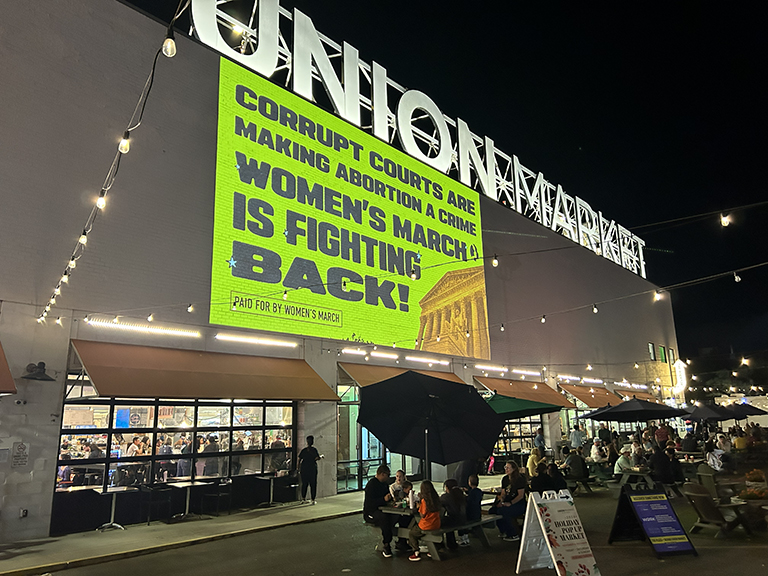
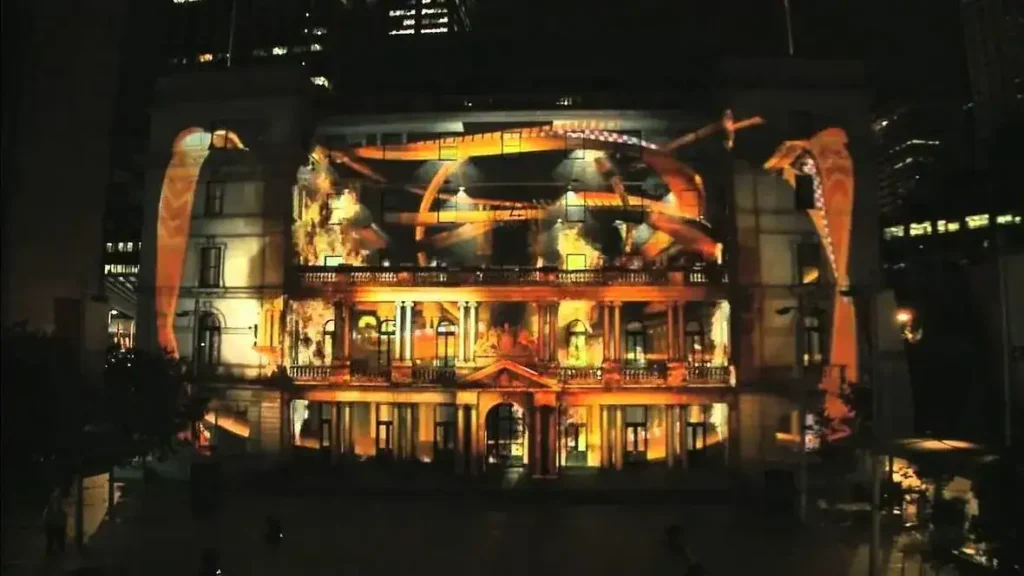
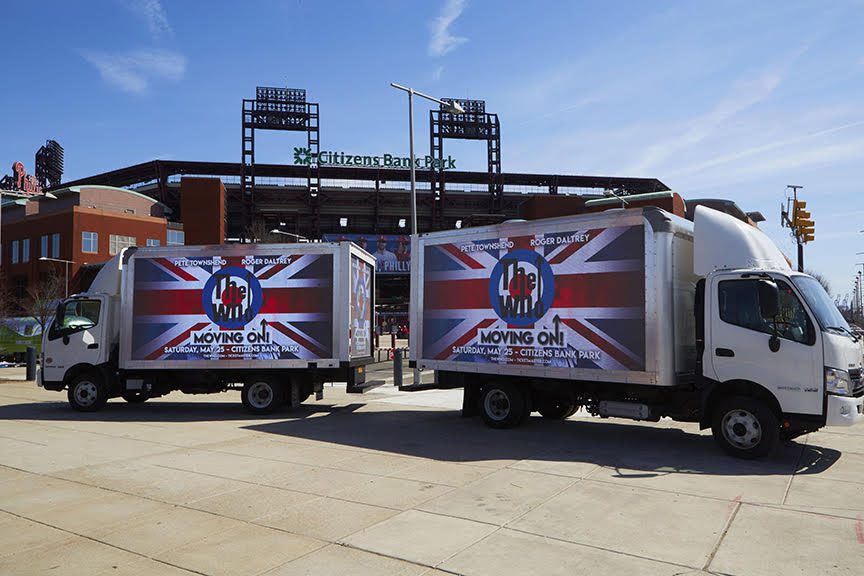
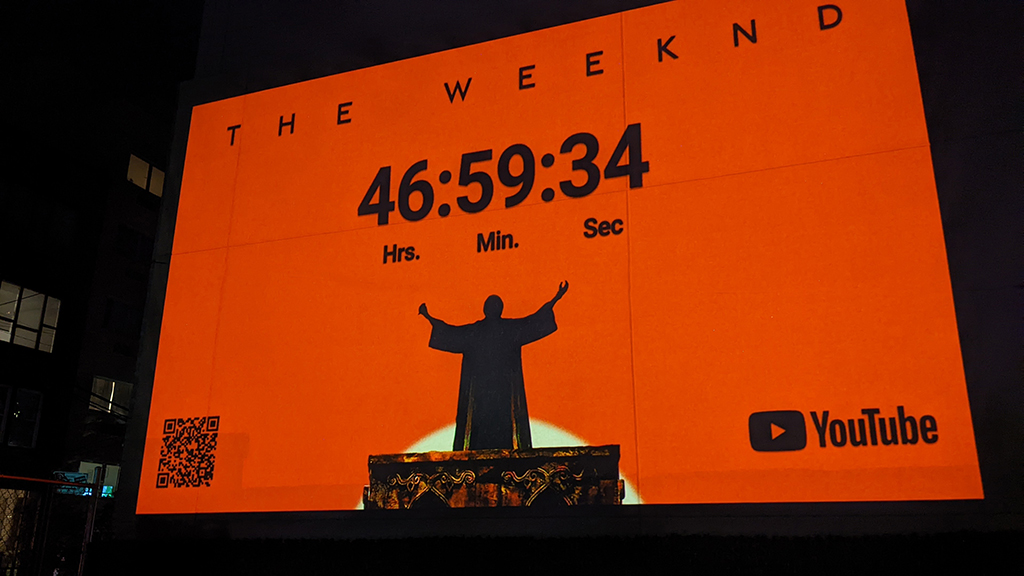
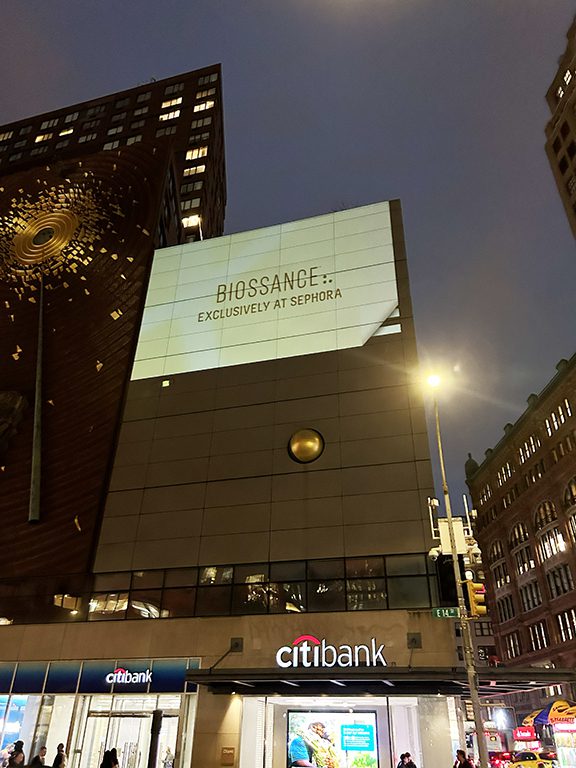
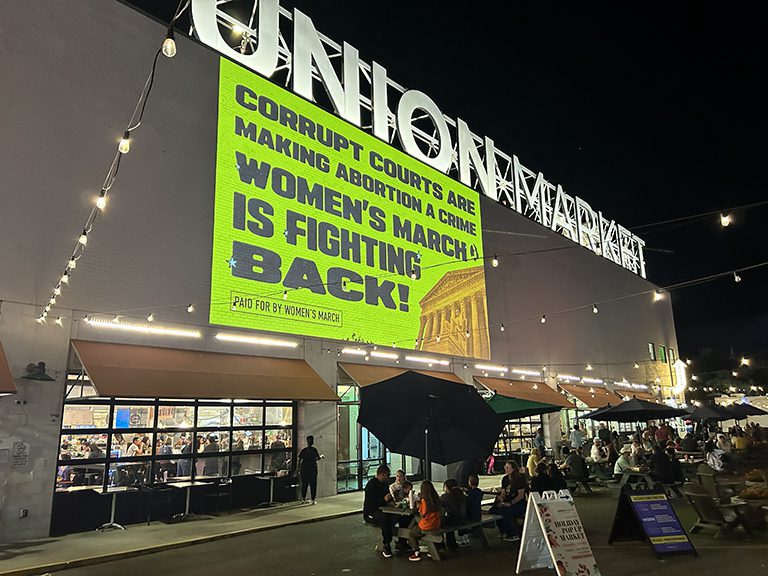
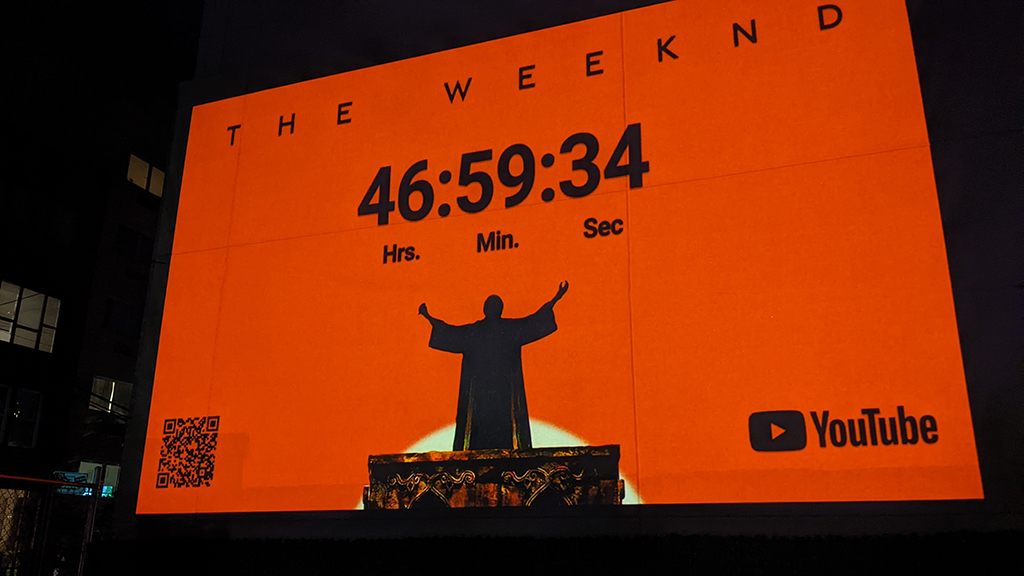
AGM has executed campaigns for clients including Biossance, The Weeknd, the US Marine Corps, Women’s March, Reproductive Freedom for All, and YouTube — across consumer brand, entertainment, and advocacy categories. The Mizzou × Cotton Bowl sports activation campaign demonstrated AGM’s capacity to execute brand projection campaigns for major institutional clients in concentrated audience environments. Auto and mobility brands targeting the Metro Detroit suburban market work directly within our established campaign capabilities. AGM’s projection client roster includes Netflix, Disney, Coca-Cola, FanDuel, Live Nation, iHeartRadio, and the US Marine Corps. A confirmed case study: the US Marine Corps × CMA Fest Nashville — multi-night projections onto architectural surfaces throughout the festival footprint, reaching 80,000+ attendees across the campaign window. Projection advertising scales across every brand category; what our campaigns share is scale, precision, and a physical presence digital cannot replicate.
Surface selection is the primary answer — our scouting team specifically documents and rejects surfaces with adjacent signage that would overwhelm the projection’s visibility at operating distances. For surfaces that pass the ambient light assessment, the 20,000-lumen output of our commercial projection system delivers sufficient brightness to register clearly against the commercial corridor background. We can share scouting photographs and ambient light documentation before the campaign is committed.
Metro Parkway’s restaurant and entertainment cluster generates consistent evening and weekend foot and vehicle traffic from across the Sterling Heights and Macomb County market. On Friday and Saturday evenings in particular, the dining and entertainment destination traffic along Metro Parkway represents a substantial suburban audience. For entertainment brands, restaurant groups, and consumer brands targeting the suburban leisure demographic, the Metro Parkway entertainment zone is Sterling Heights’ highest-value projection environment.
Standard post-campaign deliverables include GPS-documented location data and photography of the projection in the Sterling Heights commercial corridor environment. For clients who need expanded reporting — vehicle traffic count data for the specific corridor, time-of-day audience analysis, or structured reach reporting for internal stakeholders — expanded reporting packages are available. The post-campaign photography from a Sterling Heights commercial corridor projection also functions as proof-of-execution content for client reporting and earned media distribution.
Detroit’s Eastern Market and downtown corridor reach a culturally engaged urban audience that responds to brand campaigns with strong artistic and lifestyle dimensions. Sterling Heights’ commercial corridors reach the working automotive consumer — the Metro Detroit suburban resident who buys and drives the vehicles the industry produces. For auto brands targeting the direct consumer purchase audience rather than cultural credibility, Sterling Heights may actually be the more targeted deployment of the two. Many automotive campaigns use both markets for complementary audience coverage.