Boston is one of the most walkable World Cup host cities in North America. When FIFA 2026 matches bring international fans to New England, the audience will concentrate in specific corridors that are uniquely accessible by foot and transit — the Seaport District, Back Bay, Fenway, and the connecting transit arteries that move people between them. That concentration creates a high-efficiency environment for street marketing: placements that reach a higher percentage of the target audience per installation than almost any other host city.
American Guerrilla Marketing plans and executes street-level activations in Boston markets. Our team maps the corridors where tournament audiences actually move, identifies the posting zones and activation locations that produce real contact with that audience, and deploys crews that document every placement and interaction. For brands that want to win World Cup 2026 visibility in Boston without paying official sponsorship rates, this is the operating playbook.
This guide covers AGM’s geographic strategy for Boston activations, the formats that work in this market, how to sequence campaigns across match weeks, and what the planning timeline needs to look like to execute well.
Why Boston Rewards Route Discipline
Most major U.S. cities require car-aware planning. Boston is different. The core fan audience for World Cup matches at Gillette Stadium will travel by commuter rail from South Station, flow through Back Bay, and decompressed in the Seaport and downtown neighborhoods. That means a brand with strong presence in those walking corridors reaches the audience repeatedly — on the way in, at hospitality, and on the way out — without needing to scatter placements across a sprawling metro area.
The Boston street grid is compact enough that a well-planned poster program can achieve visual saturation with a fraction of the budget required in car-dependent markets. The challenge is that the same density makes location quality matter more. A placement on a high-foot-traffic block in Seaport outperforms ten placements in low-traffic areas. Route discipline — knowing exactly which corridors carry the audience — is what separates effective programs from wasted spend.
Geographic Priority Zones for World Cup Boston
AGM’s planning for Boston World Cup activations focuses on four geographic zones, each with distinct audience flow patterns and format opportunities:
Seaport District
The Seaport is where sponsor hospitality, fan villages, and brand activations will concentrate. World Cup sponsors will pay premium rates to operate here. Non-sponsors who establish a presence in the streets and corridors adjacent to official footprints can achieve comparable visibility at a fraction of the cost. The key activation locations are the pedestrian corridors connecting the convention center area to the waterfront, the restaurant and bar cluster along Congress and Seaport Boulevard, and the Silver Line stops that funnel transit traffic from South Station.
Back Bay and Copley
Back Bay handles overflow audience and the hotel concentration for tournament visitors. Boylston Street, Newbury Street, and the corridors around Copley Square see sustained foot traffic during event weeks. Poster saturation in Back Bay reaches the high-value hospitality and business audience that moves through this neighborhood during the day and evening.
South Station and Transit Nodes
South Station is the primary transit gateway for fans traveling from Gillette Stadium. The commuter rail platforms, the bus terminal, and the surrounding streets compress the entire departing audience into a tight geography for 45-60 minutes after each match. Street team distribution at this location during post-match windows reaches more fans per hour than almost any other activation format in the market.
Fenway Neighborhood
The Fenway and Kenmore areas attract the fan bar crowd — international visitors and local fans who want the match-watching experience without venue tickets. The Green Line corridor, the cluster of bars around Kenmore Square, and the pedestrian flow along Brookline Avenue create a self-contained activation zone that complements the Seaport and Back Bay programs.
Formats That Perform in Boston’s Street Environment
Boston’s brick-and-mortar urban environment and its permitting landscape require format selection that accounts for both legibility and compliance. Not every format that works in New York or Los Angeles translates directly to Boston.
Wheatpasted Posters
The Boston street grid has strong permitted posting inventory in the Seaport and surrounding neighborhoods. Wheatpasted poster campaigns in these zones generate sustained impressions for the duration of the tournament. We identify compliant posting locations, execute installations with documented photo and GPS records, and schedule refresh runs to maintain saturation through the full event window.
Street Team Distribution
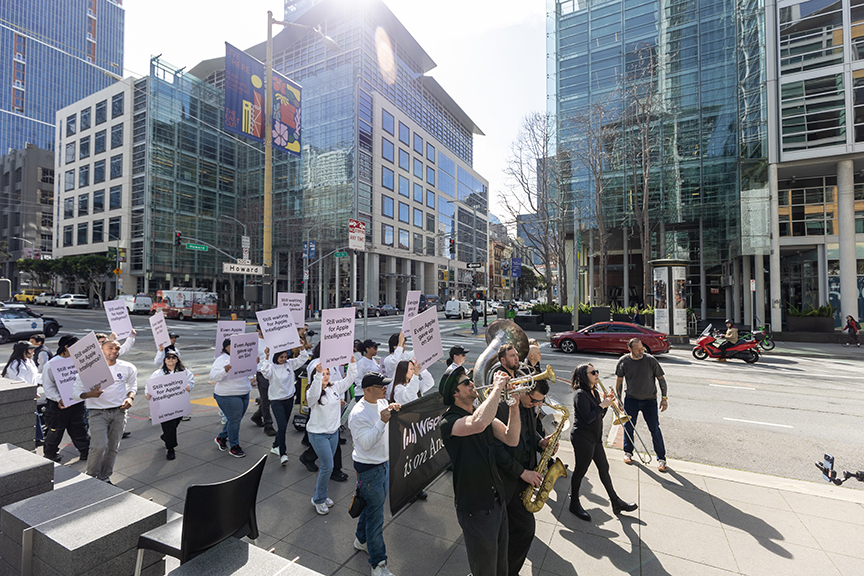
Boston pedestrian density makes street team distribution efficient. A crew of four to six people positioned at the right transit nodes and pedestrian intersections can reach thousands of fans per shift. We deploy branded teams with materials designed for the specific match day audience — international visitors, local fans, hospitality guests — and document distribution counts by location and time window.
LED Billboard Trucks
LED billboard trucks routed through the Seaport, Back Bay, and South Station areas bring mobile visibility to the corridors where posted formats cannot operate. We plan truck routes around match day timing to maximize audience encounter rates and GPS-track all movements for the client report.
Sidewalk Stencils
Sidewalk stencils in high-dwell pedestrian areas — plaza spaces, transit station approaches, bar corridors — create ground-level brand impressions that photograph well and generate social sharing. We use water-soluble chalk formats that comply with Boston street regulations.
Sequencing Campaigns Across the Tournament Window
World Cup Boston 2026 is not a one-day event. The tournament brings multiple match days across several weeks, with fan activity concentrated around each match cluster. The brands that win World Cup visibility are the ones that build presence before the first match and maintain it through the final games in their geography.
AGM plans Boston World Cup activations in three phases:
Phase 1: Pre-Tournament Visibility (2-3 Weeks Before First Match)
Poster saturation programs launch before tournament crowds arrive. The goal is to establish visual presence in target corridors before the environment gets cluttered with competing brand activity. Brands that are already on the walls when fans arrive look like they belong — not like they showed up at the last minute.
Phase 2: Match Week Intensity
Street teams deploy on match days and the evenings before. Distribution concentrated at South Station, Seaport, and Back Bay captures the full fan movement cycle. LED truck routes run during peak pedestrian hours. Documentation from each shift feeds into the match week field report.
Phase 3: Post-Match Reinforcement
Poster refresh runs maintain saturation through the end of the tournament window. Tear-downs are documented. Final field reports consolidate the full campaign record.
Ambush Marketing Strategy for Non-Official Sponsors
Official World Cup sponsorships cost millions. The exclusion zones around FIFA venues and official events are real, but they are geographically limited. The vast majority of the city — including the highest-foot-traffic corridors where fans spend most of their time — is open to well-planned non-sponsor marketing activity.
AGM has developed a compliant ambush marketing framework for non-sponsors that operates entirely outside protected zones while still capturing the audience concentration created by the tournament. The strategy focuses on owning the routes and the recovery spaces — the streets where fans walk to and from the venue, the bars where they watch and celebrate, the transit corridors that move them across the city.
Non-sponsors who invest in street-level presence in these areas achieve comparable recall to official sponsors at a fraction of the cost. The key is executing at sufficient density and quality that the brand feels like a natural part of the environment rather than an afterthought.
What Brands Usually Get Wrong in Host City Activations
Most brands planning World Cup activations in host cities make the same mistakes. Understanding them prevents wasted budget:
Chasing the Venue Instead of the Audience
The venue footprint is the most expensive and most crowded place to operate. The audience is not only at the venue. It is in the hotels, the bars, the transit corridors, and the neighborhoods. Brands that chase the venue compete for expensive, cluttered inventory. Brands that follow the audience find better placements at lower cost.
Match-Day-Only Programs
Match day is the spike. Tournament week is the campaign. Fans arrive days before matches, stay after, and circulate continuously through the hospitality zone. A match-day-only program misses the majority of total audience contact hours available.
Generic Creative That Doesn’t Localize
Boston is not Houston is not Philadelphia. Each host city has a distinct audience character, neighborhood culture, and visual environment. Creative that doesn’t acknowledge the local context looks imported and gets ignored. We help clients adapt creative for the Boston market without slowing down production timelines.
Planning Timeline and Lead Time Requirements
Boston’s permitting environment and the competition for posting inventory during a major event require earlier planning than standard campaigns. The minimum recommended lead time from brief to deployment is 60 days. Campaigns that brief 90 days out have access to better location selection, more production options, and less schedule pressure on installation crews.
Key milestones: format selection and permitting research in the first two weeks, creative finalization and production by week four, installation scheduling locked by week six, crew briefing and materials staging complete by week eight, and deployment running on schedule with documentation from day one.
How AGM Measures Boston World Cup Activation Performance
Documentation is what converts a field marketing budget into a verifiable record of performance. Every AGM Boston World Cup deployment produces:
- GPS-tracked crew movements by shift
- Time-stamped photo documentation of all placements
- Materials distribution counts by location and time window
- Placement persistence tracking (checking that posters remain up through the deployment window)
- Written field observations covering audience density, competing activity, and format performance
- Final consolidated campaign report covering all market activity
This documentation supports internal reporting, media coverage of the campaign, and planning for future deployments in the market.
FAQ
Where should brands focus first in Boston during World Cup 2026?
The Seaport District and Back Bay are the primary activation zones. Seaport concentrates fan hospitality and sponsor activity. Back Bay handles transit overflow from Fenway and downtown. The Green Line corridor from Boylston to Kenmore, the Silver Line from South Station, and the pedestrian flow along Boylston Street are the corridors we’d prioritize first.
Should a Boston World Cup activation be built only around match days?
No. Match days are the spike, but the week around each match is where the audience is most concentrated and most receptive. Fan villages, hospitality events, and nightlife activity run the entire tournament week. Brands that build a continuous presence outperform those that show up only on game day.
What street marketing formats work best for World Cup Boston?
Wheatpasted poster saturation along foot-traffic corridors, street team distribution at transit nodes, LED billboard trucks routing through fan zones, and branded sidewalk stencils near high-dwell locations all perform well. Boston’s compact street grid makes repetition achievable with a smaller budget than sprawling markets.
How far in advance should brands plan a Boston World Cup activation?
Ideally 60-90 days before the first match in your activation window. Permitting takes time. Posting zones need to be identified and locked early. Crews need briefing and materials need production. Brands that wait until match week compete for the same locations against better-prepared competitors.
Can non-official sponsors run street marketing during World Cup Boston?
Yes, with proper planning. The official sponsor exclusion zones around venues do not extend to most of the city. Non-sponsors who operate in street corridors, transit areas, and hospitality zones outside the official perimeter can achieve significant reach without official sponsorship costs.
What makes Boston different from other World Cup host cities for activation?
Boston’s walkability, compact downtown, and transit-dependent audience make it a high-efficiency market for street work. A well-placed poster program reaches a higher percentage of the audience per placement than in car-dependent cities. The density also means street teams cover more ground on foot.
How does AGM document a World Cup activation in Boston?
Every deployment includes GPS-tracked field crew movements, time-stamped photo documentation of all placements and activations, materials distribution counts, and a written field report. Clients receive a complete record of what was done, where, and when.
Frequently Asked Questions
What is world cup boston 2026?
American Guerrilla Marketing provides world cup boston 2026 services across 50+ U.S. markets. Every campaign is planned, scouted, executed, and GPS-documented by our field teams. We work with regional brands and Fortune 500 companies on campaigns that require real street-level execution and documented proof of performance.
How does AGM approach boston 2026?
Our process starts with a market consultation to understand your goals, target audience, and budget. We then scout locations, handle any required permissions or permits, coordinate production and installation with our local crews, and provide a full GPS-tagged photo report after the campaign runs.
What markets does American Guerrilla Marketing cover for boston 2026?
We operate in 50+ U.S. markets including New York, Los Angeles, Chicago, Miami, Houston, Atlanta, Seattle, Denver, Boston, and dozens of secondary markets. Contact us to confirm availability and pricing for your specific market.
How much does a boston 2026 campaign cost?
Campaign pricing depends on market, format, quantity, and duration. We work with budgets ranging from targeted single-market runs to national rollouts across multiple cities. Use our RFP Builder or contact us directly for a custom quote based on your specific campaign requirements.
How do I get started with boston 2026 through AGM?
The fastest way to get started is to submit your campaign details through our RFP Builder at americanguerrillamarketing.com, or contact us directly at [email protected] or (646) 776-2770. Our team typically responds within one business day with availability and initial pricing.