Mexico City is the music industry’s nerve center for Latin America. Every major label maintains offices here. The touring infrastructure is among the most developed anywhere in the hemisphere. And the fan culture — the way people in CDMX engage with music releases, with artists, with the street-level moments that surround a record drop — is a different animal from any other market in the region. When a label or an independent artist wants to make a release feel like an event in Latin America, the activation starts in Mexico City.
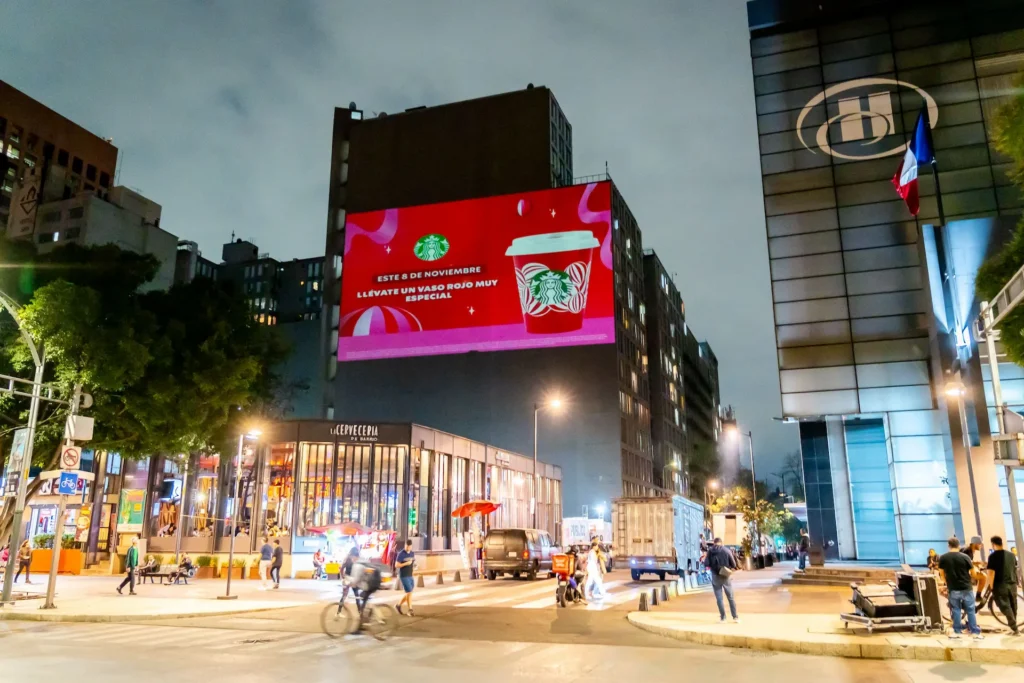
Guerrilla projection campaigns have become one of the primary tools for that activation. A well-placed projection on a building in Roma Norte or outside Auditorio Nacional the night before a major release creates a moment that is simultaneously a street experience and a social media trigger. Fans photograph it, share it, tag the artist. The projection becomes a distributed announcement — one that reaches far beyond the people who physically see it on the street.
Our team at AGM has run music release campaigns across CDMX’s major neighborhoods and venue corridors, and the patterns are consistent: the city responds to street-level music marketing in a way that few other markets do. This piece breaks down what makes CDMX work for music projections, which neighborhoods and surfaces matter most, and how a street campaign connects to the streaming metrics that labels actually measure.
Mexico City as the Latin Music Industry Capital
Understanding why CDMX matters so much for music release campaigns starts with the industry infrastructure. Sony Music Latin, Universal Music Latin Entertainment, and Warner Music Latina all operate major regional offices in Mexico City. The independent label ecosystem is equally concentrated here — labels and distributors serving banda, regional Mexican, cumbia, electronic, and alternative genres all cluster in CDMX, particularly in the colonias of Polanco, Lomas de Chapultepec, and Santa Fe.
This means that CDMX is not just a large consumer market — it is where decisions get made about Latin music. A release that breaks through in Mexico City tends to break through across the region. The music press here — publications, YouTube channels, podcast networks covering Latin music — has reach that extends to Buenos Aires, Bogota, Lima, and Miami. What happens on the streets of Roma Norte and Condesa on a release night feeds coverage that runs in markets thousands of miles away.
The streaming data reflects this. Mexico consistently ranks among the top streaming markets in the world, with CDMX driving a disproportionate share of national volume. A successful guerrilla projection in the right Mexico City neighborhood on the right night doesn’t just create a local moment — it can seed a national and regional conversation about an artist’s new work.
Mexico City’s Foro Sol (GNP Seguros Stadium) holds 65,000 people and has hosted nearly every major international touring act for the past 30 years. Auditorio Nacional holds 10,000 and is consistently ranked among the world’s top concert venues by ticket volume.
The Concert Venue Corridor and Its Projection Geography
Mexico City’s major venues cluster in distinct geographic zones, and each zone creates a specific projection opportunity around show nights. Understanding the venue geography is essential to planning release campaign projections effectively.
Foro Sol — now officially GNP Seguros Stadium — sits at the Autodromo Hermanos Rodriguez in the Granjas Mexico borough, southeast of the historic center. With 65,000 capacity, it is the destination for stadium-scale tours. The surrounding venue complex has large industrial structures and parking facility facades that can carry substantial projections. A show night at Foro Sol draws tens of thousands of people who have been anticipating that artist for weeks — an extremely motivated audience for an adjacent campaign.
Auditorio Nacional on Paseo de la Reforma in Chapultepec is a different character entirely. It is one of the most prestigious music venues in Latin America — a 10,000-capacity theater in a park setting, with a smooth, modernist exterior facade that projects exceptionally well. The Auditorio sits directly on Reforma, which means its exterior is visible to Reforma traffic as well as to concert attendees. A projection on or adjacent to the Auditorio on a show night catches one of the most concentrated fan audiences anywhere in the city, positioned exactly on the most photographed boulevard in Mexico.
Pepsi Center WTC sits in the World Trade Center complex on Insurgentes Sur, serving mid-size shows in the 10,000-15,000 range. The WTC towers behind the venue create large projection surfaces visible from Insurgentes, one of the city’s main arterial avenues. Arena CDMX, in Azcapotzalco, serves arena-scale productions and draws from the city’s broader geography rather than neighborhood-specific audiences.
Smaller Venues in Roma Norte and Condesa
For indie, alternative, and electronic music campaigns, the concentration of smaller venues in Roma Norte and Condesa creates a different kind of projection opportunity. El Plaza Condesa, Foro Indie Rocks, Foro Bizarro, Dada X, and a cluster of other venues in this zone collectively draw the city’s most music-engaged audience on any given night of the week. A projection in Roma Norte or Condesa doesn’t need to be tied to a specific show — the baseline foot traffic of music-interested people in these neighborhoods is high enough to build meaningful reach on its own.
The buildings in Roma Norte and Condesa also have exceptional projection surfaces. The neighborhood is characterized by Art Deco and early modernist architecture — large, flat, light-colored facades on four and five-story buildings that line wide streets with good sightlines. A projection on a Roma Norte corner building visible from both the cross street and the main avenue can be seen by passing pedestrians, terrace diners, and people gathered outside venues within a two-block radius.
The Altitude Advantage: Why CDMX Projections Photograph Differently
Mexico City sits at 7,350 feet above sea level — higher than Denver, higher than most cities on earth. That altitude has a measurable effect on nighttime projections that our team noticed early and has factored into our CDMX campaign planning since.
At lower altitudes, especially in coastal cities, nighttime air carries more water vapor, sea salt particulates, and urban pollution that diffuse projected light as it travels from the lens to the surface. The result is slightly softened edges, some color shift in the longer throw distances, and a hazy quality in photographs taken from a distance. At Mexico City’s altitude, particularly in the dry season (November through March), nighttime air has significantly lower particulate density. Projected images are sharper, color saturation is more accurate, and photographs taken of CDMX projections show a clarity and vividness that coastal cities don’t consistently deliver.
For music release campaigns, where the photographs and video clips taken by fans and media are part of the campaign’s actual deliverable, this is not a trivial distinction. A projection that photographs brilliantly generates better social content than one that looks slightly washed out. The CDMX altitude advantage translates directly into better organic media from the campaign.
At 7,350 feet, Mexico City’s night air is thinner and cleaner than most major cities. Projections here photograph with a sharpness and color saturation that consistently outperforms equivalent campaigns in lower-altitude markets — which matters when fan photography is part of the campaign strategy.
Neighborhood-by-Neighborhood: Music Audience Geography in CDMX
Different music genres and artist profiles map to different neighborhoods in Mexico City, and successful projection campaigns are placed where the target audience physically concentrates. Here is how AGM maps the music audience geography:
| Neighborhood |
Primary Music Audience |
Key Streets/Surfaces |
Best Hours |
| Roma Norte |
Indie, electronic, alternative, singer-songwriter |
Alvaro Obregon, Orizaba, Sonora |
9pm – 1am |
| Condesa |
Electronic, jazz, international acts |
Amsterdam, Tamaulipas, Nuevo Leon |
9pm – 2am |
| Polanco |
Mainstream pop, urban, Latin pop |
Presidente Masaryk, Oscar Wilde |
8pm – midnight |
| Santa Fe |
Corporate crossover, mainstream pop |
Vasco de Quiroga, Javier Barros |
7pm – 11pm |
| Centro Historico |
Cumbia, traditional, broad reach |
Madero, Tacuba, 5 de Mayo |
8pm – midnight |
| Tepito / La Merced |
Regional Mexican, banda, norteño |
Eje 1 Norte, Congreso de la Union |
Afternoon – 10pm |
This geography is not fixed — certain releases will pull audiences outside their normal neighborhoods, particularly around album releases or tour announcements that generate citywide conversation. But understanding the default concentration points for different music audiences allows campaigns to be placed precisely rather than broadly.
Fan Gathering Culture in Mexico City
Mexico City fan culture has specific physical gathering patterns that projection campaigns can target directly. Fans in CDMX organize — they know where to be, when to be there, and what is worth photographing. A projection campaign that appears at the right location at the right time will be found by fan communities before it is found by casual passersby.
Outside Auditorio Nacional before show nights, fans gather hours early — along the park paths in Chapultepec, on the Reforma sidewalk, and outside the venue entrance itself. This pre-show arrival window is one of the highest-dwell fan concentrations in the city. A projection on the Auditorio’s exterior visible during this window catches an audience in exactly the mode you want for a release campaign: excited about the artist, phones out, ready to create content.
The Glorieta de los Insurgentes — the large roundabout at the intersection of Insurgentes and Chapultepec, with its below-grade commercial corridor — is a known gathering and transit point for young people heading to shows in Roma Norte and Condesa. The circular commercial structure around the glorieta has exterior faces that can carry projections visible to the heavy pedestrian traffic above and around the roundabout. On any Friday or Saturday night when multiple shows are running in the Roma-Condesa corridor, thousands of people pass through this area.
OXXOs — the convenience store chain — are significant gathering points for late-night social activity in Mexico City. The location on Sonora in Roma Norte is a known meeting point for the neighborhood’s night crowd, positioned near several music venues. A projection on the building directly above or facing a high-traffic OXXO in Roma Norte on a Friday night reaches a concentrated, exactly-right demographic for indie and electronic music campaigns.
The Release Campaign Sequence: Street to Stream
The most effective music release projection campaigns in CDMX are not single-night activations — they are sequenced across multiple touchpoints that build from announcement to release to streaming performance. Here is how AGM structures a release campaign sequence:
Phase 1: Announcement projection (7-14 days before release). The first projection is designed to create mystery and anticipation. It shows the album artwork, the artist name, and the release date — nothing more. This gets photographed, shared, and speculated about by fans who see it and those who see the fan photos online. The first projection plants the flag; it doesn’t need to explain everything.
Phase 2: Release day activation (the night before or the night of release). This is the main event — a projection that goes up on a significant building at 9pm or 10pm on the release date or the night before. The creative is fully developed: album artwork, artist imagery, track titles, streaming platform callouts. This is the projection that fans and media come to photograph. It should run at maximum visibility and maximum creative impact.
Phase 3: Tour announcement follow-up (if applicable). If the release is tied to a tour, a third projection activation announcing the Mexico City date drives the connection between the record and the live experience. This typically runs 2-4 weeks after the release, on the day the tour is announced, on a surface near the venue where the Mexico City date will be held.
The window between a projection appearing on a street in Roma Norte and the first fan photographs reaching social media is typically under 10 minutes on a busy Friday night. AGM builds campaigns with this distribution speed in mind — the projection needs to be photograph-ready from the first minute of operation.
How Street Projections Feed Streaming Metrics
The connection between a street-level projection campaign in CDMX and an artist’s streaming performance is not direct — you cannot measure it with a single attribution click. But the mechanism is well-understood, and labels consistently report it in post-campaign analysis.
When a projection goes up in Roma Norte the night before a release and fan photographs start circulating on social media within the hour, those photographs carry the album artwork, artist name, and release date to audiences who didn’t physically see the projection. Some portion of that social audience is motivated to pre-save the album on Spotify or Apple Music, which directly boosts the release day numbers. Others simply have the release date lodged in their memory because they saw it on their feed — and when the release drops, they go find it.
The search spike pattern is consistent: a strong Mexico City guerrilla projection campaign produces a measurable spike in organic search for the artist’s name and the album title in the 24-48 hours after the projection runs. Labels track this using their preferred analytics tools, and the correlation is reliable enough that CDMX street campaigns are now a standard component of Latin music release strategy for major labels.
The streaming platform dimension adds another layer. When an artist’s release is being supported by a street campaign in Mexico City, streaming platforms — which also run their own marketing campaigns — often coordinate their digital pushes to align with the street activation dates. The result is a reinforcing cycle where the physical street campaign drives social media engagement that drives streaming platform algorithms to serve the music more broadly.
Projection Surfaces That Perform for Music Campaigns
Music release campaigns benefit from surfaces that read as culturally aligned with the music’s identity. The architectural vernacular of the surface matters — a reggaeton release projection belongs on a different building than a classical crossover campaign, even if both buildings are the same physical size.
For contemporary pop and urban music, the mid-century modern and Bauhaus apartment towers of Polanco and Napoles are ideal surfaces. Their clean geometry and light-colored concrete faces project with excellent clarity, and their location in neighborhoods that skew affluent and mainstream-pop-consuming matches the audience well.
For indie, alternative, and electronic music, Roma Norte’s Art Deco building stock is the right visual environment. The decorative architectural detail of a Roma Norte facade gives projection content a richness and texture that matches the aesthetic sensibility of those genres’ audiences. A projection that maps to the ornamental geometry of an Art Deco building face creates visual content that looks designed, not just displayed.
For regional Mexican music — banda, norteño, corridos — Centro Historico and the neighborhoods along Eje Central provide projection surfaces that situate the campaign within Mexico City’s cultural and demographic heartland rather than its cosmopolitan periphery. The scale of Centro buildings is also appropriate for the mass-market character of regional Mexican releases.
The Viral Potential of Show-Night Projections
Show nights at Auditorio Nacional, Foro Sol, or Pepsi Center WTC create some of the highest-concentration, most-motivated fan audiences in the city. People attending a concert are in maximum engagement mode — they have spent money on tickets, traveled to the venue, and are emotionally primed for that artist’s music. A projection campaign visible to this audience, on the night of the show, captures that energy at its peak.
The specific opportunity is the arrival and dispersal windows around shows. In the 60-90 minutes before a major show at Auditorio Nacional, fans fill the Reforma sidewalk, the Chapultepec park paths, and the streets immediately surrounding the venue. This is prime projection time — high dwell, low transit speed, phones in hand. After the show, the dispersal traffic is equally concentrated and equally motivated: fans who just experienced the artist live are the most likely audience on earth to share a projection of that artist’s release campaign.
A show-night projection visible from the Auditorio Nacional entrance is simultaneously seen by tens of thousands of concert attendees and photographed in the background of countless fan photos taken outside the venue. Those photos circulate on social media with the artist tagged, the venue tagged, and the album campaign visible in the frame — organic branded content created by the audience rather than the brand team.
Streaming Platform Campaigns and Street Projections in the Same Neighborhoods
One of the more interesting dynamics we see in current CDMX music marketing is the overlap between streaming platform campaigns and artist release campaigns. Streaming platforms — Spotify, Apple Music, Amazon Music, Deezer — all run their own marketing activations in Mexico City to drive engagement with their platforms and their featured content.
When a streaming platform is pushing a playlist or a new release with marketing support, and the artist is simultaneously running a street projection campaign in the same neighborhoods, the two campaigns reinforce each other without coordination costs. A fan who sees a Spotify campaign for a new album on their app, then walks past a guerrilla projection of the album artwork in Roma Norte that same evening, has received two high-quality brand impressions in the same day. The street campaign makes the digital campaign more memorable; the digital campaign gives the street impression a destination.
AGM increasingly helps artists and labels think about their CDMX campaigns in this integrated way — not as a standalone projection activation, but as a street presence that works in tandem with the streaming and digital campaigns already in market. The neighborhoods where streaming platforms concentrate their CDMX marketing (Roma Norte, Condesa, Polanco) are exactly the neighborhoods where street projections perform best for the same demographic. The overlap is not coincidental.
Seasonal Windows for Music Release Projections in CDMX
Mexico City’s year-round mild climate means projection campaigns can run in any month, but certain periods create better conditions and higher audiences than others. Understanding the seasonal calendar helps in scheduling release campaign projections to maximum effect.
January through March is the dry season — clear nights, low humidity, excellent projection clarity. The post-holiday period in January tends to have high music release volume as artists target the new-year consumption spike. This is a strong period for projection campaigns, with good technical conditions and high cultural receptivity.
April through June sees Mexico City’s entertainment calendar heating up with festival season. Vive Latino (March-April) and Corona Capital (November) are the two anchor music festivals, and both generate weeks of promotional activity before and after. A release campaign timed to run the week before Vive Latino can embed itself in the festival conversation while it is at its most active.
July and August is rainy season — afternoon and evening rains are common, which can interrupt outdoor projections. Our team plans rainy-season campaigns with backup timing windows and weather monitoring protocols. The rains tend to clear by late evening, and a projection that runs after a rain on a wet-street surface in Roma Norte actually benefits from the water reflection on the pavement, which extends the visual reach of the light.
September through November is arguably the strongest sustained window for music release projections: post-rainy season clarity, high cultural activity (Dia de Muertos, the run-up to holiday season), and maximum street traffic in the key neighborhoods. Artists and labels who can time their releases to this window for Mexico City activations consistently see strong results.
Layering Projection with Wheatpasting for Music Campaigns
Wheatpasting and projection are a natural pair for music release campaigns because they operate in complementary time frames and at complementary scales. A wheatpasting campaign can go up days or weeks before the release, building street-level awareness at eye level across multiple neighborhoods simultaneously. The projection then arrives on release day at building scale, creating the main visual event of the campaign week.
In Roma Norte, wheatpasted album artwork at street level on the same block as an evening projection creates a layered brand presence — the poster catches people during daylight hours, the projection catches people at night. The two formats use the same creative assets, so there is no confusion or fragmentation in the campaign message. The combined effect is a neighborhood that feels like it is covered in a release campaign, which in turn generates more organic sharing from people who encounter multiple touchpoints in the same day.
Frequently Asked Questions
Why is Mexico City the best Latin American market for music release projection campaigns?
CDMX is home to the Latin American offices of every major label — Sony, Universal, Warner — plus a deep independent label scene. Its concert infrastructure is among the largest in the hemisphere. Fan engagement culture is intense and organized, and the city’s 7,350-foot altitude creates air clarity that makes night projections unusually sharp and photograph well.
Which neighborhoods in Mexico City should music release projections target?
Roma Norte and Condesa for indie, electronic, and alternative audiences; Polanco and Santa Fe for mainstream pop and urban; Centro Historico for cumbia, traditional formats, and broad reach; and Tepito for regional Mexican music. The areas surrounding major venues — Foro Sol, Auditorio Nacional, Pepsi Center WTC — are effective for show-night activations.
How do music release projection campaigns connect to streaming performance?
A street-level announcement projection in CDMX creates a social media moment — fan-generated video and photography — that drives search and streaming activity on release day. The campaign sequence typically runs: announcement projection (1-2 weeks before release), social media amplification, release day streaming push. The street campaign primes the audience for the digital release.
Can projection campaigns run on Mexico City venue show nights?
Yes — show-night projections on buildings adjacent to Auditorio Nacional, Foro Sol, or Pepsi Center WTC target audiences who are already in maximum engagement mode for that artist. AGM coordinates projection timing to coincide with pre-show arrival traffic and post-show crowd dispersal, which are the two highest-dwell moments around venue exteriors.
How does the altitude of Mexico City affect projection campaigns?
At 7,350 feet above sea level, Mexico City’s thinner air has lower particulate density than coastal cities at night. This creates a clarity to nighttime projections that coastal cities don’t have — sharper edges, more saturated color, less atmospheric haze between the projector and the surface. Photographs of CDMX projections consistently show more detail and color vibrancy than equivalent campaigns in lower-altitude markets.