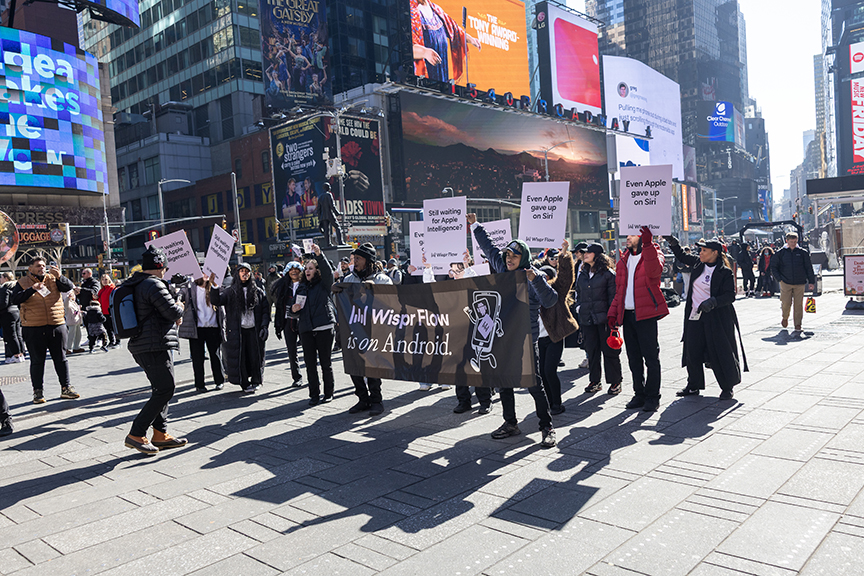
Political campaigns are won or lost on ground-game execution. You can flood social feeds with paid impressions, but the voter who sees your name on a poster every morning walking to the train, who gets a flyer from a crew member who actually knows the neighborhood, who notices your team at three separate intersections on Election Day — that voter is already primed before they pull a lever. A political marketing agency that understands street-level execution brings something digital spend alone cannot buy: physical presence in the specific places where your audience moves, waits, and makes up its mind.
American Guerrilla Marketing works with political campaigns, advocacy organizations, ballot initiative groups, and issue-based nonprofits across 50+ U.S. markets. Our team plans and deploys street visibility programs, canvassing support operations, and brand activations built around the operational realities of field politics — compressed timelines, geographic precision, message discipline, and the need for documentation that holds up when a campaign manager asks what actually got done.
This guide covers how we approach political field marketing, what formats perform, how street work and canvassing reinforce each other, and what a campaign should expect from a serious field execution partner.
Why Physical Visibility Still Drives Political Outcomes
Digital advertising dominates most campaign budgets for a reason: it scales, it targets, and it reports. But digital-only campaigns have a blind spot. They reach people on screens where attention is contested by thousands of other messages at the same moment. Political street marketing reaches people in the physical environment — on the block they grew up on, near the polling location they’ll use, in the corridor between the subway and their apartment.
Physical presence communicates something digital cannot: legitimacy. A campaign with posters on walls, crew members on corners, and materials in circulation looks like a campaign that is actually organized. That visible organization signals viability. It creates the social proof that translates into word-of-mouth. Voters tell each other about candidates who feel real and present — and a coordinated street program makes a campaign feel exactly that.
The research on canvassing consistently shows that face-to-face contact produces durable persuasion effects that digital cannot match. Street teams add energy and human texture to that contact. Combine a strong canvassing program with saturated physical visibility and you create a ground game that closes the persuasion loop from every direction.
Who This Work Is For
AGM’s political marketing work serves several distinct types of clients. Understanding which category fits your situation shapes how we plan the campaign:
Candidate Campaigns
Local, state, and federal campaigns use street visibility to build name recognition in targeted precincts, signal organizational strength, and mobilize volunteers and supporters into a cohesive ground operation. We plan these programs around voter file geography — targeting the precincts where turnout or persuasion move the needle most.
Ballot Initiative Organizations
Issue campaigns — for or against a ballot measure — often face a public that doesn’t yet understand what they’re voting on. Street marketing creates sustained visibility for the message before the final push. Repeated exposure to the core ask builds comprehension and familiarity that translates into favorable votes.
Advocacy and Nonprofit Groups
Advocacy organizations with legislative or regulatory goals use street work to demonstrate public support, build coalition visibility, and create earned media moments that extend reach beyond the paid program. Guerrilla marketing tactics are especially effective for groups that need to punch above their budget weight.
Political Agencies and Consultants
Political consultants and media buyers partner with AGM as a field execution vendor — we run the street program while they manage the broader campaign. These relationships work best when we’re brought in during planning rather than handed a brief at the last minute.
Street Team Canvassing: How AGM Plans Field Operations
Canvassing support is different from canvassing itself. AGM’s street teams are not voter identification crews reading from a script. They are field ambassadors who carry materials, build physical presence, create energy in target neighborhoods, and reinforce the message environment that makes direct voter contact more effective.
We plan canvassing support programs around a simple operational framework:
Geographic Prioritization
Every market has high-leverage corridors and low-leverage corridors. We map target precincts against foot-traffic data, transit density, and neighborhood anchors — farmer’s markets, transit hubs, college campuses, community centers — to identify where a street presence generates the most encounters per hour of field time. Budget follows concentration, not coverage.
Team Composition and Training
Field crews are recruited from the market being targeted wherever possible. Local familiarity matters. A crew member who grew up in the neighborhood can navigate, contextualize, and hold conversations with residents in ways that an outside crew cannot. We train all political field staff on message discipline, documentation procedures, and the specific goals of the deployment before the first shift.
Materials and Formats
Street team canvassing programs typically incorporate: branded materials (flyers, palm cards, literature), branded crew attire that signals organization and professionalism, high-visibility placard formats for intersections and transit areas, and distribution logistics calibrated to the volume and geography of the target zone. We source, print, and kit all materials in-house or through vetted vendors to ensure quality control.
Documentation and Reporting
Every AGM political deployment produces a field report: GPS-tracked crew movements, photo documentation of placements and activations, materials distribution counts, and a written summary of field observations. Campaign managers get a record they can use for internal reporting and a baseline for future deployment planning.
Brand Activation for Political Campaigns
Brand activation in a political context means creating moments — structured encounters between the campaign and its target audience that produce engagement rather than passive reception. It is the difference between a voter seeing a poster and a voter talking to a campaign representative, taking a photo, and sharing it on social media.
Brand ambassador programs work well for political activations at events: rallies, town halls, festivals, sporting events, and community gatherings where the target audience is already assembled and in an open social mode. We deploy branded teams to these environments to create contact points that feel natural rather than intrusive.
Event-Adjacent Activation
Some of the most cost-effective political activations happen adjacent to events rather than inside them. When the audience is already in line, waiting, decompressing, or moving through a neighborhood for a specific occasion, a coordinated street presence can reach the entire audience in a compressed geography and timeframe. We plan event-adjacent programs around transit corridors, parking and rideshare zones, and the hospitality and nightlife clusters that capture audience movement after the main event ends.
Pop-Up and Flash Activations
Short-duration, high-intensity activations at specific locations — a bus depot in the morning rush, a community center on a Saturday afternoon, a college campus during class-change hours — allow campaigns to concentrate impact without committing to extended deployments. We design these programs to create the visual impression of scale even with a lean crew, using materials, signage, and positioning to maximize apparent presence.
Political Poster Campaigns and Visual Saturation
Poster campaigns are one of the oldest tools in political marketing and one of the most durable. A well-placed poster in a high-foot-traffic corridor generates thousands of impressions over its lifespan with no ongoing cost. Saturation programs — multiple placements per block across a target neighborhood — create the perception of dominant presence that translates into candidate viability signals for persuadable voters.
Wheatpasting and poster campaigns are AGM’s core format for political visual programs. We work with campaigns to identify legally compliant posting zones, plan placement density by precinct priority, and execute installations with crews that document every placement with photo and GPS data. The result is a verifiable record of the program alongside the visual impact on the street.
Design for Street Legibility
Political posters must work at street scale. That means high-contrast design, minimal text, and clear visual hierarchy — name, message, call to action — that communicates in the two to three seconds a pedestrian spends looking at any given wall. We review artwork before print to catch legibility issues that look fine on screen but fail in the field.
Format Selection by Environment
Different environments call for different formats. Narrow corridor walls take vertically oriented formats. Wide walls in high-visibility transit areas can support landscape formats or large-scale installations. Sidewalk stencils work well near polling locations and high-pedestrian intersections. We match format to environment rather than applying a one-size-fits-all approach.
What Makes Political Field Marketing Different from Consumer Brand Work
Political campaigns have unique constraints that consumer brand campaigns do not. Understanding them changes how we plan and execute the work.
Time Compression
Political timelines are unforgiving. Primary deadlines, debate schedules, early voting windows, and Election Day create hard stops that cannot move. We build political programs backward from the deadline rather than forward from the brief, ensuring that execution is complete when it needs to be and not still in progress when votes are being cast.
Message Discipline
Political messaging carries reputational and legal stakes that consumer brands rarely face. Field reps must stay on message consistently, materials must reflect approved creative, and nothing that goes into the public environment should create a liability or media story. We enforce message discipline through training, material control, and field supervision protocols.
Geographic Precision
Consumer campaigns can often accept geographic approximation. Political campaigns cannot. The difference between a high-turnout precinct and a low-turnout precinct two blocks away can determine whether a deployment produces ROI or wastes budget. We plan political programs at the precinct level and route field crews with GPS tracking to ensure the work lands where the voter file says it matters.
Compliance and Permitting
Campaign finance disclosure requirements, city ordinances on posting and canvassing, and local rules on electioneering near polling locations all apply to street marketing programs. We build compliance into every political campaign plan — permitted formats in permitted locations, materials labeled as required by law, and field operations that stay well clear of any protected zones.
How Street Visibility and Canvassing Reinforce Each Other
The most effective political field programs treat street visibility and direct canvassing as a coordinated system, not parallel tracks. Visibility primes the environment. Canvassing converts the primed audience. The sequence matters.
When canvassers knock on doors in a neighborhood that is already visually saturated with the campaign’s message, they get a different reception than canvassers going into a cold environment. The poster on the wall or the corner crew the voter saw last Tuesday has already established that the campaign is real, organized, and present. The canvasser arrives as confirmation, not introduction.
We help campaigns sequence these elements deliberately: visual saturation programs launch first, canvassing operations follow, and reinforcement placements extend visibility through Election Day. The field report from each phase informs the targeting decisions for the next.
Measuring Political Field Marketing Performance
Documentation is how field marketing earns its place in a campaign budget. Every AGM political deployment produces a complete photo and GPS record of the work. Field reps document placements, crew positions, and materials distribution at the time of execution — not reconstructed after the fact.
Beyond documentation, we track several indicators that tell campaigns whether the work is performing:
Placement Persistence
Posters that stay up are posters that keep generating impressions. We track removal rates in high-priority corridors and schedule replacement runs to maintain saturation through the critical pre-election window.
Geographic Coverage vs. Voter File Priority
We cross-reference field crew GPS tracks against the voter file targeting map after each shift to verify that coverage is concentrated where it matters. Drift toward lower-priority areas gets corrected in real time.
Field Observations
Experienced field supervisors note what they observe in target neighborhoods: competing campaign activity, receptivity levels, unusual concentrations of foot traffic, and anything that changes the operating picture. These observations inform next-shift planning and are included in the client field report.
Multi-Market Political Campaigns
Statewide and national campaigns require coordinated deployment across multiple markets simultaneously. AGM’s national street marketing network allows us to run coordinated political programs across multiple cities with unified reporting, consistent materials, and synchronized timing. We manage the logistics of multi-market deployment — vendor coordination, materials shipping, crew management, and documentation consolidation — so the campaign team gets a single point of contact and a single field report covering all markets.
Multi-market programs also allow campaigns to create earned media moments by executing at scale. A simultaneous poster installation in twenty cities on the same day is a news story. A coordinated canvassing blitz across a congressional district on a single Saturday is a demonstration of organizational capacity that media and opponents both notice.
LED Billboard Trucks and Mobile Visibility
For campaigns that need high-impact mobile visibility — Election Day parades, rally support, targeted neighborhood sweeps — LED billboard trucks bring the message directly to the audience rather than waiting for the audience to come to the message. We route these units through high-priority precincts on schedule and document their movements with GPS throughout the deployment.
FAQ
What does a political marketing agency do in the street that digital cannot?
Physical field work creates repeated, unignorable impressions in the places voters and supporters actually live and move. Street teams hand materials directly to people, posters stay visible for weeks, and canvassing creates face-to-face contact that no algorithm can replicate. Digital reaches screens. Street work reaches people in their neighborhoods.
How much does a street team canvassing campaign cost?
Street team campaigns for political clients typically start around $5,000 for a single-market, single-day deployment and scale to $50,000+ for multi-market, multi-week programs. Costs depend on market size, number of field reps, materials, and documentation requirements. AGM provides itemized quotes based on geography and scope.
Can a political campaign use guerrilla marketing tactics legally?
Yes, with proper permitting and location selection. Our team operates within city ordinances on every campaign, selecting permitted posting zones, using removable formats where required, and documenting all placements. Compliance is built into the planning phase, not added as an afterthought.
How should campaigns combine canvassing with visibility tactics?
The strongest programs use visibility to prime the environment before canvassers arrive. When voters have already seen your poster or your team at a corner, canvassers get warmer receptions. We plan the sequencing: awareness assets first, direct contact second, reinforcement third.
Why use AGM for political field execution?
We operate in 50+ U.S. markets with vetted field crews, GPS-tracked deployments, and photo documentation on every job. We understand political timelines, message discipline, and the operational realities of running crews in urban markets under deadline pressure.
What formats work best for political street visibility?
Wheatpasted posters in high-foot-traffic corridors, street team flyering at transit nodes, sidewalk stencils near polling locations, and branded canvassing teams with consistent uniforms all perform well. The right mix depends on budget, timeline, and the specific neighborhoods being targeted.
How quickly can AGM deploy a political street campaign?
Standard lead time is 5-7 business days from contract to deployment for most markets. Rush campaigns can launch in 48-72 hours for markets where we have standing crews. Contact us with your timeline and we’ll tell you exactly what’s achievable.
Frequently Asked Questions
What is political marketing agency?
American Guerrilla Marketing provides political marketing agency services across 50+ U.S. markets. Every campaign is planned, scouted, executed, and GPS-documented by our field teams. We work with regional brands and Fortune 500 companies on campaigns that require real street-level execution and documented proof of performance.
How does AGM approach marketing agency?
Our process starts with a market consultation to understand your goals, target audience, and budget. We then scout locations, handle any required permissions or permits, coordinate production and installation with our local crews, and provide a full GPS-tagged photo report after the campaign runs.
What markets does American Guerrilla Marketing cover for marketing agency?
We operate in 50+ U.S. markets including New York, Los Angeles, Chicago, Miami, Houston, Atlanta, Seattle, Denver, Boston, and dozens of secondary markets. Contact us to confirm availability and pricing for your specific market.
How much does a marketing agency campaign cost?
Campaign pricing depends on market, format, quantity, and duration. We work with budgets ranging from targeted single-market runs to national rollouts across multiple cities. Use our RFP Builder or contact us directly for a custom quote based on your specific campaign requirements.
How do I get started with marketing agency through AGM?
The fastest way to get started is to submit your campaign details through our RFP Builder at americanguerrillamarketing.com, or contact us directly at [email protected] or (646) 776-2770. Our team typically responds within one business day with availability and initial pricing.