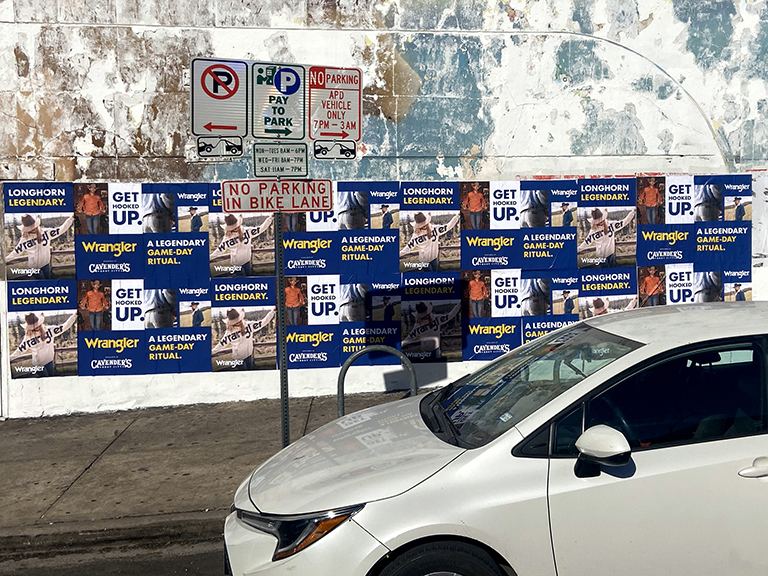
The best way to understand how guerrilla marketing actually works is to look at specific campaigns: what the brand was trying to accomplish, which formats they used, where they deployed, and what happened. Not hypothetical scenarios or theoretical frameworks — actual campaigns, with the decisions that shaped them and the results that followed. The case studies here reflect the range of objectives, formats, and audience contexts that define the modern street-level marketing landscape. We have drawn from our own campaigns and from widely documented industry examples to illustrate the principles that determine whether a guerrilla campaign succeeds or misses its objective.
Every one of these campaigns had something to teach us about the relationship between precision targeting, format selection, creative design, and execution quality. The lessons are transferable to any brand that is considering whether street-level marketing belongs in its campaign mix.
Case Study 1: DTC Food Brand — Wheatpaste Launch in Three Markets
A direct-to-consumer food brand launching a premium snack line needed to establish physical market presence in New York, Los Angeles, and Chicago before its e-commerce launch. Their digital budget was allocated entirely to social media and search. The brief: make the brand feel like it already had neighborhood-level credibility in each city before the first order shipped.
We executed wheatpaste poster campaigns in the neighborhoods with the highest density of the target consumer — health-conscious, design-aware, urban professionals aged 25 to 40. In New York: Williamsburg, Park Slope, and the East Village. In Los Angeles: Silver Lake, Echo Park, and Larchmont. In Chicago: Wicker Park and the Bucktown/Logan Square corridor.
The creative was the product’s packaging art, sized to poster format with a pre-launch URL and a “coming soon” message. The campaign ran two weeks before the e-commerce site launched. By launch day, the brand had social media posts documenting the posters from multiple cities and a modest but meaningful pre-launch traffic spike at the purchase URL. The campaign cost $28,000 across three markets including print. The brand cited the street campaign as a key factor in their first month’s above-projection sales performance in all three markets.
The lesson: pre-launch street presence creates the impression that a brand already exists and belongs in a neighborhood before the audience has ever ordered from it. That sense of familiarity accelerates conversion when the purchase option becomes available.
Case Study 2: Independent Film — Two-Phase Opening Weekend Campaign
A limited-release independent film needed to drive opening weekend attendance in New York and Los Angeles on a total street marketing budget of $18,000 including print. The film had strong critical support but no studio marketing budget behind it.
We designed a two-phase campaign. Phase one: a teaser wheatpaste deployment in target neighborhoods two weeks before opening, using key art with the film title and a QR code but no other information. The mystery created discussion in the neighborhoods. Phase two: a full campaign push in the final week before opening with complete key art, review quotes, and the theater listing for each market.
Combined with the film’s social media campaign running in parallel, the street campaign contributed to an opening weekend that exceeded the distributor’s projection by 35% in New York and 22% in Los Angeles. The QR code on the teaser posters received 847 documented scans before the full campaign launched, providing a direct engagement metric for the pre-launch phase.
The lesson: staged campaigns that build audience curiosity before delivering a full message outperform single-phase pushes that give all information at once. The teaser phase invests audiences in a brand before the sell begins.
Case Study 3: B2B Software Company — Convention Period Campaign
A B2B software company attending a major technology conference as a non-sponsor needed to generate brand awareness among conference attendees without paying the six-figure exhibitor fees their largest competitors had committed to. Budget: $22,000 for a four-day campaign.
We deployed a combination of wheatpaste posters on the convention center approach corridor (the wall run between the hotel cluster and the convention center entrance), street team programs at morning hotel exit windows, and LED truck routes through the convention center perimeter during mid-day and evening networking hours.
The company’s team reported that multiple conference attendees mentioned seeing the street campaign during the event. Inbound meeting requests on the company’s conference scheduling platform increased 40% compared to the previous year’s conference where they had attended without a street marketing program. Cost of the street campaign: $22,000. Equivalent sponsorship cost would have been $75,000 to $150,000.
The lesson: guerrilla marketing at conventions allows non-sponsor brands to achieve significant awareness among the exact audience that sponsors are paying to reach, at a fraction of the sponsorship cost.
Case Study 4: Music Label — Album Release Multi-City Push
A major music label needed to drive first-week streaming numbers for an album release by an artist with an established but not mainstream fanbase. Target markets: New York, Los Angeles, Chicago, Atlanta, and Houston. Budget: $65,000 across five cities.
We executed simultaneous wheatpaste campaigns in each city’s core music culture neighborhoods — Williamsburg and the Lower East Side in New York; Silver Lake and Los Feliz in Los Angeles; Wicker Park in Chicago; Ponce City Market adjacent neighborhoods and the Old Fourth Ward in Atlanta; and Montrose in Houston. Creative was the album art and release date with a streaming platform logo and QR code link.
The campaign launched Tuesday before a Friday release date. Social media documentation of the campaign spread organically through the artist’s fanbase in each city during the lead-up to the release. First-week streaming numbers exceeded the label’s projection, and the label’s social team documented more than 200 organic posts featuring campaign imagery from the five markets. The label booked two additional album cycle campaigns with us in the following six months.
The lesson: music campaign visual presence in the neighborhoods where the fanbase lives creates social amplification that multiplies the campaign’s reach well beyond its paid impressions.
Case Study 5: Fitness Brand — Street Team at Event Series
A premium fitness supplement brand needed to reach serious athletes in their training environment rather than in retail channels where the brand was not yet distributed. Target: competitive endurance athletes (runners, cyclists, triathletes) in New York, Boston, and Chicago.
We deployed brand ambassador teams at the start and finish zones of major running events in each city — the Brooklyn Half Marathon, the New York City Triathlon, and the Chicago Marathon — plus at the morning training sessions at popular outdoor workout sites in each market. Teams were staffed with athletes who could speak to the product from genuine personal experience.
The campaign generated more than 15,000 direct product interactions across the three markets and more than 3,000 sample distributions. The brand reported a 28% increase in direct-to-consumer online orders from the three target markets in the month following the campaign. The ambassador team’s personal credibility — actual athletes talking to other athletes — was the primary success driver.
The lesson: brand ambassador programs succeed when the team can speak authentically about the product from within the target audience’s community, not just distribute materials to strangers.
Case Study 6: Nonprofit Advocacy — Ballot Measure Awareness
A housing advocacy nonprofit needed to build public awareness for a ballot measure in a city where they had limited advertising budget. Target: voters in the three districts most affected by the housing policy at issue. Budget: $11,000 total.
We executed a concentrated wheatpaste campaign in the three target districts, using simple, declarative creative with the measure number, a brief message about the policy impact, and a URL for the advocacy organization’s voter information page. We followed the wheatpaste deployment with sidewalk stencil placements at the highest-foot-traffic pedestrian crossings in the same zones.
The campaign ran four weeks before the election. The organization reported a significant increase in traffic to their voter information page from the campaign period. The ballot measure passed. Post-election canvasser debriefs identified the street campaign as a visible presence that multiple voters mentioned during door-knocking conversations.
The lesson: concentrated neighborhood campaigns for civic objectives — voter awareness, ballot measures, community organizing — reach affected residents in their physical environment at a cost that civic organizations can fund.
Case Study 7: Gaming Company — LED Truck at Gaming Conventions
A gaming company launching a new title needed to reach convention attendees at three major gaming events over a six-week period across different markets. The events were in different cities, and the company had non-exhibitor status at all three.
We deployed LED billboard trucks with rotating creative — teaser imagery, then full game art, then a launch countdown — on routes around each convention center during the three events. The trucks operated during convention floor hours and extended into the evening entertainment hours when attendees moved to the surrounding entertainment districts.
The campaign created visible buzz at all three events. Gaming press at one convention photographed the truck for a social media post that was shared extensively within the gaming press community. Pre-order numbers increased 18% in the weeks following the three-event campaign compared to the prior campaign period.
The lesson: LED truck campaigns at gaming conventions create a visible, premium brand presence for companies without the resources for expensive convention floor space or major sponsorships.
Case Study 8: Restaurant Group — Neighborhood Saturation at Launch
A restaurant group opening its fifth location in a new neighborhood needed to create awareness in the immediate surrounding area. The new location was in a neighborhood where the brand had no prior presence. Budget: $12,000 for a three-week pre-opening campaign.
We deployed a wheatpaste campaign covering the six-block radius around the restaurant location, focusing on the high-foot-traffic routes between the nearest transit station and the restaurant’s block. Creative announced the opening date and featured the restaurant’s signature visual identity. Sidewalk stencils on the approach route created directional impressions for pedestrians walking from the transit station.
The restaurant reported its strongest opening week performance of any new location in the group’s history. Google searches for the restaurant name in the neighborhood’s zip code increased significantly during the campaign period. Staff reported consistent customer mentions of seeing the posters in the neighborhood as part of how they first became aware of the new location.
The lesson: hyper-local saturation campaigns in the immediate vicinity of a new retail location build awareness faster and with more neighborhood credibility than broad market advertising at the same budget level.
Case Study 9: Fashion Brand — SXSW Stencil Campaign
A fashion brand targeting the 22-to-35 creative professional audience needed to establish brand presence at SXSW without the cost of official festival sponsorship. Budget: $15,000 for a 10-day SXSW window in Austin.
We deployed a comprehensive sidewalk stencil campaign across the SXSW venue corridor — the Convention Center approach zones, the Red River Cultural District, and the East 6th Street music venue cluster. Stencils were refreshed on days one, four, and seven of the festival to maintain visibility throughout the event. A street team in the Red River zone on the highest-traffic Friday and Saturday evenings distributed branded materials to complement the stencil campaign.
The brand’s social media team documented organic posts featuring the stencils from multiple SXSW attendees. The campaign’s reach extended through social sharing to audiences who were following SXSW attendees but not at the event. Brand search volume in Austin increased significantly during the campaign period.
The lesson: SXSW creates an extraordinary concentration of the creative professional audience that brands in fashion, design, and lifestyle categories want to reach — and guerrilla marketing formats at SXSW extend their reach into the social networks of attendees who document their experience.
Case Study 10: Healthcare Brand — Convention City Campaign
A healthcare technology brand needed to reach hospital administrators and health system decision-makers attending a major healthcare conference. They had exhibit floor presence but needed to extend their reach to attendees who would not visit their booth. Budget: $18,000 for the convention period.
We deployed street teams at hotel shuttle stops during morning convention departures, wheatpaste posters on the approach corridor between the hotel cluster and the convention center, and LED truck routes through the convention hotel zone during evening networking hours. The street team brief emphasized the brand’s specific value proposition for hospital administrators — the exact audience profile of the convention — and trained teams on the conversation approach for a professional healthcare audience.
The brand’s conference team reported multiple unprompted mentions from attendees who had noticed the campaign outside the convention floor. Post-conference sales pipeline activity in the target markets exceeded the prior year’s conference performance by 32%. The combination of booth presence inside the convention and street-level presence outside created a total campaign environment that made the brand feel ubiquitous during the event.
The lesson: convention street campaigns work most effectively when the approach corridor, hotel zone, and evening entertainment zone create a complete brand environment that convention attendees encounter throughout their day, not just when they visit the exhibit floor.
What These Case Studies Have in Common
Looking across all ten campaigns, the pattern is consistent. The campaigns that performed best shared three characteristics: they placed the right message in front of a precisely defined audience rather than a broadly defined market; they executed at a quality level that reflected the brand’s standards rather than cutting corners on print or crew; and they were documented thoroughly enough that clients could actually learn from the campaign and apply the learning to future programs.
The campaigns that underperformed relative to expectations — and we have run those too — almost always failed on one of these three dimensions. Vague audience targeting produces impressions on the wrong people. Poor execution quality creates brand impressions that work against the brand. Inadequate documentation produces campaigns that cannot be evaluated, optimized, or built upon.
The entry point for a well-executed guerrilla campaign is lower than most brands assume. The case study examples here range from $11,000 nonprofit programs to $65,000 multi-city music campaigns. What they have in common is not budget size but execution discipline — the same discipline that separates effective campaigns from expensive noise, at any budget level.
Frequently Asked Questions
What makes a guerrilla marketing campaign successful?
Successful guerrilla marketing campaigns place the right message in front of the right audience at the right moment, execute at a professional quality level that reflects well on the brand, and are documented with enough specificity to measure results. Precision targeting and operational quality consistently matter more than creative novelty.
What industries use guerrilla marketing most effectively?
Entertainment, consumer packaged goods, food and beverage, fashion and apparel, fitness and wellness, DTC e-commerce, nonprofits, and technology startups all produce strong guerrilla marketing results. Any brand that wants to build physical market presence in specific urban neighborhoods or at specific events can benefit from street-level campaign formats.
How do you measure guerrilla marketing ROI?
Measurement approaches include impression estimates based on documented foot traffic at placement locations, social media amplification tracking, digital attribution comparing website traffic or sales in campaign markets versus control markets, and direct response tracking through QR codes or unique URLs placed in street-level campaign creative.
What is the minimum budget for an effective guerrilla marketing campaign?
Effective single-city campaigns can be structured from $4,000 to $8,000 for a focused wheatpaste deployment or street team program. The most impactful campaigns typically run $15,000 to $45,000 for a combined format program in one to two markets.
Do guerrilla marketing campaigns work for B2B brands?
Yes, particularly for B2B brands targeting decision-makers at trade shows, conferences, and conventions. Convention-period guerrilla campaigns reach C-suite and senior professional audiences in the approach corridors and evening entertainment districts that surround every major convention, at a fraction of the cost of floor sponsorships.
What are the most common guerrilla marketing mistakes?
The most common mistakes are: targeting the wrong geography, underestimating lead time requirements, using low-quality print materials that create poor brand impressions, failing to document the campaign with sufficient specificity to learn from it, and treating street-level campaigns as isolated tactics rather than as integrated components of a broader campaign architecture.
How do guerrilla marketing case studies apply to my brand?
For more on this topic, see our guide to snipe advertising.
For more on this topic, see our guide to mural advertising.
The principles from effective guerrilla marketing campaigns are highly transferable: audience concentration over broad reach, format selection based on how the target audience moves through specific environments, message simplicity at street scale, and professional execution quality. The specific formats and geographies differ by brand, but the underlying discipline is consistent.