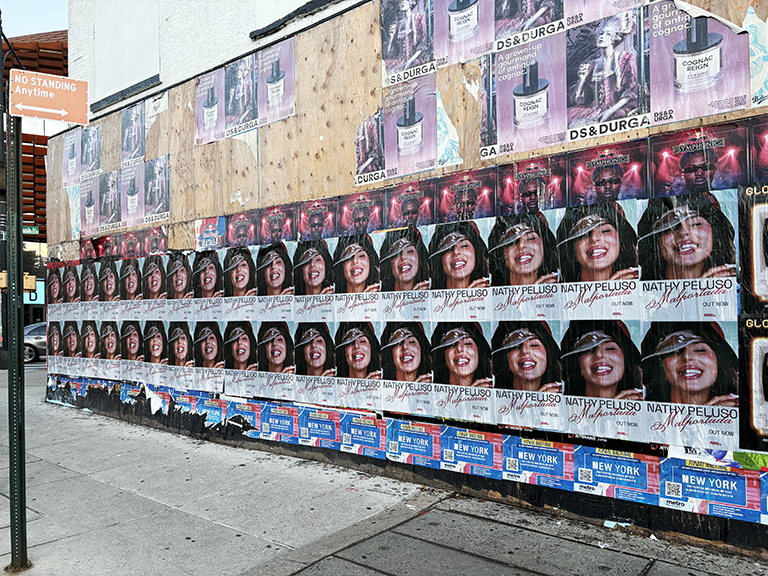
Traditional out-of-home advertising and guerrilla marketing are not competing channels. They are complementary formats that handle different jobs within a campaign, and the brands that understand that distinction consistently build campaigns with more complete market presence than those that choose one approach or the other.
OOH handles scale. A billboard at a major intersection, a transit shelter campaign in a dense urban corridor, or a digital screen buy in a high-traffic venue creates broad visibility across a media market. Guerrilla marketing handles depth. A wheatpaste wave in a target neighborhood, a sidewalk stencil run from a transit stop to a retail location, or a street team working a cultural event creates textured, direct presence in the specific places where the audience actually is. Those are genuinely different functions, and campaigns that use both create something neither format can produce independently: the sensation of full-environment brand presence.
Our team works across the guerrilla side of this combination from Industry City in Brooklyn, NY, planning and deploying street-level activations across 50-plus markets. What follows is a practical breakdown of how OOH and guerrilla marketing work together and when each approach should carry more of the campaign weight.
What OOH and Guerrilla Marketing Are Each Good At
The most useful starting point for integrating OOH and guerrilla marketing is understanding what each format is actually designed to do well. Treating them as interchangeable or assuming they compete for the same function leads to misallocation. They do different work.
What OOH Does Well
Traditional OOH creates broad, consistent visibility across a media market. A billboard in a high-traffic location builds brand impressions at scale with guaranteed placement in a known inventory position. Transit campaigns create frequency by reaching the same commuter audience repeatedly across a campaign window. Digital OOH in premium environments (airports, arenas, shopping centers) creates contextual relevance based on audience mode. OOH is predictable, inventory-based, and built for awareness at market scale.
What Guerrilla Marketing Does Well
Guerrilla marketing creates local depth, cultural texture, and direct physical presence that OOH cannot replicate. A wheatpaste poster wave in a specific neighborhood creates the sensation that the brand lives there, not just that it is advertising there. A street team creates direct human contact. A projection activation creates a one-night spectacle that generates organic social spread. Guerrilla marketing is flexible, deployable on short timelines, and built for concentrated local presence.
How the Two Formats Create More Together
The combination works because OOH and guerrilla marketing reach the same audience through different modes of contact. OOH reaches the audience at a distance, from a car, from across the street, from a platform. Guerrilla marketing reaches the audience at street level, in the neighborhoods where they walk, at the events they attend, from the ground they stand on. Both contacts are real. Together they create more complete market coverage than either achieves alone.
OOH Creates Legitimacy; Guerrilla Creates Texture
One of the less-discussed benefits of OOH is that it signals investment. A brand that can afford a Times Square digital buy or a transit shelter campaign across a market is perceived as established and credible. Guerrilla marketing creates a different kind of credibility: cultural belonging. A brand that shows up on the walls of the neighborhood the audience calls home feels like it is actually part of that world, not just advertising into it. The combination creates both institutional legitimacy and local authenticity simultaneously.
OOH Announces; Guerrilla Converts
For product launches and event campaigns, OOH can handle the broad announcement: the product exists, the event is happening, the brand is in market. Guerrilla marketing can handle the conversion layer: directional stencils toward a launch location, street teams at relevant event corridors, sidewalk decals at retail entry points. The OOH creates awareness at market scale. The guerrilla elements create the physical environment that converts that awareness to action at street level.
Campaign Structures That Integrate OOH and Guerrilla Effectively
The most effective integrated structures we have seen share a common architecture: OOH handles the broad market presence layer while guerrilla handles the neighborhood depth layer. The two layers are designed to complement each other rather than duplicate each other.
The National-to-Local Structure
For campaigns launching across multiple markets, OOH at the national or major-market level creates the broad presence layer, while guerrilla activations in priority neighborhoods within each market create the depth layer. A national launch might run transit and billboard OOH across ten markets while running guerrilla activations in the two or three neighborhoods per market where the target customer is most concentrated. The national OOH creates market-wide awareness. The local guerrilla work creates neighborhood-specific presence that the OOH cannot deliver at that scale.
The Event-Anchor Structure
For event-anchored campaigns, OOH around the venue and in the broader market creates the awareness and anticipation layer before the event. Guerrilla activations in the event footprint, at nearby transit stops, and along the audience arrival routes create the experiential layer during the event itself. The combination ensures the campaign reaches both the audience that could not attend (via OOH) and the audience that is physically present (via guerrilla activation).
The Launch-Sequence Structure
For product launches, a teaser period anchored in guerrilla street placements creates anticipation and cultural presence before the official launch. OOH placements that deploy on or just before launch day create the broad market announcement. Post-launch guerrilla activations at retail locations and event venues convert the announced interest into direct engagement. The three phases use different formats for different phases of the audience decision journey.
Budget Allocation Between OOH and Guerrilla
There is no universal ratio for OOH versus guerrilla budget allocation because the right split depends entirely on the campaign goal, the market type, and the audience distribution. A few general principles do apply consistently.
When the primary goal is broad market awareness across a large geography, OOH typically carries the larger budget share because it covers the most audience ground per dollar at scale. When the primary goal is hyperlocal presence in a specific neighborhood or around a specific event, guerrilla marketing typically carries the larger share because it creates the concentrated, high-quality contact that OOH at that scale cannot achieve. When the goal is both broad awareness and neighborhood depth, a split in the range of 50-60% OOH and 40-50% guerrilla is a reasonable starting point to model before the specifics of the market and format choices are worked through.
Timing the Integration for Maximum Effect
The timing relationship between OOH and guerrilla placements matters. In most integrated campaigns, OOH should be in market before the guerrilla elements deploy so the broad awareness layer is already established when the street-level work creates the neighborhood depth. When guerrilla activations appear in markets before any OOH awareness has been built, the guerrilla elements carry the full brand introduction burden, which they are not designed for at scale.
For campaigns where guerrilla activations are centered on a specific event or launch date, the OOH campaign typically needs two to four weeks of lead time before the event to build the awareness layer, while guerrilla activations deploy in the week of or the days leading up to the event to create the concentrated presence at the moment of maximum relevance.
Creative Strategy Across OOH and Guerrilla Formats
When OOH and guerrilla marketing run together, the creative strategy needs to account for how each format type communicates differently to the audience. OOH creative is designed to work at distance, often from a moving vehicle or across a street, where reading time is measured in one to three seconds. Guerrilla marketing creative is designed to work at street level, where the audience is on foot, closer to the installation, and has a few more seconds of engagement time if the piece is interesting enough to hold attention.
This means the two formats do not need to use identical creative. They need to use creatively consistent materials that acknowledge the different communication constraints of each context. A billboard can carry a brand mark and a single bold message. A wheatpaste poster in a neighborhood can carry that same brand mark with slightly more contextual information and a QR code response element. The brand is unified. The creative format adapts to the medium.
Avoiding Creative Collision
One risk in integrated OOH-plus-guerrilla campaigns is creative collision: when the OOH and guerrilla creative are too similar, they create redundancy rather than reinforcement. A billboard that says the same thing as the wheatpaste poster in the same neighborhood just below it is not creating a layered campaign. It is creating a repeated single message through two different formats. Stronger integration uses the formats to say related but distinct things: the OOH announces at scale, the guerrilla material contextualizes or extends at street level, and the combination creates a more complete message than either carries alone.
Media Buying and Guerrilla Planning on a Shared Timeline
Integrating OOH and guerrilla marketing effectively requires coordinating two different planning processes that run on different timelines and involve different vendor relationships. OOH media buying typically requires four to eight weeks of lead time for standard inventory, with premium inventory often booked further in advance. Guerrilla marketing planning requires a comparable or shorter timeline for simpler formats, but complex activations with multiple markets and large street team components can require as much planning time as the OOH buy.
The coordination challenge arises when one component is planned in isolation and then the other is added later as an afterthought. OOH campaigns that add guerrilla elements at the last minute typically cannot complete the scouting, permitting, and production processes needed for quality execution. Guerrilla campaigns that discover the OOH buy is already locked cannot adjust their street-level creative to complement the OOH messaging because the OOH creative has already been finalized. Integrated campaigns require integrated planning from the brief stage, not coordination between two separately planned executions.
Market-by-Market Integration Planning
For multi-market campaigns, the OOH-plus-guerrilla integration may look different in each market based on the OOH inventory available in that market, the walkability and street culture of the city, and the specific neighborhood concentration of the target audience. A campaign that uses transit shelter OOH and a wheatpaste wave in New York may use billboard OOH and a street team activation in Los Angeles and use digital OOH at a convention center combined with conference-adjacent guerrilla work in Austin.
The unifying principle across all markets is the campaign architecture: OOH handles broad reach, guerrilla handles local depth. The specific formats within each layer adapt to what is available and effective in each specific market. This market-adaptive approach produces better results than mandating identical format combinations in every market regardless of how well those specific formats fit each market’s media environment and audience behavior.
Market-Specific Guerrilla Briefing
When running integrated campaigns across multiple markets, providing market-specific guerrilla briefs rather than a single brief for all markets ensures that the street-level planning accounts for the specific neighborhood dynamics, permit environments, and pedestrian patterns that differ from city to city. A brief that works for Manhattan does not work as written for Houston. Market-specific briefing is more work upfront but produces significantly better execution quality in each individual market.
Measurement Across OOH and Guerrilla Components
Measuring an integrated OOH-plus-guerrilla campaign requires distinct approaches for each component because the formats produce different types of measurable evidence.
OOH measurement typically relies on media vendor impression data (which is based on traffic counts and panel ratings), campaign recall studies if the budget supports them, and any branded search or direct traffic lift in the markets where OOH ran. These metrics are well-established and familiar to media planning teams.
Guerrilla marketing measurement uses a different framework: direct response data (QR scans, URL visits, offer redemptions), campaign documentation (GPS-verified photo packages, route maps), and market lift signals in the specific neighborhood geographies where the guerrilla elements ran. When both components are running simultaneously, the guerrilla direct response data provides more granular audience behavior evidence than the OOH impression counts, while the OOH data provides the market-scale context that guerrilla metrics alone do not cover.
Attributing Results in an Integrated Campaign
Clean attribution in an integrated campaign requires distinguishing the response channels each format produces. OOH-generated traffic arriving through branded search should be identifiable from the market and timing of the OOH flight. Guerrilla-generated traffic arriving through campaign QR codes and vanity URLs is clearly attributable to the street-level component. When both are running in the same market simultaneously, any traffic or conversion lift above the sum of the attributed channels likely reflects the compounding effect of the combined presence, which is itself a useful measurement of the integration value.
Stakeholder Communication About the Combined Strategy
One practical advantage of combining OOH and guerrilla marketing is the stakeholder communication value of the combination itself. OOH placements are familiar to most marketing leadership teams and comfortable in a media plan because the format is established, the metrics are well-understood, and the inventory is bought through recognized channels. Guerrilla marketing sometimes requires more explanation for leadership teams that are less familiar with street-level formats and less comfortable with the measurement differences.
An integrated campaign gives the team a way to introduce guerrilla marketing to conservative stakeholders in a context where it is positioned as a complement to the familiar OOH investment rather than a replacement for it. Leadership teams that would hesitate to approve a guerrilla-only campaign often approve the same guerrilla budget when it is framed as the neighborhood-depth layer of a campaign that also includes OOH. Once the guerrilla component produces documented results, the case for future guerrilla investment stands on its own evidence rather than requiring the familiar OOH context to make it credible.
How Guerrilla Marketing Extends OOH’s Reach Into the Street
OOH reaches the audience at the scale of the market. Guerrilla marketing reaches the audience at the scale of the block. The combination is not redundant. It is a zooming-in from market-scale visibility to block-level presence that creates the sense of complete brand immersion.
A campaign that runs OOH across a major transit corridor and then runs guerrilla marketing in the neighborhoods at each end of that corridor creates a presence that follows the audience from their commute to their doorstep. Each format handles the geography it was designed for. Together they cover the full audience journey through the market in a way that neither format can manage alone.
How the Two Formats Document Differently
OOH and guerrilla marketing produce different types of campaign documentation, and both types have value in the post-campaign reporting package. OOH campaigns are documented through vendor affidavits and proof-of-posting photographs that the media vendor provides as part of the buy. These documents confirm the placement ran at the contracted location for the contracted duration. They are standardized and familiar to media planning and finance teams.
Guerrilla marketing campaigns are documented through GPS-verified photography by the installation crew, route maps showing placement geography, timestamped installation records, and supplementary social documentation when the campaign generates organic sharing. Our team provides a complete documentation package with every deployment. This documentation serves the same proof-of-performance function as OOH vendor affidavits but is built from field-generated records rather than vendor-provided confirmation. Combined, the two documentation types create a complete audit trail for the full outdoor campaign investment.
Case for Integration in Annual Campaign Planning
Brands that run OOH and guerrilla marketing as separate annual line items in separate planning processes often underperform the potential of both because the formats are never genuinely coordinated. The OOH buy happens in one planning cycle, the guerrilla activation happens in another, and neither is designed with the other in mind. The result is two campaigns that run near each other in time without creating the combined effect that genuine integration produces.
The more effective planning structure treats OOH and guerrilla as a unified outdoor strategy with a single brief, a single objective, and a single measurement framework that covers both components. That structure allows the creative, timing, market, and measurement decisions to be made with both formats in mind from the start. It also simplifies internal reporting because the outdoor campaign performs as one integrated unit rather than as two separate line items competing for credit on the same business outcome.
Budget Efficiency Through Integration
Integrated planning often produces budget efficiency gains because duplicated functions can be eliminated. A single creative development process produces assets for both formats rather than two separate development tracks. A single location scouting process covers both OOH research and guerrilla location assessment in the same neighborhoods. A single measurement framework tracks outcomes from both components rather than maintaining two separate reporting systems. The operational overhead of two parallel planning processes is real, and consolidating them into a unified outdoor campaign planning approach typically reduces it significantly.
Frequently Asked Questions
What is the difference between OOH and guerrilla marketing?
OOH refers to paid placements in established media inventory: billboards, transit shelter ads, digital screens in airports and arenas. Guerrilla marketing uses non-traditional, often temporary street-level formats like wheatpaste posters, sidewalk stencils, street teams, and pop-up activations that are not in standard media buying inventory. OOH is purchased through media channels. Guerrilla marketing is planned and executed through specialist agencies.
Why do the best campaigns use both OOH and guerrilla marketing?
OOH handles broad visibility at distance and scale. Guerrilla marketing handles local pressure, texture, and direct audience contact at street level. Together they create a layered market presence that neither format achieves alone. The combination produces higher recall, stronger neighborhood saturation, and more complete market coverage than either format running independently.
When should a brand prioritize OOH over guerrilla marketing?
OOH is the priority when the primary goal is broad market awareness at scale, when the campaign needs guaranteed placement in high-visibility inventory, when the audience is distributed broadly enough that hyperlocal formats would miss a significant portion of the target, or when the brand has the budget to purchase premium paid positions.
When should a brand prioritize guerrilla marketing over OOH?
Guerrilla marketing is the priority when the goal is hyperlocal neighborhood presence, when the campaign needs to feel culturally native to a specific community, when the budget does not support premium paid inventory, when the timeline requires rapid deployment, or when the brand specifically wants formats that create earned spread and organic social documentation.
How do brands split budget between OOH and guerrilla marketing?
Budget allocation depends on the campaign goal and audience geography. A national launch might allocate 60-70% to OOH for broad market reach and 30-40% to guerrilla for neighborhood-level depth in priority markets. A hyperlocal campaign for a single market might invert that ratio. The allocation should follow the campaign objective rather than a default formula.
Can guerrilla marketing placements be bought through standard OOH channels?
No. Guerrilla marketing formats are not part of standard OOH media inventory. They are planned and executed through specialist agencies that handle location research, permit management, creative production, crew deployment, and campaign documentation. Brands that want both OOH and guerrilla components typically work with their media agency for OOH buys and a guerrilla marketing specialist for the street-level activation.