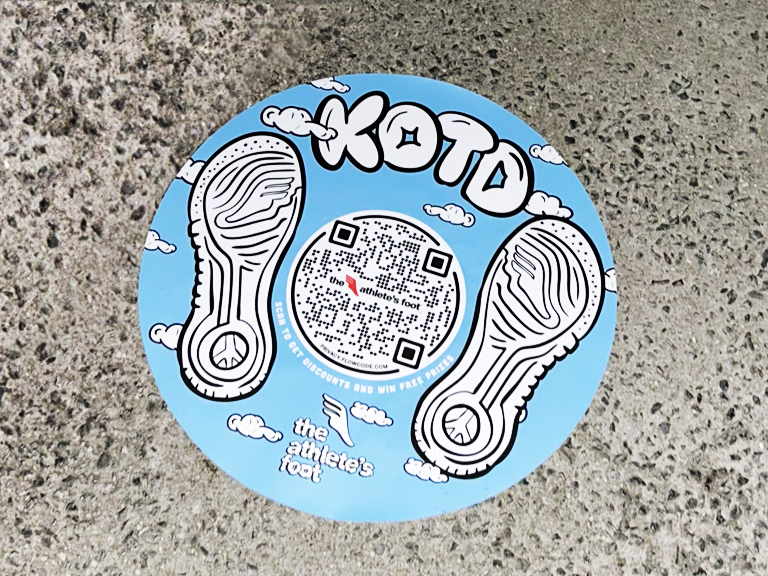
Most outdoor advertising occupies vertical space — walls, billboards, transit shelters. Sidewalk decal advertising occupies a different visual plane entirely: the ground, where pedestrians look constantly without expecting to find advertising. That unexpectedness is the source of the format’s effectiveness. When someone looks down and finds your brand where they weren’t expecting it, the encounter registers more strongly than the background noise of vertical advertising they’ve trained themselves to ignore.
Sidewalk advertising has been used across entertainment launches, retail campaigns, event marketing, product introductions, and brand awareness campaigns. This guide covers the real-world applications and campaign types that perform best, the creative principles that make sidewalk campaigns land, and how our team executes them across 50+ U.S. markets with GPS documentation of every placement.
What Sidewalk Decal Advertising Actually Is
The term covers several distinct format types, each with different characteristics, legal considerations, and performance profiles:
Chalk-Based Stencil Campaigns
Chalk-based applications use stencils and chalk paint or chalk powder to create brand imagery directly on sidewalk surfaces. The material is water-soluble and fully temporary — it washes away with rain or cleaning and leaves no permanent mark. This is the most broadly legal format, permissible on public sidewalks in most major U.S. cities without requiring surface permits.
Chalk campaigns are ideal for short-duration, high-impact moments: a product launch week, a conference perimeter campaign, an event approach corridor, or any situation where the goal is intense presence over a brief defined window. The temporary nature is a feature, not a limitation — it creates a now-or-miss-it quality that can reinforce limited-time campaign messaging.
Water-Soluble Paint Stencils
Water-soluble paint stencil campaigns use removable paint through pre-cut stencils to create higher-resolution imagery than chalk applications allow. The materials are still temporary — they wash off with rain — but the visual quality is sharper and holds better in foot traffic conditions. These campaigns work well in commercial environments where visual clarity matters and the pedestrian load is high.
Our sidewalk stencil campaigns primarily use water-soluble paint applications for the combination of visual quality and removability that clients and property owners both require.
Removable Adhesive Decals
Removable adhesive decals are pre-printed vinyl or paper-based materials applied to surfaces with removable adhesive. They offer the highest print quality of any horizontal advertising format and can include photography, complex graphics, and QR codes that photo-based stencils can’t reproduce. They require surface owner permission and are most commonly used on private property — retail floors, hotel lobbies, event venues, plazas under private management.
For brands that need exhibition-quality visuals on horizontal surfaces — retail launches, branded pop-up floors, event activations at venues — removable adhesive decals are the right format. We work with decal production partners who specialize in materials that apply cleanly and remove without surface damage.
Sidewalk Decal Advertising: Real Campaign Types and Examples
Event Approach Corridors
One of the highest-performing applications for sidewalk advertising is the event approach corridor — the pedestrian path between transit entry points and event venue entrances. Every attendee walks this corridor, often multiple times per event day. A sidewalk campaign covering the approach creates guaranteed impressions with the entire event audience in the exact moment they’re moving toward the event.
For a concert with 5,000 attendees at a venue with a single primary approach from the nearest subway station, a sidewalk campaign covering three blocks of that approach reaches every attendee at least twice per day. The frequency and targeting precision are better than nearly any alternative format at comparable cost.
Campaign elements that work well in approach corridors: directional arrows that guide attendees toward a brand interaction, countdown messaging that reinforces event urgency, teaser creative that builds on wall-based campaign elements visible at the same time.
Trade Show and Conference Floor Approaches
Convention centers with controlled entry flows create ideal sidewalk advertising environments. The corridors between parking, transit, and convention hall entrances funnel thousands of verified buyers through defined paths on defined schedules. A sidewalk campaign at a major trade show approach reaches the exact audience that would cost significantly more to reach through official show sponsorship packages.
Trade show sidewalk campaigns work particularly well paired with street team activations at the same corridors — ambassadors who engage with attendees who notice the sidewalk campaign create a second brand impression that reinforces the first and adds personal contact to the passive visual encounter.
Retail and Commercial District Campaigns
Retail-adjacent sidewalk campaigns target the pedestrian traffic in commercial shopping corridors — the foot traffic that’s already in a purchase mindset. Campaigns positioned near retail entry points or along the primary pedestrian flow of a shopping district create brand encounters in the moment that’s most likely to influence purchasing behavior.
For retail launch campaigns, a combined sidewalk and vertical poster campaign covering the same commercial corridor creates an immersive multi-plane brand environment that generates significantly more attention than either format alone. The horizontal component surprises people who have learned to filter vertical advertising; the vertical component catches people at eye level when they look up from the sidewalk campaign.
Campus and University Campaigns
University campuses concentrate the 18-to-24-year-old demographic in high-density pedestrian environments — exactly the audience that many consumer brands, streaming services, and lifestyle products most want to reach. Campus walkways between class buildings, the paths around student union buildings, and the approaches to high-attendance campus events are premium sidewalk advertising locations for brands targeting this demographic.
Many campuses operate through approved vendor relationships for advertising applications. Our team navigates campus permit requirements and works with campus administration to identify approved locations and application methods.
Marathon and Race Approach Campaigns
Running events concentrate athletic demographics in defined geographic corridors on specific dates. A sidewalk campaign along the race route or at the approach to the start area reaches runners and spectators with a captive, defined audience profile. Sports nutrition, apparel, footwear, and fitness brands frequently use race-adjacent sidewalk campaigns to reach verified athletic consumers in a context directly relevant to their product category.
Streaming and Entertainment Launch Campaigns
Entertainment brands use sidewalk campaigns to extend poster campaign presence to horizontal surfaces in the same neighborhoods. When a streaming platform is running a major launch campaign with vertical poster coverage in a neighborhood, adding sidewalk stencils at key pedestrian intersections in the same area creates the “everywhere at once” effect that signals the launch is a major cultural event.
Creative Principles for Effective Sidewalk Advertising
Design for the Ground Plane
Effective sidewalk creative is designed specifically for horizontal reading — not vertical designs rotated 90 degrees. People read ground-level content at a different angle, with different movement speed and different visual field. Type must be significantly larger than vertical applications to be readable at walking speed. Images that work at distance on a wall may read better as close-up detail on a sidewalk surface.
Use Directional Elements
Sidewalk advertising’s native advantage is its proximity to foot traffic direction. Directional arrows, footprint graphics, path-following elements, and wayfinding-style creative leverage the format’s ground-level position to guide pedestrian attention rather than just interrupt it. Campaigns that lead people toward a brand destination — a store entrance, a street team interaction point, an event space — perform consistently better than purely decorative ground campaigns.
Integrate QR Codes
Sidewalk advertising is one of the ideal environments for QR codes: pedestrians are stationary or slow-moving at the moment they encounter the campaign, their phone is typically in hand or pocket, and the act of looking down puts the phone in the right position for camera scanning. A high-contrast QR code linking to a campaign landing page converts passive impressions into measurable digital interactions with attribution data.
Create Urgency or Curiosity
Sidewalk campaigns that create a reason for continued attention — a question that demands an answer, a partial image that requires context, a countdown that demands follow-up — outperform campaigns that communicate a complete message and release the pedestrian’s attention. The sidewalk encounter is a beginning; effective creative uses it to initiate a sequence that drives the next step.
Executing a Sidewalk Advertising Campaign: Logistics and Process
The operational requirements for a sidewalk advertising campaign differ from vertical poster campaigns in ways that affect planning, crew requirements, and documentation. Here is how a professional sidewalk advertising campaign runs from brief to completion:
Location Assessment and Permit Coordination
Before any sidewalk advertising campaign launches, every target location requires assessment for surface type, material compatibility, traffic volume, and regulatory status. Concrete, asphalt, and paved brick surfaces have different adhesion properties that affect material and application method selection. High-traffic surfaces experience faster wear from foot abrasion. Regulatory status — public sidewalk vs. private plaza vs. permitted posting zone — determines which application methods are allowable.
For campaigns in business improvement district (BID) areas, special permit considerations often apply separately from city regulations. BIDs manage the sidewalk maintenance and appearance standards in their districts and may have specific approval processes for temporary advertising applications. Our team coordinates BID permit requirements in every market where they’re relevant before campaign installation begins.
Stencil Production
The quality of the stencil directly determines the quality of the applied result. Professional stencils for sidewalk campaigns are laser-cut from durable materials that maintain edge precision through multiple applications. Poorly produced stencils — hand-cut from thin material, with imprecise edge cuts — produce blurry, inconsistent results that communicate low production quality regardless of the campaign’s creative intent.
For complex designs or campaigns covering multiple markets, we coordinate stencil production with professional fabrication partners who specialize in large-format stencil production. Multiple identical stencils allow simultaneous multi-location application without quality variation across locations.
Crew and Application Process
Sidewalk stencil application crews typically operate in two-person teams: one person positioning and holding the stencil, one person applying paint with consistent pressure and overlap to ensure uniform coverage. Application consistency is the biggest quality variable in sidewalk campaigns — paint that’s applied too heavily bleeds under the stencil edges, and paint applied too lightly produces faded, inconsistent coverage.
Crew briefing for sidewalk campaigns covers: application technique for the specific surface types being used, paint concentration calibration for the conditions (temperature and humidity affect paint flow behavior), stencil positioning relative to the pedestrian flow direction, and documentation protocol for each installation.
Documentation and Removal Verification
Every sidewalk placement receives GPS-tagged photo documentation at installation. For campaigns using water-soluble materials that wash away naturally, documentation captures the installation quality before weathering begins. For campaigns where removal within a defined timeframe is required by property owner agreements, we provide removal verification documentation confirming the surface has been restored to pre-installation condition.
Sidewalk Advertising Performance Metrics
Sidewalk advertising is measurable through several approaches that provide meaningful performance data:
Physical Impression Estimation
Foot traffic data providers (Placer.ai, Foursquare, and similar) offer pedestrian count data at the location level for major urban markets. Applying foot traffic counts to documented placement locations and multiplying by campaign duration days produces an estimated impression count that can be compared against other media on a CPM basis. Sidewalk advertising CPMs in major urban markets typically run $5 to $25 per thousand impressions depending on location quality and traffic volume.
Direct Response Tracking
QR codes integrated into sidewalk stencil designs provide direct response attribution. The unique scan rate of sidewalk QR codes is often higher than vertical advertising QR codes because pedestrians are already looking in the right direction (down) and moving at a pace that allows camera use more easily than vertical scanning requires. High-contrast QR codes with adequate surrounding white space consistently achieve the highest scan rates in outdoor sidewalk applications.
Event-Specific Attribution
For campaigns at events with defined entry flows — conference approach corridors, concert venue entrances, festival transit points — the total event attendance number provides a denominator for impression estimation. Every attendee who passes through the decorated corridor has encountered the campaign. Comparing the cost of the sidewalk placement against the per-attendee rate for official event sponsorship formats demonstrates the cost efficiency of the guerrilla alternative.
Legal and Regulatory Considerations
Sidewalk advertising regulations vary significantly by city and surface type. Our team knows the regulatory landscape in every market we operate and advises clients on appropriate formats for each location.
General principles that apply across most markets:
- Water-soluble and chalk-based applications on public sidewalks are permissible in most major U.S. cities without additional permits
- Permanent or semi-permanent adhesive materials on public sidewalks require city permits and are subject to more restrictive regulation
- Private property applications require property owner permission regardless of material type
- Business improvement districts and private plazas have their own rules separate from city regulations
We handle all permit and compliance requirements for every market we work in. Clients don’t need to navigate city-specific regulations independently.
Sidewalk Advertising at Scale: Multi-City Coordination
For brands running sidewalk advertising campaigns across multiple markets simultaneously — national product launches, touring events, multi-city brand activations — the operational challenge is maintaining consistent execution quality and documentation standards across cities where different crews are working in different regulatory environments with different surface types and pedestrian traffic patterns.
Our multi-city sidewalk campaign model applies centralized coordination to key quality variables: standardized stencil sets are produced from a single master file and distributed to all market crews before the installation date, ensuring visual consistency across cities. Documentation protocols are standardized so the report format from Chicago is identical to the report format from Los Angeles and New York. Creative compatibility review happens at the campaign level rather than market by market, catching any specification issues before they affect installation quality in any market.
For campaigns where the sidewalk installation is one component of a multi-tactic national rollout — paired with vertical poster campaigns, street team activations, or mobile LED trucks in the same markets — we coordinate the full tactical mix from a single project management structure. This reduces the communication overhead of managing separate vendor relationships for each tactic and ensures that timing, creative, and documentation are consistent across the full campaign rather than fragmented across multiple vendor timelines.
Integrating Sidewalk Campaigns with Other Street-Level Tactics
- Wheatpaste poster campaigns on vertical surfaces in the same neighborhoods for multi-plane immersive coverage
- Street team activations at the highest-traffic sidewalk campaign locations to convert passive impressions to active brand encounters
- Mobile LED billboard trucks routing through campaign corridors to add moving-media presence alongside the static horizontal campaign
- Integrated guerrilla campaign strategy combining multiple formats for launch events and major brand moments
Frequently Asked Questions
What is sidewalk decal advertising?
Sidewalk decal advertising uses temporary adhesive decals or water-based paint stencils applied to sidewalk, plaza, and other horizontal surfaces to create brand impressions at the ground level. The format reaches pedestrians in a visual angle that vertical advertising doesn’t occupy, creating genuine novelty and attention in high-foot-traffic environments.
Is sidewalk decal advertising legal?
Sidewalk advertising legality varies by city and surface type. Removable chalk-based or water-soluble materials are legal in most major U.S. cities on public sidewalks. Permanent adhesive decals require property owner permission and may have city-specific regulatory considerations. AGM navigates these requirements in every market we operate and advises on the appropriate format for each location.
What are the best use cases for sidewalk decal campaigns?
High-foot-traffic events (concerts, trade shows, marathons, festivals), subway and transit entry points, retail and commercial district pedestrian corridors, college campuses, and any environment where pedestrians are looking down and forward while moving are ideal for sidewalk decal campaigns.
How long do sidewalk decals last?
Chalk-based and water-soluble stencil applications typically last seven to fourteen days outdoors, depending on weather and foot traffic. Permanent adhesive decals on private surfaces can last months. We recommend format selection based on campaign duration requirements and surface type.
What does a sidewalk decal campaign cost?
Single-city sidewalk decal campaigns typically run between $2,000 and $10,000 depending on the number of locations, surface size, and application method. We provide itemized quotes based on your specific campaign brief.
Can sidewalk advertising work alongside other guerrilla marketing tactics?
Yes. Sidewalk campaigns pair particularly well with vertical poster campaigns (covering horizontal and vertical surfaces simultaneously), street team activations at the same locations, and mobile LED trucks routing through the same corridors. The combination creates immersive coverage that single-format campaigns can’t achieve.