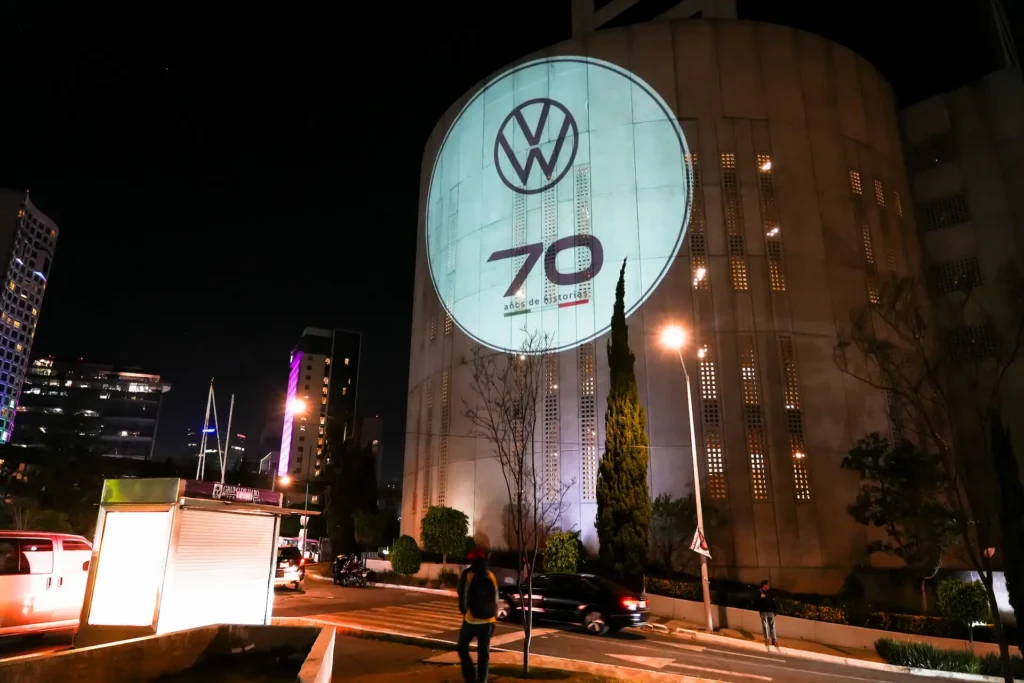
Tlatelolco is unlike any other projection market in Mexico City. The combination of pre-Columbian ruins, a 16th century colonial church, and a massive 1960s modernist housing complex existing simultaneously on a single plaza — the Plaza de las Tres Culturas — produces an environment where the concept of projection advertising becomes something almost archaeological. You are not projecting onto a blank wall. You are projecting onto layers of Mexican history that span three civilizations and five centuries.
Beyond the philosophical dimension, Tlatelolco is practically significant for projection work because of what it offers as a technical canvas. The Nonoalco-Tlatelolco housing complex, designed by Mario Pani and built in the 1960s, consists of massive concrete residential towers with blank panel facades of a scale that residential buildings in other colonias simply do not provide. We are talking about projection surfaces measuring fifteen to twenty meters wide and extending twelve or more stories tall. These are among the largest available projection canvases anywhere in Mexico City.
AGM has worked in Tlatelolco for campaigns targeting the colonia’s dense urban population and for clients that specifically want the visual and cultural association of projection work in one of the city’s most historically weighted locations. This guide explains what makes Tlatelolco distinct, how the building stock functions as a projection environment, and how campaign strategy differs here from the more commonly discussed central and southern colonias.
Plaza de las Tres Culturas: Three Civilizations in One Space
The Plaza de las Tres Culturas is Mexico City’s most concentrated expression of its layered history. On a single piece of ground, you can stand among the excavated ruins of the Aztec marketplace of Tlatelolco — one of the largest commercial centers in pre-Columbian America — face the Santiago de Tlatelolco church built by the Spanish in the 16th century on top of those ruins, and look up at the modernist concrete residential towers of the Nonoalco-Tlatelolco complex completed in 1965. Three eras of Mexican civilization, stacked on the same few acres of ground.
The Aztec ruins at the plaza are among the most extensively excavated in Mexico City. The ceremonial center of ancient Tlatelolco, with its pyramid platforms and temple foundations, is preserved in place and visible at the plaza level. The Santiago de Tlatelolco church, completed in 1609, is one of the oldest churches in Mexico City and has served the community continuously since the colonial period. The Nonoalco towers loom behind both.
The 1968 Massacre and Mexico’s Unresolved Memory
The Plaza de las Tres Culturas is inseparable from the events of October 2, 1968, when soldiers and plainclothes officers surrounded a student demonstration and opened fire just ten days before the Mexico City Olympics opened. The number of dead has never been officially confirmed — estimates have ranged from dozens into the hundreds, and the government suppressed information about the event for years. What Mexicans understood privately was far larger than what was publicly acknowledged. The massacre at Tlatelolco entered Mexican political consciousness not as a historical event that resolved and closed but as an open wound that has remained active across generations.
That quality has never fully healed. Each October 2nd, tens of thousands march from Tlatelolco through the city center to the Zócalo — a march that has been happening continuously for decades and remains one of the largest recurring political demonstrations in Mexico. The memorial plaques at the plaza, the Altar de la Demanda, and the Memorial del 68 inside the foreign ministry complex are maintained and visited year-round. The Centro Cultural Universitario Tlatelolco houses a permanent exhibition documenting the massacre, the student movement of 1968, and its long aftermath, drawing student groups, researchers, and anyone working through what happened. The plaza is not a passive historical site. It is a place where Mexican political memory is actively rehearsed and renewed.
When a brand or campaign projects onto the buildings of the Plaza de las Tres Culturas, it is projecting into a space where this history is not background decoration but active collective memory. The people who live in the Nonoalco towers — residents who have watched October 2nd marches from their windows for thirty or forty years, or whose parents did — bring that context with them when they see a projected image on their building’s facade. Content that is trivial, careless, or poorly considered lands differently in this space than it would on a blank wall in a commercial district with no history. The visual message acquires a gravity that it simply does not carry elsewhere in the city.
For the right campaign, that gravity works in your favor. Social causes that speak to justice, accountability, or memory find a resonant frequency in Tlatelolco that is not accessible anywhere else in CDMX. Cultural institutions, civic organizations, and brands that want a genuine connection to the history of Mexican political life — not as exploitation but as honest acknowledgment — can use the plaza as a platform that carries real meaning. Brands projecting here are projecting onto one of the most historically charged public spaces in Latin America. That distinction is either a burden or an advantage depending entirely on whether the campaign was designed with that knowledge.
The Nonoalco-Tlatelolco complex designed by Mario Pani was at the time of its construction one of the largest public housing projects in Latin America, housing approximately 100,000 residents in 102 buildings across 1 square kilometer of urban land.
The Nonoalco-Tlatelolco Housing Complex: A Brutalist Projection Canvas
Mario Pani’s Nonoalco-Tlatelolco complex was a product of the same modernist urban planning ambitions that were reshaping cities across the world in the 1950s and 1960s. The vision was totalized: a self-contained residential neighborhood with schools, shops, cultural facilities, and public space all integrated into a single mega-development. The architecture reflects this ambition — massive, repetitive, authoritative concrete towers arranged on a superblock grid with open plazas between them.
For projection advertising, this architectural vocabulary creates specific opportunities. The towers’ blank concrete panel facades — the sections of wall between window bands — are often 15 to 25 meters wide and extend for many floors without interruption. These are not the narrow party walls of a Del Valle apartment building or the irregular stone faces of a San Ángel colonial structure. They are enormous, smooth, engineered surfaces that were designed to be functional first and aesthetic second. Under projection light, they become something else entirely.
Concrete Surface Characteristics
Raw concrete and painted concrete behave differently under projection. The Nonoalco towers have a mix of both, depending on which building and which face. Raw or lightly finished concrete scatters light slightly more than smooth painted stucco, which reduces apparent brightness at a given lumen output. But the visual texture it creates — the slight grain and depth of the concrete surface reading through the projected image — gives the result a material quality that is distinctive and powerful. In the right conditions, that grain reads as almost cinematic: the projected image seems embedded in the building rather than painted onto it.
Painted concrete in lighter colors (many of the towers have been painted over the years in cream, off-white, or pale gray) reflects projection content cleanly and produces high image fidelity. Our surface scouting in the Nonoalco complex prioritizes light-painted faces on the lower towers around the plaza perimeter, where throw distances are manageable and audience positioning is most favorable.
Window Pattern Rhythm and Compositional Grid
One specific quality of the Nonoalco towers that distinguishes them from generic large blank walls is the rhythm created by their window pattern. The towers were designed with a regular grid of window openings separated by solid concrete spandrel panels — the horizontal strips of wall running between floor levels. This grid is not random. It repeats at consistent intervals across the full face of each tower, creating a built-in compositional structure that skilled projection designers can work with rather than around.
Content that ignores the window grid treats the facade as a flat canvas and projects full bleed imagery that the window openings interrupt arbitrarily. Content designed around the grid uses the window rhythm as a framing element — placing graphic elements in the spandrel zones, letting the window bands act as horizontal dividers, building visual structure that the architecture reinforces. When this is done well, the building’s own geometry amplifies the projection instead of competing with it. The spandrel panels of the Nonoalco complex are typically one to two meters tall per floor, running the full width of the facade — enough surface area at each floor level to carry text, graphic elements, or clean color fields that read clearly from the plaza floor.
Scale as the Dominant Variable
The dominant factor in Tlatelolco projection planning is scale. In most CDMX colonias, the projection surface is sized to fit the building stock — residential-scale apartment buildings produce residential-scale projected images. In Tlatelolco, the buildings are the size of institutional structures. A full-face projection on one of the plaza-facing Nonoalco towers produces an image that is visible from the entire length of the plaza and beyond.
This scale requires a different approach to equipment selection. The projectors we use for a Del Valle apartment wall do not produce an image bright enough to fill a Nonoalco tower face at the throw distances the plaza geometry creates. Tlatelolco campaigns require higher-output equipment and more careful attention to throw ratio calculations.
Torre de Tlatelolco and the Secretaría de Relaciones Exteriores
The Torre de Tlatelolco — which houses the Secretaría de Relaciones Exteriores, Mexico’s foreign ministry — sits at the edge of the plaza complex on Ricardo Flores Magón. The tower is a significant modernist structure in its own right, but for projection planning its most relevant characteristic is the building mass it adds to the architectural environment of the plaza. Its surrounding streets see government worker traffic during business hours and a mixed population in the evening as the area transitions to residential activity.
The foreign ministry building’s presence in the area is a reminder that Tlatelolco serves multiple urban functions simultaneously — it is residential housing, historical site, government precinct, and working-class commercial zone all compressed into a relatively compact geography. Projection campaigns that understand this layered function can position themselves accordingly.
Avenida Ricardo Flores Magón, which runs through the Tlatelolco zone, connects to Avenida Reforma Norte — one of the key north-south corridors linking Tlatelolco to Tepito and the northern colonias, carrying significant daily pedestrian and vehicular traffic.
Proximity to Tepito: Working-Class Audiences and Commercial Energy
Tlatelolco sits immediately adjacent to Tepito, one of Mexico City’s most famous working-class markets and barrios — a dense commercial and residential area known throughout CDMX and beyond for its informal markets, its street culture, and its intense local identity. The Tepito market complex draws buyers from across the city and represents a massive commercial ecosystem operating largely outside formal retail channels.
For projection campaigns, the Tepito adjacency matters because it shapes the audience composition in Tlatelolco’s commercial zones. Residents and workers who live and operate in the Tepito-Tlatelolco corridor are predominantly working-class and lower-middle-class — a demographic that major consumer brands regularly want to reach but rarely address through targeted projection work. The assumption in most guerrilla advertising planning is that the desirable audience is in Roma or Condesa; the reality is that Mexico City’s largest consumer base by volume is in places like Tlatelolco.
The foot traffic pattern between Tepito and Tlatelolco runs primarily east-west along the streets connecting the two neighborhoods — Calle del Moctezuma, Gonzalez Ortega, and the pedestrian flows that funnel through the blocks east of the Nonoalco complex. Market buyers moving from Tepito’s tianguis toward the Metro Tlatelolco station pass through the edges of the Nonoalco complex during peak market hours. These are not tourists or office workers. They are residents and shoppers who live within a few kilometers of where they are standing, who shop in these markets regularly, and who are buying for households rather than collecting souvenirs. The consumer behavior in this corridor is practical, price-conscious, and brand-aware in a way that is specific to working-class Mexico City commercial culture.
Brands that project in the eastern blocks of Tlatelolco — the streets immediately adjacent to the Tepito boundary — tap into this market crowd flow at its highest density. The buildings in these transitional blocks are typically older, shorter, and have more conventional stucco facades than the Nonoalco towers proper, but the audience concentration on their streets during market hours more than compensates for the smaller surface scale. For consumer brands with broad distribution in Mexico’s traditional retail and tianguis channels, this is precisely the geographic and demographic overlap that makes Tlatelolco worth prioritizing over more culturally polished colonias.
Metro Stations and Pedestrian Flow
Tlatelolco is served by two Metro stations that drive significant pedestrian traffic through the zone. Metro Tlatelolco on Line 3 sits adjacent to the Plaza de las Tres Culturas itself, depositing riders directly into the colonia’s core. Metro Buenavista serves the Buenavista district immediately to the southwest, near the major rail and bus terminal of the same name.
Beyond that, the Tren Suburbano terminal at Buenavista is one of the busiest commuter rail stations in the metro area, drawing workers from the Estado de México and the northern CDMX suburbs into the city center daily. The pedestrian flow from Buenavista northward through the Tlatelolco zone represents a consistent and high-volume audience during morning and evening commute windows.
Station Exit Zones as Projection Anchors
The blocks surrounding Metro Tlatelolco and the Buenavista terminal are among the most reliable projection zones in the area. Station exits concentrate pedestrian traffic at specific points and at predictable times. The buildings on the blocks immediately surrounding these exits see the densest foot traffic in the zone, and the mix of older commercial buildings with large stucco facades in this area provides more conventional (and slightly easier to work with) surfaces than the large modernist towers deeper in the Nonoalco complex.
Mercado de Artesanías and Craft Tourism Traffic
The Mercado de Artesanías in the Tlatelolco area serves the local residential population as well as drawing buyers from across the northern CDMX colonias. This kind of traditional market generates concentrated pedestrian traffic on market days and contributes to the colonia’s commercial street character. The streets around the market — foot traffic from shoppers, vendors, and the continuous pedestrian flow connecting the market to the Metro stations — are projection zones where audience density is reliable and predictable.
The craft market also introduces a segment of visitor that the rest of Tlatelolco’s audience mix does not typically include: domestic and international tourists specifically seeking Mexican artisan goods. These buyers are different in profile from both the working-class Tepito market shopper and the Nonoalco residential neighbor. They arrived in the area deliberately, they are spending discretionary money on culturally identified products, and they tend to move slowly through the surrounding streets rather than commuting through. For brands with cultural or artisan positioning — or for any campaign that benefits from being seen by visitors engaged with authentic Mexican material culture — the craft market generates an audience segment that is difficult to access in other projection markets across the city.
The Mercado de Artesanías draw also extends the hours when the blocks around it carry meaningful pedestrian volume. Market visitors arrive mid-morning and circulate through the area into the early afternoon, creating an audience window during hours when the residential population is largely indoors and the morning commute crowd has dispersed. Projection campaigns timed for evening will miss this craft-tourist segment, which argues for either daytime projection strategies in the market vicinity or understanding that the evening audience and the market-hours audience are effectively different campaigns.
Night Character of the Plaza: What Changes After Dark
The Plaza de las Tres Culturas at night is a very different environment from its daytime state. During the day, the plaza draws visitors, students, and workers from the government buildings nearby. The excavated ruins are visible and active as a historical site. The plaza has a public, civic character.
After dark, the plaza becomes a quieter space — less tourist traffic, more local residents. The illuminated ruins and the church facade take on a different quality under artificial light. Young people from the surrounding towers gather in the plaza’s open areas. The residential character of the Nonoalco complex becomes the dominant energy rather than the historical-site function.
“The Plaza de las Tres Culturas after dark is one of Mexico City’s genuinely unusual public spaces — the combination of excavated ruins, a colonial church, and modern towers all visible simultaneously creates a projection environment with no parallel anywhere else in the city.”
This night character is relevant for projection timing. Early evening (7pm to 9pm) is the transition period when daytime visitors are departing and residents are coming out. From 9pm onward, the plaza and surrounding streets belong primarily to the local population. Campaigns targeting this later window hit a genuine neighborhood audience rather than a mixed visitor-and-local crowd.
Tlatelolco at night is quieter than Centro Histórico, and that quietness is a feature for projection work rather than a drawback. In Centro, evening ambient light from commercial signage, restaurants, and high foot-traffic entertainment zones competes with projection brightness. In Tlatelolco, the streets settle into a residential cadence — the lighting is lower, the signage is minimal, and a projection on a tower facade stands out with less competition from surrounding visual noise.
The local food culture reinforces the residential character of evening Tlatelolco. The fondas and small family restaurants operating on the streets around the Nonoalco complex fill with neighbors rather than diners from across the city. These are places where residents eat regularly — a taco spot that has served the same building’s residents for twenty years, a comida corrida place that does most of its business between 2pm and 4pm and then again for early dinner before 8. The foot traffic these establishments generate is slow and local — people walking from their building to a nearby fonda and back, covering a one or two block radius. That pedestrian pattern is exactly what keeps eyes on a projected facade for longer than a commuter or transit-through audience would. Residents moving slowly through familiar streets look up in a way that people rushing between stations do not.
UNAM Student Population and Educational Influence
The Tlatelolco area has historically had a significant student population — partly due to the UNAM campus further south drawing students who live in the northern colonias, and partly due to the Centro Cultural Universitario Tlatelolco, a UNAM-operated cultural center within the Foreign Ministry complex. This cultural center houses an exhibition about the 1968 student movement as well as other cultural programming, drawing student groups, researchers, and culturally engaged visitors to the area on a regular basis.
This student presence creates a specific demographic layer in Tlatelolco that is absent from purely working-class or purely residential zones. Young, educated, politically conscious, and culturally engaged — UNAM students who pass through or live near Tlatelolco add a segment to the projection audience that responds to very different content than the working-class residential majority.
Projection Surface Comparison: Tlatelolco vs. Other CDMX Zones
| Zone |
Primary Surface Type |
Max Surface Dimension |
Texture |
Best For |
| Tlatelolco (Nonoalco towers) |
Bare/painted modernist concrete |
20m wide, 15+ stories tall |
Concrete grain, industrial |
Large-scale spectacle, urban brands |
| Del Valle |
Painted residential stucco |
10-15m wide, 5-8 stories |
Smooth, neutral |
Standard brand advertising |
| San Ángel |
Colonial plaster over stone |
8-12m wide, 2-4 stories |
Textured, historic |
Cultural brands, heritage associations |
| Roma Norte |
Art Deco stucco |
8-12m wide, 3-6 stories |
Smooth, architectural detail |
Creative brands, lifestyle |
| Chapultepec perimeter |
Modern commercial facades |
10-20m wide, varies |
Mixed, modern |
High-reach brand campaigns |
Tlatelolco is the clear winner on raw surface scale. The Nonoalco towers produce projection opportunities that no other standard colonia in Mexico City can match for sheer size. The trade-off is equipment requirements — these surfaces demand higher-output projectors and more precise positioning than smaller residential facades.
Campaign Considerations for Tlatelolco
The colonia’s layered identity — historical site, working-class residential neighborhood, student zone, government precinct — means that campaign content needs to be selected with awareness of context. Projection advertising on the buildings of the Plaza de las Tres Culturas is never a neutral act in the way that a building-face projection in an anonymous commercial district might be. The location carries meaning.
Brands that work well in Tlatelolco are those that either consciously engage with the neighborhood’s identity or, at minimum, are not tonally incongruous with it. Consumer goods brands with broad working-class targeting, social cause campaigns, cultural institutions, telecom companies reaching underserved urban populations — these fit the context. Luxury fashion brands or premium hospitality that are deliberately exclusive in their targeting feel out of place here and produce fewer returns on the cultural investment.
Multi-Surface Strategy in the Nonoalco Complex
The Nonoalco complex’s layout — multiple towers arranged around open plazas and pedestrian paths — allows for multi-surface campaigns where two or three projectors running simultaneously on different tower faces create a surrounding effect. Pedestrians moving through the complex paths encounter the projection from multiple angles rather than a single fixed point. This creates an immersive quality that single-surface campaigns cannot replicate and that leverages the specific spatial character of Pani’s urban design.
Frequently Asked Questions About Guerrilla Projections in Tlatelolco Mexico City
What makes Tlatelolco’s concrete building facades ideal for guerrilla projections?
The Nonoalco-Tlatelolco housing complex, designed by Mario Pani in the 1960s, consists of massive modernist concrete towers with large uninterrupted blank wall sections up to 20 meters wide and 15 or more stories tall. These surfaces are among the largest available projection canvases in Mexico City, and the raw concrete or painted concrete texture creates a distinctive visual effect under projection light.
How does the Plaza de las Tres Culturas affect projection campaign strategy in Tlatelolco?
The Plaza de las Tres Culturas is an open public space that creates long sightlines from the plaza floor to the surrounding building facades. Projections on the towers visible from the plaza are seen by everyone in the open space simultaneously. The plaza’s historical and cultural significance also means its audiences tend to be thoughtful and engaged — students, cultural visitors, and local residents rather than purely transit-through pedestrians.
Is Tlatelolco a viable market for brand projection campaigns?
Yes, particularly for brands targeting working-class and lower-middle-class CDMX consumers, youth audiences, and culturally conscious brands that benefit from association with Tlatelolco’s historical and urban character. The area’s proximity to Tepito and its dense residential population make it effective for mass-market consumer brands, telecom, food and beverage, and social cause campaigns.
What is the best time of day to run guerrilla projections in Tlatelolco?
Evening hours from 7pm to 11pm on weeknights are the most productive for reaching the colonia’s residential population. Weekend evenings around the Plaza de las Tres Culturas attract a more mixed audience including cultural visitors and young people from surrounding areas. Projections timed to coincide with evening foot traffic from the nearby Metro Tlatelolco and Metro Buenavista stations maximize impressions.
How does Tlatelolco differ from Centro Histórico as a projection market?
Tlatelolco lacks the tourist concentration of Centro Histórico but makes up for it with a more authentic urban residential character and the unique scale of its modernist concrete building stock. Centro Histórico projections hit a mix of tourists and workers; Tlatelolco projections reach a predominantly local, residential audience with working-class and student demographics. The surface quality in Tlatelolco — large, uninterrupted concrete panels — is technically superior for projection work.