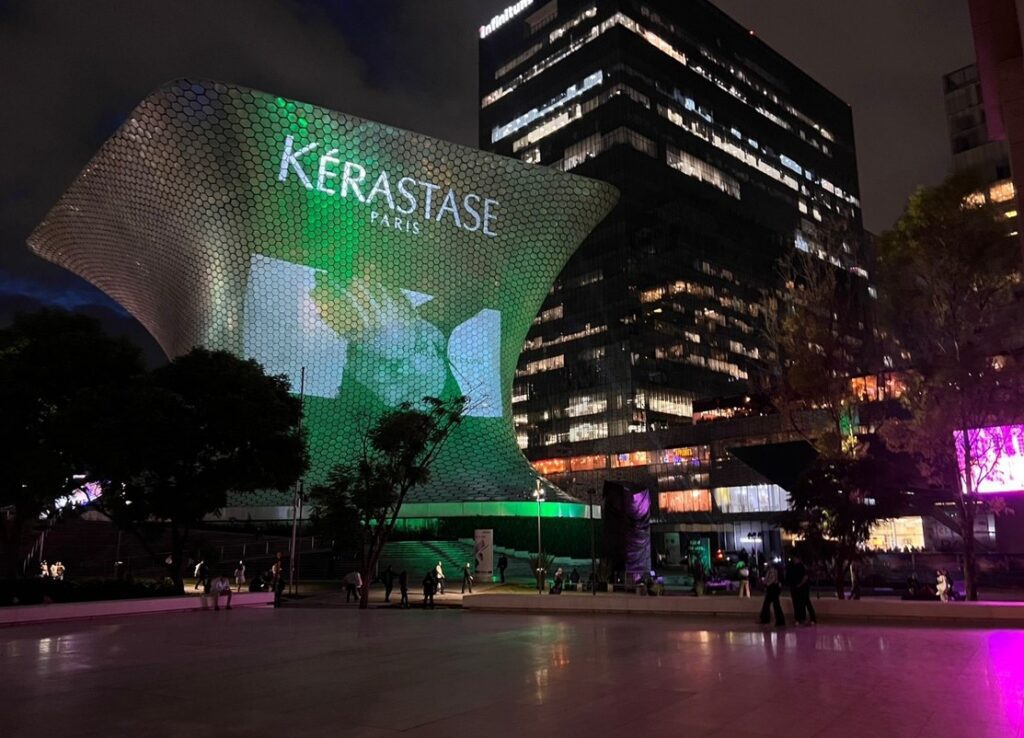
When streaming services want to make a new show feel like a cultural event in Latin America, they start in Mexico City. Not because CDMX is simply the largest Spanish-speaking market — though it is — but because CDMX is where the platforms themselves live. Netflix Latin America, Amazon Prime Video Latin America, Disney+ Latin America, and Paramount+ Latin America all maintain their regional headquarters in the city, concentrated largely in Polanco and Santa Fe. The marketing teams, the PR agencies, the content production offices — all of it is here.
This concentration creates a specific dynamic for guerrilla projection campaigns. A projection launch in Mexico City is seen by the press, the influencers, the platform competitors, and the media industry contacts who amplify content across the region. It is not just a consumer impression — it is an industry impression. When a streaming platform projects a new series onto a building in Roma Norte or on a landmark facade in Centro Historico, the story travels from Mexico City to Buenos Aires, Bogota, Lima, and Miami within the same news cycle.
Our team at AGM works with streaming platform campaigns in CDMX regularly, and the pattern is consistent: brands that treat the city as Latin America’s media capital — not just a local market — get results that scale far beyond the activation’s physical footprint. This piece breaks down how streaming platform projection campaigns work in Mexico City, which content types perform best, and how the city’s night economy creates a specific window that no other market in Latin America can replicate.
CDMX as Latin America’s Streaming Operations Center
The concentration of streaming platform offices in Mexico City is not accidental — it reflects the city’s broader role as Latin America’s media and entertainment hub. CDMX is home to Televisa’s historic San Angel campus (one of the largest television production complexes in the Spanish-speaking world), the major production studios that service international streaming productions, and the talent, crew, and creative infrastructure that makes large-scale content production possible at Latin American scale.
Netflix has produced or co-produced multiple major original series set in Mexico City and shot locally — the city’s visual identity is embedded in globally recognized streaming content. Amazon Prime Video and Disney+ have both invested in Mexican-origin content as a strategy for building loyalty across the Latin American subscriber base. The logic is straightforward: content that feels authentically Mexican resonates not just in Mexico but across the Spanish-speaking world, where Mexican cultural products have a historical reach that no other Latin American country matches.
For streaming platform campaigns, this means that a guerrilla projection in CDMX is launching content in the city where the platform’s own team works, where the press that covers the platform is based, and where the influencer and media ecosystem that amplifies the launch across the region is concentrated. The campaign works on multiple levels simultaneously: consumer awareness, industry visibility, and press amplification.
Mexico City is the headquarters city for the Latin American operations of Netflix, Amazon Prime Video, Disney+, and Paramount+. It is also home to Televisa’s San Angel studio campus and the production infrastructure for the majority of Spanish-language original content produced for global streaming platforms.
The Content Types That Project Best in Mexico City
Not all streaming content is equal as a projection subject. The content types that generate the strongest projection campaign response in CDMX share common characteristics: strong visual identity, cultural resonance with the Mexico City audience, and the kind of plot or aesthetic that compels people to want to know more when they see it on a building face.
Crime dramas and narco-themed series have an enormous natural audience in Mexico City. The genre has deep cultural roots in Mexican television and film, and streaming platforms have consistently found that their highest-performing Mexican-market content falls in this category. A projection of key imagery from a crime or cartel series in Centro Historico or Tepito — neighborhoods where the genre’s cultural geography is immediately legible — generates a quality of attention that a projecting a generic romantic drama in the same location would not.
Telenovela-format dramas — the serialized, high-drama domestic series that built Mexican television’s global reach — maintain massive audiences in CDMX across all demographic segments. When a streaming platform acquires or produces telenovela-format content, projection campaigns using the show’s key characters and emotional imagery hit an audience that already has strong genre loyalty. The poster graphic conventions of telenovela marketing — big faces, intense expressions, strong color — also translate well to projection format.
Sports content tied to Liga MX, the Mexican national football team, boxing, or lucha libre has a natural fan base that is intensely social-media-active and concentrated in specific CDMX neighborhoods. A projection promoting a streaming platform’s sports coverage ahead of a major Liga MX match, placed near the Estadio Azteca in Coyoacan or near sports bars in popular neighborhoods, lands with audiences who are already planning around that content.
True Crime and Documentary Content
True crime documentary series have become one of the strongest-performing content categories for streaming platforms globally, and this holds in Mexico City. The genre’s visual language — archival footage, crime scene imagery, interview graphics — translates into compelling projection content that stops foot traffic. In a city with as rich and layered a modern history as CDMX, true crime documentary projections create an immediate sense of local relevance even when the subject is not Mexico-specific.
Neighborhoods Where Streaming Audiences Concentrate
Streaming platform target demographics in Mexico City are not uniform, and campaign projections should be placed in the neighborhoods where the specific platform’s subscriber base physically concentrates. The broad geography breaks down as follows:
| Neighborhood |
Streaming Demographic |
Platform Alignment |
Key Projection Streets |
| Roma Norte |
25-40, affluent, culturally engaged |
Netflix originals, indie content |
Alvaro Obregon, Sonora, Orizaba |
| Condesa |
25-40, international-oriented |
Premium platforms, international co-productions |
Amsterdam, Nuevo Leon, Tamaulipas |
| Polanco |
30-55, premium subscribers |
Apple TV+, Disney+, premium tiers |
Presidente Masaryk, Emilio Castelar |
| Centro Historico |
Broad demographic, high volume |
Mass-market platforms, telenovela content |
Madero, 5 de Mayo, Tacuba |
| Santa Fe |
Corporate, 30-50, tech-affluent |
All major platforms, corporate access |
Vasco de Quiroga, Javier Barros Sierra |
| Narvarte / Del Valle |
25-45, middle-class families |
Netflix family, Disney+, sports |
Insurgentes Sur, Universidad |
Campaigns that target a premium subscriber demographic — the audience most valuable to platforms competing on quality rather than volume — concentrate in Roma Norte, Condesa, and Polanco. Campaigns aiming for mass subscriber awareness at scale reach for Centro Historico, Insurgentes Sur, and the broad east-west corridors that cross the entire city.
The Night Economy Window: 11pm-2am
Mexico City’s night economy runs later than almost any other major city in the world. The combination of a warm climate, a culture of late dining and socializing, and a metro area with 22 million people means that streets in Roma Norte, Condesa, and Centro Historico have significant foot traffic well past midnight on any night of the week, and extremely heavy traffic on weekends. The 11pm-2am window is not a marginal activation period in CDMX — it is prime time.
For streaming platform campaigns specifically, this window has a particular value. The people outdoors in Roma Norte at 11:30pm on a Saturday are actively on their phones. They are not at home watching something — they are out, and when they see something interesting, they share it immediately. They are in content discovery mode by habit. A streaming platform projection that appears in this audience’s environment, at this hour, is landing in exactly the mental space where content discovery decisions get made.
The phone-out behavior of late-night CDMX crowds is well-documented by anyone who has spent time in Roma Norte after 10pm. Tables at outdoor restaurants face the street; people at terrace bars have unobstructed sightlines to building facades across narrow streets; pedestrian traffic is slow and lingering rather than purposeful commuter transit. A projection in this environment gets more dwell time per impression than a projection during rush hour in the same location. People stop, look, photograph, and discuss.
The 11pm-2am crowd in Roma Norte and Condesa is simultaneously outdoors and on their phones — a combination that exists in very few major cities. For streaming platform campaigns, this is the moment when a street projection and a streaming app are separated by about 15 seconds of thumb movement.
How a CDMX Projection Reaches Buenos Aires, Bogota, and Lima
The geographic amplification of a Mexico City guerrilla projection campaign is one of the most important factors for streaming platforms evaluating the format. The question they ask is always: what reach does this activation actually generate? The answer is consistently larger than the physical impression count.
Mexico City has the most active creator, influencer, and media ecosystem in Latin America. Fashion journalists, food writers, political commentators, entertainment critics, and content creators of every variety are concentrated here at a density matched only by Buenos Aires. When something visually interesting happens on a street in Roma Norte, it is photographed within minutes by people whose social media reach extends across the hemisphere.
A projection on a well-chosen building in CDMX generates a cascade of organic content: Instagram stories, TikTok clips, X posts, WhatsApp forwards among friend groups. The CDMX-based followers of a well-connected content creator are not just Mexico City residents — they are distributed across the Latin American region and beyond. A projection that reaches 10,000 people physically in CDMX may reach 300,000 people through secondary social sharing within 48 hours, the majority of whom are in other countries.
This dynamic is precisely why streaming platforms’ Latin American marketing teams — which are based in CDMX and understand the city’s media ecology — consistently use the city as the launch point for campaigns they want to spread across the region. It is the most efficient single-market investment for multi-market reach in Latin America.
The Role of CDMX Press in Streaming Launch Amplification
Mexico City has a media infrastructure that punches well above a city of its size. National newspapers like El Universal, Reforma, and Milenio; national television networks with headquarter studios in the city; entertainment press titles covering Latin entertainment specifically; and a substantial international press corps stationed in CDMX — all of these organizations are potential amplifiers for a streaming campaign projection that generates genuine visual interest.
Entertainment and culture journalists in CDMX actively cover guerrilla marketing activations when the content is interesting enough and the placement is visually dramatic. A streaming platform that projects the imagery from a major new series onto the Palacio de Bellas Artes exterior or onto a landmark building in Centro Historico will get press inquiries. That press coverage — in El Universal online, in entertainment trade publications, in the social posts of journalists who document CDMX life — multiplies the projection’s reach by orders of magnitude.
The key distinction is between a projection that is merely present and one that is worth covering. Press attention goes to projections that use significant surfaces, that show high creative quality, and that have a natural news hook (series premiere date, major cast announcement, Mexico City connection in the content). AGM helps platform clients engineer the press-worthy version of their projection campaigns from the planning stage.
Mexico City is home to major national newspapers, national television network headquarters, the Latin American bureaus of international news organizations, and one of Latin America’s densest concentrations of entertainment and culture journalists — all potential organic amplifiers for a streaming platform campaign projection.
The Content Production Geography of Mexico City
One underutilized aspect of streaming platform projections in CDMX is the city’s identity as a content production center. When a streaming platform projects imagery from a series that was shot in Mexico City — using CDMX streets, buildings, and neighborhoods as its visual backdrop — the projection creates a direct connection between the show and the city’s identity.
Residents of Roma Norte who see a projection of a show that was filmed on their street experience a category of brand impression that goes beyond awareness — it is recognition. “That’s our neighborhood.” That recognition generates a quality of social sharing that pure advertising rarely achieves. The person sharing a photo of the projection is not just sharing an ad; they are sharing proof that their city is a character in global entertainment.
Streaming platforms that have produced Mexico City-set originals should amplify this connection explicitly in their projection campaigns. Placing the projection on or near the actual filming locations creates an easter egg for engaged viewers and a discovery moment for those who haven’t yet watched the show. “This is where that scene was filmed” is one of the most shareable pieces of content in entertainment marketing, and a projection on the actual location turns the city into a living making-of document.
Multi-Format Launch Week Strategy for Streaming Platforms
A single projection night generates impact, but a full launch week strategy that layers formats across the city generates saturation. Our recommended approach for streaming platform launch weeks in Mexico City combines four formats across a 5-7 day window:
Day 1-2: Wheatpasting deployment. Show key art and premiere date go up across multiple neighborhoods simultaneously — Roma Norte, Condesa, Centro, Polanco. The wheatpasting campaign establishes street presence before the main event and generates early social media attention from people who discover it while going about their day.
Day 3: Main projection activation. The headline projection goes up on the campaign’s key building — Bellas Artes, a Reforma tower, a Roma Norte corner building, depending on the content type and target demographic. This is the visual centerpiece of the launch week. It runs at maximum brightness from 9pm to 2am and is the primary content for social sharing.
Day 4-5: LED billboard truck circulation. Billboard trucks carrying show imagery circulate through the high-density corridors — Insurgentes, Reforma, Circuito Interior — extending the campaign’s geographic reach beyond the fixed projection and wheatpasting locations. The mobile format catches commuter traffic that the fixed placements don’t reach.
Day 5-7: Brand ambassador activation. A street team in key neighborhoods distributes branded campaign materials — custom show merchandise, QR codes linking directly to the streaming platform, photo opportunity installations — that extend the campaign’s engagement depth beyond a visual impression to a direct subscriber action.
Influencer Culture in CDMX and the Projection Amplification Loop
Mexico City’s influencer ecosystem is the largest and most influential in Latin America. Creators across fashion, food, politics, technology, and entertainment — many with followings in the hundreds of thousands or millions — are based in CDMX and are active consumers of the city’s visual culture. When a guerrilla projection goes up in Roma Norte, it is photographed not just by passersby but by people with platforms.
AGM’s CDMX network includes relationships with the creator community in key neighborhoods — people who document the city’s visual culture for their audiences as a matter of personal interest, not just paid partnership. When a projection is genuinely interesting — when it uses a significant surface well, when the creative is strong, when the content is something their audience cares about — these creators document it organically. The distinction between earned media and paid amplification collapses when the work is good enough.
Streaming platforms that are considering their influencer marketing budgets in CDMX should think about the projection campaign as the content anchor that makes influencer posting natural rather than obligatory. A creator who posts about a projection because they think it is cool provides far more authentic endorsement than a creator who posts because they were paid to. The guerrilla projection — precisely because it is street-level, unscripted, and visually dramatic — gives creators something worth posting about on its own terms.
Projection Mapping for Streaming Content: Technical Considerations
Streaming platform campaigns typically have high-quality visual assets developed for their content — key art, character portraits, title treatments, motion graphics from trailers. These assets need specific adaptation for projection mapping onto building surfaces, and the adaptation process is where the difference between a generic projection and a memorable one is made.
A flat image projected at large scale onto a building with windows, fire escapes, and architectural relief will look unintended without projection mapping. Mapping software allows the projected content to be warped and adjusted to treat the building’s features as part of the design — framing character faces in building windows, wrapping imagery around cornices, using the building’s own geometry to create depth and dimensionality that a flat projection lacks.
For streaming platforms, whose content key art is designed by professional creative studios, our team works with those assets to create projection-specific versions that take full advantage of the building surface. The result is a projection that looks like it belongs on that building — not like a billboard superimposed on architecture, but like a collaboration between the campaign and the city itself.
The Subscription Conversion Layer
Streaming platforms ultimately measure campaigns against subscriber acquisition and retention metrics, and a guerrilla projection has to connect to those metrics through a clear path. The most effective mechanism is a QR code integrated into the projection itself — either embedded in the projection content as a visual element, or placed on physical materials (wheatpasting, handouts) at the projection location that link directly to a trial offer or a specific show page on the platform.
In CDMX’s active night economy environment, the conversion path from projection to QR scan to app action is short. A person who sees a compelling projection, photographs it, notices the QR code in the image, and scans it is only 30 seconds from being on the streaming platform’s subscription page. This conversion sequence works at a measurably higher rate than the equivalent digital advertising conversion path because the physical encounter creates a level of attention that digital display advertising rarely achieves.
AGM builds the QR strategy into projection campaigns from the design stage — determining where in the visual composition the code should appear (visible but not dominant), what landing page it should route to, and how to measure the scan-to-conversion path across the launch window.
Frequently Asked Questions
Why do streaming platforms use guerrilla projections in Mexico City for Latin American launches?
Mexico City is the headquarters city for Netflix Latin America, Amazon Prime Video Latin America, Disney+ Latin America, and Paramount+ Latin America. It is also the content production center for the region and the largest streaming consumption market in Latin America. A viral projection moment in CDMX reaches audiences in Buenos Aires, Bogota, and Lima through organic social sharing — making it the most efficient single-market launch investment in the region.
Which content types perform best with guerrilla projection campaigns in Mexico City?
Content with strong visual identity performs best: crime dramas, narco-themed series, sports content, and visually distinctive fantasy or sci-fi productions. Telenovela-style dramas have extremely high natural audience recognition in CDMX. Content produced in Mexico — which Netflix and Amazon both produce heavily — has built-in cultural resonance that makes street placements feel like local events rather than platform promotions.
What time should streaming platform projection campaigns run in Mexico City?
The 10pm-2am window is the most valuable for streaming platform campaigns because it targets the audience that is simultaneously on their phones, open to content discovery, and still outdoors in CDMX’s active night economy. This audience is already in media consumption mode, making the distance between seeing a projection and opening a streaming app extremely short.
How does a Mexico City projection campaign reach audiences in other Latin American countries?
Mexico City generates disproportionate social media content that circulates across the region. A projection in Roma Norte that is photographed and shared by CDMX-based influencers, journalists, and fans reaches followers across Latin America within hours. The cultural centrality of CDMX in Latin media means that what happens on its streets is watched closely from Bogota to Buenos Aires.
Can projection campaigns in Mexico City be combined with other formats for a streaming launch week?
Yes — AGM typically structures streaming launch campaigns as multi-format activations: projection on a key building for the high-impact visual moment, wheatpasting in multiple neighborhoods for sustained street presence across the full launch week, LED billboard trucks for mobility along high-traffic corridors, and brand ambassador activations in neighborhoods where the target demographic concentrates. The combination creates full-city saturation that no single format achieves alone.