
November 22, 2026
Glass Truck Advertising Explained: How It Actually Works
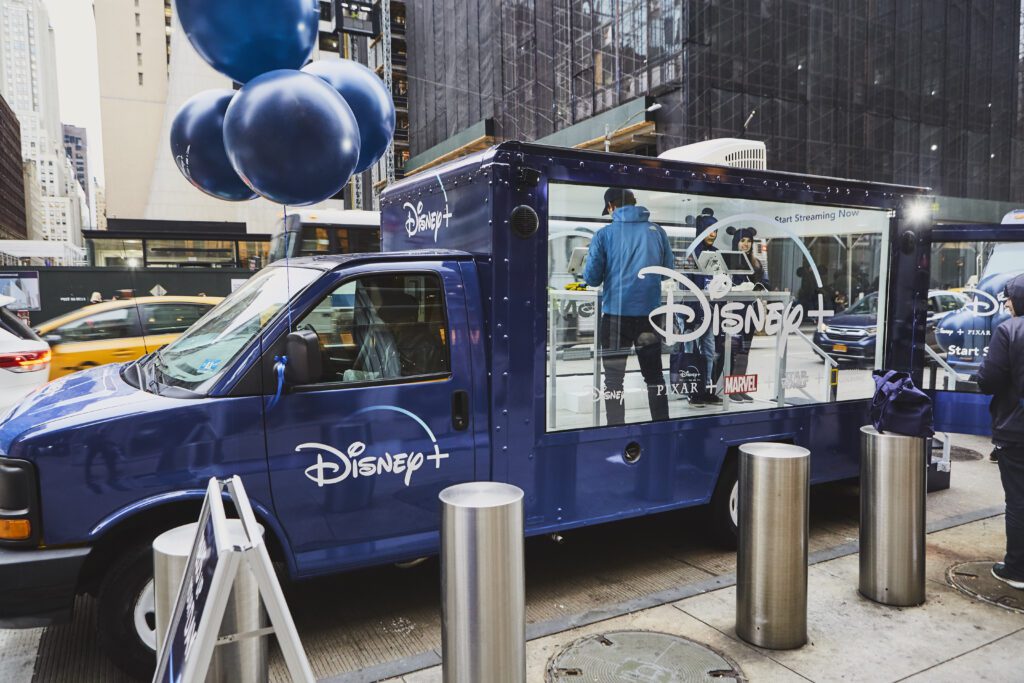
A glass truck is a box truck whose cargo body has been replaced, on one or both sides and sometimes at the rear, with transparent panels and a lit interior. Instead of a printed surface, you get a display case on wheels.
People who have seen one in a city usually remember it, which tells you most of what you need to know about why the format exists. People who have only read about one usually imagine something far simpler than what it takes to run.
This page is the honest version. What the vehicle actually is, what you can put inside it, what the lighting and glare problems are, how the crew runs it, where it beats a printed truck or an LED rig and where it is clearly the wrong tool. Plus the things we talk clients out of, which with this format is a longer list than usual.
I like glass trucks. I also turn down more glass truck briefs than I accept, and the reasons are worth understanding before you start planning one.
What a glass truck actually is
Strip the marketing away and you have four things.
**A transparent box.** Usually tempered or laminated panels in a frame, mounted where the body sides would be. Some builds are full height glass on both flanks with a solid roof and floor. Some are partial, with glass over the upper two thirds and a solid lower section that hides mechanicals and gives the structure rigidity.
**An interior stage.** The space inside the glass is a set. It has a floor, usually a back wall or a divider down the centre so the two sides can be dressed independently, and mounting points for whatever goes in.
**Lighting.** This is the part that separates a good glass truck from a rolling vitrine nobody can see into. Interior lighting has to overcome daylight on the outside of the glass during the day, and at night it has to be the only thing making the display visible at all. The lighting design is the single biggest technical variable in the whole format.
**Power.** Lighting, any motion or media inside, and climate control if the contents need it. That means a generator or a substantial battery system, and the same cooling and fuel considerations any powered rig carries.
Underneath it is still a commercial vehicle with a driver, a height, a turning circle and a list of streets it cannot use.
What goes inside, and what goes wrong in there
The interior is the product. This is where briefs either get interesting or fall apart.
**Product display** is the obvious one and the one it does best. A physical object, lit properly, at a scale people can see from the sidewalk. Footwear, beverages, consumer electronics, apparel on forms, a piece of hardware. The format exists to show a real thing to people who have only seen it in photographs.
**Set dressing and environment.** Building a small scene rather than showing one object. A room, a counter, a landscape in miniature. This photographs extremely well and is where the strongest work tends to live.
**Live occupancy.** A person inside. A barista, a performer, an artist working, someone demonstrating. This is the highest impact version and by some distance the most operationally demanding, because now you have a human in a glass box on a public road and every single safety, comfort, ventilation and welfare question becomes real.
**Motion.** Rotating platforms, mechanical elements, a product that moves. Adds a great deal of attention and a great deal of failure risk in a vibrating vehicle.
**Screens behind glass.** Possible, generally a mistake. If your content is a screen, you want an LED rig, where the panel is the exterior surface and is built for outdoor brightness. A screen sitting behind a sheet of glass fights reflections and loses.
What goes wrong inside, reliably:
**Things move.** A vehicle is a vibration machine. Anything not mechanically fixed will walk across the floor over a shift. Everything gets fixed down, and the fixings have to be invisible from outside, which is a real fabrication problem rather than an afterthought.
**Things fall over at the first hard brake.** Static display design has to survive emergency stops, not just cruising.
**Things fade and cook.** Sun through glass is an oven. Food, anything with pigment, anything with a cosmetic finish. Interiors get hot fast in summer, and heat plus sunlight destroys display items over a multi day run.
**Things look smaller than you planned.** People consistently underestimate how big an object needs to be to read from across a street. A single shoe, beautifully lit, is a dot at thirty feet. Scale is the most common fabrication revision.
**Things get dirty.** Glass on a vehicle collects road film, dust, rain spots and fingerprints at a rate that surprises people. A glass truck that has not been cleaned since the morning looks neglected by evening.
The glare problem, which is the real craft
Here is the thing nobody mentions in a pitch deck. Glass reflects.
In daylight, the outside of your panel mirrors the street. The sky, the buildings opposite, the sun. Depending on the angle a viewer stands at, they may be looking at a reflection of a building rather than at your display. The brighter the day, the worse it gets.
At night, the glass reflects your own interior lighting back at itself, and it reflects streetlights and headlights.
Three things fight this.
**Interior brightness.** The display has to be meaningfully brighter than the reflected scene. During the day that is a serious lighting load, and it is why underpowered glass trucks look like empty boxes at noon.
**Dark backgrounds.** A dark interior back wall with a brightly lit subject in front of it gives maximum separation and kills a lot of reflected clutter. Light coloured interiors look clean in a render and wash out on the street.
**Angle and routing.** Which way the flank faces relative to the sun matters. A corridor where the display side faces into low afternoon sun is a dead stretch. Good routing knows this and schedules around it, the same way it does for an LED screen.
Anti reflective treatments on the glass help and do not solve it. Physics wins. You design around glare rather than defeating it.
The practical consequence: glass trucks are generally stronger after dark than in bright midday sun, which is the opposite of what people assume about a format with no screen. Evening work in a lit district is where they look their best.
Crew reality and what a shift looks like
A glass truck is not a one person vehicle.
**Driver.** Same route judgement as any mobile format, plus extra care because a glass bodied vehicle is less forgiving of contact and the contents do not like sudden inputs.
**Display attendant.** Someone whose job is the inside: lighting on and correct, items in position, glass clean, nothing shifted. On stationary blocks they are also the person the public talks to, and the public will talk to them, because a glass truck invites questions in a way a printed panel never does.
**Third person on live occupancy builds.** If someone is working inside, you need a person outside managing access, timing, breaks, crowd flow and welfare. Non negotiable.
So two minimum, three for anything with a human inside or a complex build.
The shift itself:
**Load in and dress.** Done before the vehicle moves, in a yard or depot, and it takes real time. Fixing items down, setting lighting levels, checking the view from outside at distance rather than from arm’s length inside. A display dressed from inside always looks wrong from the sidewalk.
**Glass clean before departure**, and again at least once mid shift.
**Pre shift checks** on generator fuel, lighting circuits, any motion elements, and interior temperature management.
**On route**, with far more stationary blocks than a typical mobile campaign. This is important. A glass truck’s value is concentrated in moments when people can stop and look. Driving past at twenty miles an hour, a viewer gets a glimpse of a lit box. Parked beside foot traffic, they get the whole display. We weight these routes heavily toward stationary positions, far more than we would for an LED rig.
**Teardown.** Items out or secured, lighting off, generator cooled. Nothing valuable stays in a glass box overnight on a street, ever. That seems obvious and it needs saying because people propose it.
Permission, ordinance and the grey area
Mobile advertising sits in a grey area. The treatment of advertising vehicles varies by municipality and sometimes between districts in the same city. Some places have explicit provisions, some restrict certain districts or hours, some have nothing specific and the question falls to general vehicle, parking or nuisance rules. Enforcement is inconsistent. I will not tell you the format is legal or illegal, because that is not a statement that holds across the country and it would be advice I am not qualified to give.
Glass trucks carry a few extra wrinkles worth naming.
**Stationary time is where the scrutiny lands.** This format depends on parked blocks more than any other mobile format, and parked advertising display is exactly where local rules tend to be most specific. We check what is actually permitted at each position rather than assuming a kerb is available.
**A crowd changes the question.** A printed truck parked on a street is a parked truck. A glass truck with something interesting in it gathers people on the sidewalk, and a gathering on a sidewalk is a different conversation with whoever is responsible for that sidewalk. For anything likely to draw a crowd, we want a private property position with the owner’s permission, or we want to have had the conversation with the venue or the site in advance.
**Live occupancy raises the stakes considerably.** A person working inside a vehicle on a public road brings in questions about safety, welfare, ventilation, egress and insurance that go well beyond advertising rules. We treat these builds as productions, not as media buys, and we plan them accordingly.
**Private property is our preference** for extended stationary blocks. A lot beside a venue, a retail site, an event footprint. Owner permission turns a grey question into a settled one and it is usually a better position commercially anyway.
**We document.** Route logs, timestamps, photographs, permissions in writing.
**We move when asked**, without debate at the kerbside, to the alternate position that is already in the plan.
None of this is legal advice. Talk to your own counsel about your own campaign.
Where a glass truck beats the alternatives, and where it loses
**Against a printed box truck.** The glass truck wins on attention and on photography by a wide margin, and it is the only mobile format that shows a physical object. The printed truck wins on simplicity, reliability, access to tight streets, cost of change, and the fact that it works every second it is visible with nobody tending it. If your message is a message rather than an object, print is the better buy and I will tell you so.
**Against an LED truck.** The LED rig wins on night time dominance at distance, on message flexibility, on rotation and dayparting, and on being readable from across four lanes. The glass truck wins on tangibility and on dwell quality, because people stop and look into it in a way they do not stop and look at a screen. If you need reach, LED. If you need people to encounter an actual thing, glass.
**Against a pop up or a stand.** A glass truck goes to several places in a day and needs no site build at each one. A stand gives people physical access to the product, which the glass truck specifically denies. That denial is sometimes a feature, creating distance and display value, and sometimes the whole problem.
**Against projection.** Different universe. Projection is scale and spectacle on architecture at night. Glass is intimacy and object at street level. They pair well and compete not at all.
What we talk clients out of
**Using it as a general awareness format.** This is the big one. A glass truck’s strength is close range encounter, and close range encounter has low reach per hour by definition. If the goal is a lot of people seeing a message across a city, this is an expensive and inefficient way to get it and something else will do better.
**Filling it with screens.** Covered above. If the content is a screen, buy a screen rig.
**Putting anything fragile, perishable or valuable in it for a long run.** Heat, vibration, sunlight and overnight security are all real. We design builds around replaceable or robust items for multi day campaigns.
**Fine detail and small type on interior graphics.** Same rules as any street format. Behind glass, with reflections competing, small type is worse than usual.
**Light coloured interiors.** Looks beautiful in a render, washes out against reflections. Dark background, lit subject.
**Planning it like a media buy.** This is a fabrication project with a vehicle attached. The build needs lead time, a maker, revisions, and a test with the lighting on, viewed from thirty feet away in daylight and at night. Briefs that treat it as a booking rather than a production are the ones that end badly.
**Running it alone.** A glass truck creates strong encounters for a relatively small number of people, and when the shift ends the street has nothing of yours on it. If you want the district carrying your message between shifts, run Wheatpasting & Poster Campaigns in the same corridors the vehicle works. The truck delivers the object and the moment. The posters hold the ground overnight and keep the campaign present at hours no vehicle is on the road. That pairing is what I recommend on nearly every glass truck brief, and it is also what makes the truck’s limited reach acceptable rather than disappointing.
What drives scope on a glass truck campaign
No numbers, but these are the levers any serious conversation will be about.
**Build complexity.** A single lit product on a plinth is a different project from a dressed environment with motion.
**Lighting design.** Daylight capable interior lighting is substantially more involved than night only.
**Live occupancy.** Adds a person, adds welfare and safety planning, adds insurance questions, adds scheduling constraints around breaks.
**Stationary position count and permissions.** Private property positions take lead time to arrange.
**Run length.** Multi day runs need a maintenance plan for cleaning, item replacement and reset.
**Vehicle size against route.** A larger glass body is more impressive and locks you out of more streets.
**Documentation.** This is a format worth photographing properly, and that is another person and a set of decisions about timing and position.
Frequently asked questions
What is a glass truck in advertising?
It is a box truck whose cargo body has transparent panels on one or more sides with a lit interior, so the vehicle works as a mobile display case rather than a printed surface. Instead of a message on the outside, you show a physical object or a dressed scene inside, visible to people on the sidewalk and across the street.
Is a glass truck better than an LED truck?
They do different jobs. An LED rig wins on reach, night dominance at distance, message rotation and dayparting, so it suits broad awareness. A glass truck wins on tangibility and dwell quality, because people stop and look into it. Choose glass when the point is encountering an actual object, and LED when the point is a message reaching many people.
How do you deal with reflections on the glass?
You design around glare rather than defeating it. The interior has to be meaningfully brighter than the reflected street scene, dark background walls with brightly lit subjects give the best separation, and routing avoids headings where low sun hits the display flank. Anti reflective treatments help but do not solve it. Glass trucks usually look strongest after dark.
How many crew does a glass truck campaign need?
Two minimum: a driver, and a display attendant handling lighting, item positions, glass cleaning and the public, who will ask questions. Anything with a person working inside, or a complex build with motion, needs a third person outside managing access, timing, breaks and crowd flow. Load in and dressing happen before the vehicle moves.
Can someone work or perform inside a glass truck?
Yes, and it is the highest impact version of the format, but it is a production rather than a media buy. A human in a glass box on a public road raises safety, welfare, ventilation, egress and insurance questions that need planning well before the run, plus a dedicated person outside. We scope these builds very differently from a static display.
Where are glass trucks allowed to park and display?
That is a grey area varying by municipality and district, and stationary advertising display is exactly where local rules tend to be most specific. Because this format depends heavily on parked blocks and can gather a crowd, we prefer private property positions with written owner permission, check each public position rather than assuming, and move when asked.
Request a campaign quote
Tell us what you want people to encounter, which city, and what dates. If there is a physical object at the centre of it, send a photo and rough dimensions so we can be honest about whether it reads from the sidewalk.
If a printed truck or a poster run would serve the brief better, we will say that instead of selling you a build.
Request a campaign quote and we will come back with a build approach, a lighting plan, stationary positions and a realistic schedule.

Ready to Run Your Campaign?
Call us or email us. We’ll tell you exactly what we can do in your market and what it costs.
Related Services
Explore similar advertising solutions offered by American Guerrilla Marketing.
American Guerrilla Marketing — Los Angeles
Street-level campaigns in Los Angeles and nationwide. Wheatpasting, LED trucks, street teams, and more.
(646) 776-2770
Related Articles
-
Mobile LED Billboard Truck for Sale: Works and Fails
November 22, 2026
-
Mobile Billboard Dwell Time Strategy vs the Alternatives
November 22, 2026
-
Mobile Billboard Truck Rental: How It Actually Works
November 22, 2026
-
What to Expect From LED Billboard Truck Rental
November 22, 2026
-
What to Expect From Mobile Billboard Truck Advertising
November 22, 2026