
November 4, 2026
Poster Campaigns in New York City: How They Run
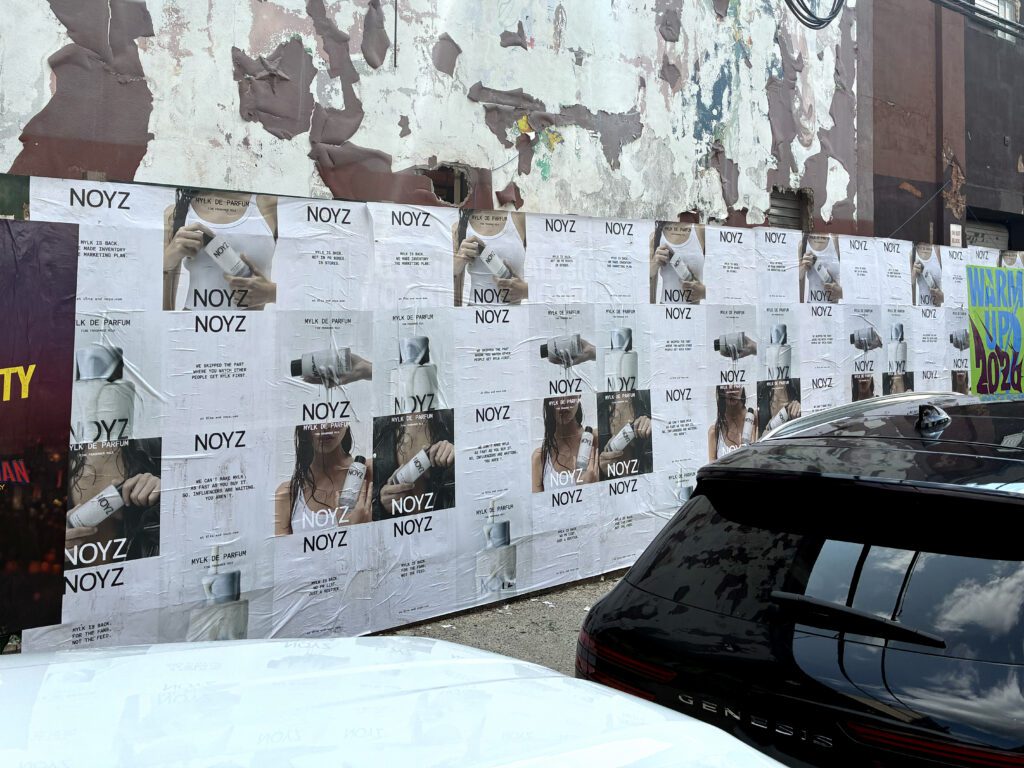
Most of the New York poster briefs that reach me are written for a city that does not exist.
They say “New York” the way a media plan says “national”. One audience, one creative, one buy. Then the brief asks for coverage, and coverage in a five borough city of distinct neighbourhood economies means your paper lands in places where nobody in your target set will ever walk past it.
New York is not one market. It is a stack of neighbourhood markets with different wall stock, different audiences and genuinely different tolerance for what goes up. Bushwick and the Lower East Side are both dense, both late, both visually literate, and they will read the same poster completely differently.
The second problem is surface. Buyers arrive assuming the street furniture is available, because in their head a poster goes on a pole. In New York that assumption is the fastest way to waste a print run, and I will explain why below in plain terms.
The third problem is the shed. New York has several hundred miles of plywood sidewalk shed frontage standing at any given moment, and it is the most distinctive poster surface in American advertising. It is also perishable in a way nothing else is, because the city is actively taking it down.
So this page is the conversation I have with buyers before we scope anything here. Where the paper actually goes, what the weather does to it, which nights are workable, and what I talk people out of.
I am Livy Phillips. I run Poster Campaigns for American Guerrilla Marketing nationwide, and New York is the market where the gap between what clients imagine and what the street allows is widest.
New York is a set of neighbourhoods, and the brief has to name them
If a brief says “Manhattan and Brooklyn” I send it back. That is not a target, that is two and a half million people.
The neighbourhoods that actually support poster work here are the ones with an existing visual culture, old building stock, independent retail and late foot traffic. In Brooklyn that means Bushwick first, with Williamsburg next door carrying its own bar, music and retail density. Bushwick is where The Bushwick Collective turned the neighbourhood into an open air gallery of large scale wall work by artists from around the world, to the point where the Collective publishes self guided tour maps. Walls there are curated and deliberate, not incidental.
That cuts both ways and buyers need to hear it. Bushwick is the most art literate audience in the city, which means it is also the most critical. Weak creative gets read as weak creative in front of people who look at murals for fun. I have told clients their artwork was not strong enough for that neighbourhood and suggested a different district rather than let them spend a print run proving the point.
In Manhattan the honest answer is narrower than people expect. The Bowery and its side blocks carry a long running street art character, with paste ups and tags on the side streets and real dwell time from people who stop to look. First Street Green Art Park at 33 E 1st Street, where the East Village meets the Lower East Side, is a public lot turned into rotating mural space with murals wrapping the fencing and the stage, plus weekend performances. The Lower East Side and East Village around it give you dense nightlife, independent retail, old brick and very late foot traffic.
Beyond those, I will not characterise neighbourhoods I have not surveyed for a given campaign. Conditions on a specific block in Harlem, Chelsea, Long Island City or the Bronx nightlife corridors change with construction and ownership, and a route sheet built on assumption is a route sheet that sends a crew to walls that are not there any more.
The planning rule I give clients: pick three neighbourhoods and own them. Three districts posted densely will out perform the whole city posted thinly, every time, because the format works through repetition on a route somebody walks daily.
The surface conversation, and why street furniture is closed here
This is the part of the New York brief that most often needs correcting, so I will be direct about it.
New York City’s Administrative Code contains a posting provision, section 10-119, and it is the most explicitly enumerated posting rule of any city we work in. It prohibits pasting, posting, painting, printing, nailing, attaching or affixing printed material by any means whatsoever onto a long, specific list of street surfaces. That list names the curb, gutter, flagstone, tree, lamppost, awning post, telegraph pole, telephone pole, public utility pole, public garbage bin, bus shelter, bridge, elevated train structure, highway fence, barrel, box, parking meter, mail box, traffic control device, traffic stanchion, traffic sign including its pole, tree box, tree pit protection device, bench, traffic barrier, hydrant and public pay telephone.
The enumeration is exhaustive by design. I read that list the way the city clearly intends it to be read, which is that the entire street furniture category is closed to us in New York. We do not post it. We do not offer it. We will not quote penalty figures, and we do not give legal advice, but I am not going to pretend there is ambiguity where the code has gone to the trouble of naming a tree pit protection device.
That is not the same as saying posting in New York is settled everywhere. It is not. The broader question of what can go on a privately owned wall, under what permission, with what zoning and agency requirements, is a grey area that varies by district and by building, and enforcement attention is uneven. We confirm requirements with the controlling agency and the property owner before a wall campaign, we do not summarise permit routes we have not verified, and we document the permission we obtain.
What this means practically is simple. In New York, the campaign lives on private surfaces. That is where the opportunity is anyway.
Sidewalk sheds: the surface that defines poster work in this city
Scaffolding and sidewalk sheds are New York’s signature surface, and the scale of it has no equivalent anywhere else.
When the city launched its Get Sheds Down programme in July 2023, there were roughly 9,000 active construction sheds covering about two million linear feet of sidewalk, close to 400 miles. By 2025 the City Council was still legislating against a figure of more than 8,400 sheds and roughly 400 miles. The Mayor’s Office has reported 173 miles of shed removed since the plan launched. An analysis of Department of Buildings active sidewalk shed data dated 8 July 2026 counted 7,625 active permits covering more than 1.76 million linear feet, about 334 miles.
Several hundred miles of plywood frontage, at eye level, on the busiest sidewalks in the country. That is the asset.
Three things follow from it operationally.
First, it is privately controlled. The shed belongs to the contractor or the owner of the site, not to the city, and the site board names the permit holder. Permission runs through that party. That is a normal commercial conversation, and it is the conversation we have.
Second, it is perishable. Permission ends when the shed comes down, and under current policy sheds are coming down faster than they used to. The trend line between 2023 and 2026 is unmistakable. A shed you surveyed in spring may not exist in autumn. We re survey rather than reusing old route sheets, and the published DOB active shed data is the practical scouting source.
Third, the political weather matters. Get Sheds Down has been framed around reclaiming public space and around what sheds cost the businesses behind them. An operator who reads that correctly leads with owner permissioned, well made work rather than anything that adds to the clutter argument. I would rather be the crew that makes a block look better for six weeks than the one that gives a council member a photograph.
Private walls are the other half of the market, and New York is unusually good ground for them. The Bushwick Collective, First Street Green’s rotating fence murals and the Bowery’s mural tradition all exist because property owners said yes. There is a developed ecosystem of owners, building managers and agents here who already understand wall licensing. The permission conversation is ordinary in New York in a way it simply is not in most American cities.
What the weather actually does to paper here
New York has a humid subtropical climate. Long, hot, humid summers with frequent late day thundershowers, and moderately cold winters that bring snow or a mix of snow and rain. Typical temperatures run from around 28F to 85F and rarely drop below 14F. Average humidity sits around 68%. The city is on the Atlantic coast, so nor’easters often arrive here mixed with rain rather than as pure snow, and seasonal snowfall in the city and the coastal strip is lower than inland New York, broadly in the 10 to 25 inch range.
Here is what that means with a brush in your hand.
Rain mixed with snow is worse for paste than snow alone. A dry cold snap preserves a poster. What destroys a bond is New York’s actual winter pattern, which is repeated transitions through the freezing point with liquid water present. Water enters at an edge, freezes, lifts the corner, and the next wind event finishes the job. Centre out application with fully saturated edges is the difference between a one week post and a six week post in this city. On winter work we over saturate the perimeter deliberately and accept the slower pace.
Late day summer thundershowers are a daily planning factor here, not an occasional one. They are frequent and they arrive in the afternoon. A morning or early afternoon post in July can be rained on before it cures. From June to September we work evenings and overnight, which avoids both the showers and the heat.
Humidity around 68% slows cure year round. Allow dwell time. Crews that treat New York like a dry climate and move on too fast leave edges that have not keyed.
Wind in New York is architectural, not meteorological. Avenue canyons and tower downwash produce gusts far above the ambient forecast, and the effect is worst on avenue facing elevations and at corners. Cross street side elevations are measurably calmer and hold material longer. When the forecast is marginal we move the night’s work to side street faces rather than cancel.
Soiling is severe. Traffic film, brake dust and soot grey down light artwork fast on trafficked corridors. Dark grounds and high contrast design hold legibility far longer than pale ones here. If a client brings me a white field with thin type, I tell them what it will look like in ten days on a bus route.
UV is moderate but highly uneven because of shading. A south facing wall with open sky above it fades on a completely different schedule from a wall shaded by towers across the street. We survey the specific elevation. City wide UV assumptions are useless in a vertical city.
Crew logistics: the one American city where you do not plan around a vehicle
New York is walkable to an extreme degree and transit first. For most poster work here, the crew should not be planning around a van at all. The subway reaches every working neighbourhood and moves faster than driving at most hours.
Parking is the single worst logistical problem of any market we operate in. Kerbside space is scarce, restricted and aggressively enforced. A vehicle based crew in Manhattan will lose more time to parking than to the work itself. Where a vehicle is genuinely needed to carry paste, paper and ladders, we set a fixed base and work out from it on foot.
Traffic makes cross town vehicle movement unpredictable at nearly all hours. We build routes that stay inside one neighbourhood per shift rather than crossing the city mid shift. A crew that tries to do the Lower East Side and Bushwick on the same night does neither well.
Night windows run later here than anywhere else. The Lower East Side, East Village, Bushwick and Williamsburg stay genuinely busy until very late, so the quiet window in nightlife districts is pre dawn rather than late evening. Commercial and office districts empty early and give you a usable evening window instead. Those are two different shift patterns and we schedule them separately.
Crew size follows surface type. A shed run on a single block is a tight two person job, one pasting and one carrying and spotting. Large wall work needs more hands plus ladder or lift access, and access is the thing that sets the night’s pace, not the pasting.
Shed churn changes the physical environment constantly. With several hundred miles of shed frontage standing and a city programme actively removing it, a surface that existed last month may be gone and a new one may have appeared around the corner. Re survey, always.
Summer means evening work. Winter’s early darkness extends the usable window, offset by the freeze thaw adhesion risk and the rain mixed with snow pattern. Marathon day and major event days close streets across multiple boroughs, so we check closures before committing a shift.
Timing a New York campaign against the local calendar
New York’s event calendar is effectively continuous, so the useful question is never “what is on” but “what concentrates the audience I want, in a place I can post”.
SummerStage has run since 1986 and now extends from Central Park to around a dozen neighbourhood parks across the five boroughs, June through October. The borough spread is the valuable part. It puts concentrated, repeated, arts receptive audiences into specific neighbourhood parks across five months, which suits neighbourhood level poster campaigns far better than one central festival does.
Governors Ball is the city’s premier music festival, held at Flushing Meadows Corona Park in Queens, scheduled for 5 to 7 June 2026, with crowds reported around 150,000 across the three days.
The TCS New York City Marathon is scheduled for 1 November 2026. The five borough route produces enormous linear crowds and heavy street closures citywide, which is an audience opportunity and a crew problem on the same day.
Tribeca Festival, New York Fashion Week and the rest of the annual circuit are tracked on the official city tourism events listing. I will not quote 2026 dates for those here because I have not confirmed them, and a campaign timed off a wrong date is worse than a campaign with no timing.
Tourist peaks cluster in summer and across the late year holiday period, and the holiday peak concentrates very heavily into a small part of Midtown. For most of our clients that is the wrong crowd in the wrong place.
The most dependable rhythm in New York is not a festival at all. It is the weekday commuter pattern around major transit nodes, and for a poster campaign that is worth more than any one weekend.
What goes wrong, and what I talk clients out of
The thin spread. A client wants all five boroughs. What they get is paper nobody sees twice. Posters work through repetition on a route a person walks every day. I push for fewer neighbourhoods, posted deeper, with a longer run.
The pale creative. White or pastel grounds with fine type look beautiful in a PDF and grey out in two weeks on a trafficked New York corridor. I ask for a dark ground and heavy contrast, and if the brand guidelines will not allow it, I say so before we print rather than after.
The street furniture request. Somebody always asks about poles and bus shelters because that is what a poster means to them. The code here names those surfaces explicitly. The answer is no, and the answer does not change.
Avenue facing elevations on a windy brief. They look like the premium placement and they are the first to fail. If the client wants longevity, side street faces hold better, and I would rather deliver six weeks on a side street than nine days on an avenue.
Reusing last year’s site list. New York’s shed inventory turns over constantly and the direction of travel is downward. Any route sheet older than a few weeks is fiction.
Posting into marathon day or a major closure. The crowds are real, the access is not. We plan around those dates rather than into them.
And the one I push hardest on: national creative that pretends to be local. Bushwick in particular reads that instantly and punishes it. If a brand wants that audience, the work has to be good enough to stand next to curated murals. That is a creative conversation, not a media conversation, and it is better to have it early.
Pairing posters with projection in the outer borough blocks
The natural companion to a New York poster campaign is projection, but only if you understand where it can work.
New York has the highest ambient light levels of any market we operate in, and that is the dominant constraint on projection here. Midtown, or any avenue with illuminated retail, will wash out an underpowered projector completely. The usable sites are side streets, lower rise neighbourhoods and the darker industrial blocks of Bushwick and the outer boroughs. Humid summer air adds scatter on long throws, so cold clear winter nights give the best results, and winter’s early darkness extends the window substantially.
Run that way, projection and paper complement each other well. The posters hold the street for weeks on surfaces you have permission for, and a projection night gives you a dated, photographable moment in the same neighbourhood, which is usually what the social half of the brief actually needs. Sidewalk decals and stencils and LED Trucks can extend the same idea, but in this city projection on a dark Bushwick block is the pairing I recommend most often.
Frequently asked questions
Can posters go on lampposts and bus shelters in New York City?
No. New York City’s Administrative Code section 10-119 enumerates the street surfaces that cannot be posted, and the list names lampposts, utility poles, bus shelters, mail boxes, hydrants, benches, parking meters and more. We treat that entire category as closed and do not offer it. Our New York work runs on privately controlled surfaces with the owner’s or contractor’s permission.
How long does a poster actually last on a New York street?
It depends on season and elevation more than anything else. A well pasted sheet with saturated edges on a sheltered side street face can hold for weeks. An avenue facing elevation in a wind event, or any surface during a winter freeze and thaw cycle with rain present, can fail far sooner. We survey the specific wall rather than quoting a citywide number.
What makes sidewalk sheds such a good poster surface here?
Scale and position. Published city figures have described several hundred miles of shed frontage standing at once, at eye level, on the busiest sidewalks in the country. The plywood is controlled by the contractor or owner, so permission is a normal commercial conversation. The catch is that sheds come down, so inventory has to be re surveyed before every campaign.
Which New York neighbourhoods suit poster campaigns best?
The districts with existing visual culture, older building stock and late foot traffic. Bushwick is the strongest, with Williamsburg beside it, and in Manhattan the Bowery side blocks, the East Village and the Lower East Side. Those areas have audiences who actually look at walls. We recommend posting three districts deeply rather than spreading thinly across five boroughs.
When is the best time of year to run posters in New York?
Spring and autumn give the most reliable adhesion. Summer works if the crew runs evenings and overnight, because late day thundershowers are frequent and can hit a poster before it cures. Winter is workable with slower, fully saturated application, but repeated freezing with liquid water present is the pattern that lifts edges fastest here.
Is poster advertising in New York legal?
It is a grey area that depends on the surface and the permission behind it, and we do not give legal advice. What we can say plainly is that the city’s code enumerates street furniture surfaces as off limits, so we avoid them entirely. We work on private walls, hoarding and sheds with documented owner or contractor permission, and we commit to removal.
Request a campaign quote
If you are planning poster work in New York, bring me the neighbourhoods you care about, the run length you want and the creative as it stands. I will tell you which districts fit, which surfaces we can get permission on, what the season will do to the paper and what I would change before we print.
We handle survey, permission, print specification, installation, documentation and removal, and we will tell you when a different format serves the brief better.
Request a campaign quote and we will scope the New York run properly, neighbourhood by neighbourhood.

Ready to Run Your Campaign?
Call us or email us. We’ll tell you exactly what we can do in your market and what it costs.
Related Service
Explore similar advertising solutions offered by American Guerrilla Marketing.
American Guerrilla Marketing — Los Angeles
Street-level campaigns in Los Angeles and nationwide. Wheatpasting, LED trucks, street teams, and more.
(646) 776-2770
Related Articles
-
What Size Are Trends Posters: A Crew Field Guide
November 5, 2026
-
Wheatpasting & Poster Campaigns in Durham, NC
November 5, 2026
-
Wheatpasting & Poster Campaigns in Columbus, Ohio
November 5, 2026
-
Print Flyers and Posters: How It Actually Works
November 5, 2026
-
Bus Posters: How It Actually Works
November 5, 2026