
November 5, 2026
Wheatpasting & Poster Campaigns in Durham, NC
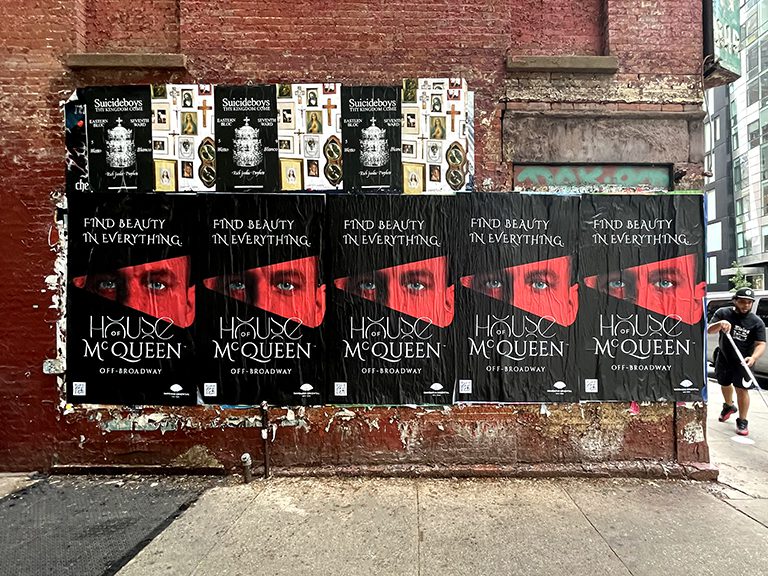
Most of the Durham briefs that land on my desk ask for the same thing. Downtown, Ninth Street, a few hundred sheets, up for a month.
Two of those three are reasonable. The third one is where the conversation starts.
Durham takes about fifty inches of rain a year and the climate summaries describe it as wet and partly cloudy year round. That is not a detail you design around after the fact. It is the first constraint on the page, before surface, before corridor, before creative.
I have had buyers tell me they want paper up for six weeks because that is what their media plan said. In this market, on an exposed wall, through a spring that happens to be the wettest part of Durham’s year, that plan is a reinstall schedule wearing a different name.
The honest version is shorter runs, refreshed deliberately, in corridors tight enough that a crew can actually service them. Durham gives you that. The city’s working core is compact by southern US standards, and the surfaces that matter sit in three or four pedestrian pockets rather than scattered across forty miles of arterial road.
What follows is how we read this market: where paste belongs, what the weather does to it, how permission actually works when the dominant landowner is a university and the best wall estate is a privately managed campus, and the things we tell Durham clients not to do.
The four Durham pockets that are worth posting
Durham is not a city you blanket. It is a city you work in legs.
Downtown is the nightlife core. It is described, fairly, as the one part of Durham that is not quiet on a Friday night, and the Warehouse District inside it carries its own nightlife identity. That combination of brick building stock, late trading hours and a dense pedestrian flow is what makes downtown the primary paste target in this market. It is walkable within itself, which means one crew on foot can service a meaningful sheet count in a single window.
Ninth Street is the student corridor, sitting beside Duke’s East Campus. Duke students and staff dissolve into the wider Durham population almost everywhere except Ninth Street and Brightleaf, where their presence at the bars and cheap-eats restaurants is most visible. If a campaign needs a student audience on foot, Ninth Street is the single best corridor in the city. It is also a separate vehicle leg from downtown, walkable once parked, and it backs onto campus and residential blocks.
Brightleaf is the third pedestrian pocket and the second place where Duke affiliation concentrates in nightlife and dining. It is smaller than downtown and it reads as a supplement rather than a standalone buy.
American Tobacco Campus is the outlier, and the most interesting surface opportunity in Durham. It is a revitalised historic campus built out of the old American Tobacco works, now holding creative office tenants, restaurants and retail, with an amphitheater lawn that carries a concert series. For an outdoor operator, ATC is the clearest large-format opportunity in the city: consolidated historic industrial building stock, under coordinated single management, with a programmed event audience arriving on a published schedule.
I will say plainly what that means. ATC is not a street-level grey area. It is one conversation with one managing party, and if that conversation goes well you have access to surface quality that no amount of street work in Durham will match.
Hayti carries Durham’s historic African-American community and its legacy remains central to the city’s cultural calendar. We treat it as a place that deserves a cultural read before anyone shows up with a bucket, not as inventory.
Fifty inches of rain is the whole material argument
Durham is humid subtropical. Hot muggy summers, short cold winters, roughly fifty inches of precipitation a year, around four inches of snow, temperatures typically running from about 32°F to 89°F. July and August sit at 87°F to 91°F highs with thunderstorms that often drop four to five inches of rain in a month.
Here is how each of those facts lands on a wall.
Rain volume sets the medium. Fifty inches a year, spread fairly evenly, means paper in Durham is a short-cycle refreshed medium. That is not a weakness. Paper posting is at its best when it is treated as a campaign that gets fed, not an installation that gets abandoned. If a client needs a single image to hold cleanly for a long stretch on an exposed face, we specify vinyl with sealed edges instead and stop pretending paper will do it.
Spring is the riskiest window for fresh paste. Spring is the wettest part of Durham’s annual cycle. Mild temperatures make it feel like the obvious season to work, and the rainfall record says otherwise. Fresh paste wants a dry curing window and spring in Durham is reluctant to give one.
Autumn is the best working season. Autumn is the driest season in Durham’s cycle, which makes September through November the most reliable stretch for installs that need to cure clean and hold. If a client has flexibility on timing and wants maximum life out of a paper buy, that is where I steer them.
Summer is a scheduling problem more than a material one. Four to five inches of monthly rain arriving as convective afternoon storms means short-notice washouts. Not a slow degrade, a sudden one. Summer campaigns need reinstall allowance built into the scope from the start, and crews need standing authority to abort a run when the sky turns. A crew that pastes into an incoming storm has wasted the sheets and the night.
July and August humidity is a mixed gift. Uncomfortably humid air extends paste open time, which genuinely helps on large multi-sheet work where you need the adhesive to stay workable across a big surface. It also lengthens the window during which the sheet is vulnerable before rain. Useful, but not free.
Freeze-thaw is minor here and that matters. About four inches of snow a year and a typical floor near 32°F means Durham gets isolated ice events rather than a sustained freeze-thaw cycle. Winter in this market is workable. We do not write off December through February the way we would in a northern city. We plan around a handful of ice days.
That is the climate read in full, and it produces a genuinely Durham-specific recommendation: favour autumn for life, treat spring as high risk, build reinstall allowance into summer, and keep winter on the table.
Permission here runs through landowners, and it is a grey area
I will not tell you what is legal in Durham. Nobody honest will, because posting sits in a grey area that varies by municipality, by surface ownership and by how a given ordinance is enforced in practice.
What I can give you is the working picture.
No Durham-specific published posting ordinance text turned up in our research, so I am not going to quote a section number or a fine figure at you. I would rather say that plainly than invent one. The North Carolina pattern across municipalities is consistent, though: sign ordinances in the state commonly make it an offence to post bills, placards, posters or advertisements on telephone, telegraph or electric light poles, on trees, or on traffic control signs and their supporting structures. Charlotte, the state’s largest city and the closest large comparator, specifically addresses material painted, pasted, stapled, taped or otherwise affixed to trees, fences, utility poles, benches and trash receptacles, with inspection and enforcement provided for.
There is no evidence Durham diverges from that pattern and no basis for assuming it does. So the working assumption we operate on is simple. Poles, trees, fences, benches, bins and street furniture are the exposed category and we treat them as unavailable. That is a scope decision we make before a client asks, because it is the category that generates complaints, removals and the kind of local reputation damage that closes doors on every future campaign in the city.
Three things shape permission culture in Durham specifically.
Duke is its own regime. Duke University is the defining institution of the city and its dominant landowner. Anything on or adjacent to East Campus or other Duke property is governed by the university, not the city, and the route is Duke’s own approvals process. This matters enormously on Ninth Street, because the corridor’s value is precisely that it sits beside campus. The boundary between public street and university land has to be understood before a crew works a single face there. Getting that wrong does not just cost you the sheets, it costs you the relationship with an institution that controls a lot of Durham.
American Tobacco Campus is private and managed. Coordinated management across a single estate means one permission conversation rather than a dozen. That is the cleanest route to large-format work in Durham and we push clients toward it when the creative justifies the scale.
Durham’s self-image is independent and creative. The city presents itself through indie spirit, block parties and local concert culture. In practice that means downtown and Warehouse District property owners are often genuinely receptive to hosting creative work on their walls, and documented private-wall agreements are realistic to obtain here in a way they are not in every market.
That receptiveness is an asset. It is also fragile. A crew that abuses an open door in downtown Durham does not just lose one wall, it hardens a small property-owner community that talks to itself. We protect it by working with written permission, keeping an install record with dated photographs of every face, and committing to removal in writing.
Construction hoarding and scaffolding follow the same logic. We go through the contractor or site owner controlling the structure. Given that comparable North Carolina language names fences explicitly, we treat hoarding as requiring the controlling party’s agreement rather than as ambiguous surface.
Durham’s calendar decides when, not just whether
Durham notes that unique events happen on most days of the year, and the festival calendar backs that up. For a poster campaign the question is which of those events actually move an audience into the corridors where paste lives.
Early April brings Full Frame. The Full Frame Documentary Film Festival is a four-day international event built around nearly a hundred documentary films, with the directors, producers and subjects present, produced in connection with Duke University’s Center for Documentary Studies. It puts a concentrated, culturally engaged audience into downtown Durham for four days. For arts, film, nonprofit and cultural-sector campaigns it is the strongest single window in the city’s year. It also lands in spring, which is the wettest season, so the material plan and the audience plan pull in opposite directions. We resolve that with vinyl on the key faces and paper on the refreshable ones.
February is denser than people expect. The Bull City Food & Beer Experience runs at DPAC, and a February festival centred on Durham’s historic Hayti community and the city’s African-American legacy anchors that month culturally. Winter being workable in Durham means February is a real campaign window, not a dead one.
Duke basketball anchors the winter. It is a marquee draw running through the winter and spring academic terms and it reliably pulls people into the city on a game schedule. For anything targeting that crowd, the schedule is the media plan.
Summer and autumn belong to outdoor programming. The American Tobacco Campus amphitheater lawn carries a concert series through summer and autumn, including free outdoor concerts programmed by Duke Arts. The American Dance Festival, the Bull Durham Blues Festival and the OUTSOUTH Queer Film Festival are all annual Durham fixtures. Autumn programming overlapping with Durham’s driest season is the happiest coincidence in this market’s calendar, and it is why we push flexible clients toward September through November.
Term time is the underlying rhythm. Ninth Street and Brightleaf audiences thin substantially outside Duke’s academic terms. A student-targeted poster buy that goes up in a term break is money spent on an empty corridor. We check the academic calendar before we quote a Ninth Street scope, every time.
I will flag the obvious limitation: festival dates move year to year and I am not going to publish specific dates I have not confirmed for your campaign year. We confirm them directly during planning.
What a Durham night actually looks like for a crew
Downtown Durham on a Friday is the loudest part of the city. That cuts both ways. High audience during trading hours, and a practical install slot that opens only after the bars thin out.
A typical downtown and Warehouse District run is a small crew working on foot from a parked vehicle, late, after the core quiets. Paste work is two-person minimum for anything above eye level and for anything on a sheet size that needs a second set of hands to keep square. One person on the bucket and brush, one on placement and the ladder, both watching the street.
Ninth Street is a different discipline entirely. It sits beside East Campus with residential blocks behind it. Noise carries there in a way it does not in a brick warehouse district with no one sleeping overhead. Quiet handling, no shouting across the street, no vehicle idling outside a residence. The corridor is small enough to work quickly and the right approach is to be in and out rather than to set up camp.
American Tobacco Campus is not a street run at all. Vehicle and pedestrian access is controlled because the estate is managed as a single property. We plan it as a coordinated daytime or scheduled visit with the managing party’s knowledge, not as a night operation.
Brightleaf is a quick third leg, usually folded into the same night as one of the others.
The practical consequence is that a Durham campaign covering downtown, Ninth Street and Brightleaf is a multi-leg night with vehicle moves between pockets, not a single continuous walk. That shapes crew size and how many nights a given sheet count needs. More sheets concentrated in fewer pockets is always more efficient here than the same count spread thin across all four.
What we talk Durham clients out of
Long paper runs on exposed faces. Covered above, and it is the single most common correction we make in this market. Fifty inches of rain does not negotiate.
Treating Ninth Street as public inventory. The corridor’s proximity to East Campus is the reason people want it and the reason it needs careful handling. Clients sometimes assume that because they can see a wall from a public sidewalk, it is fair game. We check ownership first and we route anything institutional through the proper channel.
Spring launches for paper-dependent campaigns. If a campaign is locked to a spring date for business reasons, fine, we build for it with sealed vinyl on anchor faces. If the date is flexible, we move it.
Poles, fences and street furniture. Clients ask. The answer is no, consistently, and the reason is that the exposed category is what generates removals and complaints, and Durham’s receptive property-owner culture is worth more to a campaign than a row of pole sheets that come down in a week.
Blanket coverage. Durham does not reward it. The audience is in four pockets. Spending the budget on arterial surfaces between them buys windshield impressions from drivers who are not the target.
Summer campaigns without reinstall allowance. If the scope has no slack for a washout, the campaign is one thunderstorm from a gap in coverage and an awkward phone call.
Removal decides whether you work in this city again
Paper comes down. That is the deal we make with every property owner who gives us a wall.
In a market where the property-owner community is small, receptive and in conversation with itself, removal is not an afterthought on the scope sheet. It is the thing that determines whether downtown Durham walls are available to the next campaign. We commit to removal in writing, we photograph faces at install and at takedown, and we keep the documentation.
Wet climates help here in one narrow way. Paper that has taken fifty inches of annual rain is easier to wet down and strip than paper baked onto a wall in a dry heat market. Autumn installs that cured clean hold better and also come off cleaner.
Vinyl is a different removal conversation and we scope it as one, with surface condition checked before anything goes up.
Where Sidewalk Decals & Stencils fits alongside a Durham poster buy
Durham’s pedestrian pockets are small and dense, which is exactly the geometry where ground-level work earns its place. Downtown’s walkable core, the Ninth Street strip, the ATC pedestrian estate: in all three, people are looking down at a sidewalk as much as up at a wall.
Sidewalk Decals & Stencils pairs naturally with a poster campaign in those pockets because it reaches the same foot traffic at a different eye line, and it does so on surfaces where the permission conversation is with a specific property owner rather than with an ambiguous streetscape. For event-driven campaigns around DPAC or the ATC amphitheater lawn, a ground-level directional layer on private surfaces does work that a wall poster cannot.
It is a complement, not a substitute. The wall carries the image. The ground carries the instruction.
Frequently asked questions
How long do paper posters actually last in Durham?
Plan short and refresh rather than expecting a long single run. Durham takes roughly fifty inches of rain a year and reads as wet and partly cloudy year round, so exposed paper is a short-cycle medium here. Autumn installs, going up in the driest part of the year, give you the best life. Anything that must hold through a long window should be vinyl with sealed edges.
Which Durham corridors are worth posting?
Four pockets carry this market. Downtown and the Warehouse District for nightlife density, Ninth Street for a Duke student audience on foot, Brightleaf as a smaller second student pocket, and American Tobacco Campus for large-format work on a managed private estate. Concentrating sheets in one or two pockets beats spreading the same count across all four.
Is poster advertising legal in Durham?
It is a grey area and anyone who answers that with a flat yes or no is guessing. Enforcement varies by municipality and depends heavily on surface ownership. No Durham-specific posting ordinance text surfaced in our research, so we do not cite one. We reduce risk by working on private surfaces with documented owner permission and committing to removal.
When is the best time of year to run a poster campaign in Durham?
September through November. Autumn is the driest part of Durham’s annual cycle, which gives fresh paste the cleanest curing window and the longest hold. Spring is the wettest season and the highest risk for paper. Summer works with reinstall allowance built in. Winter is largely workable around isolated ice days.
Does the Duke academic calendar affect a Durham campaign?
Substantially, if your audience is students. Duke affiliation concentrates visibly at Ninth Street and Brightleaf, and those corridors thin out when term is not in session. Duke basketball anchors the winter and spring terms. We confirm the academic calendar before scoping anything in those two pockets rather than assuming a corridor is populated.
Can AGM post on Duke property or at American Tobacco Campus?
They are different routes. Duke property is governed by the university’s own approvals process, not the city, and anything on or near East Campus goes through Duke. American Tobacco Campus is a privately managed estate, which makes it a single permission conversation and the cleanest path to large-format work in Durham. Both need agreement before a crew mobilises.
Request a campaign quote
If you are planning poster work in Durham, the useful conversation starts with three things: which pockets you actually need, what date the campaign is locked to, and how long the creative has to stay live. From there we can tell you honestly whether paper or vinyl carries it, how many nights the sheet count needs, and whether your timing is fighting Durham’s wettest season or riding its driest.
Request a campaign quote and we will scope it against this market rather than against a template.

Ready to Run Your Campaign?
Call us or email us. We’ll tell you exactly what we can do in your market and what it costs.
Related Service
Explore similar advertising solutions offered by American Guerrilla Marketing.
American Guerrilla Marketing — Los Angeles
Street-level campaigns in Los Angeles and nationwide. Wheatpasting, LED trucks, street teams, and more.
(646) 776-2770
Related Articles
-
What Size Are Trends Posters: A Crew Field Guide
November 5, 2026
-
Wheatpasting & Poster Campaigns in Columbus, Ohio
November 5, 2026
-
Print Flyers and Posters: How It Actually Works
November 5, 2026
-
Bus Posters: How It Actually Works
November 5, 2026
-
Wheat paste for posters: How It Actually Works
November 5, 2026