Wheatpaste Advertising: How Brands Use Street Posters to Own the Block
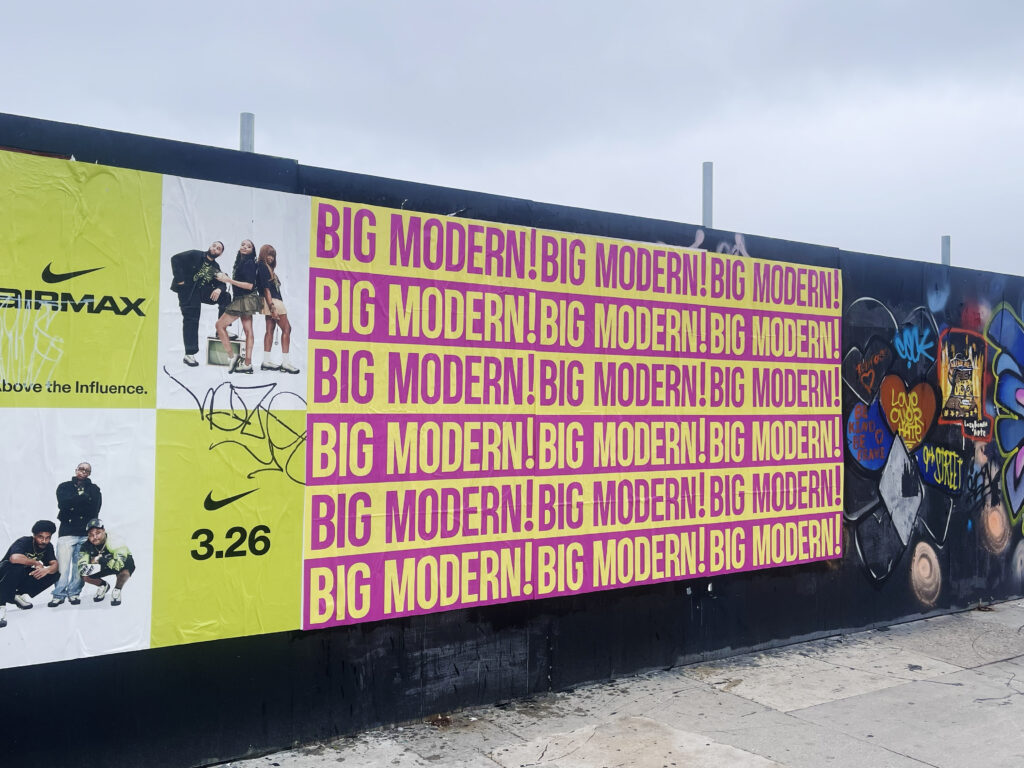
Walk through SoHo on a Monday morning after a weekend campaign push and you’ll see it: a 48×72 poster on a construction barrier, clean paper, sharp colors, impossible to miss. Walk past that same block on Friday and there are four more posters from two other brands. That’s wheatpaste advertising at work. Not a billboard lease. Not a permit application that takes six weeks. Just paper, paste, and a crew that knows the city.
Wheatpaste advertising has been moving product and building awareness for brands since before digital existed. It’s older than television. It’s cheaper than most media placements. And in dense urban markets, it still outperforms formats that cost ten times as much. This guide covers everything from what it actually is to how campaigns run from brief to photo documentation, with real pricing numbers and the specific neighborhoods where it performs best.
What Wheatpaste Advertising Is (And What It Isn’t)
Wheatpaste advertising is the practice of affixing paper posters to walls, construction barriers, scaffolding, and other urban surfaces using a paste made from wheat flour and water. The paste acts as both adhesive and sealant. A poster applied correctly with proper wheatpaste will stay up through rain, wind, and foot traffic for weeks.
The format goes by several names. Wheatpasting. Fly posting. Paste-up advertising. Wheatpaste poster advertising. They all refer to the same basic method: large-format paper printed with bold graphics, applied to a surface in high-pedestrian or high-traffic locations, often in clusters that create visual density.
What it is not: graffiti. Wheatpaste advertising is a print medium. The posters are produced off-site on commercial press or large-format inkjet, transported to the location, and installed with paste and a brush or roller. There is no spray paint, no freehand work, no vandalism in the traditional sense. Properly executed campaigns are run on permitted surfaces with property owner authorization.
What it is not: digital OOH. There’s no screen, no scheduling, no programmatic buy. You don’t get impressions served and rotated to multiple advertisers. When you put up 200 posters on a block, that block shows your creative and only your creative. It doesn’t rotate. It doesn’t share inventory. It sits there at eye level, in context, in the neighborhood where your audience actually walks.
Wheatpaste advertising generates CPMs of $0.50 to $2.00 in dense urban markets, compared to $5 to $25 for most digital display formats.
The distinction matters because brands sometimes confuse the formats. Wheatpaste is tactile, physical, and neighborhood-specific. The authenticity comes from the medium itself, paper on a wall, not from the brand message. That’s what makes it feel credible in cities where people have learned to tune out screens.
How a Wheatpaste Campaign Works: Brief to Documentation
Most brands underestimate how operationally tight a good wheatpaste campaign has to be. Here’s the full sequence, from the conversation that starts it to the report that closes it out.
Step 1: Brief and Market Selection
The campaign starts with a brief covering target audience, launch window, geography, and creative direction. Market selection comes next. Wheatpaste performs differently in different cities. New York and Los Angeles have the densest networks of permitted surfaces. Chicago and Miami have strong specific corridors. Austin punches above its weight for younger audiences.
Within each market, you’re selecting neighborhoods, not just cities. A campaign targeting sneaker buyers in New York goes to Lower East Side, Williamsburg, and maybe Crown Heights. A campaign targeting beauty consumers hits the West Village, Nolita, and Echo Park in LA. The neighborhood-level selection is where experienced agencies earn their fee.
Step 2: Creative Specs and Print
Wheatpaste posters run in two primary formats: 24×36 inches (standard) and 48×72 inches (double-sheet or “large-format”). The 24×36 is the workhorse. It fits most surfaces, stacks well in clusters, and keeps per-unit cost manageable. The 48×72 is the statement piece. It commands attention and reads from across the street.
File specs matter. Paper needs to accept paste cleanly and not bleed or tear when wet. Most campaigns use 60 lb to 80 lb uncoated stock. Glossy finishes don’t adhere as well and tend to peel faster. The file itself should be a high-resolution PDF at actual size with at least 0.25 inch bleed on all sides.
Print lead times run 3 to 7 business days depending on quantity and format. Factoring in shipping to market, you want to build at least two weeks from creative approval to install date.
Step 3: Location Scouting and Surface Selection
Surfaces aren’t interchangeable. A construction barrier on a block with 8,000 daily pedestrians is worth ten times a wall on a side street that only sees delivery traffic. The best surfaces are smooth (concrete, plywood, painted brick), dry, and in locations where people slow down or stop. Bus stops, crosswalk corners, storefront clusters, and transit entrances all generate dwell time.
Permitted surface networks vary by city and agency. An established agency maintains relationships with property owners and building managers who have agreed to accept poster advertising. This is what separates a legal campaign from a guerrilla one.
Step 4: Install
Installs typically run at night or early morning to minimize foot traffic around the crew. A two-person team can install 60 to 80 standard posters in a four-hour shift. Large-format installs require more time per placement and usually a three-person crew for handling the paper.
Paste is mixed on-site or in advance. The surface gets a base coat of paste, the poster goes up wet, a top coat seals the edges and smooths any air pockets. Done right, the poster is nearly impossible to peel cleanly.
Step 5: GPS Photo Documentation
Every placement gets documented. GPS-stamped photos show the location, the condition of the poster at install, and the surrounding context. This documentation serves two purposes: proof of performance for the client, and a record that helps optimize future campaigns. At American Guerrilla Marketing, every campaign comes with a full GPS photo report. You can see exactly where every poster went up and what it looked like post-install.
A properly run wheatpaste campaign generates GPS-documented proof-of-placement for every single poster, not just a handful of sample shots.
Who Uses Wheatpaste Advertising
The short answer: any brand that needs urban credibility, street-level visibility, and a quick turnaround at a price point that doesn’t require board approval.
Entertainment and Film
Movie studios and streaming platforms have used wheatpaste since before the format had a formal name. Album drops, film releases, and streaming premieres all benefit from the format because the install-to-street timeline is fast and the creative is big. A 48×72 movie poster on a construction barrier in Williamsburg reaches the same demographic as a targeted social ad but without the scroll and swipe behavior that buries it. Major studio campaigns for theatrical releases routinely include wheatpaste buys in New York, LA, and Chicago.
Consumer Packaged Goods
CPG brands, especially in beverage, beauty, and personal care, use wheatpaste to drive trial in specific cities before national rollouts. The format lets you concentrate impressions in a tight geography for a short window. A new beverage launching in Austin doesn’t need a national media buy in month one. It needs South Congress, the Warehouse District, and East 6th Street to look like the city already knows the brand.
Fashion and Streetwear
This is the category where wheatpaste runs deepest. Streetwear brands have been using fly posting since the format existed. Supreme, Off-White, and dozens of independent labels have built entire campaign strategies around street-level poster advertising because it speaks the same visual language as the culture they’re marketing to. You can’t manufacture credibility in a high-traffic urban corridor by buying a digital billboard. You earn it by showing up where the community walks.
Tech and App Launches
Consumer tech companies targeting urban early adopters use wheatpaste for launch windows. The format concentrates awareness in the exact neighborhoods where tech-forward audiences live and commute. A fintech app targeting 25 to 35-year-old professionals in New York might run 300 posters across the Financial District, Midtown East, and Long Island City over a two-week launch window.
Nonprofits and Advocacy
Organizations running awareness campaigns, fundraising drives, and public health messaging use wheatpaste because the cost per impression is low and the visual impact is high. A nonprofit can run 150 posters in a target neighborhood for a fraction of what a transit shelter buy costs, and the street-level placement often lands harder with the community the campaign is trying to reach.
Why Brands Choose Wheatpaste Over Other OOH Formats
Wheatpaste isn’t the right format for every campaign. But when the conditions are right, it outperforms almost everything else at its price point. Here’s why brands keep coming back to it.
Cost
Compared to painted murals, transit shelters, or traditional billboards, wheatpaste is inexpensive. You’re paying for print, labor, and placement rights. There are no long-term lease commitments, no digital infrastructure fees, and no revenue share arrangements. A campaign that would cost $40,000 in transit shelter placements can often be replicated in coverage area and impressions with a $7,500 wheatpaste buy.
Speed
From approved creative to posters on the street can be as fast as five to seven business days. That kind of turnaround is impossible with almost any other OOH format. For brands working around launch windows, event tie-ins, or reactive cultural moments, speed is often the deciding factor.
Authenticity
There is a credibility signal embedded in a paper poster on a wall that no digital format can replicate. It’s the same visual language as the city itself. Galleries, music venues, independent businesses, political campaigns, and cultural institutions have all used this format. When a brand shows up in that context, it borrows some of that credibility. That doesn’t happen with a banner ad.
Placement Flexibility
A permitted surface network in a city like New York can cover hundreds of locations across every major neighborhood. You’re not locked into the inventory that a media company controls. An experienced agency can put your poster on the specific block in the specific neighborhood where your audience walks. That level of geographic targeting is something media planners rarely get to do with traditional OOH formats.
No Rotation
Billboards and transit shelters typically rotate multiple advertisers. Your ad runs for a percentage of available display time. A wheatpaste poster is there until it comes down. If you put up 200 posters, 200 placements show your creative 24 hours a day for the campaign window.
Wheatpaste Advertising Costs
Pricing for wheatpaste advertising depends on format, quantity, market, and whether you need design services. Here’s how it breaks down for campaigns run through American Guerrilla Marketing.
Standard Format: 24×36 Inches
Campaigns at the 24×36 format start at $4,500 for 100 posters. That includes print, paste, crew labor, and GPS photo documentation. At 100 placements in a dense urban market like New York or Los Angeles, you’re looking at a CPM in the $0.50 to $1.50 range depending on the specific locations and foot traffic levels.
Large Format: 48×72 Inches
The 48×72 format runs at $10,500 for 100 posters or $13,500 for 200 posters. These are the placements that stop people cold. At nearly four feet wide and six feet tall, a 48×72 poster on a construction barrier reads from across the street and registers before a pedestrian has time to make the conscious choice to look at it.
Design Add-On
If you need print-ready files created, design services are available at $650 for the 24×36 format and $750 for the 48×72 format. This covers layout, typesetting, and file prep for print. It does not include brand development or concept creation. You should bring a finished concept; this service gets it production-ready.
Format
Quantity
Price
Est. CPM
24×36 inches
100 posters
$4,500
$0.50 – $1.50
48×72 inches
100 posters
$10,500
$0.75 – $2.00
48×72 inches
200 posters
$13,500
$0.50 – $1.50
Design (24×36)
Per project
$650
—
Design (48×72)
Per project
$750
—
What Affects Price
Geographic market affects pricing. New York and Los Angeles carry a premium because surface costs, crew rates, and logistics are higher than in secondary markets. A campaign in Austin or Nashville at the same poster count will typically run at a lower total cost than the same buy in Manhattan.
Timing also matters. A campaign with a two-week lead time runs at standard rates. Rush installs, where you need posters on the street in under five business days, carry an expedite fee. If you’re launching around a specific event or cultural moment, build the timeline accordingly.
Repeat campaigns and multi-city buys offer better economics per placement. If you’re running 300 posters across three cities, the blended cost per placement will be lower than three separate 100-poster orders.
At $4,500 for 100 placements in New York City, wheatpaste advertising delivers a cost per placement of $45, compared to $300 to $500 for a single transit shelter showing.
Cities Where Wheatpaste Advertising Performs Best
Wheatpaste works in any city with dense foot traffic and a culture of street-level visual communication. Some markets are better than others, and within each market, some neighborhoods deliver significantly better results than others.
New York City
New York is the strongest wheatpaste market in the country by a wide margin. The city has the highest pedestrian density, the most permissive surface culture, and an audience that has been trained by decades of street poster advertising to actually read what’s on the wall. Top-performing neighborhoods include: SoHo and Nolita for fashion, beauty, and lifestyle brands; Williamsburg and Bushwick for music, entertainment, and streetwear; Lower East Side for culture and nightlife adjacency; Midtown West and Hell’s Kitchen for entertainment releases; Crown Heights and Bed-Stuy for community-facing campaigns targeting Black and Caribbean audiences.
Construction barriers on active building sites are the best surfaces in New York. The city has an enormous amount of active construction at any given time, creating fresh, smooth, high-visibility surfaces on heavily trafficked blocks.
Los Angeles
LA requires more geographic precision than New York because the population is more spread out. The best-performing corridors are Silver Lake and Los Feliz for music and entertainment; Echo Park and Highland Park for young adults and the art-adjacent crowd; West Hollywood and Melrose for fashion; Fairfax and La Brea for streetwear and sneaker culture; Venice and Abbot Kinney for lifestyle and wellness brands. On the Westside, Santa Monica proper has strong foot traffic near the Third Street Promenade and Main Street.
Chicago
Chicago’s strongest wheatpaste corridors run through Wicker Park and Bucktown on the north side, which carry dense foot traffic from young adult residents, bars, and independent retail. Logan Square has been growing as a creative hub. Pilsen, on the south side, is the right neighborhood for campaigns targeting Latino audiences and arts-adjacent consumers. The Loop generates volume but is more competitive and tends to be better suited to transit advertising than street-level paste-ups.
Miami
Wynwood is the anchor market for wheatpaste in Miami, and it’s genuinely one of the strongest neighborhoods in the country for the format. The street art culture is embedded in the neighborhood’s identity, and brands that show up in Wynwood are seen as culturally aware rather than out of place. Little Havana has strong community density. Brickell targets the finance and professional crowd. South Beach has high tourist traffic but can feel less authentic for brands targeting locals.
Austin
Austin performs well for wheatpaste relative to its size. The South Congress corridor has strong foot traffic and a neighborhood character that rewards interesting creative. East 6th Street and the East Austin arts corridor are good for music, beverage, and lifestyle brands. The Warehouse District works for event and entertainment tie-ins. Austin’s pedestrian density is lower than the major coastal markets, so surface selection and neighborhood targeting matter more here than anywhere else.
Nashville, Atlanta, and Other Markets
Nashville’s Broadway corridor and East Nashville have become solid wheatpaste markets as the city has grown. Atlanta’s Old Fourth Ward, Ponce City Market area, and Westside are strong for brands targeting younger urban consumers. These secondary markets often deliver better results per dollar than primary markets because there’s less competing poster clutter and the audiences are less ad-saturated.
How to Find a Wheatpaste Advertising Agency
The quality gap between agencies in this space is significant. There are crews doing guerrilla installs on unpermitted surfaces and calling it a “marketing campaign.” There are vendors who deliver low-resolution proof photos from a single location and claim coverage across an entire market. Here’s what to look for and what to avoid.
What to Look For
Permitted surface networks. A legitimate wheatpaste agency has signed agreements with property owners for specific surfaces. Ask them directly: “Are these permitted placements?” If the answer is vague or hedging, that’s a problem. You are liable for the placements your vendor makes on your behalf, even if you didn’t know they were unpermitted.
GPS photo documentation. This is non-negotiable. Every placement should be photographed with GPS metadata. If an agency delivers a stack of unverified photos at the end of a campaign, you have no way to confirm the placements were real, in the stated locations, or installed at the claimed quantity.
City-specific experience. Ask for examples from the specific city you’re running in. Wheatpaste in New York requires different surface knowledge, crew management, and permit relationships than wheatpaste in Austin. A vendor that claims to do everything in every market from a single office without local crews should be questioned carefully.
Clear pricing. A good agency will give you a quote that breaks down print, labor, placement fees, and documentation. If someone gives you a lump sum with no line items, you don’t know what you’re paying for.
Red Flags
Refuses to confirm whether surfaces are permitted
Can’t provide GPS-stamped documentation from previous campaigns
Quotes a price with no breakdown and no explanation of what’s included
Guarantees specific traffic numbers without being able to explain the methodology
No local presence in the market they claim to cover
Pushes you to approve creative in 24 hours with no discussion of specs or print requirements
How American Guerrilla Marketing Runs Wheatpaste Campaigns
At American Guerrilla Marketing, wheatpaste campaigns follow a production model built around accountability and measurable results. Here’s what the process looks like end to end.
When a campaign comes in, the first conversation is about geography and timing. We establish which markets, which neighborhoods, and what the install window looks like. From there, we confirm the creative specs and brief the print order. Our standard lead time from creative approval to install is five to seven business days, with rush options available.
Our surface networks in New York, Los Angeles, Chicago, Miami, Austin, Nashville, and Atlanta cover permitted locations with documented authorization. We know which surfaces perform best in which neighborhoods because we’ve been running campaigns in these cities long enough to have real performance data. That means your 100 posters go to the 100 best locations in your target neighborhood, not just the 100 available spots.
Install crews are local to each market. We don’t fly a New York crew to Chicago. Local crews know the city, know the surfaces, and can respond to site-level issues without delay.
After install, every campaign gets a GPS photo report. Each placement is photographed on install with location data embedded in the file. The report shows street address, photo timestamp, and visual confirmation of the poster in place. You’re not taking our word for it. You’re looking at documentation.
For brands running multi-city campaigns, we coordinate timelines across markets so installs align with launch windows. A brand opening a campaign in New York on a Tuesday and Los Angeles on a Wednesday can have posters in both markets within the same 48-hour window if production is planned correctly.
American Guerrilla Marketing runs wheatpaste campaigns in seven U.S. markets with GPS photo documentation on every single placement.
Frequently Asked Questions About Wheatpaste Advertising
Is wheatpaste advertising legal?
It depends entirely on whether the surfaces are permitted. Wheatpaste advertising on surfaces where the property owner has given authorization is completely legal. Posting on surfaces without permission constitutes illegal posting, which can result in fines and cleanup liability for both the vendor and the brand. American Guerrilla Marketing operates exclusively on permitted surfaces. When you work with a reputable agency, you’re running a legal campaign.
How long do wheatpaste posters stay up?
Properly installed wheatpaste posters on smooth surfaces typically last two to four weeks in normal urban conditions. Rain accelerates wear at the edges but rarely causes immediate failure on a well-installed poster. Sun and foot traffic cause gradual degradation. Most campaign windows are planned for two to three weeks, which aligns well with the natural lifecycle of the format.
What is the difference between wheatpaste advertising and wheatpasting?
The terms are often used interchangeably. Wheatpasting is the broader category that includes any large-format street poster campaign. Wheatpaste specifically refers to the adhesive method: using a flour-and-water paste to affix the poster. In practice, most wheatpasting campaigns use wheatpaste or a commercial paste equivalent. If you hear either term from an agency, confirm what adhesive they use and whether the surfaces are permitted.
What is the minimum budget for a wheatpaste campaign?
American Guerrilla Marketing’s standard 24×36 wheatpaste campaign starts at $4,500 for 100 posters. That’s the entry point for a single-market campaign with full documentation. Campaigns with larger poster quantities, larger formats, or multiple cities will scale from there. If a vendor is quoting you significantly below that for a “full campaign,” ask for a detailed breakdown of what’s actually included.
Which poster format performs better, 24×36 or 48×72?
It depends on the campaign objective and the surfaces available. The 24×36 is better for building density and saturation across a neighborhood. You can put up more placements at a lower per-unit cost and create a pattern of visibility that makes the brand feel present everywhere. The 48×72 is better when you want a single placement to make a strong visual statement. Many campaigns use a combination: a large-format anchor placement at a key intersection supported by a cluster of standard-format posters in the surrounding blocks.
Do I need to provide print-ready files or can AGM handle design?
Both options are available. If you have print-ready files, you provide the files and we handle everything from print through documentation. If you need design, AGM offers design services at $650 for 24×36 files and $750 for 48×72 files. Design services cover layout and print preparation, not brand concept development. The strongest campaigns come in with a finished concept and use the design service to make sure the files are production-ready at the correct specs.
Can I run a wheatpaste campaign in multiple cities at once?
Yes, and multi-city campaigns are common. Entertainment releases, product launches, and tour campaigns often require simultaneous installs in New York, Los Angeles, Chicago, and other markets within the same week. American Guerrilla Marketing coordinates multi-market campaigns as a single project, with unified timelines and a combined GPS documentation report for all markets. Pricing on multi-city buys is more favorable per placement than running separate single-market orders.
How do I measure the results of a wheatpaste campaign?
You won’t get a dashboard with click-through rates. Wheatpaste is an awareness format, and measurement works differently than digital. The primary accountability tool is GPS photo documentation confirming every placement. Beyond that, brands measure results through foot traffic lift at nearby retail, branded search volume changes during the campaign window, social media photo mentions from people photographing the posters, and direct attribution surveys. Some brands also run before-and-after brand awareness surveys in campaign markets to quantify awareness lift. The format drives real-world behavior, and measurement strategies should match the medium.
Questions about wheatpaste advertising campaigns? Contact American Guerrilla Marketing at (646) 776-2770 or visit our contact page. We run campaigns in New York, Los Angeles, Chicago, Miami, Austin, Nashville, and Atlanta.