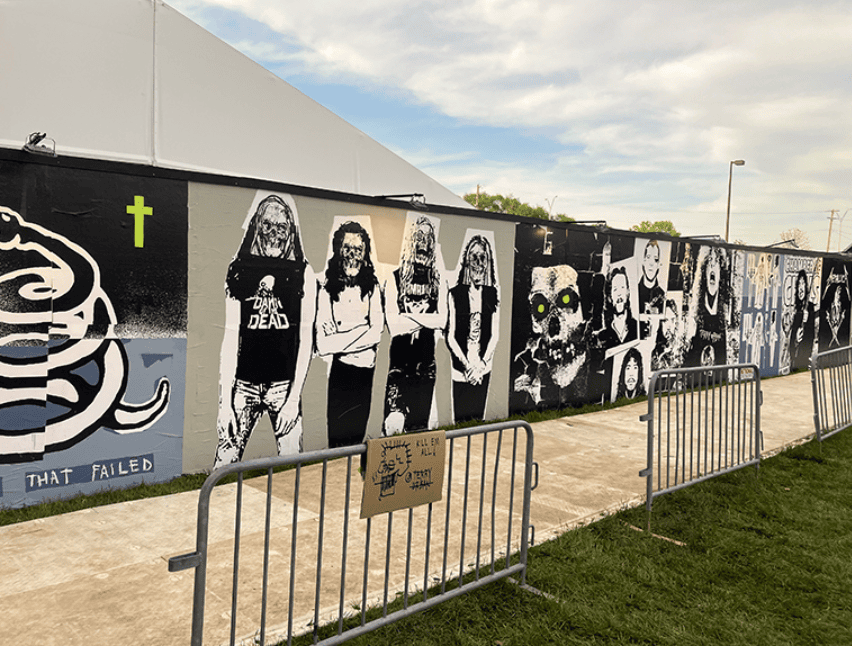
We have painted murals on buildings in Bushwick, on warehouses in Long Island City, on the brick facades of coffee shops on Bedford Avenue in Williamsburg, and on the side of a restaurant on Flatbush Avenue in Crown Heights. Our crews have worked in summer heat and early spring cold, mixing colors on tarps on the sidewalk, working from lift gates and ladders, and producing hand-painted and vinyl-applied murals that have become part of the visual identity of their neighborhoods.
Mural advertising is not a new format. Painted building advertisements have been part of New York City’s visual history for well over a century. What has changed is the sophistication of how brands approach them and the scale of the social media amplification that a well-placed, well-executed mural can generate. A branded mural in the right location in Bushwick or Williamsburg can earn hundreds of thousands of social media exposures from organic photography and sharing, without a single dollar of paid promotion. The mural just sits there, on the wall, doing the work.
This guide covers the full scope of mural advertising: the formats we execute, the neighborhoods we work in, how we approach the design and production process, what brands should expect to invest, and how mural advertising compares to other outdoor formats on the metrics that matter most.
What Mural Advertising Delivers That Other Formats Cannot
Permanence and Presence
A painted mural on a building wall has a presence that no poster, transit shelter, or digital screen can replicate. It is part of the building. It becomes part of the neighborhood. When a mural is executed well, locals stop thinking of it as advertising. They think of it as a feature of the block. That shift from “ad” to “landmark” is the most powerful thing mural advertising can do for a brand.
The permanence of a well-maintained mural means it continues working for the brand long after the campaign period a traditional media buy would cover. Murals we painted three years ago in Williamsburg still generate social media photography from passersby who have no awareness they are looking at a branded installation. The building owner is happy. The neighborhood has a piece of art. The brand has an ongoing presence. When all three parties are satisfied, the installation endures.
Social Media Amplification at Scale
Instagram and other visual platforms have transformed what a mural can deliver for a brand. Before social media, a mural reached the people who walked past it, period. Now, when someone photographs a compelling mural and posts it to their Instagram story or feed with a location tag, the mural’s reach extends to every one of their followers. In neighborhoods like Bushwick, where mural photography is part of the local visual culture, a single strong installation can generate thousands of organic social exposures from independent photographers and neighborhood residents in the first week after painting.
We design murals with the photograph in mind. Before a brush touches the wall, we ask: what is the image that someone will take from the sidewalk in front of this mural? What is the background? What is the light doing at different times of day? How does the brand element integrate into the composition in a way that reads naturally in a social media photograph? These questions shape the design as much as the brand brief does.
Neighborhood Integration and Brand Credibility
A brand that commissions a mural in a neighborhood is investing in that neighborhood. When the mural is designed with authentic artistic intent rather than purely commercial intent, the neighborhood receives it differently than it receives a billboard or transit shelter. The mural becomes a point of local pride when it is done well. That neighborhood integration carries a credibility that no media buy can manufacture. Brands that have invested in mural advertising in communities across New York City over multiple years often find that those murals have become their most valuable long-term brand assets in those communities.
Where We Execute Mural Advertising Campaigns in NYC
Bushwick and the Brooklyn Mural Corridor
Bushwick is the capital of New York City’s outdoor mural culture. The streets around the Morgan Avenue L train station, specifically the blocks of Troutman Street between Wyckoff and Irving Avenues, Jefferson Avenue east of Wyckoff, and Flushing Avenue between Wyckoff and Knickerbocker, constitute one of the most densely muraled corridors in the world. We have painted brands on walls in this zone and watched the installations become regular fixtures in the neighborhood’s photographic culture.
The Bushwick Collective has been the primary organizing force behind the neighborhood’s mural program, and brands that want to paint in Bushwick benefit from the permission framework and community relationships the Collective has running with property owners throughout the neighborhood. We navigate that framework on behalf of our clients and manage the property owner relationship from initial conversation through final payment.
Beyond the Collective’s primary blocks, Bushwick’s Myrtle Avenue corridor, the Rheingold development area east of Cypress Hills, and the Knickerbocker Avenue commercial strip all offer wall inventory that works well for brand mural campaigns targeting the neighborhood’s diverse demographic mix.
Williamsburg and the North Side
Williamsburg’s mural and street art culture is concentrated on the north side of the neighborhood, in the blocks between the Williamsburg Bridge and McCarren Park. The Kent Avenue corridor between North 3rd and North 12th Streets carries significant wall inventory on the backs of converted warehouse buildings. The Bedford Avenue-adjacent blocks on the side streets between Metropolitan Avenue and North 9th Street have visible walls facing residential foot traffic that holds mural placements well.
The East River waterfront area in North Williamsburg, specifically the walls visible from the waterfront park near the North 5th Street Pier, offers high-visibility placement that reaches the waterfront’s weekend visitor traffic. A mural facing a public waterfront space is seen by everyone who uses the park, more than the people moving along a specific street corridor.
Long Island City and the Queens Arts District
Long Island City’s arts district, anchored by the MoMA PS1 at Jackson Avenue and 46th Avenue and extending north along the Vernon Boulevard waterfront, has emerged as one of the city’s strongest mural advertising markets. Property owners in LIC have been receptive to mural commissions for years, and the concentration of gallery visitors, creative industry workers, and Amazon and media company employees in the neighborhood creates a higher-income, creative-class audience than most outer borough neighborhoods.
The walls along Jackson Avenue between Pearson Street and 44th Drive, the facades of the converted factory buildings on Vernon Boulevard, and the warehouse walls on 48th Avenue between Vernon and 5th Street all hold large-scale mural work well. The proximity to Manhattan via the 7 train and the East River ferry means these LIC locations reach a mixed audience of local residents and Manhattan visitors on weekends.
Crown Heights and Prospect Lefferts Gardens
Crown Heights has developed a strong mural culture along the Franklin Avenue and Kingston Avenue corridors. The Flatbush Avenue corridor between Atlantic Avenue and Empire Boulevard carries both commercial wall inventory and significant foot traffic from the neighborhood’s dense residential base. Brands targeting a Brooklyn-wide audience find that Crown Heights placements reach a demographic mix that Williamsburg and Bushwick placements miss.
Property owners along the Franklin Avenue Vintage Strip, the blocks of Franklin between Lincoln Place and St. Johns Place, have been actively commissioning murals on their commercial properties, and the neighborhood’s visual culture has grown around those installations. We have running relationships with several property owners on this corridor that give us preferred access for brand mural commissions.
Harlem and Upper Manhattan
Harlem’s Frederick Douglass Boulevard corridor, specifically the stretch between 116th and 125th Streets, has significant wall inventory on the backs and sides of commercial buildings. The 125th Street corridor itself, from St. Nicholas Avenue east to the Triborough Bridge approach on Lexington Avenue, carries some of Upper Manhattan’s highest-visibility wall placements. A mural on 125th Street reaches the foot traffic of one of Manhattan’s most active commercial corridors.
The East Harlem corridor on Lexington Avenue between 110th and 125th Streets has a long history of community mural production, and brand murals that engage honestly with the neighborhood’s cultural identity and history are received well. Brands that treat East Harlem walls as simply another inventory location without engaging with the community tend to face more friction. We manage the community relationship process as part of every Harlem mural commission.
Mural Advertising Production: How We Do the Work
Site Selection and Property Owner Agreements
Every mural advertising campaign begins with wall scouting. We identify walls that meet four criteria: size appropriate for the design concept, surface condition suitable for the selected production method, viewing angle that maximizes visibility from the primary pedestrian and vehicle sightline, and a property owner relationship we can secure before committing the wall to the client’s campaign map.
Property owner agreements for mural advertising are typically structured as a licensing arrangement. The property owner licenses the wall surface for a defined period, usually one to three years. We negotiate these agreements on behalf of the client and manage all communications with the property owner through the campaign period. When the license expires, we manage the renewal discussion or, if the campaign has concluded, the removal or overpainting process.
Design Development and Mural Concept
The design process for a mural advertising campaign starts with a wall measurement and photograph session. We measure the exact dimensions of the wall surface, note any architectural features that affect the design, photograph the wall at multiple times of day to understand the light conditions, and photograph the view from the primary sightline so the design team can see what the mural will look like in context.
From those materials, our design team develops a mural concept. We present two to three directions at the first review, each reflecting a different approach to integrating the brand elements into the mural aesthetic. The client selects a direction, we refine it through one or two additional rounds of review, and the final approved design goes to production prep.
Production prep for a hand-painted mural involves scaling the design to the exact wall dimensions and creating a grid or projection system the painters use during installation to transfer the design from the small-scale mockup to the large-scale wall. For vinyl-applied murals, the production prep involves file preparation and print production with our Long Island City print partners.
Hand-Painted vs. Vinyl Mural Production
We execute murals using two primary production methods: hand-painting and vinyl application. Each has distinct advantages depending on the brand objective, the design aesthetic, and the wall surface.
Hand-painted murals have a warmth and texture that vinyl cannot replicate. The organic qualities of brushwork, color mixing, and surface texture give hand-painted murals an authenticity that signals to the neighborhood that the brand invested in craft rather than just in coverage. In neighborhoods like Bushwick and Williamsburg where the visual culture values hand-made quality, the hand-painted approach consistently earns more neighborhood acceptance and social media engagement than vinyl. Hand-painting is more labor-intensive and therefore more expensive, but the investment shows in the result.
Vinyl-applied murals offer precise color reproduction and faster installation timelines. A vinyl mural can be produced with photographic-quality imagery and fine detail that would take a hand-painted mural team significantly more time to reproduce. For brands whose visual identity depends on precise color matching or photographic imagery, vinyl is the appropriate production method. Installation of a vinyl mural is typically faster than a hand-painted mural of comparable size, which matters for campaigns with tight timelines.
Installation Logistics
Mural installation requires access to the wall surface, which means a lift gate for walls above 15 feet or a scaffolding setup for taller walls. We manage all equipment rental and operator licensing as part of the production process. Our installation crews work during daylight hours for hand-painted murals, requiring coordination with the property owner and adjacent businesses when the lift gate or scaffolding occupies sidewalk space.
A standard 15 by 30 foot hand-painted mural takes three to five days of installation time with a two-person crew, depending on design complexity and weather conditions. A vinyl mural of comparable size typically installs in one to two days. We build weather contingency days into every outdoor mural installation schedule, because New York weather during any month of the year can interrupt exterior work.
Mural Advertising Pricing and Format Comparison
Mural Campaign Investment
Mural Advertising Investment, New York City Market
Mural Type
Size Range
Production Method
Includes
Investment Range
Small Feature Mural
10×15 ft
Hand-painted
Design, paint, install, documentation
$8,000 to $15,000
Standard Brand Mural
20×30 ft
Hand-painted
Design, paint, install, 1-year license
$18,000 to $35,000
Large-Scale Mural
40×60 ft
Hand-painted
Design, scaffolding, paint, 1-year license
$40,000 to $80,000
Vinyl Brand Mural
20×30 ft
Vinyl application
Design, production, install, documentation
$12,000 to $25,000
Large Vinyl Installation
40×60 ft
Vinyl application
Design, production, install, lift gate
$25,000 to $55,000
Multi-Wall Campaign
Custom
Mixed
Full service, multi-location
From $60,000
License fees for wall surfaces are not included in the ranges above and vary significantly by neighborhood and property owner. In high-demand locations on running mural corridors, property owners may charge no license fee in exchange for receiving a free artwork that improves the building’s visual presence. In prime commercial locations with high visibility, license fees can range from $500 to $3,000 per month. We negotiate license terms on behalf of the client as part of the wall sourcing process.
Mural Advertising vs. Other Outdoor Formats
Outdoor Advertising Format Comparison for Brand Presence
When measured on a cost-per-month-of-presence basis, mural advertising is one of the most cost-efficient outdoor formats available in the New York market. A well-maintained hand-painted mural on a prime wall in Bushwick or Williamsburg that remains in place for three years costs a fraction per month compared to a transit shelter buy, and it generates significantly more social media coverage and neighborhood credibility over that period.
Measuring Mural Advertising Impact
Social Media Reach and Photography Tracking
We track social media impact for mural advertising campaigns using location tag monitoring and brand mention tracking in the neighborhoods where our murals are installed. After a mural launches, our team monitors Instagram location tags for the street address, the neighborhood name, and any relevant hashtags for the first 30 days to establish a baseline pickup rate. This monitoring continues monthly for the duration of the campaign license.
On campaigns where the brand has a specific social media objective, we incorporate a QR code or a unique URL into the mural design at a natural integration point and track inbound traffic from that code as a direct attribution metric. We have tracked QR engagement rates of 1 to 3 percent of estimated daily passersby from high-visibility mural locations in Bushwick and LIC, which compares favorably to most digital display formats on a cost-per-click basis.
Press Coverage and PR Value
Brand murals at high-visibility locations in notable neighborhoods generate press coverage at a rate significantly higher than other outdoor advertising formats. We have had mural installations covered by Hypebeast, Adweek, the New York Times Styles section, Time Out New York, and numerous neighborhood and culture publications without any paid media placement. The press coverage from a single editorial mention in a national publication can reach millions of readers and provide a brand credibility signal that a media buy cannot.
For brands where press coverage is a primary objective, we design the mural concept and location selection with editorial appeal in mind. Murals at historically significant locations, collaborations with artists who have their own press following, or designs that connect authentically to a cultural conversation all generate more editorial interest than generic brand murals at standard commercial locations. We brief the press strategy alongside the creative concept so both are working toward the same objective.
Foot Traffic and Retail Impact
For brand murals near retail locations, we track foot traffic changes in the retail location during the period following the mural installation. Point-of-sale data correlation with campaign launch dates provides the clearest picture of mural-driven retail impact. Brands that have painted murals within a block of a retail location in neighborhoods like Bedford Avenue in Williamsburg and Smith Street in Carroll Gardens have reported foot traffic increases of 10 to 25 percent in the months following installation, though this attribution is directional rather than definitive given the other factors that affect retail foot traffic.
Frequently Asked Questions
How long does it take to produce and install a mural?
From initial brief to finished installation, a standard 20 by 30 foot hand-painted mural takes five to eight weeks. That timeline covers wall scouting and property owner negotiation, design development and client review, mural prep and production logistics, and a three-to-five-day installation period. Vinyl murals can move faster, often four to six weeks from brief to completion. Rush timelines ar
Can we use an existing artist collaboration for the mural design?
Yes. If your brand already has a relationship with an artist whose work fits the mural brief, we work with that artist directly. We manage the design development process, the production prep, and the installation logistics. The artist focuses on the creative. We handle everything operational. If you want our help identifying an artist whose work fits both the brand brief and the neighborhood, we m
What happens to the mural when the license period ends?
At the end of the license period, we discuss the options with the property owner and the brand. If both parties want to renew the license, we negotiate renewal terms. If the brand campaign has concluded and the property owner wants a fresh installation, we can commission a new mural on behalf of the brand or facilitate the wall being opened to a new artist. If removal is required, we manage the ov
Can you paint a mural indoors as well as outdoors?
Yes. We execute interior murals in retail spaces, offices, restaurants, bars, and event venues across New York City. Interior murals follow the same design and production process as exterior work and typically install faster because weather and lift equipment are not factors. Interior murals are a strong option for brands that want a permanent brand presence in a specific commercial space, for res
How do we find the right wall for our brand?
Wall sourcing is one of the most valuable things we do. The right wall for a brand depends on the target audience, the neighborhood visual culture, the physical dimensions required by the design, and the property owner relationship. We maintain ongoing relationships with property owners across Brooklyn, Manhattan, and Queens who have hosted murals previously and who are open to new commissions. We
How do you protect a mural from vandalism?
We apply a clear anti-graffiti topcoat to all exterior murals as a standard production step. This coating makes it significantly easier to remove graffiti tags from the surface of the mural without damaging the underlying paint. We also monitor the installation on a monthly basis and respond to vandalism within 48 hours of documentation. In high-vandalism zones, we coordinate with property owners
Can a mural campaign work in conjunction with other advertising formats?
Yes, and we design multi-format campaigns around mural anchor placements regularly. A brand mural in Bushwick combined with wheat paste poster runs in the surrounding blocks creates a layered street-level presence that reinforces the brand message at multiple scales and contact points. Adding a street team activation near the mural location on a high-foot-traffic day creates a third touchpoint tha