College Campus Advertising: Reach Students Where They Are
College students do not watch linear TV, run ad blockers, and scroll past digital display before it registers. But they do walk to class. They hang out on the same blocks every day. That is where this work happens.
College students are one of the hardest audiences to reach through traditional channels. They do not watch linear TV. They run ad blockers. They scroll past digital display before it even registers. But they do walk to class. They eat lunch on the same streets every day. They hang out in the same neighborhoods, the same coffee shops, the same two or three blocks between campus and the subway. We have been building college campus advertising campaigns for over a decade, and the fundamental insight has not changed: if you want to reach students, you have to show up where they live.
American Guerrilla Marketing runs street-level campus campaigns near major universities across the United States, from the NYU corridor along Broadway and Washington Square Park in Manhattan’s Greenwich Village to the USC campus perimeter on Figueroa Street in South Los Angeles. We plan campaigns around the academic calendar, deploy experienced field crews, and measure results with brand recall surveys rather than rough estimates. This guide covers how campus advertising actually works, which formats perform best, which campuses we operate near, and how we structure every campaign from the first conversation to the final post-campaign report.
Why College Campus Advertising Requires Its Own Approach
Campus advertising is not a subset of out-of-home advertising. It is a distinct discipline with its own rules. The audience is concentrated in a tight geographic footprint. A single university campus might house 20,000 students, all moving through the same handful of streets, transit stops, and pedestrian corridors every single day. That density creates real opportunity. It also creates a skeptical, socially aware audience that will reject anything that feels generic, corporate, or out of place.
Students talk to each other. When a campaign resonates, word spreads fast, across residence halls, through group chats, on social feeds. When a campaign misses, that spreads too. The stakes for execution quality are higher than in a general out-of-home buy. A banner that looks like it belongs in a suburban shopping mall will not land on a college campus. You need to show up in a way that feels earned and authentic to the specific campus culture.
The other defining characteristic of campus advertising is pure physicality. The brands that win on campus do it by creating physical moments, real interactions, tangible experiences. A street team that hands something useful to students walking to an 8am lecture. A poster campaign that is visually distinct enough to cut through a crowded board that students pass every day. A projection on the building across from the library on a Tuesday night in October. The throughline is always presence. Not digital presence. Physical presence, in the right place, at the right time, for the right audience.
This also means campus advertising demands operational specificity. Knowing that Columbia students walk north on Broadway between 10am and 11am after a major morning lecture block. Knowing that NYU’s heavy pedestrian window near Washington Square is between 9am and 10am on Tuesday and Thursday mornings. That level of operational knowledge is what separates a campaign that performs from one that just fills a time slot.
The Academic Calendar Is Your Production Schedule
Every campus campaign we build starts with the same question: what is the window? The academic calendar creates hard constraints and clear opportunities that most brand teams do not fully account for when they are planning. Here is how we think through the calendar:
Move-in week and orientation, typically the last week of August running into the first week of September, is the highest-value window on the campus calendar. Students are forming new habits. They are exploring neighborhoods they have never lived in before. They are receptive to discovering brands in ways they simply will not be once the semester routine sets in. A strong presence during move-in week plants a brand flag that can last all four years of a student’s relationship with that campus.
The first six weeks of the fall semester, roughly September 1 through mid-October, is prime time for campus advertising. Students are settled but still curious. They are building social lives, spending money establishing themselves, and actively engaging with their new environment. This is when experiential sampling, street teams, and high-visibility placements produce the strongest results we see all year.
Late October through early November gets harder. Midterms compress student schedules and dampen receptivity. The first week of November can still work for the right campaign, but the window narrows considerably. December is generally unproductive for campus work, especially the final three weeks of the semester.
Spring semester opens a second major window, typically January 15 through March 15. Students are back from break, refreshed, and spending again. Valentine’s Day and spring break planning create natural moments for lifestyle, travel, and entertainment brands. March through mid-April is another productive stretch. Late April through May moves into finals territory, and we consistently advise against running campaigns during that period.
College Campus Advertising Formats That Actually Work
We run several core formats for campus campaigns. The right choice depends on the brand, the campaign goal, and the specific campuses in the plan. Most effective campaigns combine two or three formats to create a layered effect across different moments of student life.
Street Teams and Sampling
Street teams are the backbone of campus advertising. Our crews position themselves at high-traffic entry and exit points: subway exits serving campus buildings, main pedestrian gates, the stretch of street between campus housing and academic buildings. The interaction is brief and direct. A crew member engages a student, offers a sample, a coupon, a product, an experience. Done well, it is a genuine brand touch that a student remembers. Done poorly, it is an awkward interaction nobody wanted.
Near NYU, we position crews at the 4th Street and Broadway subway exits, at the main Washington Square Park entry points on 4th Street and West Broadway, and on the residential blocks north toward 14th Street. Near Columbia, we work the 116th Street and Broadway intersection during the morning rush and the post-lecture midday window, and the blocks between 110th and 120th Streets on both Broadway and Amsterdam Avenue. The crew needs to be where students actually walk, not where a map suggests they might walk.
Sampling programs add a product dimension that pure street team work does not achieve on its own. We have run food and beverage sampling near campuses where students pick up breakfast on the way to morning classes. We have run apparel, tech accessory, and personal care sampling near campus housing areas during move-in week. The format works because it creates a real exchange. The student carries something away. The brand gets a trial moment that no digital touchpoint can replicate.
Poster and Board Placements
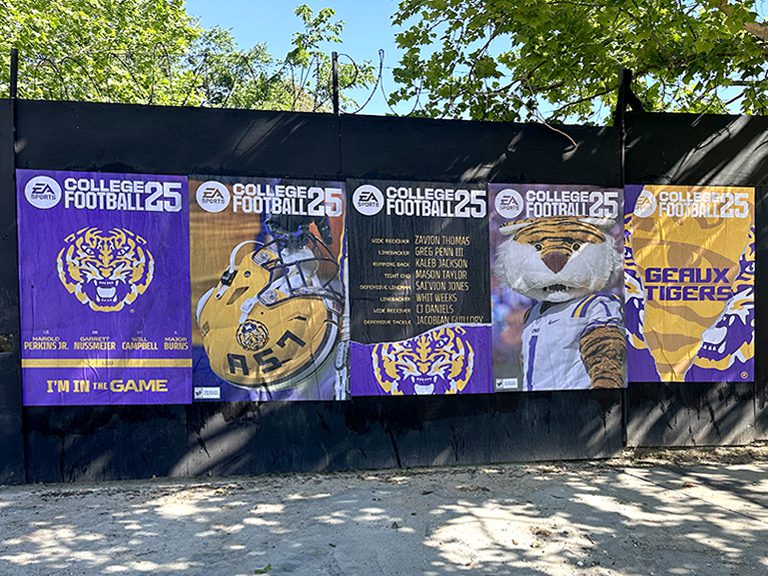
On-campus board placements and off-campus poster placements serve as sustained awareness drivers. They are a different tool than street teams. Where street teams create a direct individual interaction, poster and board placements create repeated visual exposures over days and weeks. A well-designed poster in the right locations becomes part of the visual environment students move through every day, building familiarity through repetition.
Off-campus placements near NYU go on boards and available surfaces along W 4th Street, Bleecker Street, and the Broadway corridor between Houston and 14th. Near Columbia, we work the Broadway and Amsterdam corridors from 110th to 125th, plus the side streets running east toward Morningside Park. These placements catch students during transit, on their way to and from campus, in the moments when they are actually looking at the world around them rather than a screen.
Building Projections
For campaigns with higher production budgets and a specific goal of creating a shareable cultural moment, building projections near campus are extraordinary. A projection on a building facade facing a campus-adjacent park or pedestrian street, running from 9pm to 1am on a Thursday night in September, creates an event. Students photograph it. It circulates through group chats and social feeds. No other format creates that kind of surprise and scale.
We have run projections on SoHo building facades for NYU-targeted campaigns, timed to evening hours when students from nearby residence halls are out in the neighborhood. The visual scale distinguishes projections from everything else in the urban environment. A 40-foot image on a blank brick wall is impossible to ignore and impossible not to photograph. That social amplification effect is unique to this format.
Chalk and Environmental Graphics
Sidewalk chalk graphics and stencil work are lower-cost formats that can cover a large geographic footprint quickly. We place them at campus entry points, at the base of stairways near academic buildings, and on high-pedestrian sidewalks in the surrounding neighborhood. They are short-lived by design, and that ephemerality is part of the appeal. A chalk graphic that appears overnight and is gone in three days creates a moment of discovery for the students who see it. It does not feel like advertising. It feels like something happened.
Where We Run Campaigns Near Major US Campuses
We operate near campuses in every major US market. Here is how we approach the key cities:
New York City
New York has the highest concentration of major university campuses of any American city, which makes it uniquely efficient for campus advertising campaigns. NYU’s Washington Square campus centers on 4th Street and Washington Square East, with student population extending north to 14th Street and east through the East Village. Columbia’s main campus is at 116th Street and Broadway, with graduate student housing south toward 110th and a student pedestrian corridor running all the way up Broadway to 125th Street in Harlem.
Parsons School of Design and The New School concentrate their students around 5th Avenue and 13th Street, with strong daily foot traffic on 14th Street. Fordham Lincoln Center occupies the corner of Columbus Avenue and 60th Street. FIT is on 7th Avenue between 26th and 28th Streets. The density of these campuses in Manhattan means a well-planned multi-day crew deployment can reach multiple student populations across different brand touchpoints in a single campaign window.
Los Angeles
Los Angeles campuses require city-specific crew planning because of the city’s sprawl. USC’s University Park campus sits at Figueroa Street and Jefferson Boulevard, with the University Village mixed-use development along Hoover Street and the Exposition Park neighborhood to the south. Our USC-adjacent campaigns run along the Figueroa Street corridor between Jefferson and Exposition, targeting student traffic moving to and from campus. UCLA’s campus perimeter exits into Westwood Village, concentrated on Westwood Boulevard and Broxton Avenue, where students from the Hill residential area and nearby apartment housing congregate. Le Conte Avenue and Hilgard Avenue are productive secondary corridors for UCLA-targeted street team work.
Chicago
DePaul University’s Lincoln Park campus centers on Fullerton Avenue between Halsted Street and Sheffield Avenue, one of the highest-density student pedestrian corridors in Chicago. Halsted between Fullerton and Armitage is a productive secondary activation zone. The University of Chicago’s Hyde Park campus anchors to 57th Street between Cottage Grove Avenue and Ellis Avenue, with 55th Street’s commercial corridor serving as the off-campus gathering ground for students. Loyola’s Rogers Park campus runs along Sheridan Road, with Granville Avenue as the primary off-campus commercial street where students eat, shop, and gather.
Boston, Austin, and Atlanta
Boston University stretches along Commonwealth Avenue from Kenmore Square all the way to BU Bridge, making Comm Ave one of the most walkable student corridors in America for advertising placements. Berklee College of Music and the Massachusetts College of Art students concentrate around Massachusetts Avenue near Symphony Hall. In Austin, the Guadalupe Street corridor running along the western edge of the UT Austin campus is the primary activation zone, with the 21st to 26th Street stretch being most productive. In Atlanta, Georgia Tech students move through Spring Street and 5th Street. The Atlanta University Center cluster, including Morehouse, Spelman, and Clark Atlanta, concentrates pedestrian student traffic on Fair Street SW and Westview Drive.
College Campus Advertising Formats Compared
Format
Best For
Typical Duration
Primary Strength
Investment Level
Street Teams
Product launch, sampling
1 to 5 days
Direct student interaction
Moderate
Poster Placements
Event promotion, awareness
2 to 4 weeks
Repeated daily exposures
Lower
Building Projections
Brand moments, launches
1 to 3 nights
Shareable, high-impact visual
Higher
Chalk and Stencil Graphics
Awareness, event tease
3 to 7 days
Wide footprint, discovery feel
Lower
Sampling Activations
CPG, food, beverage brands
2 to 5 days
Product trial, brand memory
Moderate
How We Scout Campus Markets Before You Spend
We do not guess at placements. Before any campus campaign goes into production, we validate specific streets, intersections, board locations, and crew positioning through a market scout. We offer focused location scouting, digital or in-person, to identify the exact locations that are right for your campaign. A market scout runs $3,000 per market and delivers a ranked placement report before you spend on production. Post-campaign, we run brand recall surveys to measure awareness lift in your target markets.
The placement report details specific intersections, confirmed board locations, crew positioning times keyed to the actual class schedules at the target campus, and any operational considerations for the formats in the plan. You see exactly what you are buying before production dollars move. That is important for campus campaigns because precision matters more here than in a general out-of-home buy. The wrong block, even one block off the main student corridor, can cut reach significantly. We do not take that risk with your budget.
Timing Crews to Actual Class Schedules
Crew timing on campus campaigns is more specific than general street team work. Students cluster at transit and campus entry points during predictable windows that are driven by class schedules. We build crew deployment schedules around three primary periods: the morning rush between 8am and 10am, the midday block between 11am and 1pm, and the late afternoon window from 4pm to 6pm. Evening hours matter for formats like projections and for brands reaching students who are out socially rather than commuting between class and home.
We research class dismissal times at specific campuses before crew deployment. A 50-minute class that dismisses at 10:50am creates a pedestrian surge at 10:51 on a specific street. A large lecture that dismisses at 2:15pm creates a specific window on a specific corridor. Our crew supervisors know these schedules and position accordingly. This operational specificity is what separates a campus campaign that actually performs from one that simply logs hours on a time sheet.
Measuring College Campus Advertising
We measure campus campaign performance through brand recall surveys, not through pedestrian count estimates or projection calculations. After a campaign runs, we field surveys with students in the target markets to assess awareness lift: did more students in the target demographic recognize and recall the brand after the campaign ran than before? That is the signal that matters.
We do not use foot traffic data as a performance metric. The number of people who walked past a placement does not tell you whether any of them absorbed the message. Brand recall does. It is the cleanest signal available for measuring whether a campus advertising campaign actually moved the needle on awareness in your target demographic.
For programs that include sampling or a direct response component, we also track distribution volume at each location, active engagement rate per crew hour, and any digital conversion tracking built into the campaign via QR codes or focused URLs. The combination of field activity data and post-campaign brand recall gives a complete picture of what the campaign accomplished in the market.
Our campus field crews: Our campus field teams are trained brand representatives, not general temp labor. We brief every crew on the brand, the product, the target demographic, and the specific objectives of the campaign before they set foot on the street. Crew supervisors are experienced field marketers who have run campus campaigns before, in the same markets, on the same streets. They know how to adjust crew positioning and engagement approach based on real conditions on the ground.
Staying Current With Campus Advertising Changes
Campus advertising policies, student media platforms, and effective activation formats evolve continuously as each new student cohort brings different media habits and institutional policies adapt to new advertising formats. Brands that built their campus advertising approach 3 to 5 years ago and have not updated it since are likely working from outdated assumptions about what reaches and resonates with current students. Annual planning reviews that explicitly reassess which formats are still performing and which have declined in effectiveness keep campus advertising programs current rather than relying on playbooks built for previous student generations.
Frequently Asked Questions
What is college campus advertising?
College campus advertising is the practice of placing brand messages and experiences in and around college campus environments to reach student audiences. It encompasses street-level media, in-person ambassador programs, product sampling, mobile media formats, and event-based activations. The goal is to intercept students in the physical spaces they inhabit rather than relying exclusively on digital channels.
Why does college campus advertising work better than digital for student audiences?
College students have grown up inside digital advertising ecosystems and have developed strong filtering behaviors. Physical presence in the real-world spaces students use creates brand encounters that cannot be blocked or skipped. Peer-adjacent interactions, like sampling from a fellow student ambassador, carry credibility that paid digital advertising cannot replicate.
What are the most effective college campus advertising formats?
Street poster campaigns near campus, student brand ambassador programs, product sampling at campus gathering points, LED billboard trucks on campus-adjacent streets, and sidewalk media at high-traffic pedestrian locations. The strongest programs layer two or more of these formats.
How does AGM plan a college campus advertising campaign?
We start with a brand briefing and school selection, then conduct field walks at each target campus to map pedestrian patterns, identify high-value poster locations, and plan ambassador positioning. Campaign execution follows the field plan with real-time documentation. Post-campaign recaps cover all placements, metrics, and recommendations.
What is the best time of year to run college campus advertising?
Back to School in late August through September is the highest-value window. The January spring semester return is the second major opportunity. Spring social season in March and April offers additional openings, especially for outdoor formats. All three windows outperform mid-semester campaigns significantly.
Can college campus advertising reach graduate students as well as undergraduates?
Yes. Graduate students occupy the same campus-adjacent neighborhoods as undergraduates, especially in urban university markets. The format mix may shift, with less emphasis on dining hall sampling and more on coffee shop and library environs. Financial services, software, and professional development brands often find graduate student audiences more valuable than undergraduates for their specific goals.
How many schools should a college campus advertising campaign target?
Quality of presence at a focused set of schools consistently outperforms thin coverage across many. Three to five schools with meaningful, multi-format presence at each is a stronger starting position than a light presence spread across fifteen schools. School selection should prioritize the campuses with the strongest natural audience alignment for the specific brand.
How is college campus advertising documented and reported?
We provide timestamped field photography for all poster and sidewalk installations, crew reports with location notes, ambassador interaction counts, sampling distribution logs, and a full post-campaign recap. Route maps show exact placement geography. Brands receive a documentation package that serves as proof of completion and a planning input for future campaigns.
What categories of brands benefit most from college campus advertising?
Food and beverage brands, financial services targeting student accounts, technology and app products, personal care and wellness brands, entertainment and streaming services, and apparel and lifestyle brands all have strong campus advertising use cases. Any brand whose primary target includes the 18 to 24 age range should consider college campus advertising as a core channel.