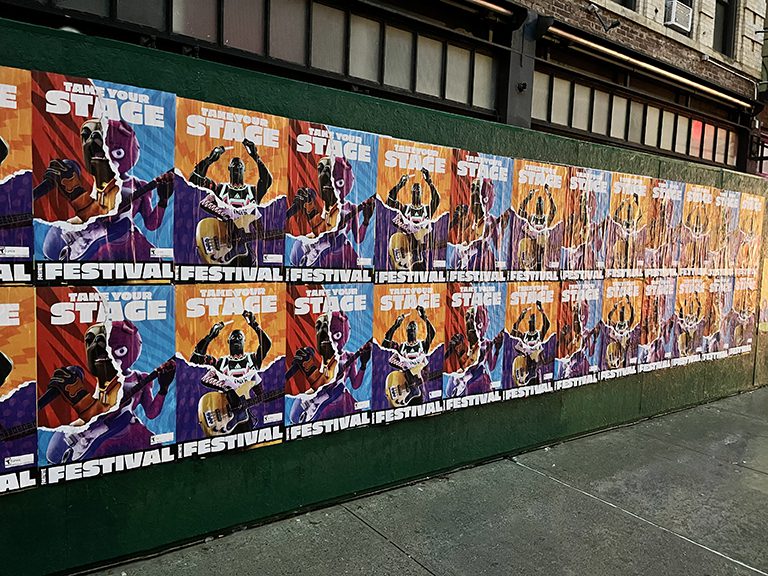
We’ve been running campaigns in New York City since before most marketing agencies knew what a street team was. We’ve put crews on Bedford Avenue in Williamsburg at 11pm on a Thursday. We’ve operated projections on building walls along Spring Street in SoHo. We’ve run sticker campaigns down Orchard Street on the Lower East Side and watched brands go from invisible to unavoidable in a single weekend.
So when someone asks us what is guerilla marketing, we don’t reach for a textbook. We reach for our campaign logs, our crew contact sheets, and our street photography files. Here’s what we know from hundreds of activations across the country.
Guerrilla marketing is unconventional, high-impact marketing that takes place in public spaces. It works with a fraction of what traditional advertising costs, and it regularly outperforms those budgets in reach and memory. The core idea is simple: earn attention rather than rent it.
Traditional marketing buys space. It secures a billboard, a TV spot, a full-page print ad. Guerrilla marketing creates moments. It puts something unexpected in front of people who weren’t anticipating an ad, in a place they actually want to be. When the execution is right, people photograph it, share it, and talk about it. That organic spread is what separates guerrilla from everything else.
We’ve watched a sticker campaign on Orchard Street between Delancey and Houston generate more trackable social exposures than a $50,000 digital buy. We’ve run a projection onto a building near 42nd Street and 7th Avenue in Times Square and watched a crowd of two hundred people stop mid-step to pull out their phones. That’s what this discipline delivers when it’s executed correctly.
What Makes a Campaign Truly Guerrilla
A few characteristics define guerrilla marketing and separate it from conventional campaigns:
It operates in physical public spaces where the audience already exists
It interrupts the ordinary without being invasive
It creates a reaction, usually surprise, delight, or curiosity
It generates organic conversation and social sharing
It works at budgets well below traditional media
It puts the brand in direct, human contact with real people
That last point matters most to us. You can’t fake the reaction when someone stops on West Broadway in SoHo to photograph something our crew placed overnight. The response is real. It’s earned. And it can’t be replicated by any ad served to a scrolling thumb.
Guerrilla vs. Traditional Advertising
Traditional advertising works by occupying inventory. You buy a time slot, a placement, a position on a page. The audience may or may not be paying attention. Most aren’t.
Guerrilla marketing works by occupying a moment. The audience encounters something they didn’t expect, in a space they trust, during a part of their day that isn’t typically commercial. Their guard is down. Their attention is real. The impression goes deeper.
That’s the fundamental difference. Not size. Not format. The relationship between the brand and the moment of contact.
Where Guerrilla Marketing Came From
The term comes from Jay Conrad Levinson. He published “Guerrilla Marketing: Secrets for Making Big Profits from Your Small Business” in 1984. Levinson was a former advertising executive at major agencies who spent years watching small businesses get outspent and outmaneuvered by larger competitors. He built a framework to fix that.
His core argument was straightforward. You don’t need a massive budget if you have creativity, time, and a willingness to show up where your audience actually lives. Large brands win through volume. Guerrilla marketers win through precision and impact.
The book became one of the best-selling marketing titles of all time. It spawned dozens of sequels and variations. But the original premise still holds up forty years later, and it’s still the foundation everything we do is built on.
How the Streets Shaped the Industry
Long before Levinson put a name to it, people were doing this. Political campaigns chalked sidewalks. Street artists painted murals that became neighborhood landmarks. Brands handed samples out on street corners in Chicago’s Loop and along the boardwalk at Venice Beach in Los Angeles. Record labels sent crews to barbershops in Harlem to play new releases to real audiences before radio got involved.
New York City was always the proving ground. The density, the foot traffic, the culture of looking up and paying attention. If you could get noticed here, you could get noticed anywhere. That’s still true today.
We’ve worked Spring Street in SoHo so many times we know exactly which corners pull the most foot traffic between 10am and 2pm on a Saturday. We know that Bedford Avenue in Williamsburg draws a younger, more brand-aware crowd on Thursday and Friday evenings. We know that Canal Street bridges tourist traffic with local residential foot traffic in a way few other streets in Manhattan do. That knowledge comes from years of physical presence, not from analytics platforms.
The Evolution Into a Modern Discipline
Levinson’s ideas have absorbed new tools over the decades. Digital amplification, experiential design, precision audience mapping, real-time content capture. But the core has stayed the same: show up where people are, create something worth noticing, and let the moment do the work.
Brands like Red Bull, Nike, and Apple built major campaigns using guerrilla principles before those campaigns had formal names. Red Bull’s early sampling crews in college towns, handing cans from branded cars to people who’d never tried the product, were pure guerrilla. Nike’s early presence on basketball courts in Harlem, product in hand, players in the game, was guerrilla. The tactics work at every brand scale. They just look different depending on the budget and the objective.
Today, the best guerrilla campaigns generate content that travels across social platforms, extends the campaign’s lifespan far beyond the activation window, and reaches audiences who weren’t even physically present. The street is the starting point. The content it produces is the multiplier.
The Core Tactics We Run in the Field
Guerrilla marketing isn’t one thing. It’s a family of tactics held together by a shared philosophy: be unexpected, be precise, be human. Here’s how each major tactic works in real execution, and what our crews actually do when they’re on the ground.
Street Teams
Street teams are groups of brand ambassadors deployed in high-traffic public areas. They engage directly with passersby, distribute samples, hand out materials, demonstrate products, and represent the brand through energy and genuine conversation. This is one of the oldest and most effective guerrilla tactics in existence, and it still works because human connection still works.
We’ve run street teams from the Magnificent Mile in Chicago to Bourbon Street in New Orleans. In New York, our crews work Times Square near the TKTS steps on 47th Street, Union Square on market days, the High Line during weekend afternoons, and the Plaza in front of Grand Central Terminal during the morning rush. We match the crew’s energy to the neighborhood and the audience. What plays on Bedford Avenue in Williamsburg is different from what plays on Fifth Avenue near Rockefeller Center.
A great street team does more than distribute materials. They start conversations. They answer questions. They create small moments of genuine connection that no banner ad can replicate. Training is everything. We brief every crew specifically for each campaign. Generic ambassador scripts don’t work. The crew has to understand the brand well enough to speak for it without a script.
Sticker campaigns place branded visuals in the physical spaces where your audience already spends time. Utility boxes, lamp posts, benches, urban surfaces with high pedestrian visibility. These placements aren’t random. We map them based on foot traffic patterns, demographic composition, and visual sightlines.
On the Lower East Side, Orchard Street between Delancey and Houston is a corridor we’ve worked many times. The mix of vintage shops, restaurants, and foot traffic from the Essex Market creates a specific audience that responds well to street-level visual campaigns. In Brooklyn, we’ve run campaigns up and down North 7th Street in Williamsburg and along Flushing Avenue near the Brooklyn Navy Yard. In Los Angeles, our crews have worked Melrose Avenue and Fairfax, and along Abbot Kinney Boulevard in Venice.
The key to a successful sticker campaign is saturation within the right zone. A hundred stickers spread across ten square miles do nothing. A hundred stickers placed strategically within a four-block radius create the sense that a brand is everywhere. That concentration creates brand recall.
Projection Marketing
Projection marketing sends branded imagery onto buildings, bridges, and large surfaces using high-lumen projectors. The work typically runs at night. The visual scale is enormous. A single projector can cover thousands of square feet of building facade, turning architecture into a moving canvas.
We’ve run projections on buildings along West Broadway in SoHo, on warehouse walls in Bushwick, and on parking structure exteriors near the Staples Center in Los Angeles. In Chicago, we’ve projected onto building walls along the Chicago Riverwalk near the Michigan Avenue bridge. In Miami, we’ve run projections during Art Basel week on the facades of galleries along NW 2nd Avenue in Wynwood.
Projection is a high-drama tactic. It stops foot traffic, generates social content organically, and creates a sense of event without requiring a venue or a ticketed audience. It’s particularly effective for product launches, film and album releases, and brand moments that need scale but can’t afford conventional outdoor inventory at scale.
Experiential marketing turns a brand encounter into an event. Instead of showing people something, you put them inside something. Pop-up installations, interactive activations, and immersive brand environments all live in this category.
We’ve built activations in Domino Park in Williamsburg, in Washington Square Park in Greenwich Village, and in Millennium Park in Chicago near the Cloud Gate sculpture. Each one created a physical space where people could interact with a brand on their own terms, at their own pace, without pressure. That self-directed engagement creates a fundamentally different kind of brand memory than any passive ad impression.
The best experiential campaigns leave people with a memory, a photograph, and a story to tell. That organic extension of the campaign, into dinner table conversations and Instagram posts, is what makes experiential marketing so powerful for long-term brand building.
Ambient Marketing
Ambient marketing places brand messaging in unexpected, contextually relevant locations. A coffee brand wrapping elevator doors to look like a coffee cup. A fitness app placing footprint stickers leading up subway stairs. A streaming service branding the steam from a sidewalk vent with a show’s imagery. These campaigns reward observation. They’re clever in a way that makes people feel smart for catching the reference.
We’ve executed ambient campaigns in subway stations at Union Square and on the platforms at Atlantic-Barclays Center in Brooklyn. We’ve worked bus shelters along Michigan Avenue in Chicago and along Sunset Boulevard in Hollywood. The placement has to match the message. An ambient campaign that requires explanation has already failed.
Flyering and Handout Campaigns
Flyering is the most stripped-down form of guerrilla marketing. It’s direct, physical, and personal. Our crews hand-deliver brand messages to real people in real moments. Done poorly, flyering is paper spam. Done well, it’s a conversation starter and a tangible brand touchpoint.
The difference is training and targeting. Our crews are coached to read body language, to know when to approach and when to give space, to make the handoff feel like a genuine offering rather than an interruption. We’ve run flyering campaigns at concerts and music festivals, outside sports venues before and after games, and on college campuses during move-in week and orientation.
In New York, we’ve worked outside Madison Square Garden on event nights and on the steps of Columbia University at the beginning of the fall semester. In Austin, our crews have worked 6th Street during SXSW and the surrounding festival zones. Density plus receptivity equals results.
Real Campaign Examples from Streets We Know
We can describe tactics all day. But nothing lands like examples from actual campaigns we’ve run. Here are a few that show how these approaches work in practice.
SoHo Brand Launch, Spring Street and West Broadway
We ran a product launch campaign for a direct-to-consumer apparel brand along Spring Street and West Broadway. The brand had a strong online presence but zero physical visibility in New York. Our crew set up a branded street installation at the corner where Spring Street meets West Broadway. We had five ambassadors working the surrounding blocks from noon to 8pm on Saturday and Sunday. By the end of the weekend, the brand’s Instagram account had gained 4,200 new followers, and the campaign drove over 900 visits to the brand’s website from people who scanned the QR code on-site. Total campaign cost came in under $9,000.
Williamsburg Music Campaign, Bedford Avenue
For an independent record label launching a new artist, we ran a combined sticker and street team campaign along Bedford Avenue from North 7th to North 12th Street. Our crews worked the corridor on Thursday, Friday, and Saturday nights over three consecutive weekends. Stickers went up the week before street teams activated. By the time our crews showed up, people had already seen the artist’s name on surfaces around the neighborhood. That recognition created openings for real conversations. The artist’s streaming numbers jumped 340% over the campaign window.
Times Square Projection, 42nd Street and 7th Avenue
For a major entertainment brand, we projected branded content onto the side of a building near 42nd Street and 7th Avenue. The projection ran for four hours on two consecutive Friday nights. Times Square foot traffic at that hour is dense and international. The projection generated hundreds of organic social posts from bystanders who captured it on their phones. The brand’s hashtag trended locally on both nights. Total production cost came in at roughly 15% of what a comparable time buy on a Times Square digital billboard would have cost.
Chicago River North Campaign, Ohio Street and Rush Street
For a Chicago-based food and beverage brand, we ran a street team campaign along Ohio Street and Rush Street in the River North neighborhood. Our crew worked lunch hours and the Friday evening bar rush. They distributed product samples and brand literature across four city blocks. We logged over 3,000 direct interactions over five days. The brand saw a measurable sales increase at three nearby retail locations in the two weeks following the campaign.
Los Angeles Campaign, Fairfax and Melrose
For a streetwear brand, we activated on the corner of Fairfax Avenue and Melrose in Los Angeles. This intersection is one of the most brand-conscious corners in the country. We built a pop-up installation in the adjacent parking lot, brought in a photographer, and offered free content creation for anyone who engaged with the brand. Over two days, the activation generated over 600 organic social posts and introduced the brand directly to a tastemaker audience that traditional advertising wouldn’t have reached at any price.
Miami Wynwood Projection, NW 2nd Avenue
During Art Basel week, we ran a three-night projection campaign on a gallery wall along NW 2nd Avenue in Wynwood. The neighborhood draws an art-forward, creative, brand-aware crowd during that week from all over the world. Our projection ran branded content alongside original artwork created specifically for the activation. The campaign was covered by three local media outlets without any PR outreach on our part. The brand’s Instagram following grew by 6,800 accounts over the five-day Art Basel window.
What Guerrilla Marketing Costs
One of the most persistent misconceptions is that guerrilla marketing is free. It’s not. It requires real investment in materials, crews, production, and logistics. But it costs dramatically less than traditional advertising, especially when you measure cost against actual impact rather than estimated exposures.
Tactic
Typical Cost Range
Estimated Reach
Impact Level
Best For
Street Team (1 weekend, NYC)
$2,500 – $6,000
5,000 – 20,000 direct interactions
High (personal contact)
Product sampling, brand awareness
Sticker Campaign (1 city, 1 week)
$1,500 – $4,000
10,000 – 50,000 exposures
Medium-High (visual recall)
Brand visibility, event promotion
Projection Marketing (2 nights)
$5,000 – $15,000
20,000 – 100,000+ exposures
Very High (social sharing)
Product launches, film and music releases
Experiential Pop-Up (1 weekend)
$8,000 – $30,000
2,000 – 10,000 direct participants
Very High (brand memory)
Brand experiences, launches, retail
Flyering Campaign (1 city, 3 days)
$800 – $2,500
3,000 – 15,000 direct handoffs
Medium (direct contact)
Events, local promotions, awareness
Ambient Campaign (1 city)
$3,000 – $10,000
5,000 – 30,000 exposures
High (contextual relevance)
Brand storytelling, product features
Compare those numbers against a single 30-second TV spot, which can cost $300,000 or more to produce and place nationally. Or against a Times Square digital billboard, which runs $25,000 or more per week for a four-week minimum. The math does its own work.
What the Price Doesn’t Always Include
Every guerrilla campaign has costs that don’t appear on the headline rate. Material production. Crew training. Transportation and logistics. Storage. Campaign documentation through photography and video. Some campaigns require event permits or space agreements for installations.
We build all of those costs into our proposals from the start. We’ve seen campaigns go sideways because an agency quoted a crew rate without factoring in the materials, the logistics, or the documentation. Transparency on costs from day one is how we’ve built the long-term relationships we have with brands that come back to us campaign after campaign.
Return on Investment in Guerrilla
ROI in guerrilla marketing looks different from ROI in digital advertising. You’re not measuring cost per click. You’re measuring cost per real human interaction, cost per organic social post, cost per earned media mention, and cost per lasting brand impression. When you frame it that way, guerrilla is often the most efficient spend in the entire marketing mix.
We’ve seen campaigns where a $5,000 sticker and street team activation drove more website traffic and more social engagement than a $40,000 paid social campaign running in the same market at the same time. The channels aren’t competing. They’re complementary. But the street-level work consistently punches above its weight class.
How to Plan a Guerrilla Marketing Campaign
Planning a guerrilla campaign isn’t complicated. But it requires thinking in streets and bodies rather than platforms and pixels. Here’s how we approach it from the first conversation to the final campaign debrief.
Start with Your Audience
Who are you trying to reach? Where do they actually spend time? What do they respond to?
We start here every time. Before we book a crew or design a sticker, we want to know where the target audience eats lunch, what neighborhoods they live in, what time they leave the gym, what bars they visit on Friday nights. That information shapes everything downstream. It determines which streets we activate, which hours we run crews, which neighborhoods we prioritize, and what kind of interaction creates the right impression.
You can’t shortcut this step. The best creative execution in the wrong location is a wasted campaign.
Choose Your Tactics Based on Objectives
Not every tactic fits every campaign objective. A projection campaign delivers spectacle and social content. A street team delivers conversation and relationship. An ambient campaign delivers cleverness and word-of-mouth. An experiential pop-up delivers memory and deep engagement.
We help our clients match their objectives to the right tactics. Then we build the plan backward from those objectives. A brand that wants to introduce a product to a new market needs different tactics than a brand that wants to convert an existing fanbase. A brand with $3,000 needs different tactics than a brand with $30,000. Both can run effective guerrilla campaigns. They just look different.
Scout Every Location Before You Activate
We walk every location before we send a crew. Every single one, without exception.
We’ve turned down campaign locations that looked ideal on a map and were completely wrong in person. Wrong foot traffic counts. Wrong sightlines for visual placements. Wrong audience composition for the brand. Wrong physical infrastructure for the planned installation. Physical scouting is non-negotiable.
For campaigns in SoHo, we look at corner traffic flows on Spring Street, the pedestrian movement between West Broadway and Thompson Street, the density around the Mercer and Greene Street intersections. In Williamsburg, we study the flow from the L train exit at Bedford Avenue down toward the waterfront. In Times Square, we track which blocks have the densest pedestrian clustering versus the heaviest through-traffic. Those patterns inform every placement decision.
Brief Your Crew Specifically for Each Campaign
A street team is only as good as its preparation. Our crews know the brand before they ever hit the street. They know the product. They know the key messages. They know the story behind the campaign. They know what to say when someone asks a question, and they know how to exit a conversation gracefully when someone isn’t interested.
Generic brand ambassador training produces generic results. We brief every crew specifically for the campaign they’re running. The crew has to feel the brand as much as they represent it. You can see the difference immediately when both types of crews are in the field at the same time.
Capture Everything
Document the campaign in real time. Photos. Video. Crew interaction logs. Material distribution counts. Crowd observations.
This documentation serves two purposes. First, it provides measurable evidence of the campaign’s reach and execution. Second, it generates content. A well-executed guerrilla campaign produces raw social and marketing content that extends the campaign’s value long after the crew packs up. We send a photography and video crew on every major activation. Footage from those shoots has ended up in brand reels, in pitches to investors, and on brands’ own social channels for months after the campaign ended.
Build Your Measurement Framework First
Decide how you’re measuring success before the campaign starts. Not after. You need baseline data to compare against: website traffic before the campaign, social following counts, brand search volume in the target market, sales data at nearby retail locations.
Without a baseline, you can’t isolate the campaign’s contribution to any metric you care about. We help our clients build the measurement framework as part of campaign planning, not as an afterthought once the numbers come in.
Measuring the Success of a Guerrilla Marketing Campaign
Guerrilla marketing gets dismissed as hard to measure. We’ve heard that for years. It’s not accurate. It requires different measurement approaches than digital advertising, but the data is there if you build for it from the start.
Direct Metrics
For street teams, we track interactions per hour and per day. Every sample distributed. Every flyer handed off. Every conversation that runs longer than thirty seconds. Our crews log this data in real time. At the end of each activation, we have precise counts.
For sticker campaigns, we track placement counts, location quality scores based on foot traffic, and photo documentation of every placement. For projections, we track crowd size estimates, videos and photos captured by bystanders and logged through hashtag and location monitoring, and social mention volume in the hours following each activation.
Indirect Metrics
Beyond direct counts, guerrilla campaigns move measurable needles across multiple channels:
Website traffic spikes tied to campaign activation dates
Social media follower growth during campaign windows
Hashtag usage and organic social mention volume
Brand search volume increases in the campaign market
Sales lift at retail locations near activation zones
Earned media coverage from press or influencer accounts
We pull these numbers for every campaign we run. We tie them directly to what our crew did on the street and when. The correlation is consistently clear when the campaign is properly documented and the measurement framework is in place before activation begins.
The Content Multiplier
Here’s a metric most brands overlook entirely: content yield.
A well-executed guerrilla campaign generates hours of raw footage and hundreds of photographs. That content gets repurposed across Instagram, TikTok, YouTube, and brand websites. The projection we ran in SoHo on West Broadway generated content the brand was still publishing three months after we wrapped. The activation in Wynwood produced images that anchored the brand’s marketing through the first quarter of the following year.
When you account for the content a campaign produces in addition to its direct impact, the cost-per-result calculus shifts dramatically in guerrilla’s favor. The campaign ends. The content keeps working.
Comparing Guerrilla to Traditional Advertising Returns
Traditional advertising metrics are built around exposures and click-through rates. Guerrilla metrics are built around interactions, memory, and earned attention. These are fundamentally different things, and they’re genuinely hard to compare on the same spreadsheet.
What we can say from experience: the brands that have run both side-by-side in the same market over the same period consistently report that guerrilla campaigns generate stronger brand recall, more organic conversation, and more durable audience relationships than equivalent digital spends. The numbers vary by brand and category. The direction is consistent.
Frequently Asked Questions
What is guerrilla marketing in simple terms?
Guerrilla marketing is an unconventional approach to reaching audiences in public spaces. It uses surprise, creativity, and physical presence to create brand moments that people remember and share. It’s built on the idea that a well-placed, well-executed idea creates more impact than any amount of paid media inventory.
Who invented guerrilla marketing?
Jay Conrad Levinson coined the term in his 1984 book, “Guerrilla Marketing.” Levinson was a former advertising executive who developed a framework for small businesses to compete against large-budget competitors without matching their ad spend. The book became one of the best-selling marketing titles ever published, and Levinson’s principles still define the discipline today.
What are the most common types of guerrilla marketing?
The most common tactics include street team activations, sticker campaigns, projection marketing, experiential pop-up installations, ambient placements, and flyering campaigns. Each tactic suits different brand objectives and budget levels. We help clients identify which tactics match their specific goals and market conditions before recommending anything.
How much does a guerrilla marketing campaign cost?
Costs vary by tactic and market. A basic flyering campaign in one city might run $800 to $2,500. A street team weekend in New York typically runs $2,500 to $6,000. A full experiential pop-up activation can run $8,000 to $30,000 or more depending on scope and production requirements. Every campaign we price is built from actual line items, not rough estimates.
Where does guerrilla marketing work best?
High-density urban environments produce the strongest results. Cities like New York, Los Angeles, Chicago, Miami, Austin, and Atlanta give you the foot traffic, the cultural energy, and the social-media-active audiences that amplify guerrilla campaigns most effectively. Within those cities, specific corridors matter enormously. Bedford Avenue in Brooklyn, Fairfax and Melrose in LA, Rush Street in
Can small brands run guerrilla marketing campaigns?
Yes. Guerrilla marketing was built for smaller budgets. The core advantage is that creative thinking and street knowledge can replace raw spending power. We’ve run effective campaigns for independent brands with total budgets under $3,000. The tactics scale with the objective, not only with the budget. A small brand with a tight budget and a great idea will consistently outperform a larger brand w
How do you measure guerrilla marketing success?
You measure it through a combination of direct metrics (crew interaction counts, materials distributed, crowd size estimates) and indirect metrics (website traffic spikes, social follower growth, hashtag volume, retail sales lift near activation zones). The key is building the measurement framework before the campaign launches so you have clean baseline data to compare against. We build that frame