
November 25, 2026
Mobile billboard: How It Actually Works
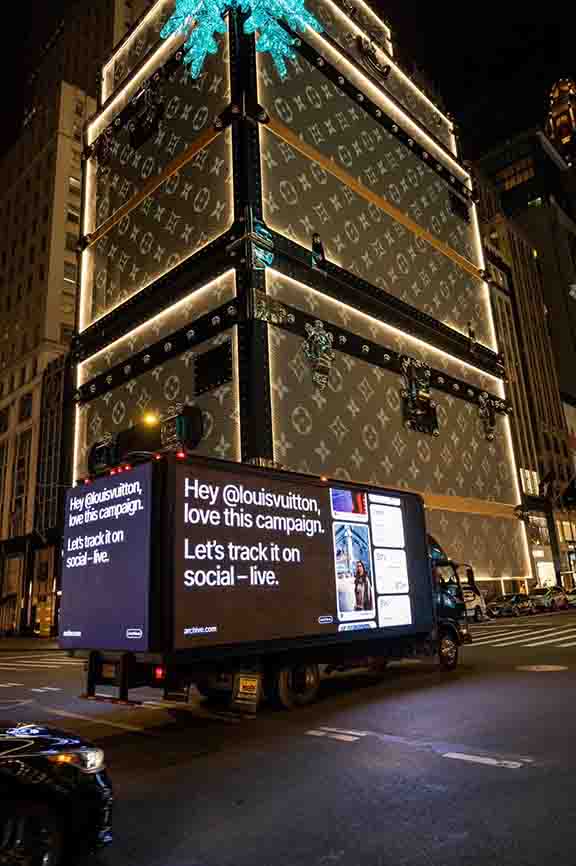
Most people who call us about a mobile billboard have already pictured the outcome. A truck with their creative on the side, parked where their customers are, all day, for as long as they want it there.
The picture is roughly right. The part that gets left out is the driving. A mobile billboard is a vehicle with a driver, and a driver has a shift, a fuel stop, a bathroom, a parking problem and a city that may or may not want a large advertising vehicle idling on its curb. Everything interesting about this format lives in those details.
I have spent a lot of nights and a lot of midday gridlock sitting in or following these trucks. The format works. It works better than most buyers expect in some situations and considerably worse in others, and the difference is almost always route design rather than creative.
So this is the operator version. How a mobile billboard actually runs, who is in the cab, what the route looks like on paper versus what happens at 5:40pm on a Friday, what holds up in weather, what gets a truck moved along, and the campaigns where I tell people to spend their money on something else.
A mobile billboard is not a billboard that moves. That framing causes most of the bad buys. A static billboard sells you a fixed position and lets the city deliver the audience. A mobile billboard sells you a moving position and makes you responsible for finding the audience. Those are different products with different failure modes.
Get the route wrong and you have paid for a truck to drive past empty warehouses. Get it right and you have put your creative in front of a dense, slow, repeat-exposure crowd that a fixed board in the same market could never have reached.
What the vehicle actually is
The category covers several different trucks and buyers tend to use one word for all of them.
The most common build is a box truck with three printed vinyl faces. Two long sides and a back. The vinyl stretches over a frame, gets tensioned, and the whole thing reads as a clean flat surface from the street. Printed faces are cheap to light with onboard floods and they hold their colour well. They are also fixed. Whatever you printed is what runs for the whole flight.
Then there are LED Trucks. Three screens, usually the same two sides and a back, running digital creative off an onboard player. LED buys you motion, dayparting, multiple creatives in rotation, and the ability to change the message mid flight from a laptop. It costs you brightness in direct sun and it gives you a screen that looks spectacular after dusk and merely fine at noon.
There are also smaller formats. Trailer-pulled boards for tight historic districts. Mobile units sized for campus loops and neighbourhood streets where a full box truck cannot turn. Scooter and bike-towed boards for dense pedestrian cores where a truck is simply the wrong tool.
The choice between printed vinyl and LED is the first real decision and I push people toward it early. If your campaign has one message, runs in daylight, and lives or dies on colour fidelity, printed vinyl is the stronger product. If your campaign needs to change, needs to run after dark, or wants different creative for morning commute versus evening nightlife, LED earns its place.
If you want both, run both. Mixed fleets are common and there is no reason a flight has to be homogeneous.
The crew, the shift and the route
A single truck runs with one driver. That is the whole crew for a standard route day. The driver is also the operator, which people forget. They are managing the generator, the screen or the lighting, the parking decisions, the route sheet and the photo documentation, all while driving a large vehicle through traffic.
On activations where the truck is a backdrop rather than a passing impression, we add brand ambassadors. Two to four people working the sidewalk beside a parked truck, handing out product, running a sign-up, pulling people in. That is a different staffing model and a different permission conversation, and it is where mobile media starts to overlap with our [Street Teams & Experiential](/services/street-teams-experiential) work.
A typical route day is six to ten hours of active driving. Not twenty-four. People ask for twenty-four and I explain that a driver is a person. Round the clock coverage means multiple drivers and a handoff point, which is a real thing we can build, but it should be a deliberate choice rather than an assumption.
The route itself is where the money is made or lost. A good route is built around dwell time, not distance. The goal is not to cover the most ground. The goal is to be stuck in the most useful traffic.
That sounds like a joke. It is not. A truck crawling through a congested commercial corridor at eight miles an hour is delivering long, repeated, unavoidable exposure to a captive audience. The same truck doing seventy on an interstate is delivering a blur. I would rather have two slow miles than twenty fast ones.
So we build routes that loop. A loop lets the same vehicle hit the same intersection several times across a shift, which gives frequency against the people who work or live there. We tune loop length to traffic. In a dense core, a loop might be a mile and take forty minutes. In a spread out market, it might be eight miles.
We also build routes around the clock. Morning commute inbound. Midday around lunch density and retail. Late afternoon outbound commute. Evening around whatever the nightlife or event anchor is. Those are four different maps, not one.
Where mobile billboards actually earn their keep
Some situations suit this format so well that I will recommend it before anything else.
Event targeting is the clearest. A conference, a stadium event, a festival, a trade show. You have a known crowd, a known time window and known approach routes. A truck working the approach and egress streets reaches a highly qualified audience at the exact moment they are thinking about the thing you are advertising. Fixed media near a convention centre is usually sold out and locked up a year ahead. A truck does not need inventory to exist.
Competitive proximity is another. You want to be seen near a particular category of retail or a particular district. A truck goes where the board is not.
Launch density is a third. You have a short window and you want a market to feel saturated. Trucks plus a poster campaign in the same corridors creates a layered impression that neither format delivers alone. Someone sees the truck on the drive in and then walks past twenty posters on the way to the office. That stacking is the single best argument for pairing mobile with [Wheatpasting & Poster Campaigns] .
Hard to reach neighbourhoods matter too. Plenty of markets have dense residential and commercial areas with almost no billboard inventory because of zoning history. A truck can serve those areas without needing a structure.
And there is the pure visibility play. Recruitment pushes, political and advocacy messaging, public awareness campaigns. Things where the point is that a large number of people in a specific geography see a specific sentence.
What goes wrong
I would rather tell you this before you buy than after.
The biggest failure is a route built on a map instead of on the ground. Maps do not show you that the left turn you planned is prohibited between 4 and 7pm, or that the corridor has a height-restricted underpass, or that a three block stretch is torn up for utility work. We drive routes before we run them. Every time. A recon pass is not optional and any route plan produced without one is a guess.
The second failure is creative designed for a screen. Mobile billboard creative gets read by people in motion, at an angle, in bad light, often partially blocked by a bus. If your design has a paragraph of body copy, a long URL and a small logo, it does not work. Big type. High contrast. One idea. A brand mark large enough to register in a glance. If someone cannot take the whole thing in while a light changes, it is the wrong creative.
The third failure is expecting a parked truck. Buyers often imagine the vehicle sitting in one perfect location for hours. Standing a large advertising vehicle in one spot is the part of this business most likely to attract attention from a property owner, a business, a parking officer or a local ordinance. Parking is a grey area and it varies enormously by city, by district and sometimes by block. Enforcement is inconsistent. We handle it by securing private lot permission where we want a true stationary placement, and by building the rest of the day around motion, which is both the safer and the more productive pattern.
The fourth failure is weather optimism. Heavy rain destroys visibility from the sidewalk and from other vehicles. Snow and road salt dull vinyl fast. High wind is a genuine safety problem for a tall flat-sided vehicle, and there are days where the right call is to pull the truck off a bridge-heavy route. Extreme heat stresses generators and dims screens. We build weather contingency into flights longer than a few days, and I would rather move a day than run a bad one.
The fifth failure is measurement fantasy. People want a single clean impression number. I will not invent one. What a mobile billboard can give you honestly is route documentation, timestamped photography, dwell logs and a clear record of where the vehicle was and when. Pair that with your own lift measurement, a unique landing page, a scannable code or a market-versus-control comparison, and you have something defensible. A confident impression figure pulled from nowhere is not measurement.
What I talk clients out of
Highway-only routes. Someone wants the truck on the interstate all day because it feels like reach. Highway driving is fast, lane-separated and the worst possible dwell environment. If a truck must use a highway it should be to get between productive surface-street zones.
Single-truck saturation. One vehicle cannot saturate a large market. It can own a corridor, a district or an event. If the brief says citywide, the honest answer is either more vehicles, a tighter geography, or a different format.
Over-designed creative. Every flight has a moment where someone wants to add a QR code, three product shots and a legal line. In motion, at distance, this reduces to noise. A single large code with real contrast and real size can work. A small one is decoration.
Tiny markets with no congestion. In a town where nothing ever slows down, a truck passes and is gone. Those markets are usually better served by static placement or a ground campaign.
All-night routes with no audience. People hear that night is when the screens look best and want 2am coverage. The screens do look best then. There is nobody there. We run evening into late evening where there is nightlife density and we stop when the street empties.
Long flights with one creative on LED. If you have bought the ability to change the message and you never change it, you have paid for a capability you are not using. Build at least a morning and an evening version.
Permissions, ordinances and the grey area
This part deserves a straight answer rather than a confident one.
Rules around advertising vehicles vary by municipality. Some cities regulate them specifically. Some address them through general signage or vehicle codes. Some have no particular framework and treat the vehicle like any other truck. Enforcement varies even within a single market, and what passes without comment in one district may draw attention a few blocks away.
I am not going to tell you a given route is legal or illegal, because that is not a claim I can make and it is not a claim you should accept from any operator.
What I can tell you is how we reduce risk. We work with drivers who know the market and the districts that attract attention. We keep vehicles moving rather than standing, because a moving vehicle in traffic is operating as a vehicle. Where we want a true stationary placement, we get written permission from a private property owner and we park on private ground. We keep documentation on the truck. We avoid restricted zones, school zones during arrival and dismissal, and anywhere a large vehicle creates a genuine obstruction.
We also brief clients honestly. If a market has a reputation for being strict with advertising vehicles, you should hear that before you book, not after. Some operators will take the booking and let the client find out. I would rather lose the sale.
How mobile pairs with everything else
A mobile billboard rarely does its best work alone.
With posters, you get the layering effect described above. The truck provides the moving, impossible-to-miss presence and the poster campaign provides the fixed, repeated, neighbourhood-level presence. The same creative in both places reinforces itself.
With sidewalk work, the pairing is about the last few feet. A truck gets someone's attention from across the street. A sidewalk decal catches them looking down, right at the point of a decision, outside a venue or a store entrance. Our [Sidewalk Decals & Stencils](/services/sidewalk-decals-stencils) work is frequently added to mobile flights for exactly this reason.
With projection, the pairing is about the night. Projection takes over once ambient light is low enough, and it goes on surfaces no truck can reach, the sides of buildings and large blank walls. A truck flight ending at dusk and a projection run starting at dusk is a natural handoff.
With street teams, the truck becomes an anchor. A parked, permissioned vehicle with ambassadors working the sidewalk converts attention into something you can count. Sign-ups, samples, conversations.
If I had to pick the single most underused combination, it is mobile plus a ground poster campaign in the same tight geography over the same ten days. It is the closest thing to feeling like a brand is everywhere, and it is reachable for campaigns that could not touch a major fixed board buy.
What a flight looks like start to finish
Here is the actual sequence, so you know what you are agreeing to.
We start with the objective and the geography. Not the truck count. What are you trying to make happen, where, and by when. A launch, an event, a recruitment push and an awareness run all produce different routes.
Then we scope. Market or markets, number of vehicles, printed or LED or both, days, hours per day, and whether there is a stationary component that needs private property permission.
Then artwork. We give you the exact dimensions and bleed for the truck faces or the screen specs for LED. Our side reviews the creative for legibility in motion, and we will push back if the type is too small. That pushback is part of the service.
Then production. Printed vinyl gets produced, tensioned and fitted to the frames. LED creative gets loaded and tested on the actual screens, because things that look right on a monitor can be wrong on a bright panel.
Then route design and recon. We build the loops, then drive them, then fix them.
Then the flight. Daily documentation, timestamped photos, route logs. If anything changes, construction, a closure, an event shift, we adjust and tell you.
Then the wrap. Documentation package, vinyl removal and disposal or return, screens cleared.
Lead time depends mostly on production and permission. LED can move faster than printed vinyl because there is no physical production step. Stationary placements on private property take longer because they need a person to say yes in writing.
Frequently asked questions
How many hours a day does a mobile billboard actually run?
A standard route day is six to ten hours of active driving with one driver. Longer coverage is possible with multiple drivers and a scheduled handoff, but it needs to be planned and staffed deliberately rather than assumed. We usually recommend concentrating hours into the dense parts of the day rather than spreading thin coverage across a full twenty-four.
Is a printed truck or an LED truck better?
Printed vinyl is stronger for single-message daytime campaigns and holds colour reliably in full sun. LED is stronger after dusk and when you need multiple creatives, dayparting or mid-flight message changes. If your flight spans both day and night, or your message needs to shift, LED earns its place. Many flights run a mix of both.
Can the truck park in one spot all day?
Standing a large advertising vehicle in one place is the highest-attention part of this format and the rules vary by city, district and sometimes block. Enforcement is inconsistent. Where a client wants a genuine stationary placement, we secure written permission from a private property owner and park on private ground rather than relying on public curb space.
What makes mobile billboard creative fail?
Too much information. The audience reads it in motion, at an angle, often partially blocked. Small type, long URLs, body copy and tiny logos all disappear. What works is one idea, very large type, high contrast and a brand mark big enough to register during a traffic light. We review artwork for this and will ask for changes.
How do you measure a mobile billboard campaign?
We provide route logs, timestamped photography and a documented record of where the vehicle was and when. We do not invent impression totals. Pair our documentation with your own measurement, a dedicated landing page, a scannable code, a promotion code, or a market-versus-control comparison, and you get a result you can actually defend internally.
Does weather stop a mobile billboard flight?
Sometimes, and it should. Heavy rain kills visibility, high wind is a real safety issue for a tall flat-sided vehicle, and snow and road salt degrade printed vinyl quickly. Extreme heat stresses generators and dims screens. On flights longer than a few days we build in contingency and move a day rather than run a wasted one.
Request a campaign quote
If you have a market, a window and a reason, we can tell you quickly whether a mobile billboard is the right tool or whether your objective is better served by posters, projection, sidewalk work or a street team. Sometimes the answer is that a truck is exactly right. Sometimes it is that a truck is the expensive way to do something a ground campaign does better, and you should hear that from us.
Tell us the cities, the dates, what you are launching or promoting and what you need people to do after they see it. We will come back with a route concept, a format recommendation and an honest read on the constraints in those specific markets.
Request a campaign quote and we will build the route before we talk about anything else.

Ready to Run Your Campaign?
Call us or email us. We’ll tell you exactly what we can do in your market and what it costs.
Related Services
Explore similar advertising solutions offered by American Guerrilla Marketing.
American Guerrilla Marketing — Los Angeles
Street-level campaigns in Los Angeles and nationwide. Wheatpasting, LED trucks, street teams, and more.
(646) 776-2770
Related Articles
-
Planning LED Trucks & Mobile Billboards in Worcester
November 25, 2026
-
Billboards Company: How It Actually Works
November 25, 2026
-
LED Trucks & Mobile Billboards in Long Beach
November 25, 2026
-
LED Trucks & Mobile Billboards in Los Angeles
November 25, 2026
-
Mobile Billboard Advertising Explained for Brand Marketers
November 25, 2026