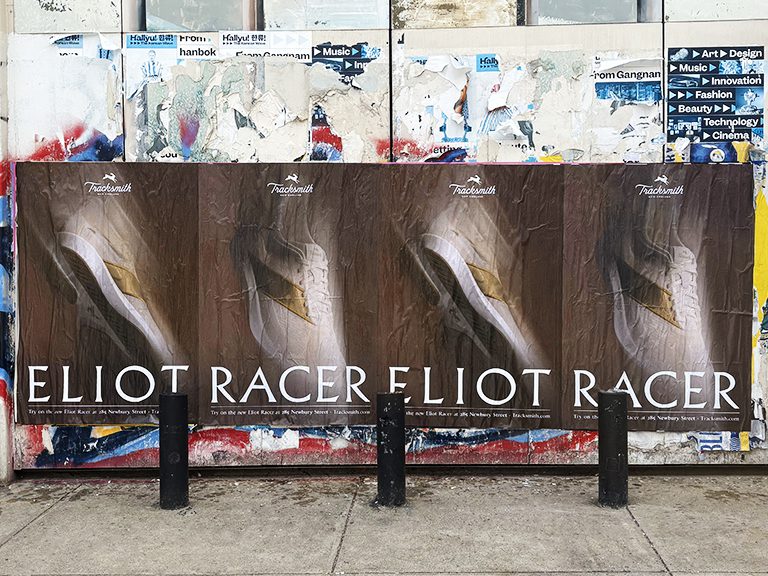
Large posters get noticed. That is the whole point. When you are running a street campaign in a dense urban environment, small format gets ignored. Large format commands attention. Understanding which large poster dimensions work for which situations is the difference between a campaign that performs and one that disappears.
We have placed large-format posters across hundreds of campaigns in New York City, Los Angeles, Chicago, and Miami. This is not theory. These are the dimensions we work with every week. Here is what we know.
The line between a regular poster and a large poster is not officially defined. In practice, the industry treats anything below 24 x 36 inches as a standard or small poster. Large posters start at 24 x 36 and go up from there. Very large format or “jumbo” starts around 36 x 48 and above.
Here is how we categorize large poster dimensions in our work:
Category
Dimensions
Square Inches
Best Application
Large Standard
24 x 36 in
864 sq in
Street campaigns, retail, events
One-Sheet
27 x 40 in
1,080 sq in
Entertainment, music, cultural events
Quad Sheet
30 x 40 in
1,200 sq in
Transit, outdoor, high-traffic zones
Extra Large
36 x 48 in
1,728 sq in
Construction walls, large venue displays
Jumbo
48 x 72 in
3,456 sq in
Outdoor advertising, flagship installations
Each step up in size is a meaningful jump in visual impact. But it also comes with higher printing costs, more challenging logistics, and stricter production requirements. Knowing when to go large and when large is overkill is a skill that comes from experience.
24 x 36: The Large Poster Standard
The 24 x 36 inch poster is the foundation of large-format street marketing. This size has become standard because it hits a practical sweet spot. It is large enough to be seen from across the street. It is manageable enough to transport, store, and place without heavy equipment. Print shops produce it efficiently and at reasonable cost.
When we run street campaigns in New York, 24 x 36 is the default large format. A well-designed 24 x 36 on a construction wall in SoHo or Bushwick generates strong exposures from pedestrians on both sides of the street. The viewing angle and distance from the sidewalk make this size work naturally in most urban contexts.
For framing purposes, standard 24 x 36 frames are widely available at retail. This makes 24 x 36 useful more than for street campaigns but for retail display, office presentation, and event decoration where you want a ready-made frame option.
The 24 x 36 Rule of Thumb
A 24 x 36 poster is readable from about 15 to 20 feet away in good lighting. Body copy at 1.5 inch height reads well at that distance. Headline text at 3 inches or more is readable from up to 30 feet. Size your type accordingly.
27 x 40: The Entertainment Industry Standard
The 27 x 40 poster is one of the most culturally significant large poster dimensions in American history. This is the “one-sheet” that has lined the lobbies of movie theaters since the 1940s. The entertainment industry standardized on this size and the network built around it has kept it central for decades.
Frame manufacturers, poster display cases, shipping tubes, and poster stores are all calibrated to 27 x 40. When clients in the music and entertainment space come to us for street campaigns, this is often their preferred size because it connects to that cultural reference point. A 27 x 40 reads as an entertainment poster in a way that other sizes do not.
The difference between a 24 x 36 and a 27 x 40 is not dramatic in appearance. You would not walk past both and immediately say “that one is bigger.” But side by side, the difference is visible. In a placement context, the additional square footage at the top and bottom of the poster gives you more design real estate. More space for a subtitle, a tagline, or credits at the bottom without crowding the main image.
30 x 40: Transit and High-Impact Placements
The 30 x 40 inch format, also known as the quad sheet, emerged from the movie and transit advertising industries. It is wider relative to its height than the standard one-sheet, giving it a more cinematic, horizontal-leaning feel even in portrait orientation.
We use 30 x 40 in high-traffic transit-adjacent locations. Bus shelters, commuter corridors, heavy pedestrian crossings. This size reads well at a distance and works in the slightly larger display cases found in transit environments. It is not as universally available as 24 x 36 from print shops, so lead time and cost are factors to plan for.
36 x 48: When You Need to Go Bigger
A 36 x 48 inch poster is a serious piece of print material. At 3 feet wide and 4 feet tall, this is a presence. You cannot miss it. In a street context, a cluster of 36 x 48 posters on a construction wall is a genuine installation. It takes up wall space that competitors cannot.
The production side of 36 x 48 is more involved. Not every print shop handles this size as a routine job. Large-format printing equipment, lamination, and finishing all scale up. Weight and rollability affect how these posters are transported and placed.
We use 36 x 48 for brand launches, major events, and campaigns where the client has both the budget and the content to justify the size. A thin design that works at 24 x 36 will look lost at 36 x 48. This size demands bold visual design. Big type. Strong imagery. Minimal clutter.
Design Principle for Large Format
For every step up in poster size, simplify your design. A 24 x 36 can carry more visual complexity than a 36 x 48. At large scale, every design flaw is amplified. Keep it bold and clean. One message. One image. One action.
48 x 72 and Beyond: Jumbo Format
At 48 x 72 inches (4 feet by 6 feet), you are in jumbo territory. This is the scale of outdoor advertising panels, construction wall takeovers, and venue installations. Prints at this size are typically produced on wide-format inkjet printers or offset litho presses, often in sections that are then joined at installation.
Campaigns at this scale are production events in themselves. Placing a 48 x 72 requires planning, equipment, and often multiple people. The results, when done right, are powerful. A 48 x 72 poster on the side of a building at a major intersection is genuinely unmissable. It does more than attract attention. It is attention.
For most standard marketing campaigns, this size is reserved for flagship moments. Album releases, product launches, major events. The investment in production and placement should be matched to an equally significant campaign moment.
Resolution Requirements for Large Poster Dimensions
Resolution is where large format printing catches designers off guard. At 24 x 36, you can get away with 150 DPI for street viewing distances. At 36 x 48, you can sometimes drop to 100 DPI. At 48 x 72, 72 DPI is often sufficient for any placement seen from 10 feet or more.
The counterintuitive reality of large format printing is that resolution requirements drop as size increases, because viewing distance increases proportionally. A print that looks sharp from 20 feet at 100 DPI would look terrible at 100 DPI if you pressed your nose against it. But nobody presses their nose against a 48 x 72 poster. They stand back and experience it from a distance.
Poster Size
Minimum DPI
Recommended Viewing Distance
24 x 36 in
150 DPI
10+ feet
27 x 40 in
150 DPI
10-15 feet
30 x 40 in
120 DPI
15+ feet
36 x 48 in
100 DPI
15-20 feet
48 x 72 in
72 DPI
20+ feet
Paper Stock and Finishing for Large Posters
Size is only part of the specification. Stock and finishing matter enormously for large-format posters.
For outdoor large posters, we almost always recommend a coated or UV-coated finish. This protects against moisture and helps the ink hold its vibrancy in direct sunlight. Uncoated paper degrades quickly outdoors. A UV-coated 24 x 36 placed outdoors in July can hold its color for weeks. The same poster on uncoated stock starts fading in days.
For indoor large posters, matte finishes are popular for a gallery or premium retail feel. Glossy finishes are common for entertainment and entertainment-adjacent campaigns. Satin finishes split the difference.
Weight matters for large formats. A heavier stock will survive handling, transport, and placement better than a lighter one. For 24 x 36 and above, we recommend at least 100 lb text weight. For outdoor campaigns, 120 lb or heavier is worth the added cost.
Large Poster Dimensions for Specific Campaign Environments
Different campaign environments have specific requirements for large poster dimensions. Here is how to match the right large format to your placement environment.
Construction Hoarding
Construction hoarding in urban markets like the Far West Side of Manhattan, the South Loop in Chicago, or Downtown LA’s Bunker Hill district creates large contiguous surfaces that are ideal for large-format poster campaigns. Individual 24×36 sheets placed in a grid pattern create the effect of a much larger visual. For a 10-foot wide hoarding section, a grid of three 24×36 sheets side by side creates a 72-inch wide visual presence. Larger 36×48 sheets cover the same area in a two-wide grid. The choice between formats depends on the graphic design: does the image work as a tiled pattern of individual sheets, or does it require a full-width unified image that spans the grid?
Building Walls and Gable Ends
Building wall and gable end placements are the large-format poster’s natural habitat. A blank wall on a corner building in a pedestrian-heavy neighborhood is a premium placement. At these scales, individual 24×36 sheets tile into larger compositions across the wall surface. The wheat paste adhesive bonds the paper to the surface and allows multiple sheets to be aligned into a single large visual without visible seams when properly executed. For a full building wall campaign, designing the artwork as a modular tiled composition that works whether 10 or 50 sheets are placed is the professional standard.
Event and Festival Signage
Event and festival signage uses large poster dimensions for directional, sponsor, and programming display purposes. At outdoor events, 36×48 and 48×72 formats work at the scale of outdoor festival infrastructure, visible from 50 to 100 feet across festival grounds. At indoor events in venues like convention centers and arenas, 24×36 mounted on foam core or gatorboard panels provide professional display that holds up under venue lighting at the expected viewing distances.
Retail Windows and Storefronts
Large retail window placements in premium retail environments use 24×36 and 27×40 formats for seasonal campaigns, sale announcements, and brand campaigns. Window film and adhesive-backed prints at these sizes fill standard storefront window panels with full-bleed graphics that read from across the sidewalk. The larger the window, the larger the format needed for visual impact. A single 24×36 in a large display window looks lost. Tiling two or three 24×36 sheets into a unified full-window composition creates the visual scale the format needs.
Large Poster Dimension FAQs for Professional Campaigns
Here are the questions we hear most often from brands planning large-format poster campaigns for the first time.
What is the largest size I can print for a street campaign? Most professional poster campaigns for street placement use 24×36 as the standard and go up to 36×48 for premium large-wall placements. Prints larger than 48×72 require specialized handling and installation equipment that makes street campaign logistics significantly more complex.
How do I design a poster that works across multiple large sizes? Design at the largest format first. Then create scaled-down versions for smaller formats. Most large-format poster designs are simple enough (bold image, minimal text, strong color) that they scale down gracefully. Complex, detailed designs lose legibility at smaller sizes faster than simple, bold designs.
What paper stock should I use for large outdoor posters? For wet paste applications outdoors, 60-pound to 80-pound uncoated offset paper is standard. Coated papers can resist paste absorption. Uncoated papers paste more reliably for outdoor applications. For dry applications (adhesive-backed vinyl, foam-mounted indoor displays), the substrate choice is driven by the display method rather than the size.
Do large posters need special permits for street display? Yes, in most cases. Outdoor poster placement on public property requires permits in virtually every US city. Private wall placement requires the property owner’s permission. Working with an experienced campaign team that handles permit logistics is the most reliable way to ensure compliance and avoid having placements removed.
Large poster dimensions are a commitment. You are investing in visibility, in production quality, and in the physical presence of your brand in a real space. When you go large, go with intention. Choose the size that your placement environment demands, your design can fill, and your budget can sustain. The right large poster in the right location is one of the most efficient forms of visual marketing that exists.
Frequently Asked Questions
What is the largest standard poster size?
There is no single “largest standard” because large format does not have a firm ceiling. The most commonly referenced large standard sizes are 36 x 48 and 48 x 72. Above that, production shifts to custom-engineered billboard-scale printing.
What is the difference between 24×36 and 27×40?
A 27 x 40 poster has 216 more square inches of surface area than a 24 x 36. The 27 x 40 is the standard “one-sheet” used in movie and entertainment marketing. The 24 x 36 is the general-purpose large poster standard used across industries.
Can large posters be printed in environment orientation?
Yes. A 36 x 24 is the environment version of a standard 24 x 36. Any large format size can be oriented horizontally. The orientation should match your design composition and your placement environment.
How much does it cost to print a large poster?
Costs vary by size, stock, quantity, and printer. A 24 x 36 from a quality print shop typically runs $5 to $15 per print for small runs. Larger sizes cost more. Volume pricing brings the per-unit cost down significantly for runs of 50 or more.
What file format should I use for large poster printing?
PDF is the preferred format for most print shops. Use press-quality PDF/X-1a or PDF/X-4 settings. Include bleed (typically 0.125 inches per edge) and embed all fonts. CMYK color mode is standard for offset printing. Large-format inkjet printers may accept RGB files but confirm with your vendor.
How do I transport large posters without damaging them?
Roll them face-out around a sturdy cardboard tube. Do not fold large posters. A fold crease in a 24 x 36 or larger is nearly impossible to remove cleanly. Use tubes that are slightly longer than the poster’s width. Secure ends with tissue paper, not foam, to prevent moisture buildup.
What is a good large poster size for a construction wall installation?
24 x 36 is the workhorse for construction wall campaigns. It stacks efficiently to cover wall space and prints cost-effectively in volume. For flagship installations, 36 x 48 or larger creates a true visual takeover effect.