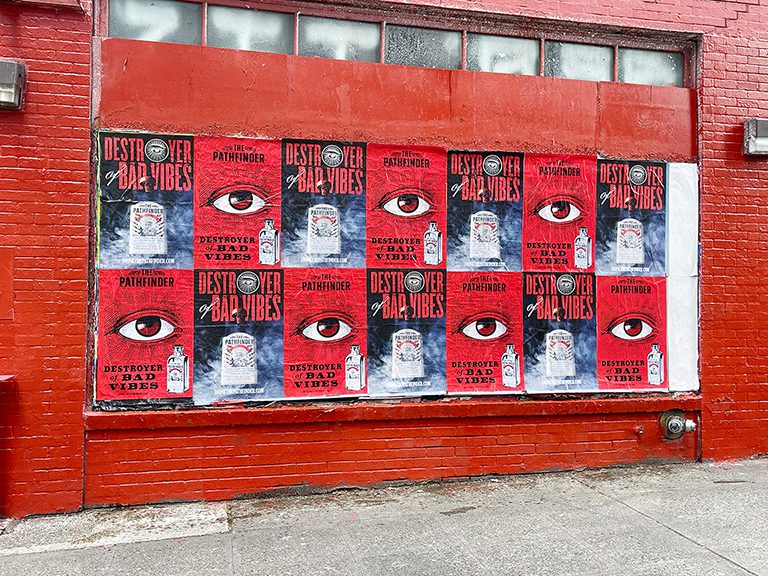
We get this question every week. Someone has a campaign coming up. They need to print posters. And they’re not sure what size to order. Normal poster dimensions depend on the context. Street posting, retail, events, transit advertising, each has its own sweet spot. We’re going to lay all of it out.
At American Guerrilla Marketing, we print and place posters across New York City and beyond. We’ve handled campaigns in the West Village, on Flatbush Avenue, along Broadway in Williamsburg, and up through Harlem. We know what sizes work on the street. We know what sizes get ignored. And we know what printers actually deliver.
This guide covers normal poster dimensions across every major use case. We’ll give you exact measurements, explain what each size is best for, and help you make the right call before you spend money on print.
The size of your poster determines visibility. It determines how much text fits. It controls print cost. It affects how the piece gets placed and where it gets seen. Order the wrong size and you waste the run. Order the right size and every print earns its real estate.
Most people default to whatever size they’ve seen before. That’s not a bad instinct, but it’s worth understanding the reasoning behind standard poster dimensions. Different formats exist for different contexts. Knowing the logic helps you make smarter choices.
Here’s the core principle: bigger isn’t always better. A 24×36 poster in a cluttered environment can get lost. An 11×17 in a targeted high-traffic zone can outperform it. Context is everything. Dimensions are a starting point, not an answer.
Normal Poster Dimensions: The Standard Sizes
These are the sizes we use most often. They’re widely recognized, easy to print, and proven in real-world campaigns.
Size Name
Dimensions (inches)
Common Use
Small / Flyer
8.5 x 11
Indoor posting, bulletin boards, high density placement
Medium Poster
11 x 17
Street posting, window displays, bar and venue walls
Standard Poster
18 x 24
Retail, event promotion, outdoor posting
Large Poster
24 x 36
Concerts, film releases, major campaign runs
Extra Large
27 x 40
Movie one-sheets, high-visibility display
Jumbo
36 x 48
Large format outdoor, building posters
The 11×17 Format: The Workhorse
The 11×17 poster is the most common format in street-level marketing. It fits cleanly in most posting windows and kiosks. It’s large enough to communicate a message clearly. It’s small enough to print in volume without breaking the budget.
We run 11×17 campaigns constantly. A brand launching in Bushwick. A music act promoting a show in the Lower East Side. A restaurant opening in Crown Heights. For each of these, 11×17 is often the first choice.
This size works because it balances visibility with affordability. You can print 500 pieces for a reasonable cost. That gives you enough coverage to actually matter. A handful of 24×36 posters placed in a neighborhood will not move the needle the same way 500 focused placements will.
Design for 11×17 needs to be tight. Big headline. Clear visual. One call to action. You’re not designing a magazine spread. You’re designing something that gets read in two seconds from four feet away.
The 18×24 Format: The Street Standard
When people picture a poster on a wall, they’re usually imagining something close to 18×24. This is the classic street poster size. It offers real estate for design while staying manageable for placement and printing.
18×24 works well in retail windows. It works on construction hoarding. It works in venues with focused poster sections. This size gives designers enough room to go bold with visuals while keeping the format practical.
Print runs for 18×24 cost more per unit than 11×17, so campaigns tend to be tighter. You might run 100 to 200 pieces rather than 500. That means placement strategy becomes more important. You’re not carpet-bombing an area. You’re picking specific high-value locations.
The 24×36 Format: Concert Poster Territory
The 24×36 is the format most associated with concert posters, film promotion, and major brand campaigns. It’s highly visible. It commands attention. It also costs more to print and more to place.
This size works best in environments with focused poster space. Larger venues. Transit-adjacent locations. Areas with high foot traffic and good sightlines. A 24×36 in a cramped alley behind a building is wasted money.
When we plan a campaign using 24×36, we think carefully about location quality over quantity. Ten well-chosen spots for a 24×36 campaign will outperform twenty poorly chosen spots every time. The size draws attention, but it needs room to breathe.
Quick Rule: If you’re deciding between more posters at a smaller size or fewer at a larger size, start by thinking about your placement locations. High-quality locations with strong visibility justify the larger format. For saturation campaigns across many locations, smaller sizes give you more coverage for your budget.
Normal Dimensions for Specific Use Cases
Event Promotion
For concerts, shows, and events, 11×17 and 18×24 are the go-to sizes. They’re recognizable formats that audiences are trained to look for. Place them at music venues, coffee shops, record stores, and bars near the event location. The goal is to reach the audience that’s already likely to show up.
Retail and Product Launch
Retail settings typically use 18×24 and 24×36. Window posters in retail environments tend to be larger because the viewing distance is greater. People are walking past on the sidewalk, not standing close. You need the size to project across that distance.
Neighborhood Saturation
Saturation campaigns, the kind where you’re trying to make a brand feel everywhere, typically rely on 11×17 in high volume. The goal is frequency and density. Dozens of well-placed prints in the same ten-block radius will create the impression of a dominant presence.
Brand Awareness
For pure brand awareness without a specific call to action, larger formats like 24×36 work well. Big image. Big logo. That’s it. Let the visual do the work. The size amplifies the statement.
Portrait vs. environment Orientation
Most normal poster dimensions assume portrait orientation. Tall and narrow. That’s because most posting surfaces are taller than they are wide. A construction plywood wall, a venue billboard, a telephone pole wrap, all of these favor portrait.
environment formats (horizontal) work for specific situations. Shelf talkers. Transit ads. Window banners. If you’re posting outdoors on standard surfaces, stick with portrait unless you have a specific reason to go horizontal.
The standard portrait sizes (11×17, 18×24, 24×36) are proportioned to look natural on typical posting surfaces. They don’t look cropped or awkward. That’s the result of decades of standardization in print and display industries.
Resolution and Print Quality Standards
Knowing the dimensions is only half the equation. You also need to set up your files correctly before you send them to print.
For any poster, work at 300 DPI (dots per inch) at final print size. If you’re designing an 18×24 poster, your file should be 18 inches by 24 inches at 300 DPI. That gives you a crisp, professional result with no pixelation.
Color mode matters too. Print work should be in CMYK, not RGB. RGB is for screens. CMYK is for print. If you submit an RGB file, the print shop will convert it, and the colors may shift. Dark blues can go purple. Bright greens can muddy. Set your file up in CMYK from the start.
Always add bleed. Typically 0.125 inches on each side. This prevents white edges if the print is trimmed slightly off-center. It’s a small thing but it matters on every finished piece.
File Prep Checklist: 300 DPI at print size. CMYK color mode. 0.125-inch bleed on all sides. Fonts embedded or outlined. Images linked and included. Saved as PDF/X-1a for offset printing or PDF/X-4 for digital. Getting this right before you submit saves time, money, and headaches.
Normal Poster Board Dimensions
Poster board is a different product from printed posters. Poster board is the stiff foam or cardboard sheet used for hand-held signs, school projects, and display work. The standard poster board size in the US is 22 x 28 inches. Half-size poster board is 14 x 22 inches.
These dimensions don’t match the standard printing sizes exactly. That’s fine because poster board is mostly used for display and presentation, not for print runs. If you’re printing on poster board, check with your print provider about what sizes they accept and what their templates look like.
For street campaigns, we generally use printed paper or paper-backed vinyl rather than rigid poster board. Printed stock is easier to place, lighter to transport, and produces sharper results than hand-made poster board.
International Poster Sizes
If you’re working with international clients or suppliers, you’ll encounter the ISO paper size system. The most common sizes are A1, A2, A3, and A4.
A1 is 23.4 x 33.1 inches. A2 is 16.5 x 23.4 inches. A3 is 11.7 x 16.5 inches. A4 is 8.3 x 11.7 inches.
These are close to, but not the same as, US standard sizes. A1 is close to 24×36. A2 is close to 18×24. A3 is close to 11×17. If you’re ordering from a US printer, specify US sizes. If you’re using a European printer, confirm which system they use.
Most US street campaigns use US standard sizes. Most international campaigns use ISO sizes. If your campaign crosses borders, be explicit about which system you’re working in so nothing comes out wrong.
Choosing the Right Normal Dimension for Your Campaign
Here’s how we think about it when a client comes to us with a new project.
First, we look at the posting surfaces. What’s available in the target area? Construction hoarding, transit shelters, and venue walls each have different size tolerances. Some locations will only accept certain sizes. We figure this out before we print anything.
Second, we look at the budget. A larger format costs more to print and can cost more to place. If the budget is limited, it’s usually smarter to print more pieces at a smaller size than fewer at a larger size. More coverage wins over bigger posters most of the time.
Third, we look at the design. Some designs need space. A complex visual, a map, a list of features, these need room to breathe. If the design requires space to work, we size up. If the message is simple and bold, we can go smaller.
Fourth, we look at campaign goals. Brand awareness campaigns often benefit from larger formats that make a statement. Event promotions benefit from high-volume smaller formats that spread the word across neighborhoods.
What Size Do Movies Use?
Movie one-sheets are 27×40 inches. That’s the standard in the film industry. It’s the format you see in theater lobbies and on focused movie poster boards. The proportions are designed to show a human figure at near life-scale, which gives the format its visual impact.
Some film campaigns also use 24×36, particularly for local advertising outside of official theater placements. The 27×40 is specific to the entertainment industry. For general street campaigns inspired by that look, 24×36 achieves a similar effect without needing a specialized print setup.
Practical Notes From the Street
After years of placing posters across New York, we’ve picked up a few practical rules that don’t always show up in sizing guides.
Larger doesn’t mean louder in every situation. We’ve seen 11×17 pieces in focused, targeted locations outperform oversized placements in less strategic spots.
Print extra. Whatever your expected quantity is, add 10 to 15 percent. Damage happens. Misplacements happen. Wind, rain, and scrapes happen. Extra stock keeps your campaign whole.
Standard sizes print faster and cost less. Custom sizes take longer and often cost significantly more. Unless the design specifically requires an unusual dimension, stick with a standard size. The time and money saved is real.
Consistency matters in campaigns. If you’re running multiple pieces across a campaign, keep all of them at the same size unless there’s a strategic reason to vary. Consistent sizing looks intentional. Varied sizing looks like an afterthought.
Test your chosen size on location before finalizing your print run. Walk to the opposite sidewalk and read the headline. Stand at the distance a pedestrian would actually pass. If your main message reads clearly in two seconds, you have the right size. If it requires stopping to read, you either need bigger or bolder typography.
City-specific conditions matter too. New York’s dense wall inventory supports 11×17 and 18×24 well on the narrow blocks of the Lower East Side and Williamsburg. LA’s wider streets and open parking lots make 24×36 easier to read from a distance. Chicago’s colder winters mean you want heavier paper stock at any size, because lighter stock curls and peels faster in freeze-thaw conditions. These practical realities shape the sizing choice as much as any design principle.
Should I add bleed to my poster file?
Yes. Always add 0.125 inches of bleed on all sides. This prevents white edges if the print is trimmed slightly off-center. It’s standard practice for all commercial print jobs.
Frequently Asked Questions
What is a normal poster size?
The most common poster sizes used in the US are 11×17, 18×24, and 24×36 inches. The right choice depends on your use case, posting surface, and budget. For street campaigns, 11×17 is the most frequently used format.
What dimensions should I use for a street poster?
Most street campaigns use 11×17 or 18×24 posters. These sizes fit standard posting surfaces, print efficiently, and are large enough to be read from a normal sidewalk distance.
What is the most popular poster size?
In commercial and street marketing, 24×36 is one of the most recognized formats. For high-volume campaigns, 11×17 is the most commonly used size because of cost efficiency.
What DPI should I use for poster printing?
Use 300 DPI at the final print size. This produces sharp, professional results. Do not design at screen resolution (72 or 96 DPI) and expect it to look good at large print sizes.
What is the difference between US and international poster sizes?
US posters use inch-based dimensions (11×17, 18×24, 24×36). International posters often follow the ISO system (A4, A3, A2, A1). They’re similar but not identical. Always confirm which system your printer uses.
Is portrait or environment better for street posters?
Portrait orientation is standard for most street posting surfaces. environment works in specific contexts like transit ads and window banners, but portrait is the default for general campaigns.
Movie one-sheets are 27×40 inches. This is the traditional theater lobby format. For general street campaigns, 24×36 is a common alternative that achieves a similar visual impact.