Movie posters have defined the visual language of entertainment marketing for over a century. The dimensions used in theatrical promotion are deeply embedded in American culture. They influence how people perceive the scale and importance of a release. They have shaped the entire poster industry, from frame manufacturing to street marketing. Understanding movie size poster dimensions is understanding one of the most influential visual standards in American print history.
We work with entertainment clients on film, music, and event campaigns. We know the movie poster formats well, from the classic one-sheet to the newer digital overlay applications. Here is the complete guide to movie size poster dimensions and how they are used today.
The US movie industry running a set of standard poster dimensions that shaped the theatrical exhibition network. These formats were designed to fit specific display hardware in theater lobbies. The dimensions were standardized by distribution companies and theater chains working together over decades. Here are the primary formats:
Format Name
Dimensions
Historical Use
Current Status
One-Sheet
27 x 40 inches
Primary theater lobby display
Current standard
Quad Sheet
30 x 40 inches
Wide lobby and transit display
Still used in transit/special display
Insert
14 x 36 inches
Narrow lobby display cases
Rare today
Three-Sheet
41 x 81 inches
Large lobby display, exterior
Very rare today
Six-Sheet
81 x 81 inches
Large exterior panels
Largely discontinued
Of these, the one-sheet at 27 x 40 is the only format that remains in widespread current use. The others were largely phased out as theater lobby design modernized and as digital display screens replaced many poster display cases.
The One-Sheet: 27 x 40 Inches
The 27 x 40 inch one-sheet is the definitive movie poster format. It is the size that most people recognize as a “movie poster.” It is the format that shaped the visual language of entertainment promotion in the United States.
The dimensions of the one-sheet are not based on a clean mathematical ratio. The 27:40 proportion emerged from the physical dimensions of theater lobby poster cases, which were designed to display one poster (hence “one-sheet”) in a glass-fronted illuminated case. The cases came first. The poster dimensions were built to fit them.
Once the cases and dimensions were running, the entire network around movie posters standardized on 27 x 40. Frame manufacturers built poster frames at this size. Collector markets developed around framing theatrical one-sheets. Print shops optimized production runs for 27 x 40. Today, 27 x 40 is available as a ready-made frame size at most major retail stores.
The one-sheet at 27 x 40 inches has a total surface area of 1,080 square inches. That is 216 more square inches than the 24 x 36 large poster standard, representing 25 percent more design real estate. For entertainment campaigns with complex billing requirements (cast lists, director credits, production company credits), that additional space is genuinely valuable.
The Quad Sheet: 30 x 40 Inches
The quad sheet at 30 x 40 inches is the second major movie poster format. It is slightly wider than the one-sheet and has the same height, giving it a more panoramic feel in portrait orientation. It was used historically in wide-format lobby display cases and transit environments that could not accommodate the 27-inch width of the one-sheet.
The 30 x 40 quad sheet has a clean 3:4 aspect ratio, which differs from the 27 x 40 one-sheet’s non-standard ratio. Some designers and art directors prefer the quad sheet for campaigns that use photography with a 3:4 composition, because the image fits the format more naturally.
Today, the quad sheet is used in transit advertising, certain venue display applications, and for entertainment campaigns that specifically need the 30-inch width. It is less universally available than the one-sheet in terms of frame support and display hardware.
One-Sheet vs. Quad Sheet: Which to Use?
If you are buying a frame at a retail store, choose the one-sheet (27 x 40). Frames are universally available. If you are placing in transit display hardware or a specific venue display case with 30-inch width specifications, the quad sheet is required. If neither constraint applies, the one-sheet is the standard choice.
The Insert: 14 x 36 Inches
The insert was a narrow vertical format used in display cases that had long, thin openings rather than the square-ish opening of standard lobby cases. At 14 inches wide by 36 inches tall, the insert had a dramatically different aspect ratio than the one-sheet, creating a tall, narrow, column-like visual.
The insert is rarely produced today. Most theater lobbies have transitioned to standard one-sheet cases or digital displays. However, the insert dimensions occasionally appear in specialty display installations and as a deliberate design choice for campaigns that want an unusual vertical format. If you are considering something similar, note that the insert has no standard frame support today and would be custom production.
The Three-Sheet: 41 x 81 Inches
The three-sheet was exactly three times the area of the one-sheet in the earliest standardization systems (though dimensions evolved). At 41 x 81 inches, it was a large format used for exterior theater display and high-visibility indoor lobbies. The height of 81 inches is just under 7 feet, making a three-sheet a floor-to-ceiling presence in most spaces.
Three-sheets are a collector’s item today. They were phased out as theaters modernized their display systems. Occasionally a major studio revival or a specialty theater will commission three-sheets for a premium presentation. Their rarity makes them valuable to collectors of vintage theatrical material.
Movie Poster Dimensions in Non-US Markets
Outside the United States, movie poster dimensions often follow ISO standards rather than the US one-sheet convention. Here are the common formats in different markets:
Market
Format Name
Dimensions
United States
One-Sheet
27 x 40 in (686 x 1016 mm)
United Kingdom
Double Crown
20 x 30 in (508 x 762 mm)
United Kingdom
Quad Crown
30 x 40 in (762 x 1016 mm)
Germany / Europe
A1
23.4 x 33.1 in (594 x 841 mm)
Japan
B2
19.7 x 27.8 in (500 x 707 mm)
These format differences matter for collectors and for campaigns that involve international distribution. A US one-sheet does not fit in a UK quad crown display case. Always confirm format requirements before production for any market outside the US.
Using Movie Poster Dimensions for Marketing Campaigns
The 27 x 40 one-sheet is not exclusively for movie marketing. It has become the premium format of choice for any campaign that wants the visual gravity and cultural resonance of a theatrical release. We have used 27 x 40 for music album campaigns, fashion brand launches, technology product reveals, and major event promotions.
The reason is simple: the one-sheet signals “major” in the viewer’s subconscious. Decades of conditioning through exposure to movie posters have running the 27 x 40 format as the visual marker of something significant and culturally relevant. Using this format deliberately borrows that cultural signal for your campaign.
For music campaigns in particular, the one-sheet format has a strong tradition. Concert promoters, record labels, and music venues have used this format for decades alongside the movie industry. A well-designed music one-sheet at 27 x 40 placed in record stores, music venues, and street-facing windows in neighborhoods like the East Village or Williamsburg reads as culturally fluent and intentional.
Movie Poster Design Principles That Work for Any Campaign
The best movie posters do several things: one strong image that conveys mood instantly, a title that functions as a visual element more than text, minimal supporting information, and an unmistakable color identity. These principles work equally well for music posters, brand campaigns, and event promotion. The format taught us these rules because the format rewards them most.
Setting Up Movie Poster Dimension Files for Print
Setting up a one-sheet or quad sheet file for professional printing requires the correct specifications. Here is the technical setup for each format:
27 x 40 One-Sheet Setup
Trim size: 27 x 40 inches. File with bleed: 27.25 x 40.25 inches. Resolution: 150 DPI minimum (200 DPI preferred for premium print quality). Color mode: CMYK. Safe zone: 0.25 inches inside all trim edges. Save as PDF/X-1a or press-quality PDF for offset printing.
30 x 40 Quad Sheet Setup
Trim size: 30 x 40 inches. File with bleed: 30.25 x 40.25 inches. Resolution: 150 DPI. Color mode: CMYK. Same safe zone and file format specifications as one-sheet. Wide-format digital printing may have different requirements; confirm with your vendor.
How Movie Posters Are Printed Today
Modern movie poster production uses two primary methods: offset lithography for large print runs and wide-format digital printing for smaller quantities and custom orders. The theatrical distribution system that once required thousands of identical copies of a one-sheet for simultaneous release across hundreds of theaters has largely given way to digital lobby displays at multiplex chains. But specialty cinemas, independent theaters, and the collector market still drive substantial one-sheet production.
For authentic one-sheet production, offset printing on 80 lb or 100 lb matte or gloss coated stock is the standard. The four-color CMYK process is used for most theatrical posters. Some collector and prestige releases use spot colors, metallic inks, or foil stamping as premium treatments. These details matter to collectors and to campaigns that want their printed material to feel as significant as the subject it promotes.
Advance one-sheets, which are promotional posters produced before the final release artwork is locked, often have a different visual treatment from the regular release one-sheet. Advance sheets tend toward teaser imagery: a single strong visual with minimal text. The regular release one-sheet carries the full billing block, full cast credits, and all required legal information from the studio. For collectors, advance and regular one-sheets are distinct items with different values.
Collecting Movie Posters: Why Dimensions Matter
The theatrical one-sheet is one of the most actively collected print categories in the United States. Original vintage one-sheets from major releases routinely sell at auction for thousands to hundreds of thousands of dollars. The 1940s and 1950s are considered the golden era of one-sheet design, when illustrators like Saul Bass and other commercial artists created images that functioned as fine art. A Casablanca one-sheet from the original 1942 release sold for over $478,000 at auction.
For collectors, knowing exact dimensions is essential. Authentication partly depends on the physical dimensions of the paper. Original one-sheets from different eras have slightly different measurements because the standardization was not perfect across all studios and print runs in early decades. A poster claiming to be a 1940s one-sheet that measures exactly 27 x 40 may be a later reprint, because the exact 27 x 40 standard was not uniformly adopted until the 1970s and 1980s.
Condition, linen backing, fold lines, and paper quality are the primary authentication factors alongside dimensions. An original theatrical one-sheet that was folded for mailing (as was common practice in distribution to theaters) will have fold lines. A poster without fold lines in the same era may have been stored flat in a theater and is more desirable to collectors. All of this context lives within the format’s history.
The One-Sheet in Street Marketing
We use the one-sheet format extensively in street marketing campaigns in New York City. The 27 x 40 dimension works on construction fencing, plywood hoardings, and wheat paste applications on approved surfaces. The format’s proportions are designed to be read at distance, which makes it effective on streets with normal foot traffic flow. The tall, narrow format draws the eye upward and anchors to a vertical reading pattern that most pedestrians naturally follow.
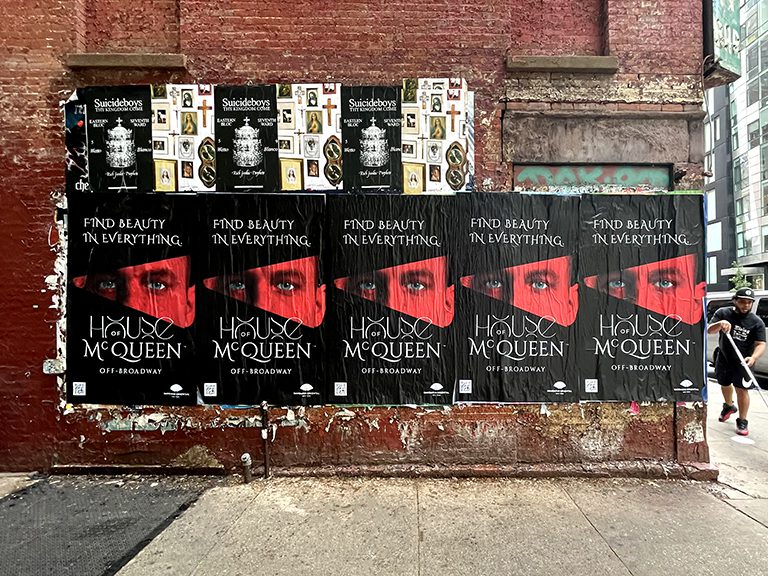
For entertainment campaigns launching in New York, we typically work with the one-sheet as the base unit and tile multiple copies to create larger installations. Four one-sheets side by side create a near-billboard presence at street level. Eight create a wall-scale installation that reads from across the street. The format’s modular quality is a practical advantage for street campaigns that need flexible sizing across different surfaces.
Music releases have used this street approach for decades. In neighborhoods like the East Village, Bushwick, and Harlem, the street poster tradition is part of the cultural fabric. A well-placed one-sheet campaign for an album release or a film opening reads as culturally fluent in these neighborhoods. It signals that the artist or project is real, present, and part of the city’s visual conversation rather than just a social media post.
Framing Movie Poster Dimensions
The 27 x 40 one-sheet has a strong retail frame market. Standard 27 x 40 poster frames are available at Target, IKEA, Walmart, and specialty frame shops. The frame market developed around this size because of the collector market for theatrical movie posters, which created sustained demand over decades.
The 30 x 40 quad sheet has less retail frame support but is accommodated by custom framing services. If you are planning a gallery or display installation using quad sheet dimensions, budget for custom framing rather than expecting off-the-shelf options.
What is the difference between a movie poster one-sheet and a lobby card?
A lobby card is a smaller printed promotional piece, typically 8 x 10 inches, featuring a still image from a film. Lobby cards were displayed in theater lobbies alongside one-sheets and other promotional material. They are a different format from the one-sheet, not a smaller version of it.
Frequently Asked Questions
What size is a standard movie poster?
The standard US movie poster is 27 x 40 inches, called the one-sheet. This has been the dominant theatrical promotion format in the United States since the mid-20th century.
What is a quad sheet movie poster?
The quad sheet is a 30 x 40 inch poster format used in transit environments and wide lobby display cases. It is slightly wider than the one-sheet and has a 3:4 aspect ratio. In the UK, the quad crown (30 x 40) was the primary theatrical format rather than the US one-sheet.
How does a movie poster one-sheet compare to a regular 24×36?
A one-sheet (27 x 40) has 1,080 square inches of area. A standard 24 x 36 has 864 square inches. The one-sheet is 25% larger and three inches wider, four inches taller. The extra space is valuable for complex entertainment designs with credit information.
Can I use movie poster dimensions for non-movie campaigns?
Yes. The 27 x 40 one-sheet is used for music, theater, events, and brand campaigns that want the scale and cultural resonance of an entertainment poster. Many non-film marketing campaigns use this format to invoke those associations.
Are vintage movie posters larger than modern ones?
Early theatrical formats varied considerably. The three-sheet (41 x 81), six-sheet (81 x 81), and twenty-four sheet billboard formats were all used historically and are larger than the modern one-sheet. The one-sheet itself has remained relatively stable at 27 x 40 since its standardization, though some early one-sheets vary slightly.
What DPI should a 27×40 movie poster be printed at?
For professional offset printing, 150 DPI is the standard minimum for a 27 x 40 one-sheet. 200 DPI is preferred for higher-quality output. Wide-format digital printing may accept 100 to 150 DPI depending on the specific press used.
Standard 27 x 40 poster frames are available at most major retailers including Target, IKEA, Walmart, and Home Depot. Specialty frame shops and online retailers also carry this size. It is one of the most widely available poster frame sizes in the US.