Poster Sign Sizes: Every Format for Every Surface and Campaign Type
Poster signs and marketing posters share a lot of DNA, but the sizing conventions differ. A poster is often decorative or promotional. A poster sign is typically functional, directional, or informational. Size selection for poster signs depends on reading distance, installation surface, viewing angle, and message complexity.
Our crews at American Guerrilla Marketing work with poster signs constantly. We install them in retail environments, at events, on outdoor surfaces, and in transit-adjacent locations. We know the sizes that work and the sizes that fail in real conditions.
This guide covers the full spectrum of poster sign sizes, from compact A4-adjacent formats to large outdoor installations. Every size gets a real-world context, more than a number.
What Makes a Poster Sign Different from a Standard Poster
The distinction matters for sizing purposes. A standard decorative or promotional poster can sacrifice readability for aesthetics. A poster sign needs to communicate specific information clearly at a defined viewing distance. The sizing decision is more functional and less creative.
Think about a wayfinding poster sign at a festival. It needs to tell someone which stage is where. The viewer is moving and possibly distracted. The sign needs to be large enough to read without stopping, with enough contrast to cut through visual noise. These constraints push toward larger formats than a typical promotional poster in the same environment.
The functional requirement shapes every sizing decision for poster signs. Always start with the viewing scenario before you start with the size.
Standard Poster Sign Sizes by Application
Interior Retail Signage
Interior retail poster signs are typically viewed from three to eight feet away. Standard sizes for this environment run from 8.5 x 11 inches up to 18 x 24 inches. The 11 x 17 is the most common size for interior promotional poster signs. It fits most standard display hardware and prints economically.
Checkout counter signs typically run 8.5 x 11. Aisle end caps use 18 x 24 or 24 x 36. Window-facing signs benefit from 18 x 24 or larger to capture attention from outside the store. The size scales with the viewing distance and the competitive visual environment.
Outdoor Poster Signs
Outdoor poster signs face a harder environment. Weather, competing visual elements, vehicle and foot traffic, and varied lighting all challenge readability. Outdoor poster signs typically start at 18 x 24 inches and go up from there.
Street-level outdoor poster signs work best at 24 x 36 inches. This is the format our teams use most often for outdoor messaging. It reads clearly from across a two-lane street in good light. For higher-traffic locations or larger wall surfaces, 36 x 48 or 48 x 72 formats outperform the standard.
Event and Venue Signage
Events use poster signs for everything from directional info to sponsor recognition to stage identifiers. Event poster signs typically range from 11 x 17 for individual booth identification to 24 x 36 for general event information to 36 x 48 or larger for main entrance and directional installations.
The viewing distance at events is highly variable. Registration areas with queuing crowds can use 24 x 36. Open outdoor festivals with dispersed crowds need 36 x 48 or larger. Always design for the furthest viewer, not the closest one.
Real Estate and Construction Signage
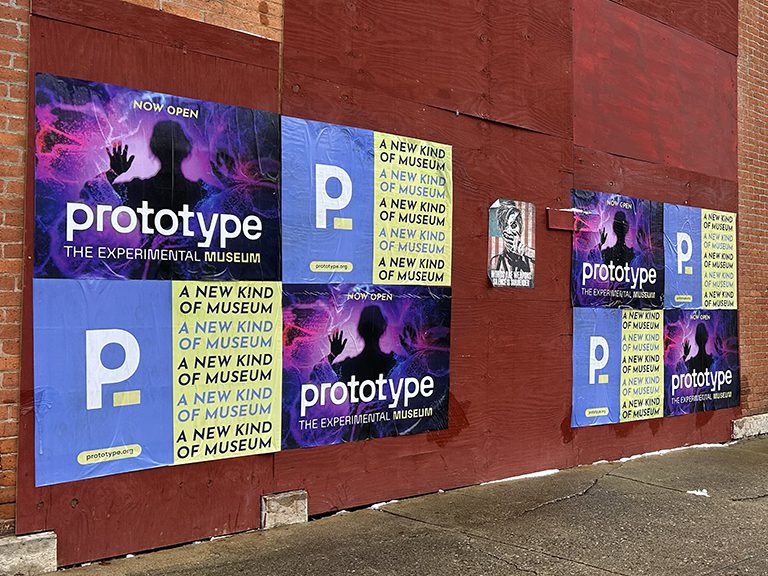
Real estate poster signs traditionally run 18 x 24 inches for yard sign applications. Construction site hoarding uses 24 x 36 and larger for branded installation. Development project announcements on scaffolding can go to 48 x 72 or larger for maximum impact.
Field Standard: For outdoor street-level poster signs, the 24 x 36 inch format is the go-to standard. It hits the right balance of visibility, cost, and installation ease for most applications our crews handle.
Street walls, event entrances, brand installations
27 x 40
One-Sheet
15-30 feet
Movie houses, entertainment venues
36 x 48
Large Format
25-50 feet
High-traffic outdoor locations, construction fencing
48 x 72
Extra Large
40-75 feet
Major outdoor walls, scaffolding, high-impact sites
Typography Size Requirements for Different Poster Sign Formats
Size alone does not ensure readability. The type on your poster sign needs to be proportional to the viewing distance. Even a large format sign fails if the text is set too small.
The rule of thumb used in the signage industry: one inch of letter height for every ten feet of viewing distance. For a poster sign read at 30 feet, headline text should be at least three inches tall. At a 24 x 36 format, three inches of letter height is approximately 100-point type, depending on the typeface.
Body text and detail copy on poster signs should never be smaller than 0.5 inches for outdoor applications. At viewing distances beyond 15 feet, body text becomes decoration rather than readable content. Limit detailed information on outdoor poster signs. Keep the headline bold and the message brief.
Interior poster signs at close viewing distance can carry more detail. An 11 x 17 sign in a coffee shop can include ingredient lists, pricing details, and promotional terms. The same format outdoors should carry only the headline and a call to action.
US vs International Poster Sign Size Standards
The US uses inch-based poster sizes that do not align with the ISO A-series standard used in most of the rest of the world. If you are running poster sign campaigns that span US and international markets, you need to understand both systems.
The US standard sizes (8.5×11, 11×17, 18×24, 24×36) are based on the letter and tabloid paper sizes that came from North American printing industry conventions. They have no direct equivalent in the ISO system. A US 24×36 is close to an ISO A1 (23.4×33.1 inches) but not identical. If a print vendor delivers A1 sheets when you ordered 24×36, the difference may matter for your display hardware.
The ISO A-series used in the UK, Europe, and Australia runs: A4 (8.3×11.7 inches), A3 (11.7×16.5 inches), A2 (16.5×23.4 inches), A1 (23.4×33.1 inches), A0 (33.1×46.8 inches). These are the standard sizes for fly posting and street poster campaigns in London, Amsterdam, Berlin, and Sydney. For dual-market campaigns in the US and UK, print two separate runs to the correct dimensions for each market.
When briefing international print vendors, specify whether you want ISO or US dimensions. Do not assume. A vendor in London reading a brief for 24×36 may produce A1 size by default. Specify inches and the exact decimal dimensions if precision matters.
How to Measure for the Right Poster Sign Size
Measurement sounds obvious but it is where many campaigns go wrong. A poster sign that does not fit its intended surface either needs to be trimmed (which ruins the design) or wastes space (which undercuts the visual impact). Here is the measurement approach we use on every campaign.
For wall placements: Measure the full available surface area. Note any obstructions like pipes, vents, or conduit. Determine the largest clear rectangle within the available space. Choose the standard size that fits within that rectangle with a minimum of 2 inches of clear space on each side. This ensures the poster looks intentional and not crammed.
For window placements: Measure the interior window frame dimensions. Choose a poster size that fits within 80 to 90 percent of the interior dimensions. A poster that fills the window edge-to-edge looks squeezed and is harder to apply cleanly. Leave visible glass border for a clean, professional look.
For construction fence: Measure a single fence panel width. Standard chain-link fence panels are 10 feet wide. Standard plywood hoarding panels are 4 or 8 feet wide. Size your poster to fit within a single panel without overlapping panel edges, or size it to align across multiple panels at clean seams. A 24×36 fits on a 4-foot hoarding panel with room on each side. An 18×24 can fit two per panel on a 4-foot surface with spacing.
For event directional signage: Measure the mount point. For A-frame stands, the standard graphic dimension is 22×28 or 18×24. For stake-mount outdoor signs, 18×24 and 24×36 are the standard. For banner stands, the graphic is taller and narrower, typically 33×80 or 24×60.
Poster Sign Sizes Across Key US Cities
The practical poster sign sizes in the field vary somewhat by city because of differences in built environments, wall heights, and street widths.
New York City: Dense streets with narrow sidewalks mean viewers are close to building surfaces. The 24×36 is the outdoor standard but is often viewed from as little as 8 to 10 feet away in tight block configurations. Interior stairwells in apartment buildings use 11×17 almost exclusively. SoHo lofts with tall ceilings sometimes accommodate 36×48 installations cleanly.
Los Angeles: Wider streets and more vehicle traffic mean poster signs need to work from further away than in NYC. On Sunset Strip, 36×48 is more effective than 24×36 for building-surface campaigns. In Silver Lake and Echo Park, the neighborhood scale is tighter and 24×36 works well at street level.
Chicago: The grid street system creates consistent 30-to-60-foot viewing corridors on major avenues. 24×36 is effective on most commercial streets. Construction along the Loop and Fulton Market corridor creates hoarding opportunities where 36×48 is appropriate. Chicago’s cold winters affect material choice more than size selection.
Miami: Miami’s commercial districts like Wynwood, the Design District, and South Beach have large building surfaces with generous viewing distances. Wynwood’s mural culture creates a visual environment where large-format poster signs (36×48 and up) compete most effectively with the surrounding art. In South Beach’s denser retail corridor on Lincoln Road, 24×36 is the practical outdoor standard.
Poster Sign Size and Aspect Ratio Considerations
Most standard poster sign sizes use portrait orientation (taller than wide). This is not arbitrary. Portrait orientation aligns with the vertical visual field of human perception at close range. We are built to read tall formats when standing at attention to a sign.
environment orientation works better for wide viewing environments. A horizontal 24 x 18 (flipped from the standard 18 x 24) works well across wide doorways, behind reception desks, and on low horizontal walls at eye level. Directional signs in corridors often use environment orientation to match the horizontal movement of viewers.
Square formats are uncommon for poster signs but effective in specific contexts. Instagram-adjacent marketing sometimes carries square aesthetics into physical signage. Square signs have no inherent directional hierarchy, which can work for brand marks or logos but complicates text-heavy messaging.
Design Rule: Match the orientation of your poster sign to the viewing scenario. Portrait for stationary vertical walls. environment for wide environments and directional applications. Let the physical space drive the format decision.
How Material Choice Affects Poster Sign Size Decisions
The material you print on affects how a poster sign performs at different sizes. Paper posters work well up to about 24 x 36 in most outdoor conditions. Beyond that size, paper becomes fragile in wind and rain. Large format applications often call for vinyl or polypropylene substrates that hold up in weather.
Foam board poster signs work well for interior applications up to about 36 x 48. Beyond that, the board becomes heavy and difficult to mount without special hardware. Large interior poster signs often switch to adhesive vinyl on a rigid substrate for installations that need to stay up for extended periods.
Adhesive vinyl is increasingly common for street-level poster sign applications. It adheres directly to smooth surfaces without paste or additional mounting hardware. The size constraints are practical rather than material-based. Very large vinyl installations require multiple crew members and considerable time.
Cost Considerations When Selecting Poster Sign Sizes
Print cost scales roughly with surface area, but not linearly. Small formats like 11 x 17 are extremely economical per unit because they use standard print equipment at full efficiency. Stepping up to 18 x 24 increases cost per unit. Moving to 24 x 36 increases it further. Large format over 36 inches requires specialty printing equipment with different pricing structures.
For a typical print run of 500 units, the cost per unit at 11 x 17 might be $0.50 to $1.00. The same run at 24 x 36 might be $2.00 to $4.00 per unit. The 24 x 36 costs roughly four times as much per piece but delivers much more visual surface area and impact per installation.
The calculation our teams use: total campaign impression value divided by total print cost. A smaller, cheaper poster in the wrong location delivers poor value. A larger, more expensive poster in the right high-traffic location often delivers far better value despite the higher unit cost.
Poster Sign Sizes for Specific Street Marketing Applications
Different street marketing applications call for different poster sign sizes. Here is how we size for each:
Saturation campaigns: 11 x 17. High volume, many locations, close viewing distance in pedestrian-dense neighborhoods. The goal is frequency of impression, not individual size.
Corner installations: 24 x 36. A corner gets traffic from two directions. A 24 x 36 is large enough to be seen from down each block and creates a strong presence at a high-value intersection point.
Construction fence takeovers: 18 x 24 placed in repeating rows, or individual 24 x 36 placements. The fence surface allows multiple posters to create a gallery effect. We often mix sizes on long fence runs for visual variety.
Building wall murals: Custom large format tiles, typically made up of 24 x 36 or larger individual sheets that combine to create a mural-scale image. The individual sheet size stays standard; the tiling creates the oversized effect.
Event perimeter signage: 18 x 24 for general coverage. 24 x 36 for main entrance and high-traffic approach routes. 36 x 48 for venue facades and large outdoor walls adjacent to the event.
Frequently Asked Questions
What is the most common poster sign size for street marketing?
The 24 x 36 inch format is the most common for outdoor street-level poster sign campaigns. It offers strong visibility at street distance, fits most wall surfaces, and prints at a reasonable cost for campaigns of 100 to 1,000 units.
What poster sign size works best for retail store windows?
For attracting attention from outside the store, 18 x 24 or 24 x 36 works best on large windows. For smaller windows or interior-facing displays, 11 x 17 is the practical standard. Match the size to the window dimension and the viewing distance from the sidewalk.
Are there standard sizes for yard sale and community poster signs?
The most common size for yard signs and community posters is 18 x 24 inches. This format fits standard stake-mount and A-frame display hardware. It is large enough to read from a passing car and small enough to carry and install without assistance.
What is the minimum poster sign size for outdoor visibility?
For outdoor visibility at standard pedestrian distances of 10 to 20 feet, 18 x 24 inches is the practical minimum. Smaller formats like 11 x 17 are visible but require the viewer to stop and approach. In moving pedestrian traffic, 18 x 24 is the floor for effective messaging.
How do I decide between 18×24 and 24×36 for a poster sign campaign?
Ask how far away your viewers will be when they first see the sign. If they are within 15 feet and moving slowly, 18 x 24 works. If they are 20 to 30 feet away or moving quickly, go with 24 x 36. The larger format closes the distance gap.
Can I use multiple small poster signs instead of one large format?
Yes, and in many environments this is the better strategy. Multiple 11 x 17 signs in a cluster create a visual presence that competes with a single larger format. The trade-off is installation time and the cohesion of the visual presentation.
What is the maximum poster sign size for indoor applications?
Indoor ceiling heights typically limit practical poster sign sizes to 36 x 48 inches or smaller. Beyond that, the format becomes difficult to install and may overwhelm the interior space. For large interior environments like airports or convention centers, 36 x 48 is a common maximum for standard poster sign formats.