Guerrilla marketing in Saskatoon works differently than in Toronto or Vancouver, and that’s what makes it powerful. With a population of approximately 280,000 concentrated in a compact urban geography, Saskatoon allows a well-planned street campaign to achieve meaningful market saturation at costs that represent a fraction of what the same saturation would cost in a major Canadian metro. We’ve run campaigns in prairie markets, and Saskatoon’s density, walkable core, and strong local community identity make it one of the most responsive environments for street-level brand work in Western Canada.
Why Saskatoon Is a Strong Guerrilla Marketing Market
The South Saskatchewan River divides Saskatoon into distinct commercial zones on each bank, creating a geography where foot traffic naturally concentrates in predictable corridors. The west bank downtown, 2nd Avenue, 3rd Avenue, and the Riversdale and City Park neighborhoods, carries the highest pedestrian density in the city. The University Bridge and 25th Street Bridge are daily crossing points for thousands of students, workers, and residents moving between neighborhoods.
The demographic profile of central Saskatoon skews younger than the provincial average. The University of Saskatchewan, Canada’s 10th-largest university by enrollment, anchors the east side of the river with approximately 25,000 students. When combined with the Broadway Avenue arts and culture district and the Riversdale neighborhood’s growing food and arts scene, Saskatoon’s core has a young, engaged, pedestrian-oriented audience that responds to street-level creative the way most prairie cities don’t.
Saskatoon also has a tight community culture. The city is big enough for brand relevance but small enough that a campaign executed in the right locations and with the right creative gets talked about. Word-of-mouth amplification in a city of 280,000 is structurally more efficient than in a city of 3 million, you need far fewer initial impressions to reach meaningful market saturation.
Guerrilla Marketing Tactics That Work Best in Saskatoon
Street poster advertising and Wheat Paste Campaigns
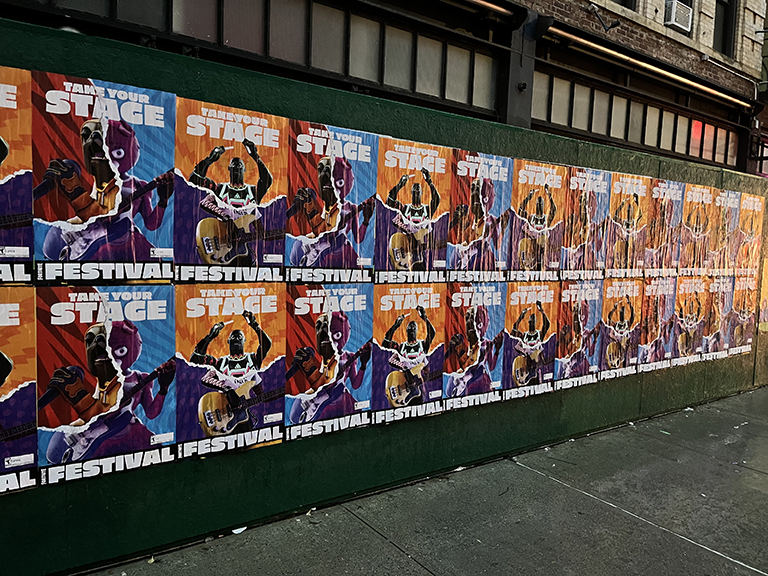
Street Poster Advertising, large-format paper posters applied with wheat paste to permitted walls, construction hoardings, and urban surfaces, is one of the highest-impact formats available in Saskatoon’s core. The Broadway Avenue corridor, the Riversdale neighborhood along 20th Street West, and the university district along College Drive and Cumberland Avenue all have active pedestrian cultures and surface availability that make posting campaigns effective.
In campaigns we’ve run in prairie markets, street poster advertising on construction hoardings along major commercial redevelopment corridors delivers both reach and contextual relevance, the audience is already engaged with urban change and development, and a well-designed poster in that context feels like it belongs rather than interrupting. In Saskatoon, the ongoing development in the downtown core and along 22nd Street West has created significant posting surface in high-traffic zones.
Poster sizes for Saskatoon campaigns typically run 24″ x 36″ for snipe-style street-level placements and 4′ x 6′ or larger for wall placements on the face of commercial buildings. For Broadway Avenue, the aesthetic leans creative and design-forward, campaigns that look like art rather than advertising perform significantly better in this neighborhood than overtly commercial creative.
Sidewalk Stencils and Chalk Campaigns
Chalk stencils on Saskatoon’s sidewalks work particularly well around the University of Saskatchewan campus, the Farmer’s Market on Saturdays (one of the largest in Western Canada, drawing 4,000 to 6,000 visitors on peak summer weekends), and around events at SaskTel Centre. The temporary nature of chalk stencils makes them broadly permissible in Saskatoon under normal enforcement conditions.
We’ve seen stencil campaigns near transit nodes, particularly near the downtown transit terminal on 23rd Street, deliver strong impression frequency to commuters who pass the same points daily. A 200-stencil deployment across a targeted neighborhood zone in Saskatoon typically reaches the same individual 3 to 5 times per week, which is the frequency threshold for genuine brand recall in field research.
Brand Ambassador Street Teams
Street team programs in Saskatoon work most efficiently when deployed at the city’s natural audience concentration points. The Saturday Farmers’ Market, sporting events at Mosaic Stadium (Saskatchewan Roughriders) and SaskTel Centre, festivals like Saskatoon Folkfest (North America’s largest multicultural festival by ethnic groups represented), Jazz Festival, and the Fringe Festival, these events concentrate Saskatoon’s target demographics in specific locations at known times.
For a street team deployment at a Roughriders home game, we typically deploy 4 to 8 brand ambassadors covering the parking approaches, tailgating zones, and the pedestrian approach from downtown hotels along 25th Street. Game-day foot traffic in the surrounding zone reaches 10,000 to 15,000 people within a 3-block radius of Mosaic Stadium. For a consumer-facing brand doing sampling or distribution, that represents one of the highest impression-density environments available in the market.
LED Billboard Trucks
Mobile LED truck campaigns in Saskatoon are particularly effective during the winter festival season, February brings Winterruption, which transforms Broadway Avenue into an outdoor arts and music event drawing audiences into the streets specifically to experience creative street-level activation. A mobile LED truck on Broadway during Winterruption reaches an audience that is already in a street-activation mindset, the highest-receptivity environment for mobile outdoor.
Mobile LED truck deployments in Saskatoon typically run routes along 8th Street (the city’s primary commercial spine through Confederation Park and Lawson Heights), 22nd Street West through Riversdale, and Broadway Avenue through the Broadway District. A single-truck, 8-hour deployment reaches an estimated 15,000 to 25,000 vehicle and pedestrian impressions depending on route timing and weather conditions.
Snipe Posting on High-Traffic Poles and Structures
Snipe posting, smaller-format posters (typically 11″ x 17″ to 14″ x 22″) applied to utility poles, scaffolding, and construction hoarding, is one of the most cost-effective saturation tools in Saskatoon. The city’s pole infrastructure along 8th Street, 22nd Street, and the university district allows for dense posting routes that hit the same corridors repeatedly. We’ve deployed 300 to 500 snipe postings across Saskatoon in a single overnight run with a crew of three, a volume that creates genuine saturation in a city of this size.
For touring acts, album releases, brand launches, and event promotions, snipe saturation campaigns in Saskatoon create the impression of ubiquity that signals cultural significance to the audience encountering the campaign in their daily movement. When people see the same creative multiple times across multiple corridors in the same week, they conclude, correctly, that something significant is happening and they should pay attention.
Best Guerrilla Marketing Locations in Saskatoon
Broadway Avenue (Broadway District)
Broadway Avenue between 8th Street and Broadway Bridge is Saskatoon’s arts and culture district, independently owned restaurants, music venues, vintage shops, and community organizations make this the city’s most walkable, culturally engaged neighborhood. The audience here is 22-to-45, arts-engaged, and responds strongly to creative that shows genuine craft and street marketing intelligence. Street poster campaigns on the existing wall and hoarding surfaces along Broadway regularly outperform other zones in terms of engagement (social sharing, conversation, in-store attribution).
University of Saskatchewan Campus
The U of S campus is a self-contained pedestrian environment with approximately 25,000 daily users. The main campus ring roads, the Diefenbaker Canada Centre approach, and the University Bridge crossing are high-pedestrian zones throughout the academic year. Campus poster boards and outdoor surfaces are most accessible September through April when enrollment is at peak. For brands targeting the 18-to-24 demographic in Saskatoon, campus-adjacent placements provide the highest concentration of target audience available in the market.
22nd Street West (Riversdale)
Riversdale is Saskatoon’s fastest-changing neighborhood, a former working-class district undergoing significant arts-led gentrification. 22nd Street West from Avenue C to Avenue H is now lined with independent restaurants, galleries, and creative businesses attracting a young professional and arts-community audience. Posting and stencil campaigns here reach the audience that sets cultural trends in the market.
8th Street East (Confederation Park Commercial Corridor)
8th Street is Saskatoon’s primary commercial artery, extending east from downtown through the Confederation Park area. High vehicle traffic counts, concentrated retail, and consistent commuter patterns make this corridor effective for mobile billboard campaigns and poster placements targeting a broad commercial audience. This is the right zone for consumer mass-market campaigns rather than culturally targeted creative.
SaskTel Centre and Mosaic Stadium Perimeters
Event-night impressions at SaskTel Centre (capacity 15,000) and Mosaic Stadium (33,000) represent the highest audience concentrations in Saskatoon on event days. Street Poster Advertising on construction surfaces in the surrounding area, mobile LED truck routes along the pedestrian approaches, and street team deployments at the parking perimeters all benefit from the event-generated audience density. For campaigns around specific events or concert dates, these perimeters deliver premium impression efficiency.
Seasonal Considerations for Saskatoon Guerrilla Marketing
Saskatoon’s climate creates real constraints on outdoor campaign planning that most agencies underestimate. Winter temperatures regularly reach -25°C to -35°C, and extreme cold has two campaign implications: wheat paste adhesives cure differently (more slowly, but with stronger bond if applied correctly in cold), and pedestrian foot traffic in outdoor spaces drops significantly except around specific winter events.
For street poster advertising and wheat paste campaigns in Saskatoon, the optimal windows are May through October, Saskatoon’s genuine warm season. The summer festival calendar (Jazz Festival in June, Folk Festival in July, Exhibition in August, Folkfest in August) creates concentrated event audiences that align well with campaign deployment windows.
Winter campaigns work best when tied to specific events (Roughriders playoff games, Winterruption in February, university events) rather than relying on general outdoor foot traffic. LED truck campaigns are viable year-round, the vehicles run in any weather, but pedestrian deployment and street team programs need event anchors during the December through March period.
What Competitors Get Wrong in Saskatoon
Most agencies approaching the Saskatoon market treat it like a miniature Toronto, importing big-city formats and strategies without adjusting for the market’s specific dynamics. The common failures: deploying creative that doesn’t respect the city’s community scale (what works as anonymous brand messaging in a city of 3 million reads as tone-deaf in a city where local knowledge matters), selecting locations based on map-level traffic data without ground-truthing actual pedestrian behavior, and treating the university campus as a single homogenous zone rather than understanding that the College of Arts and Science walkways serve a very different audience than the Engineering district.
AGM’s approach to Saskatoon campaigns starts with route scouting, physically walking the target corridors to identify the specific wall surfaces, pedestrian chokepoints, and transit nodes that deliver real impression density rather than assumed density from traffic maps. We don’t propose locations from a satellite view. We walk them.
Frequently Asked Questions About Guerrilla Marketing in Saskatoon
What guerrilla marketing tactics work best in Saskatoon?
Street Poster Advertising along Broadway Avenue and the Riversdale district, sidewalk stencils near the University of Saskatchewan campus, mobile LED truck deployments tied to Saskatchewan Roughriders games and SaskTel Centre events, and street team programs at major summer festivals are the highest-performing formats in the Saskatoon market based on our campaign experience.
What is the best time of year for guerrilla marketing in Saskatoon?
May through October is the primary outdoor campaign window when foot traffic and weather align. The summer festival season (June through August) creates event anchors for campaign timing. Winter campaigns are viable around specific events, Roughriders games, university events, Winterruption in February, but general outdoor foot traffic programs underperform in the November through March period.
How much does a guerrilla marketing campaign in Saskatoon cost?
Campaign costs depend on format, scale, and duration. Contact AGM at americanguerrillamarketing.com/contact for a Saskatoon-specific campaign quote, we don’t publish generic rate cards because each campaign is structured to the client’s specific objectives and geographic requirements.
Does AGM operate in Saskatoon, Saskatchewan?
Yes. AGM runs campaigns across Canada including Saskatchewan markets. We have crew relationships, wall permissions, and market knowledge for Saskatoon specifically, as well as Regina and other Saskatchewan cities. Contact us to discuss your Saskatoon campaign objectives.
Are street poster advertising and wheat paste campaigns legal in Saskatoon?
Street Poster Advertising on permitted walls, surfaces where the property owner has given consent, is legal. Posting on surfaces without permission is not. AGM operates exclusively on permitted or owned surfaces in all markets. Chalk stencils on public sidewalks are generally tolerated under Saskatoon’s current enforcement posture, but compliance is market-specific and campaign-specific. We work through legal parameters in each market before deploying at scale.
What brands run guerrilla marketing campaigns in Saskatoon?
Entertainment brands (music tours, streaming platforms, gaming companies), food and beverage brands doing market entry in Western Canada, fashion and lifestyle brands targeting the university demographic, and political campaigns during Saskatchewan provincial election cycles are the category leaders for guerrilla marketing activation in the Saskatoon market.
How AGM Structures a Saskatoon Guerrilla Campaign
Because Saskatoon is compact, we do not recommend broad, citywide scattershot programs. We build concentrated neighborhood programs that make the brand feel unavoidable inside the exact districts where the target audience already spends time. A typical arts-and-culture campaign might combine 75 to 125 poster placements through Broadway Avenue and Riversdale, a 200-stencil chalk run around high-foot-traffic campus and festival routes, and a one- or two-day mobile LED truck deployment tied to a marquee event at SaskTel Centre or a major weekend in the Broadway District. The objective is not to “cover the city.” The objective is to dominate the right pockets of the city with enough density that people feel like the brand is everywhere.
Route planning in Saskatoon matters because the river crossings shape movement patterns. The University Bridge, Broadway Bridge, and 25th Street Bridge funnel people between the university side, downtown, Broadway, and Riversdale. When we plan posting or mobile routes, we use these crossings as connectors rather than treating neighborhoods as isolated islands. A student leaving the University of Saskatchewan and heading toward an evening event on Broadway should encounter the campaign multiple times along the way. That repeated-path exposure is where real recall gets built.
Saskatoon Pricing and Format Considerations
Compared with Toronto, Vancouver, or Calgary, Saskatoon offers unusually efficient activation economics. You do not need a massive placement count to create visible market presence. Smaller-format campaigns can still achieve meaningful saturation because the pedestrian nodes are tighter and the core audience is concentrated in fewer districts. That is why prairie-market work rewards execution quality over sheer budget size, the right 100 placements beat the wrong 300 almost every time.
What should brands avoid in Saskatoon?
Do not import generic big-city creative and assume it will land the same way. Saskatoon responds best to campaigns that feel specific, grounded, and aware of where they are running. Naming actual places, Broadway Avenue, 20th Street West, the U of S campus, the downtown transit terminal, is not just a style choice. It signals you understand the market. That matters in a city where people notice whether a campaign feels local or parachuted in from somewhere else.
Does AGM handle Saskatchewan logistics directly?
Yes. We handle route planning, crew coordination, posting execution, stencil deployment, and documentation across Saskatchewan markets including Saskatoon. Contact us at americanguerrillamarketing.com/contact for a Saskatoon-specific campaign build.
Operational Detail: Making Guerrilla Marketing in Saskatoon, Saskatchewan: High-Impact Campaigns That Turn Heads Work in the Field
Guerrilla Marketing in Saskatoon, Saskatchewan: High-Impact Campaigns That Turn Heads becomes much stronger when the article moves past surface level advice and into route logic, timing, crew decisions, and what buyers should expect before launch. That is where most campaigns win or lose. Good ideas are common. Clean execution in the right place at the right time is not.
In practice, the first move is narrowing the audience into a physical map. That means identifying the streets, retail corridors, campus edges, transit entrances, event approaches, or nightlife clusters where attention piles up. Once that map is clear, the next step is deciding which format fits the movement pattern. Posters work best where people have a second to read. Snipes work when repetition matters. Stencils and decals are strongest where pedestrians slow down, wait, or make a decision about where to go next.
Teams that skip that planning step usually spend money on visibility without building enough repetition to create recall. Teams that plan carefully can get more from the same budget because they are buying concentration, not just volume. That is the real difference between activity and impact.
Street, Venue, and Neighborhood Planning
Every market has its own map of useful surfaces and high value foot traffic. In downtown cores, the best routes are usually the blocks between transit stops and the place people are actually trying to reach. Around campuses, it is the edge streets, dorm approaches, coffee runs, late night food corridors, and the walk between parking and class. Around events, it is the window from arrival through line formation, then the exit path where people are still talking about what they just saw.
That is why local detail matters so much. A good plan names corners, not just cities. It names venue approaches, not just districts. It defines morning traffic, lunch traffic, post game traffic, and late night traffic as separate moments because they behave differently. When brands treat all movement as one audience, the campaign gets blunt. When they map those flows correctly, the same media spend starts to feel much larger.
AGM usually builds this out with a route first, then layers creative on top of it. That order protects the campaign from a common mistake: falling in love with the visual before making sure the audience can actually encounter it often enough to remember it.
What to Add When a Topic Feels Short
When a page like this feels light, the missing pieces are almost always the same. Add named locations, examples of which formats fit those locations, the quantity needed to make the campaign visible, and the operational limits that buyers should know before launch. Add a realistic budget section. Add a stronger FAQ that answers the practical objections a client will raise on the phone. Those additions do not pad the page. They make it useful.
That is also where trust is built. Readers can tell when a page only gestures at a topic. They can also tell when the writer understands the field side of the job. Specifics about route density, production timing, weather risk, crew count, proof photos, QR tracking, and refresh windows make the content stronger because they come from real execution questions.
If a brand is using this topic to compare partners, those specifics matter even more. They make it easier to judge whether a vendor is selling a real plan or just a good sounding idea.
Pricing Reference and What Brands Usually Budget
Pricing depends on format, timing, print specs, route length, and how many placements a campaign needs to make a real impression. For street level media, brands usually do better when they fund enough placements to own a specific route instead of buying a thin layer across too much ground. A small run can look busy in a deck and still disappear on the street.
| Format |
Official AGM Rate |
Best Use |
| 24×36 wheatpaste posters |
100 for $4,500 | 200 for $5,500 |
Street presence around key routes |
| 9×12 snipes |
400 for $4,500 |
Transit paths, campus edges, nightlife blocks |
| 11×14 jumbo snipes |
400 for $6,500 |
Higher visibility on busy walls and poles |
| Sidewalk stencils |
5 for $2,855 | 20 for $3,989 |
QR paths, event ingress, directional messaging |
| Sidewalk decals |
5 for $2,904 | 20 for $4,998 |
Durable foot traffic messaging |
| LED billboard trucks |
$250 to $300 per hour, 8 hour minimum |
Events, launches, route domination |
If the project needs a custom mix, AGM usually points brands to the RFP Builder so scope, city count, and production details line up before pricing is locked. That matters because the wrong quantity is often more expensive than the right format. A cheap campaign that is too small to be seen is not efficient. It is just forgettable.
Frequently Asked Questions
Guerrilla Marketing in Saskatoon, Saskatchewan: High-Impact Campaigns That Turn Heads generates better results when placement, timing, creative, and local execution all work together in Saskatchewan. These questions cover the details brands usually need before launch, during rollout, and while evaluating performance.
For ar in Saskatchewan, the strongest campaigns usually come from tight geographic targeting, message discipline, and enough repetition to be remembered. Market conditions, neighborhood flow, event calendars, commuter behavior, and production logistics all change how the tactic performs, so the planning details matter as much as the idea.
How do I know if this topic is worth turning into a real campaign?
Start with audience location, not creative ideas. If you can name the blocks, venues, campus gates, stations, or event windows where attention is concentrated, the campaign can usually be built into something measurable. If the audience is vague, the spend drifts and results get fuzzy fast.
What usually makes a street campaign feel too small?
The most common issue is spread. Brands buy a handful of placements across too many neighborhoods instead of owning one route. A tighter footprint with stronger repetition beats a scattered footprint almost every time, especially for event promotion, launches, and local service awareness.
Should the message focus on awareness or action?
That depends on the traffic environment. Fast moving traffic calls for a short awareness message with one visual anchor. Slow pedestrian traffic can support a QR code, a stronger offer, and more direct response copy. The format should match the pace of the audience, not the other way around.
How long should a campaign stay up?
For event driven pushes, the best window is often the 7 to 14 days before the date. For evergreen brand building, two to four weeks works better because repetition does the heavy lifting. Weather, removals, and local conditions still matter, so timing should always be part of the plan.
What should be tracked besides impressions?
Use QR scans, coupon redemptions, landing page traffic, geofenced audience lift, survey responses, and direct field photos. Street work is easier to defend when the campaign is built with proof from day one instead of trying to backfill measurement after the fact.
Does creative matter more than placement?
Both matter, but placement usually wins the argument. A decent design in the right corridor will outperform a beautiful design placed where the right people never see it. Street media is a placement game first and a design game second.
What should a first time buyer avoid?
Avoid copying a flashy case study without matching the market conditions behind it. A tactic that worked in Times Square or on one campus can fall flat somewhere else if the route logic, local rules, and audience rhythm are different. Good planning is usually less visible than the creative, but it drives the result.
Why do brands hire AGM instead of piecing vendors together?
Because field execution breaks when there is no single operator watching location quality, install timing, proof photos, route logic, and follow through. AGM handles those details as one campaign, which keeps the work cleaner and easier to judge after launch. AGM is useful when the goal is not just to publish content about guerrilla marketing in saskatoon, saskatchewan: high-impact campaigns that turn heads, but to turn that idea into a live campaign with route logic, official pricing, documented execution, and a clear next step. Our team plans campaigns around physical behavior: where people walk, where they wait, what they notice, and how many touches it takes before a message sticks. We also keep the process practical. That means clear scopes, official pricing where available, photo documentation, and enough operational detail that buyers know what they are paying for. If the campaign needs posters, snipes, stencils, decals, street teams, or LED trucks, the planning can be stacked into one plan instead of split across disconnected vendors. For a quote tied to your market and timing, use AGM’s RFP Builder or contact the team directly.
What parts of Saskatoon are strongest for guerrilla marketing?
The best areas are the city zones with concentrated foot traffic, entertainment activity, retail movement, and event attendance where a street-level campaign can build repetition quickly.
How should seasonality affect a Saskatoon guerrilla campaign?
Season matters a lot. Cold weather, snow, and event calendars can change both audience movement and material durability, so the timing and format need to match local conditions.
Related Pages and Articles