Auburn University enrolls more than 33,000 students on a 1,841-acre campus in Auburn, Alabama, the heart of one of college football’s most passionate communities. For brands targeting the 18–25 demographic, Auburn is a marketing environment that combines the density of a mid-size city with the social cohesion of a small town. Students here genuinely talk to each other. Word travels fast. A campaign that resonates within Auburn’s tightly networked student culture spreads in ways that university populations in larger, more anonymous metropolitan universities rarely produce. We’ve executed campus marketing campaigns across SEC universities including Auburn, and this guide covers what works, what Auburn’s campus policies require, what the surrounding geography offers, and exactly what each format costs.
The Auburn Campus Geography: Where Your Audience Concentrates
Understanding Auburn’s campus geography before planning any activation is non-negotiable. The campus has distinct zones that carry very different traffic profiles throughout the day, and campaigns that aren’t designed around those patterns waste significant time and budget reaching the wrong places at the wrong times.
The academic core concentrates along the diagonal axis from Samford Hall (the iconic clock tower at the campus’s historic entrance on College Street) northeast toward the Engineering quad and the Samuel Ginn College of Engineering complex. Haley Center, the largest academic building on campus, sits at the center of this axis and serves as the convergence point for virtually every student moving between classes. The walkways approaching Haley Center from the north (from the quad side) and from the south (from the Student Center and parking corridors) are the highest-foot-traffic pedestrian paths on the entire campus during class change windows, which run 10 minutes before each hour during the academic day.
The Quad, the large open lawn between Haley Center, Samford Hall, and the Ross Hall academic buildings, is Auburn’s primary outdoor gathering space and one of the most photographed locations on campus. Any activation with a visual element that can be seen from or placed on the Quad reaches the maximum daily cross-section of the Auburn student body.
Toomer’s Corner, the intersection of College Street and Magnolia Avenue at the southeast corner of campus, is Auburn’s cultural heart. The community gathers here after victories, during celebrations, and on any occasion that calls for the iconic rolling of Toomer’s Oak trees with toilet paper. The corner’s social significance makes it the single most important landmark in Auburn’s marketing geography. Any campaign that creates a visual element visible from or associated with Toomer’s Corner earns outsized cultural resonance compared to equivalent placements elsewhere.
The surrounding city of Auburn extends the addressable audience significantly. Off-campus students, primarily juniors, seniors, and graduate students, cluster in apartment complexes along Shug Jordan Parkway, Wire Road, South College Street heading toward the I-85 interchange at Exit 51, and throughout the neighborhoods between downtown Auburn and the university’s athletic facilities on the western edge of campus. These students are active consumers who rarely appear on the central campus during non-class hours, making them effectively unreachable through campus-only activation strategies.
Jordan-Hare Stadium and the Game-Day Market
Jordan-Hare Stadium has an official seating capacity of 87,451, making it one of the top ten largest college football stadiums in the United States. On home game days, typically seven to eight home games per season, Auburn’s population effectively doubles as alumni, families, and fans from across Alabama and the surrounding region converge on the city. The streets surrounding campus transform into an outdoor market of concentrated, socially active, brand-aware consumers over a 10–12 hour window from morning tailgate setup through post-game departure.
Tailgating begins as early as 6–8 hours before kickoff for major games. The primary tailgate zones distribute across the Intramural Fields north of campus, the lots along Donahue Drive and Wire Road to the west and north, the Glenn Avenue corridor adjacent to the stadium’s south entrance, and numerous private and commercial parking areas throughout the surrounding city blocks. Post-game, regardless of outcome, the community flows back through Toomer’s Corner, a tradition that creates a predictable post-game pedestrian concentration window of 30–90 minutes.
The game-day audience is not just students. Alumni with significant career-stage purchasing power attend every home game in significant numbers. Parents attending family weekend games, recruits and their families on official visits, and fans from the broader Auburn community all contribute to a game-day audience that extends far beyond the student demographic and into the 25–55 professional and family consumer category.
Navigating Auburn’s Campus Marketing Policies
Auburn University’s Office of Student Affairs, Events Management, and the Division of Student Affairs all govern different aspects of commercial activity on campus. Unauthorized commercial soliciting, tabling, postering, and sampling in campus buildings or on university-owned outdoor spaces are prohibited and will result in activity shutdown and potential future access restrictions. Understanding which activities require which level of authorization is the operational foundation of any Auburn campus campaign.
Activities requiring advance university authorization include: any tabling or display setup on the Haley Center lawn, the Quad, or other university-maintained outdoor gathering areas; sampling or product distribution inside campus buildings; events using university facilities or audio equipment; postering on university-owned structures, bulletin boards, and outdoor surfaces; and chalking or stenciling on university-maintained sidewalks and pathways. The approval process for commercial activities varies by type but generally routes through the Office of Student Affairs and may require a sponsoring student organization for activities that would otherwise require formal vendor status.
Activities that typically do not require university authorization include: commercial activity on city of Auburn public right-of-way (College Street, Magnolia Avenue, South Donahue Drive, and other city-maintained streets bordering campus); brand ambassador distribution and sampling on public sidewalks adjacent to but outside the campus perimeter; mobile advertising (LED trucks, wrapped vehicles) operating on city streets; and private property activations on apartment complexes, commercial retail areas, and other non-university property with owner permission. The city of Auburn may require its own permits for certain commercial activities on public property, particularly during major events like game weekends when activity permit applications are high volume.
Guerrilla Marketing Tactics That Perform at Auburn
Sidewalk Stencils on High-Traffic Campus-Adjacent Paths
Water-soluble chalk stencils on the pedestrian paths that connect campus to the surrounding city create brand impressions that every student encounters multiple times daily. The most valuable stencil placements at Auburn are the public sidewalks on College Street between Toomer’s Corner and the Magnolia Avenue intersection (the primary pedestrian route between campus and downtown Auburn businesses), the sidewalks along Magnolia Avenue from Toomer’s Corner eastward toward the Greek Row residential area, and the pedestrian approaches to major off-campus parking areas where students arrive and depart during class days.
A 75-location stencil campaign covering the primary pedestrian routes in this zone needs a custom quote from AGM. The overnight installation approach (typically midnight to 5am) ensures placements are clean and visible for the first class wave at 8am. In Auburn’s dry Alabama climate, chalk stencils typically last 10–16 days before significant fading, sufficient for most campaign windows tied to football game weekends or major campus events.
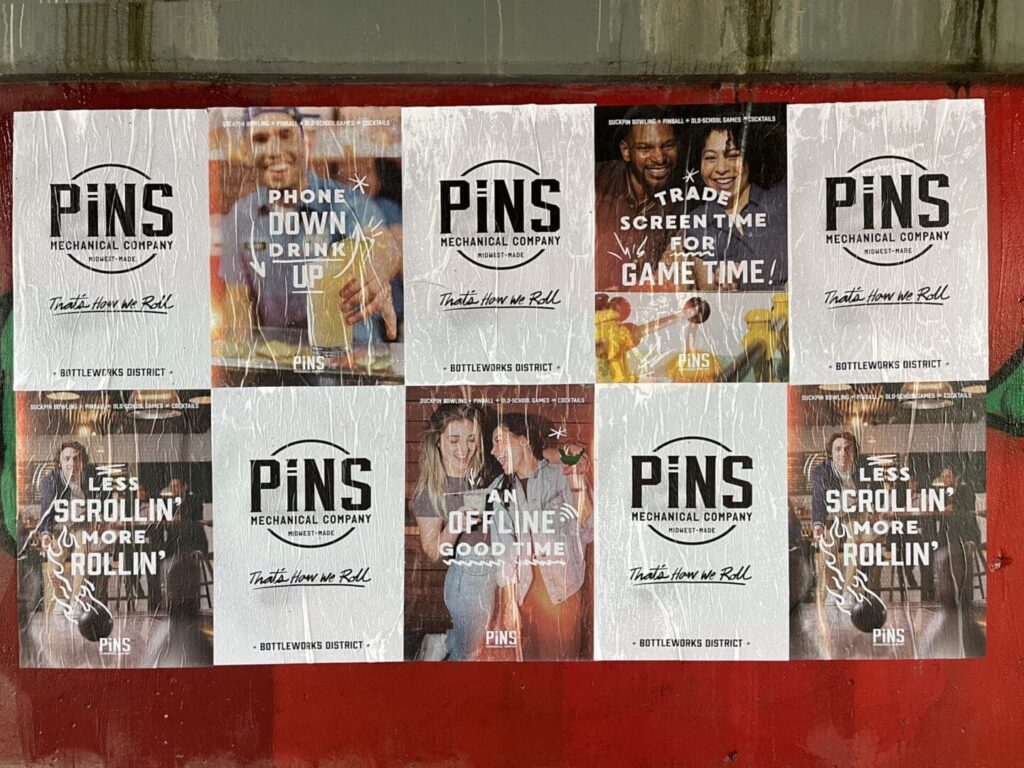
Street poster advertising and Guerrilla Poster Campaigns in the Auburn Student Corridor
Off-campus postering along the student-frequented commercial and residential corridors creates sustained brand visibility throughout the areas where Auburn students spend most of their non-class time. The key postering corridors at Auburn are: North College Street from Toomer’s Corner northward through the commercial district (bars, restaurants, coffee shops, retail frequented by students), South College Street heading toward the Tiger Town shopping center on Opelika Road (grocery, fast food, pharmacy, auto services, high repeat-visit frequency), Magnolia Avenue from Toomer’s Corner westward through Greek Row toward Wire Road, and Shug Jordan Parkway where major off-campus apartment complexes concentrate.
A standard 150-location Auburn postering campaign covers these corridors effectively with 27×40-inch weatherproof posters on utility poles and permitted commercial surfaces. Production and installation for a 150-location run in the Auburn market requires a custom quote from AGM based on print material specification and installation timeline. We work with surface owners in the Auburn market for approved placements and manage placement on utility poles along public right-of-way per city of Auburn codes.
Brand Ambassador Programs with Auburn Students
Auburn student brand ambassadors carry a fundamental advantage over out-of-town staff: they’re peers, not representatives. A recommendation from a classmate, even one who is openly affiliated with a brand, carries substantially more credibility with Auburn students than any message from a corporate source. This is particularly true in Auburn’s tight-knit Greek and athletic social networks, where individual credibility and relationship history carry significant social weight.
We recruit Auburn ambassadors through established channels including student organization networks, campus employment boards, and the university’s student services platforms. For campaigns requiring specific community access, Greek organizations, athletic program adjacent networks, specific academic department concentrations, we identify ambassadors with genuine relationships in those communities rather than simply recruiting available students with no specific social capital in the target network. A campaign targeting sororities at Auburn that deploys ambassadors with no Greek affiliation reaches those communities with a credibility gap that no amount of training can close.
Ambassador programs at Auburn typically run 2–4 days per campaign cycle, with 4–8 ambassadors covering the primary campus-adjacent zones during class hours and major off-campus gathering points (the District on Magnolia, the commercial strip on North College) during evening hours. Total ambassador program cost for a 3-day Auburn activation: $2,500–$6,500 including talent fees, briefing, materials coordination, and field management.
Game-Day Activation: The Highest-Value Window
Auburn home football game days are the single most concentrated marketing opportunity in the Auburn calendar. The tactical mix for game-day campaigns differs significantly from weekday campus activations because the audience, the geography, and the objectives are all different. Game-day campaign elements we’ve executed at SEC campus environments:
Mobile LED billboard trucks running the primary arrival routes, from I-85 Exit 51 through the US-29 corridor into town, along College Street and Magnolia Avenue approaching campus, and circling the stadium perimeter on Glenn Avenue and Donahue Drive, reach arriving fans continuously throughout the 4–6 hour pre-game arrival window. A single truck with a 10-hour operating day on Auburn home game day generates 25,000–45,000 impressions in this specific market based on traffic counts for major game weekends.
Product sampling in the public-street tailgate perimeter positions brand ambassadors with samples along the pedestrian routes connecting major tailgate areas to the stadium gates. The blocks along Glenn Avenue, Donahue Drive, and the Wire Road approach carry the highest pedestrian density in the final 90 minutes before kickoff. Sampling here reaches fans who are in a high-energy, social, receptive state, the opposite of the brand-fatigued, over-solicited mindset of convention hall or expo floor environments.
Branded merchandise handouts, items with genuine game-day utility (koozies, rally towels, portable sunscreen packets for September and October games in Alabama’s heat, hand fans for early-season games) earn high acceptance rates because they solve a real immediate need. Fans who use your branded item in the stadium appear in thousands of attendee photos and videos from the game, extending the campaign’s social reach far beyond the direct distribution count.
Toomer’s Corner post-game positioning is one of the most culturally specific opportunities in college football marketing. The tradition of rolling Toomer’s Corner after every Auburn victory creates a predictable post-game pedestrian concentration that brands can position around (on the public sidewalks on College Street adjacent to the corner) to reach the community in its most celebrated, social-media-active moment. This requires careful operational planning to position brand elements before the post-game rush without disrupting the community tradition itself.
Projection Advertising Near Jordan-Hare
The building facades along Donahue Drive and the commercial properties with large exterior walls visible from the stadium approach corridors are natural projection advertising surfaces. A 30–50-foot projection on a building face along the primary stadium approach route reaches tens of thousands of people flowing through that corridor during the 2-hour pre-game arrival window. Evening games, particularly SEC divisional matchups and nationally televised games, provide the dark conditions that make projection advertising most visually impactful.
City of Auburn permits for commercial projection on public property are typically required. We begin the permitting process 4–6 weeks before the target game date. Private-property projection arranged directly with building owners doesn’t require city permits and gives significantly more flexibility in location selection. We’ve maintained building owner relationships in the Auburn game-day commercial zone from prior campaigns and can support private-property projection arrangements as part of campaign scoping.
AGM Pricing for Auburn University Campaigns
| Tactic |
Typical Range |
Notes |
| Street team (1–2 days, 4–6 ambassadors) |
Contact AGM |
Talent, briefing, field coordination, materials |
| Street team (3-day game weekend) |
Contact AGM |
Includes game-day positioning |
| Game-day LED billboard truck (8–10 hours) |
$250 to $300 per hour, 8-hour minimum |
Auburn, AL market; includes route planning and documentation |
| Sidewalk stencil (75-location run) |
Contact AGM |
Design, materials, overnight crew, full photo documentation |
| Street poster advertising / poster campaign (100–200 locations) |
Contact AGM |
Printing, installation crew, permit coordination, photo documentation |
| Projection advertising (1 night, Jordan-Hare area) |
$7,500 per night |
Equipment, operator, permit coordination |
| Game-day product sampling (tailgate perimeter) |
Contact AGM |
4–6 ambassadors, materials, field management |
| Full game-day multi-tactic package |
Contact AGM |
Custom scope based on game importance and brand objectives |
The Long-Term Value of Reaching Students at Auburn
Marketing research consistently shows that brand loyalties formed during the college years persist into adulthood at higher rates than brand relationships formed later in life. Consumers reached at 20 through a campus campaign may remain customers at 40, twenty years of lifetime value attributable to a campaign that cost a fraction of what it would cost to acquire those same customers as adults through conventional marketing channels. This is particularly true in categories where Auburn’s student demographic is forming first-time relationships: financial services, insurance, food and beverage, technology, automotive, and health and wellness.
Auburn’s Greek community, one of the strongest Greek systems in the SEC, provides an additional amplification layer. Brand endorsement that travels through Greek organization social networks reaches its members with peer-level credibility and social pressure dynamics that commercial advertising cannot replicate. Brands that earn genuine Greek community endorsement at Auburn often find it spreading to affiliated chapters at other SEC universities through the natural social connections between chapters at different schools.
Frequently Asked Questions
Guerrilla Marketing at Auburn University: Campus Campaigns That Convert generates better results when placement, timing, creative, and local execution all work together in Alabama. These questions cover the details brands usually need before launch, during rollout, and while evaluating performance.
For ar in Alabama, the strongest campaigns usually come from tight geographic targeting, message discipline, and enough repetition to be remembered. Market conditions, neighborhood flow, event calendars, commuter behavior, and production logistics all change how the tactic performs, so the planning details matter as much as the idea.
How much does a guerrilla marketing campaign at Auburn cost?
Focused 1–2 day street team activations, multi-tactic game-day campaigns, and annual campus ambassador programs all need a custom quote from AGM. The one published rates that apply here are LED trucks at $250 to $300 per hour with an 8-hour minimum and projection advertising outside NYC at $7,500 per night.
Can we run campaigns during SEC football season?
Yes, game days are the highest-value windows. We recommend booking game-day campaigns at least 6 weeks in advance. High-profile games (Iron Bowl, SEC Championship implications, nationally televised prime-time games) require 8–10 weeks advance booking due to demand for field staff, mobile advertising units, and coordination logistics.
Does AGM work at other SEC universities?
Yes. We’ve executed campus campaigns at Alabama, Georgia, Florida, Tennessee, LSU, Mississippi State, Ole Miss, South Carolina, Missouri, and other SEC institutions. Each school has a distinct campus culture, regulatory environment, and game-day geography that we approach specifically rather than applying a generic campus template across all markets.
Do we need university approval to market at Auburn?
On-campus commercial activities require university authorization. Activities on city of Auburn public right-of-way, streets, public sidewalks, commercial areas adjacent to but outside the campus perimeter, typically don’t require university permission, though city permits may apply. We scope each campaign specifically to maximize reach while operating within the appropriate regulatory framework for each tactic.
Can we target specific Auburn student communities (Greek, athletes, specific majors)?
Yes, through targeted ambassador selection. An ambassador with genuine membership or close relationships in a specific Greek chapter, athletic program, or academic department carries access and credibility in that community that a generic hire doesn’t. We assess target community alignment as part of the ambassador recruitment process rather than treating it as secondary to general enthusiasm or availability.
What’s the best time of year for non-football Auburn campaigns?
The academic calendar offers several high-value windows beyond football season: Back-to-School (late August), Greek Rush (January–February), Homecoming weekend (typically October, adjacent to a home football game), Spring Game weekend (April), and Finals Week (a counterintuitive but effective stress-relief activation window if the brand category fits). Each creates a distinct mood and social dynamic that different brand categories can align with authentically.
How does AGM document Auburn campus campaigns?
Every campaign is fully documented with GPS-tagged, timestamped photography from all placement zones and activation points. Stencil campaigns include photos of every installed location. Ambassador programs include field reports from each operating day. Post-campaign documentation is delivered within 5–7 business days and includes a placement map, full photo gallery, estimated reach by tactic, and execution summary.
Can campaigns target both students and the broader Auburn community?
Yes. Game-day campaigns in particular reach a mixed audience of students, alumni, parents, and fans from the broader Auburn community. Campaigns positioned in the off-campus commercial corridor (North College Street, the Tiger Town area, the downtown Auburn blocks) reach both students and the residential community simultaneously without requiring separate tactical approaches for each segment.
What makes a campus campaign work?
The best auburn university guerrilla marketing plans match class changes, student traffic paths, and the places where attention naturally slows down.
Do campus activations need school approval?
Often yes. Sampling, tabling, flyer drops, and branded setups usually need approval from the school or event organizer.
Related Pages and Articles