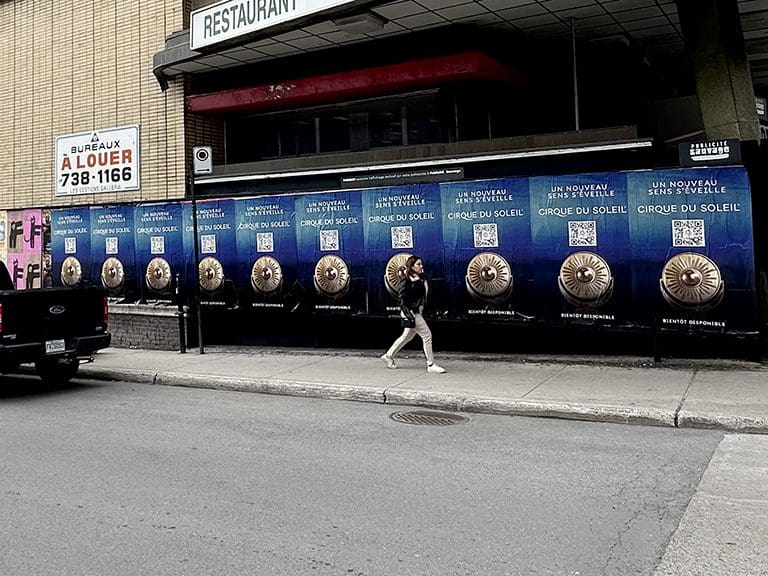
Guerrilla marketing in Mississauga, Ontario means showing up in the physical environments where your target consumer already spends time, on Lakeshore Road East in Port Credit, outside Square One on Hurontario, at Celebration Square during Canada Day, or along the Waterfront Trail on a Saturday morning. AGM has run street-level campaigns in Mississauga and across the GTA for years. This page covers the specific tactics, locations, and pricing that deliver real results in this market.
Effective Wheatpasting in Mississauga
High-Traffic Wheatpaste Locations
The best wheatpaste surfaces in Mississauga are the construction hoardings that line Hurontario Street during the LRT build, a continuous run of legal, high-visibility hoarding inventory stretching from Port Credit to Brampton. These surfaces see 30,000–50,000 vehicle and pedestrian exposures daily along the corridor.
Port Credit’s Lakeshore Road East wall inventory is limited but premium, property owner relationships matter here, and AGM has them. Streetsville Village’s Queen Street South offers approved wall placements that reach community-engaged consumers in a high-dwell-time walkable environment.
We install wheatpaste posters using commercial wheat flour adhesive that bonds to wall surfaces without leaving permanent residue. Standard poster sizes run 24″×36″ up to 4’×8′ large format. In cold-weather months (November–March), we use a modified adhesive formula with higher cold-weather bonding performance to prevent edge lift in freeze-thaw cycles.
Eye-Catching Designs That Work in Mississauga
Mississauga is a visually noisy environment in its commercial corridors. Designs that use high-contrast color combinations, minimal text, and a single clear brand action consistently outperform busy creative in this market. A single bold image with a QR code generates 3–5x more scans than a poster packed with copy.
We’ve found that brand color integrity matters more in Mississauga’s weather exposure than brands anticipate. UV-resistant inks add $0.30–$0.80 per square foot to print costs but add 2–3 weeks of visibility, that’s a positive ROI at any campaign budget level.
Guerrilla Marketing in Mississauga: Strategic Projection Advertising
Projection advertising in Mississauga is most effective in the Celebration Square zone, where the City Hall plaza and adjacent building facades create large projection surfaces visible from significant distances. We’ve deployed projectors on vehicles, rooftop positions, and ground stands depending on the target surface geometry.
A 15,000-lumen projector can cast a clear brand image across a 4–6 story facade at distances of 50–100 meters. Maximum clarity requires deployment after civil twilight (roughly 9pm in summer, 6:30pm in winter). Single-night projection activations are quoted from AGM’s official projection rates: $6,500 per night in NYC and $7,500 per night outside NYC.
Nighttime Engagement in Mississauga
Celebration Square programming creates natural nighttime foot traffic concentrations during summer events, Canada Day, Rib Fest, and various cultural festivals draw 20,000–60,000 evening visitors. A projection activation aligned with an event creates the maximum spectacle-to-audience ratio: maximum viewers, maximum social sharing, maximum brand recall.
For brands without a specific event tie-in, Friday and Saturday evenings in Port Credit (10pm–midnight) and Celebration Square area (8–11pm) are reliable nighttime activation windows for projection, LED trucks, and high-visibility ambassador deployments.
Interactive Sidewalk Stencils
Sidewalk stencils in Mississauga are most effective at pedestrian intersections near transit hubs, along the waterfront trail in Port Credit, and approaching key event venues. We use high-pressure stencil cutting for clean edge definition and apply with pressure-wash-safe biodegradable chalk paint that washes off in 1–3 rainfalls.
A well-placed Mississauga sidewalk stencil at the Port Credit GO Station exit generates 4,000–8,000 commuter exposures per weekday. That’s a CPM of well under $1 when the route and scope are right. Contact AGM for stencil pricing. Add a QR code and a strong offer and this becomes one of the highest-ROI formats in the city.
Guerrilla Marketing in Mississauga: Engaging Brand Ambassadors
Urban Spaces: Where Ambassador Teams Work Best
The highest-ROI brand ambassador locations in Mississauga are Celebration Square during programmed events, the Port Credit Village farmers market (Thursdays in-season), Erin Mills Town Centre parking entry points, and Streetsville Village’s Queen Street during weekend hours. We don’t place ambassador teams in dead zones, every location is scouted for actual pedestrian volume before deployment.
Ambassador team sizes in Mississauga range from 2-person sampling teams (sufficient for a single event or location) to 8-person brand experiences with multiple activation stations. We’ve fielded ambassador programs across Mississauga for brands in beverage, fintech, healthcare, fitness, education, and entertainment. The consistent winner is a team with high energy, full brand knowledge, and a clear single ask of every consumer they engage.
Creative Messaging That Converts
Ambassador scripts in Mississauga need to be direct. This is a commuter market, people are moving with purpose. “Here’s a sample, can I tell you one thing about what you just tasted?” outperforms a 90-second brand monologue delivered to someone trying to get their GO train. Short, high-impact interactions that close on a single action, scan this, try this, take this, consistently outconvert elaborate ambassador programs.
Bad ambassador programs deploy teams without clear objectives, no measurement mechanism, and no script discipline. AGM trains every ambassador team with brand-specific material, a defined conversation framework, and a real-time tally system so we know exactly how many interactions happened in each shift.
Mississauga Guerrilla Marketing: Official Pricing
| Format |
Scale |
Price Range |
Best Use Case |
| Wheatpaste Poster Campaign |
15–40 locations |
Contact AGM |
Brand awareness, event promotion |
| Sidewalk Chalk Stencils |
10–25 locations |
Contact AGM |
Wayfinding, event tease, brand presence |
| Brand Ambassador Team |
2–8 ambassadors |
Contact AGM |
Sampling, sign-ups, direct engagement |
| LED Mobile Billboard Truck |
Full day market route |
Contact AGM |
Mass awareness, launch events |
| Guerrilla Projection |
Single night/location |
Contact AGM |
Spectacle, product drops, event amplification |
| Flyer Distribution |
5,000–25,000 pieces |
Contact AGM |
Event promotion, direct response |
Measuring Campaign Results in Mississauga
Every AGM campaign in Mississauga includes measurement infrastructure built in from day one. QR codes in all printed materials, unique per location where budgets allow, so we can track which zones are driving the most engagement. Promo codes given to ambassador teams, trackable to the specific event and team that distributed them.
For brand awareness campaigns without hard conversion objectives, we run pre/post awareness surveys in the Mississauga DMA through our measurement partner. For campaigns with a digital conversion objective, we integrate campaign QR codes directly into Google Analytics or the client’s preferred analytics platform before the first poster goes up.
Frequently Asked Questions
Guerrilla Marketing in Mississauga, Ontario: Strategies Near You generates better results when placement, timing, creative, and local execution all work together in Ontario. These questions cover the details brands usually need before launch, during rollout, and while evaluating performance.
For ar in Ontario, the strongest campaigns usually come from tight geographic targeting, message discipline, and enough repetition to be remembered. Market conditions, neighborhood flow, event calendars, commuter behavior, and production logistics all change how the tactic performs, so the planning details matter as much as the idea.
What are the best locations for guerrilla marketing in Mississauga?
For high-volume reach: Hurontario Street LRT construction hoardings, Square One exterior, and the Celebration Square area. For premium demographic targeting: Port Credit’s Lakeshore Road East and the waterfront trail. For community engagement: Streetsville Village on Queen Street and Clarkson Village on Lakeshore West. AGM scouts and recommends specific locations based on your campaign brief.
Can I run a Mississauga-only campaign, or do you require GTA-wide minimums?
Mississauga-only campaigns are completely available. We run single-market activations regularly. There are no GTA-wide minimums, your campaign is scoped to the geography that matches your objective and budget.
How does weather affect guerrilla marketing in Mississauga?
Wheatpaste campaigns run year-round in Mississauga with seasonal adhesive adjustments for cold-weather bonding. Ambassador programs are weather-dependent for outdoor deployments but can pivot to indoor venue activations. LED trucks run in all weather conditions. Projection activations need to be planned around precipitation forecasts since rain reduces projection surface visibility. AGM monitors weather and has contingency protocols for every format.
What’s the fastest I can launch a Mississauga campaign?
With existing creative assets and no location permitting complications, wheatpaste and stencil campaigns can launch in 5–7 business days. Ambassador programs with existing brand training material can launch in 3–5 business days. LED truck bookings need 5–7 days minimum. Full multi-format campaigns are best planned 3–4 weeks in advance for maximum location selection and logistical efficiency.
Does AGM handle the permits for Mississauga campaigns?
Yes. AGM handles all compliance research, property permission coordination, and bylaw review for every Mississauga campaign we execute. We don’t pass regulatory complexity back to clients. You brief us on the campaign objective; we handle everything else.
How do you source brand ambassadors for Mississauga?
How do I know if this topic is worth turning into a real campaign?
Start with audience location, not creative ideas. If you can name the blocks, venues, campus gates, stations, or event windows where attention is concentrated, the campaign can usually be built into something measurable. If the audience is vague, the spend drifts and results get fuzzy fast.
What usually makes a street campaign feel too small?
The most common issue is spread. Brands buy a handful of placements across too many neighborhoods instead of owning one route. A tighter footprint with stronger repetition beats a scattered footprint almost every time, especially for event promotion, launches, and local service awareness.
Should the message focus on awareness or action?
That depends on the traffic environment. Fast moving traffic calls for a short awareness message with one visual anchor. Slow pedestrian traffic can support a QR code, a stronger offer, and more direct response copy. The format should match the pace of the audience, not the other way around.
How long should a campaign stay up?
For event driven pushes, the best window is often the 7 to 14 days before the date. For evergreen brand building, two to four weeks works better because repetition does the heavy lifting. Weather, removals, and local conditions still matter, so timing should always be part of the plan.
Related Pages and Articles
How to Launch a Guerrilla Marketing Campaign in Mississauga: Step by Step
A Mississauga campaign done right has a specific structure. Skipping steps leads to wasted budget. Here is the process AGM uses when planning Mississauga street-level activations from scratch.
Step 1: Identify Your Audience Concentration
Mississauga has five distinct commercial nodes: the Square One and Hurontario corridor, Port Credit on Lakeshore Road East, Streetsville Village on Queen Street South, Erin Mills on Eglinton West, and the Cooksville commercial strip on Dundas Street West. Each attracts a different consumer profile. Square One and Hurontario are the highest-volume mass-market zones. Port Credit is a premium lifestyle corridor with a younger professional and creative class audience. Streetsville Village is tight-knit and community-oriented, ideal for local service brands. Erin Mills and Cooksville serve suburban families. Choose your zone before choosing your tactics.
Step 2: Match the Format to the Location
Mississauga’s construction hoarding along the Hurontario LRT corridor is the city’s best large-format poster inventory and should be the first consideration for awareness campaigns with broad reach. The Port Credit waterfront is better suited to brand ambassador activations and sidewalk chalk stencils during warm-weather weekends. Streetsville’s Queen Street South benefits from targeted small-format poster campaigns near the village core. For the highest raw vehicle and pedestrian reach, LED billboard trucks on Hurontario between Highway 403 and Port Credit cover the full length of the corridor in a single route.
Step 3: Build the Creative Around One Clear Prompt
Mississauga drivers and pedestrians process outdoor messaging quickly. Creative that works here has one visual, five to seven words of copy, and a single call to action. For QR-based campaigns, make the code large enough to scan from three meters. For event-based prompts, include only the date, location, and one-line hook. For product launches, use the product visual and a clear differentiator. Avoid body copy on outdoor formats. If the message needs more than a sentence to explain, the message needs editing.
Step 4: Time the Campaign Strategically
Mississauga has clear annual peak windows. Celebration Square’s Canada Day concert draws 50,000+ people in a single evening. The Port Credit Buskerfest in August attracts approximately 200,000 visitors over four days. The Mississauga Waterfront Festival in late June draws large crowds along the lakeshore. Timing a campaign to peak 7 to 14 days before one of these events, so that street presence is fresh when the audience is most concentrated, tends to produce 2x to 4x the response rate of campaigns running in quiet periods.
Step 5: Measure What You Launched
Every Mississauga campaign should have a baseline measurement taken before launch and a tracking mechanism built into the creative. AGM uses unique QR codes per placement location, enabling precise tracking of which zones drove which conversions. For campaigns that cannot use QR codes, a unique promo code or landing page URL achieves similar specificity. Document everything photographically. Campaign photography serves as both a verification record and owned media content.
Mississauga Guerrilla Marketing: Numbers in Context
Mississauga is Canada’s sixth-largest city with 760,000 residents and one of the highest household incomes of any Canadian city outside Vancouver and Toronto proper. It draws 24 million annual visitors to Square One Shopping Centre alone, more than any other single retail location in Ontario. The commuter population traveling through the Mississauga Transit and GO system daily adds a substantial additional audience to street-level campaigns along the main transit corridors.
For context on what these numbers mean for campaign reach: a street poster advertising campaign at 10 hoarding locations on Hurontario during the LRT construction period generates an estimated 50,000 to 100,000 daily impressions from vehicular and pedestrian traffic combined. A brand ambassador deployment at the Port Credit Buskerfest generates 5,000 to 10,000 direct consumer interactions over a four-day event. A sidewalk chalk stencil campaign near the Square One perimeter generates 15,000 to 25,000 pedestrian impressions per day during weekend peak hours.
For campaign pricing in Mississauga, contact AGM directly. Read more about guerrilla marketing strategy fundamentals and explore the sidewalk stencil advertising guide for tactical details on one of Mississauga’s most effective campaign formats.