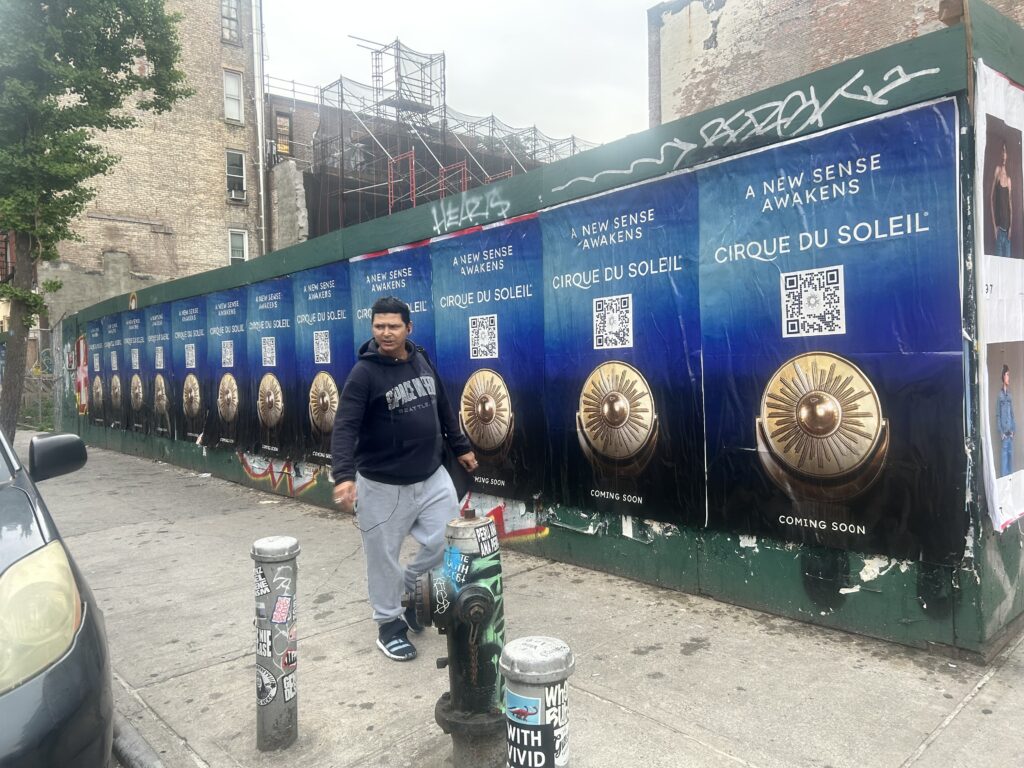
The most effective guerrilla marketing campaigns succeed because they create an unexpected interruption in a familiar environment, something that forces attention before the rational mind can filter it out. Guerrilla marketing uses unconventional, low-cost tactics deployed in public spaces to generate outsized brand impact. American Guerrilla Marketing has designed and executed over 500 campaigns across major US markets including New York, Los Angeles, Chicago, Miami, Atlanta, and dozens of secondary markets. These are the tactics that consistently deliver, what each costs, and what the common execution failures look like.
Tactic 1: Street poster advertising, The Urban Brand Saturation Engine
Street poster advertising (also called snipe advertising or street posting) places large-format posters on approved outdoor surfaces, construction hoardings, permitted building walls, utility structures, throughout a target neighborhood. A 400-snipe run on the Bedford Avenue corridor in Williamsburg, Brooklyn generates roughly 18,000 weekly impressions from pedestrian foot traffic alone, not counting vehicles. That’s per week, with posters that typically last 2–4 weeks before being covered by subsequent campaigns.
What makes street poster advertising work is repetition and concentration. The same person who walks the same block five days a week sees your poster five times that week. By the third week, your brand is embedded in their mental map of the neighborhood. That frequency is what drives the “I keep seeing this everywhere” effect that creates brand presence far exceeding the absolute impression count.
What bad street poster advertising operators do: cover locations without owner or permit authorization (creating legal liability for the client), use non-weatherproof materials that disintegrate after the first rain, provide no documentation of placement. What AGM does: work exclusively with property-owner-authorized surfaces, use UV-resistant weatherproof materials, and document every placement location with timestamped GPS-tagged photography.
Cost range: $2,500–$8,000 for a 50–200 location campaign in a major US market, including design support, printing, installation crew, and photo documentation.
Tactic 2: Sidewalk Stencils, The Invisible-Until-You-Look-Down Format
Sidewalk stencil campaigns occupy a sight line that no other advertising format competes for: the ground directly in front of your audience’s feet. On heavily pedestrian urban sidewalks, 50 well-placed stencils at major intersections and building entrances generate thousands of daily impressions from the same commuters and residents moving through the neighborhood repeatedly.
We’ve applied stencil campaigns on the sidewalks of West Broadway in SoHo, the High Line access points in Chelsea, Broadway in the Williamsburg commercial district, and Michigan Avenue in Chicago, consistently finding that stencils at key pedestrian choke points (subway exits, crosswalk corners, building entrances) dramatically outperform stencils placed in low-foot-traffic zones even on the same block.
Water-soluble chalk formulations wash away naturally and comply with most municipal requirements. Removable paint formulations are more durable (2–4 weeks vs. 1–2 weeks for chalk) but require more careful compliance review in specific markets. We scope the appropriate material for each market and client objective.
AGM pricing: Sidewalk stencils are $2,855 for 5, $3,231 for 10, $3,989 for 20, $6,982 for 50, and $11,999 for 100.
Tactic 3: LED Billboard Trucks, Mobile, Targeted, Impossible to Miss
Mobile LED billboard trucks drive custom routes through target neighborhoods, event zones, or competitor corridors, taking your brand to exactly where your audience is concentrated rather than waiting for them to pass a fixed location. A single LED truck running 8 hours through a dense urban market generates 25,000–50,000 impressions depending on traffic density and route selection.
The tactics where mobile LED trucks consistently outperform fixed advertising: event-adjacent activation (driving around a stadium, arena, or concert venue during arrival/departure windows), competitive conquesting (circling a competitor’s location or trade show booth), and neighborhood launch saturation (hitting every major arterial in a target zip code within a single operating day).
We operate LED trucks in all major US markets. The content is fully programmable, we can run multiple creative executions in rotation, schedule different messaging for morning vs. afternoon windows, and change messaging remotely between operating days without reprinting anything.
Cost range: $800–$3,500/day depending on market. Multi-day campaigns receive volume discounts. Includes route planning, GPS tracking, and field photography documentation.
Tactic 4: Guerrilla Projection, Large-Format Brand Moments at Night
Large-format projection of brand imagery on building facades, landmark surfaces, and public structures creates dramatic, high-visibility brand moments during evening hours. In major cities, the building facades adjacent to major event venues, sports stadiums, and entertainment districts are natural projection targets, large, illuminated, and facing dense pedestrian and vehicle traffic during the highest-value evening windows.
We’ve executed projection campaigns on building faces adjacent to Madison Square Garden, along the convention center approach in San Francisco’s Moscone Center district, and on warehouse walls in Chicago’s River North during event nights. Projection sizes range from 20-foot activations for urban buildings to 100+ foot displays on large industrial facades. The technology is truck-mounted and mobile, a single projection rig can hit multiple surfaces in a single operating night.
AGM pricing: Projection advertising is $6,500 per night in NYC and $7,500 per night outside NYC. Private-property projection with owner consent typically requires no city permit. Public-surface projection requires advance permitting in most major markets.
Tactic 5: Street Teams and Brand Ambassador Activations
Street teams physically engage your audience at the moment of maximum relevance, at an event, near a point of purchase, in a neighborhood with high target demographic concentration. A well-trained street team of 4–6 brand ambassadors operating for two days in the right locations generates thousands of direct brand interactions that no passive format can replicate.
The difference between street teams that drive results and street teams that generate just foot traffic noise is training, targeting, and activation design. Ambassadors need to know the product deeply, be supported to have real conversations rather than following a script, and be positioned in locations where the audience has a natural reason to stop for 30+ seconds, transit stops, coffee queue locations, street-food vendor areas, park entrances.
AGM pricing: Brand ambassadors are $389.99 standard, $489.99 professional, and $589.99 premium per 6-hour shift. Street teams are $389.99 standard or $589.99 premium per 6-hour shift per team member.
Tactic 6: Bathroom Advertising
Restroom advertising in bars, restaurants, gyms, college venues, and entertainment facilities delivers guaranteed dwell time, 60–90 seconds of captive, relaxed attention in a context with no competing advertising noise. The format is particularly effective for consumer brands targeting 21–35 demographics in nightlife and entertainment contexts.
Placement typically involves framed ad cards or vinyl decals inside bathroom stalls and at the sink/mirror area. The audience literally cannot look anywhere else for the duration. Response rates for well-designed bathroom ads in relevant venues are among the highest per-impression we track across all formats, particularly for entertainment, food and beverage, and health/wellness brands with strong relevance to the venue’s customer base.
Cost range: $500–$2,500/month depending on venue type, location, and number of placements per venue. Networks of multiple venues can be bundled for neighborhood or market-wide coverage.
Tactic 7: Wheatpaste Murals
Commercial wheatpaste murals, large-format (20–100+ square feet) paper or fabric poster installations on building walls, create brand presence at a scale that commands genuine visual attention. Unlike standard street poster advertising at poster-paper scale, mural-format installations become visual landmarks in their neighborhood, viewable from across the street and generating impressions from an entire city block rather than immediate passersby only.
The most effective commercial mural campaigns integrate custom artwork created for the specific wall and neighborhood context, not a generic brand asset scaled up. A mural that feels like it belongs in the visual culture of the neighborhood generates far more positive brand association than one that reads clearly as an advertisement dropped into an environment where it doesn’t belong.
Cost range: $2,500–$12,000 depending on mural size, location, and whether custom artwork creation is included. Larger walls with high-visibility positions (corner locations, walls facing major transit corridors) command premium placement fees.
Tactic 8: Snipe Advertising and Sticker Campaigns
Snipe advertising, smaller format cards, stickers, and posters placed on utility infrastructure, construction scaffolding, and high-traffic surfaces at eye level, creates high-frequency street-level brand impressions in pedestrian-dense urban environments. While individual snipe units are smaller than poster-format street poster advertising, their placement height and position, literally at eye level as pedestrians move through the environment, creates a different quality of attention than larger-format placements viewed from a distance.
Snipe campaigns work best in markets with dense sidewalk foot traffic and a culture of visual street expression: New York’s Lower East Side, Echo Park and Silver Lake in LA, Wicker Park in Chicago, the Mission in San Francisco, Wynwood in Miami. These neighborhoods have established visual environments where street-level creative expression is part of the aesthetic fabric, making brand placements within that tradition more culturally accepted and less likely to generate negative reactions.
How We Decide Which Guerrilla Format to Use
Creative tactics do not start with the coolest idea. They start with audience behavior. If the audience is moving fast in cars, a poster is probably the wrong first move. If the audience is on foot in a dense nightlife zone, a highway board may be too broad and too distant. If the category needs explanation, a purely visual stunt may get attention but fail to convert. The right tactic is the one the audience can actually process in the environment where you meet them.
That is why one brand may need a 200-location street poster advertising run while another needs a truck, a projection, or a sampling team. The format is not the strategy. The audience and environment determine the strategy; the format is the tool that fits it.
Campaign Documentation as a Force Multiplier
One thing bad operators consistently ignore is documentation. If the campaign is not documented well, the value of the physical execution dies when the placements come down. We capture route photos, install proof, environmental context, and short-form video because the campaign should also become sales material, social content, pitch collateral, and paid creative later. For many clients, the documentation extends the campaign’s useful life longer than the physical placements themselves.
Extended FAQ
What categories benefit most from guerrilla marketing?
Entertainment, food and beverage, events, fashion, consumer apps, local retail, and challenger brands with something visually or culturally sharp to say tend to benefit most.
Does creativity make up for a weak location plan?
No. Great creative in the wrong location is still the wrong campaign. Placement quality is usually the first determinant of outcome.
Can AGM run multi-city guerrilla campaigns at once?
Yes. We manage multi-market campaigns through local crew networks and a central reporting structure so execution stays consistent across cities.
Permits, Property, and Practical Execution
The fastest way to ruin a guerrilla campaign is to treat operations like an afterthought. Some tactics need property-owner approval. Some need city permits. Some are fine on public sidewalks but not on private paving. Good operators sort this before crews are ever booked. Bad operators improvise in the field and expose the client to unnecessary risk.
We build campaigns backward from the operational constraints because it is the only reliable way to protect both execution quality and client reputation. A campaign that looks spontaneous on the street should still be tightly managed behind the scenes.
Where We See the Strongest Performance
Dense pedestrian neighborhoods, event zones, and compact cultural districts consistently produce the best guerrilla performance because frequency and environmental fit are easier to achieve there. That is why corridors like Williamsburg, SoHo, Wicker Park, South Beach, and the LA Arts District show up repeatedly in our campaign planning. They provide the mix of traffic, visibility, and cultural receptiveness that makes unconventional media pay off.
Extended FAQ Continued
What is the best guerrilla tactic for an app launch?
Usually street poster advertising or stencils paired with a simple QR or search prompt, plus street teams or creators producing content around the install.
Do guerrilla campaigns need long lead times?
Some can launch quickly, but the strongest campaigns still benefit from planning. Creative, permits, route design, and crew coordination all improve with at least 2–4 weeks of lead time.
Can AGM pair guerrilla media with paid digital?
Yes. We regularly combine street-level tactics with geofencing, retargeting, and social amplification so the physical campaign strengthens digital conversion later.
Frequently Asked Questions
Creative Guerrilla Marketing Tactics That Drive Real Results in 2026 generates better results when placement, timing, creative, and local execution all work together in New York. These questions cover the details brands usually need before launch, during rollout, and while evaluating performance.
For ar in New York, the strongest campaigns usually come from tight geographic targeting, message discipline, and enough repetition to be remembered. Market conditions, neighborhood flow, event calendars, commuter behavior, and production logistics all change how the tactic performs, so the planning details matter as much as the idea.
What is the most cost-effective guerrilla marketing tactic?
For pure cost-per-impression, sidewalk stencil campaigns consistently deliver the lowest CPM of any format we offer, typically $1–$5 CPM in dense urban markets. For cost-per-relevant-engagement (direct interactions with your target audience), street team activations in well-chosen locations often deliver the lowest cost despite higher absolute rates, because every interaction is a direct conversation rather than a passive impression.
Do guerrilla marketing campaigns require permits?
It depends on the tactic and market. Sidewalk chalk stencils on public sidewalks typically don’t require permits in most US cities. Permanent or semi-permanent stenciling, street poster advertising on public structures, and projection on public surfaces typically do require permits or property owner authorization. AGM reviews permit requirements in each market before execution and coordinates all necessary approvals.
How does AGM document guerrilla campaigns?
Every campaign includes GPS-tagged, timestamped photography of all placements taken by field crews during installation. We provide a complete post-campaign report including a placement map, photo documentation gallery, estimated reach by tactic, and execution summary. Documentation is delivered within 5–7 business days of campaign completion.
Can guerrilla marketing work for B2B brands?
Yes, particularly for activations around industry events, trade shows, and conventions. B2B guerrilla tactics work best when concentrated around the specific venues and corridors where decision-makers concentrate, conference hotel blocks, convention center approaches, and the surrounding dining and entertainment district. A targeted snipe and street poster campaign in the three-block radius around a major trade show location, combined with a projection activation on a visible building face the night before the event opens, reaches the exact audience a B2B brand needs at the exact moment of highest engagement. Creative Guerrilla Marketing Tactics That Drive Real Results in 2026 becomes much stronger when the article moves past surface level advice and into route logic, timing, crew decisions, and what buyers should expect before launch. That is where most campaigns win or lose. Good ideas are common. Clean execution in the right place at the right time is not. In practice, the first move is narrowing the audience into a physical map. That means identifying the streets, retail corridors, campus edges, transit entrances, event approaches, or nightlife clusters where attention piles up. Once that map is clear, the next step is deciding which format fits the movement pattern. Posters work best where people have a second to read. Snipes work when repetition matters. Stencils and decals are strongest where pedestrians slow down, wait, or make a decision about where to go next. Teams that skip that planning step usually spend money on visibility without building enough repetition to create recall. Teams that plan carefully can get more from the same budget because they are buying concentration, not just volume. That is the real difference between activity and impact. Every market has its own map of useful surfaces and high value foot traffic. In downtown cores, the best routes are usually the blocks between transit stops and the place people are actually trying to reach. Around campuses, it is the edge streets, dorm approaches, coffee runs, late night food corridors, and the walk between parking and class. Around events, it is the window from arrival through line formation, then the exit path where people are still talking about what they just saw. That is why local detail matters so much. A good plan names corners, not just cities. It names venue approaches, not just districts. It defines morning traffic, lunch traffic, post game traffic, and late night traffic as separate moments because they behave differently. When brands treat all movement as one audience, the campaign gets blunt. When they map those flows correctly, the same media spend starts to feel much larger. AGM usually builds this out with a route first, then layers creative on top of it. That order protects the campaign from a common mistake: falling in love with the visual before making sure the audience can actually encounter it often enough to remember it. When a page like this feels light, the missing pieces are almost always the same. Add named locations, examples of which formats fit those locations, the quantity needed to make the campaign visible, and the operational limits that buyers should know before launch. Add a realistic budget section. Add a stronger FAQ that answers the practical objections a client will raise on the phone. Those additions do not pad the page. They make it useful. That is also where trust is built. Readers can tell when a page only gestures at a topic. They can also tell when the writer understands the field side of the job. Specifics about route density, production timing, weather risk, crew count, proof photos, QR tracking, and refresh windows make the content stronger because they come from real execution questions. If a brand is using this topic to compare partners, those specifics matter even more. They make it easier to judge whether a vendor is selling a real plan or just a good sounding idea. Pricing depends on format, timing, print specs, route length, and how many placements a campaign needs to make a real impression. For street level media, brands usually do better when they fund enough placements to own a specific route instead of buying a thin layer across too much ground. A small run can look busy in a deck and still disappear on the street. AGM publishes fixed pricing for several core services. 24×36 wheatpaste posters are $4,500 for 100 and $5,500 for 200. 48×72 wheatpaste posters are $10,500 for 100 and $13,500 for 200. 9×12 snipes are $4,500 for 400 and $5,500 for 800. 11×14 jumbo snipes are $6,500 for 400 and $7,500 for 800. Sidewalk stencils are $2,855 for 5, $3,231 for 10, $3,989 for 20, $6,982 for 50, and $11,999 for 100. Sidewalk decals are $2,904 for 5, $3,404 for 10, $4,998 for 20, $8,709 for 50, and $14,466 for 100. LED billboard trucks are $250 to $300 per hour with an 8-hour minimum. For any other quantity, market, or setup, contact AGM for pricing. If the project needs a custom mix, AGM usually points brands to the RFP Builder so scope, city count, and production details line up before pricing is locked. That matters because the wrong quantity is often more expensive than the right format. A cheap campaign that is too small to be seen is not efficient. It is just forgettable.
How do I know if this topic is worth turning into a real campaign?
Start with audience location, not creative ideas. If you can name the blocks, venues, campus gates, stations, or event windows where attention is concentrated, the campaign can usually be built into something measurable. If the audience is vague, the spend drifts and results get fuzzy fast.
What usually makes a street campaign feel too small?
The most common issue is spread. Brands buy a handful of placements across too many neighborhoods instead of owning one route. A tighter footprint with stronger repetition beats a scattered footprint almost every time, especially for event promotion, launches, and local service awareness.
Should the message focus on awareness or action?
That depends on the traffic environment. Fast moving traffic calls for a short awareness message with one visual anchor. Slow pedestrian traffic can support a QR code, a stronger offer, and more direct response copy. The format should match the pace of the audience, not the other way around.
How long should a campaign stay up?
For event driven pushes, the best window is often the 7 to 14 days before the date. For evergreen brand building, two to four weeks works better because repetition does the heavy lifting. Weather, removals, and local conditions still matter, so timing should always be part of the plan.
What should be tracked besides impressions?
Use QR scans, coupon redemptions, landing page traffic, geofenced audience lift, survey responses, and direct field photos. Street work is easier to defend when the campaign is built with proof from day one instead of trying to backfill measurement after the fact.
Does creative matter more than placement?
Both matter, but placement usually wins the argument. A decent design in the right corridor will outperform a beautiful design placed where the right people never see it. Street media is a placement game first and a design game second.
Related Pages and Articles