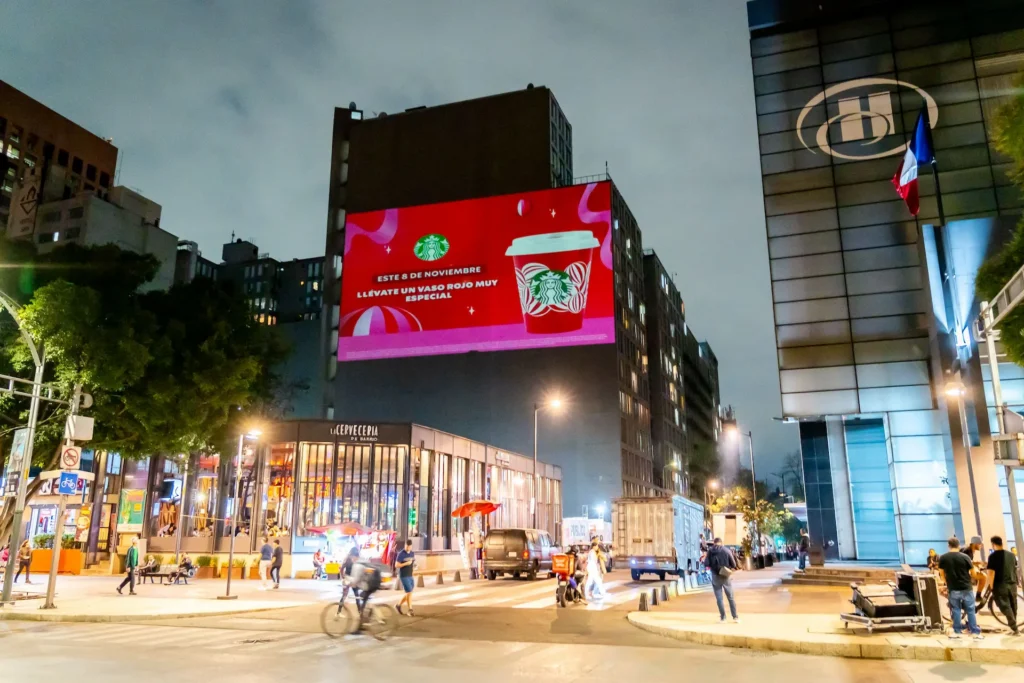
Zona Rosa does not sleep. That is not a marketing line — it is a literal operational fact about the neighborhood that shapes everything we plan when running projection campaigns there. While Mexico City’s other colonias follow a broadly predictable daily rhythm — morning commuter flow, midday commercial activity, evening dining and entertainment, then a relative quiet after midnight — Zona Rosa maintains meaningful street-level density well past 2am on weekend nights, and in some corridors, activity persists until dawn. This is the defining characteristic that makes Zona Rosa a projection environment unlike any other in the city.
The neighborhood occupies a roughly triangular territory bounded by Paseo de la Reforma to the north, Avenida Insurgentes to the east, and Avenida Chapultepec to the south. Within that triangle sits a dense, multi-layered urban environment that has evolved through several distinct phases: first as Mexico City’s elite residential zone in the late 19th century, then as the city’s original international entertainment district in the mid-20th century, then through a period of decline, and now into a complex present in which tourism, LGBTQ+ cultural life, the Korean community, international restaurants, and late-night club culture coexist in close proximity across a walkable grid of commercial streets.
For American Guerrilla Marketing, Zona Rosa is one of our most versatile Mexico City deployment zones. The density of foot traffic across extended hours, the variety of distinct audience types concentrated in a small area, and the building stock that provides usable projection surfaces throughout create conditions where a well-planned campaign can generate enormous impression counts with exceptional precision about who those impressions are reaching.
Zona Rosa’s History and Why It Still Matters
Understanding why Zona Rosa works as a projection environment requires understanding what it is — and what it was. The colonia was developed in the early 20th century as one of Mexico City’s most fashionable residential districts, and by the 1950s and 60s it had evolved into the city’s premier international entertainment zone. The neighborhood’s streets were lined with embassies, fine dining restaurants, boutique hotels, and nightclubs frequented by Mexico’s social elite and international visitors. The “pink zone” name reportedly came from a newspaper column that color-coded different parts of the city by character, with Zona Rosa designated as the international and somewhat risqué zone.
The 1985 earthquake damaged much of Mexico City and accelerated the residential flight from Zona Rosa to newer, safer colonias. But the neighborhood’s commercial and entertainment character persisted, reinforced over the following decades by new communities — particularly the Korean community that established itself around Florencia and Hamburgo streets by the 1990s, and the LGBTQ+ community that found in Zona Rosa one of Mexico City’s most accepting environments for visible social life. By the 2000s, Zona Rosa had developed a specific identity as Mexico City’s primary LGBTQ+ cultural and nightlife district, with bars, clubs, and community spaces concentrated on Amberes and the adjacent streets.
This history matters for projection campaigns because it shapes the audience reality on the ground. Zona Rosa is one of the few places in Mexico City where you will find, on any given Friday night, a mix that includes Korean families having dinner, international tourists from the nearby hotels on Reforma, LGBTQ+ community members heading to or from bars on Amberes, young Mexican professionals at new restaurants that have opened in the colonia’s current revival phase, and middle-aged visitors exploring a neighborhood they associate with Mexico City’s mid-century cosmopolitanism. That variety is unusual and useful.
The Street-by-Street Geography of Zona Rosa
Calle Génova
Génova is Zona Rosa’s central pedestrian axis — a partially traffic-calmed street running north-south through the colonia’s core that concentrates the highest foot traffic of any single street in the neighborhood during evening hours. The street is lined with restaurants, bars, and commercial establishments at ground level, with mid-rise 1960s and 1970s residential and commercial buildings above. These upper-story facades are some of the most accessible projection surfaces in Zona Rosa because the buildings run continuously along both sides of the street without significant setbacks, creating a close-range projection opportunity where the image appears nearly at eye level for pedestrians rather than requiring them to look up at a distance.
The pedestrian character of portions of Génova — the street has been partially closed to through traffic and features extended sidewalks in its central section — slows audience movement significantly compared to a standard commercial street. People stop to look at menus, sit at outdoor tables, and navigate the social density of a busy Friday night. This reduced movement speed is operationally valuable: it extends the exposure window for any individual pedestrian from the typical few-second passing impression to 15 to 30 seconds of potential engagement.
Avenida Amberes
Amberes is where Zona Rosa’s nightlife energy is most concentrated. The street hosts a dense lineup of bars, clubs, and entertainment venues that are the heart of the neighborhood’s LGBTQ+ nightlife scene, and on weekend nights the street fills to near-pedestrian-only density from 10pm through 2am. The building facades on Amberes are primarily mid-20th century construction — concrete-framed buildings with flat or lightly textured facades in the 5 to 8 story range — which provide workable but not ideal projection surfaces. The high ambient light from venue signage is the primary technical challenge on Amberes; it requires higher-lumen projectors than quieter Zona Rosa streets and careful positioning to avoid competing light sources.
The Amberes corridor in Zona Rosa is estimated to host 40 to 60 individual bars, clubs, and nightlife venues within a four-block stretch. On peak weekend nights, foot traffic density in this corridor can exceed 5,000 people per hour during the 11pm-1am window.
Hamburgo and the Korean Corridor
Hamburgo runs east-west across the northern section of Zona Rosa and carries one of the most culturally specific audiences in all of Mexico City: the Korean community that has built one of the largest Koreatown districts outside Korea along this street and the adjacent Florencia. The Korean commercial presence here is substantial: dozens of Korean restaurants, several Korean grocery stores, Korean beauty supply shops, Korean barbecue establishments, karaoke venues, and cultural organizations. The community has been here long enough that these businesses are multigenerational enterprises, not just recent immigrant storefronts.
For projection campaigns, the Hamburgo-Florencia Korean corridor offers unusual precision. This is not a diffuse audience — it is a concentrated cultural community with specific consumer preferences, language affinity, and cultural reference points. Campaigns targeting Korean-Mexican consumers or brands with strong Korean cultural identity can reach this community with a directness that would be essentially impossible through general-market out-of-home placements. Our team has positioned projections on building facades facing the main Korean commercial blocks to reach this community during peak dining hours, when the heaviest foot traffic moves between restaurants and grocery stores.
Florencia, Liverpool, and Londres
The remaining east-west streets of Zona Rosa — Florencia, Liverpool, and Londres — carry varying characters. Florencia bridges the Korean commercial zone and the international hotel district on its western end near Reforma, making it a mixed audience street with heavy tourist representation from the luxury hotels. Liverpool and Londres are more mixed commercial, with a blend of local businesses, established restaurants, and the kind of mid-market retail that has persisted in Zona Rosa’s commercial fabric despite the neighborhood’s various identity shifts. Building facades on these streets are predominantly mid-century concrete and glass, with a mix of projection-friendly plaster-finish panels and the more challenging reflective glass surfaces that characterize some of the commercial buildings updated in the 1980s and 90s.
Glorieta de Insurgentes: The Transit Heart of Zona Rosa
At the intersection of Avenida Insurgentes and Avenida Chapultepec, the Glorieta de Insurgentes forms the northeastern corner of the Zona Rosa triangle and functions as one of Mexico City’s major transit hubs. The Metro Insurgentes station here serves Line 1 (the original Metro line, running east-west across the city) with daily ridership that ranks among the highest of any single station in the system. The Metrobus Line 1 running along Insurgentes also stops at this roundabout, adding a second major transit feed. Together, the two systems funnel hundreds of thousands of daily passengers through this intersection, with significant numbers entering and exiting at street level around the glorieta’s perimeter.
The Glorieta de Insurgentes roundabout is a circular public space with street-level commercial establishments lining the interior perimeter. The buildings facing the roundabout — mostly 4 to 8 story mixed-use commercial structures — offer projection surfaces that face inward toward the circular plaza and outward toward the approaching Insurgentes boulevard. A projection positioned to face the roundabout plaza reaches the foot traffic orbiting the glorieta, waiting for transit, and navigating the crossing — a sustained audience flow rather than a single-direction stream.
Metro Insurgentes station on Line 1 serves an estimated 120,000 to 150,000 daily passengers, making it one of the busiest single-station points in the Mexico City Metro system. Combined with Metrobus flow on Insurgentes, the Glorieta de Insurgentes intersection handles the highest pedestrian transit volumes of any point in or around Zona Rosa.
The 24-Hour Character and Late-Night Projection Windows
The 24-hour nature of Zona Rosa is not evenly distributed across the neighborhood. The late-night density concentrates specifically on and around Amberes, the adjacent portion of Génova, and the blocks between them. After midnight, the rest of Zona Rosa quiets considerably — the Korean restaurants close, the tourist traffic from the hotels retreats, the casual dining crowd disperses. But on Amberes specifically, the energy often peaks between midnight and 2am when the clubs are at full capacity and the street is at its most dense.
This creates a late-night projection window from 1am to 4am that is genuinely distinct from anything available in Roma Norte, Coyoacan, Condesa, or even most of Reforma. Brands targeting nightlife audiences, music and entertainment campaigns announcing upcoming events, beverage companies with strong nightlife positioning, and campaigns specifically designed to reach the late-night social crowd can use this window to reach an audience that is awake, active, and in a highly social state when the rest of the city is asleep.
Operating in this late-night window requires some specific adjustments to our standard campaign protocols. Equipment security is a consideration at 2am in a way it is not at 9pm. Operator staffing is different. The audience behavior is different — late-night crowds are denser at narrower points, move less predictably, and respond more strongly to visual elements with humor or surprise. Our team has run enough late-night Zona Rosa campaigns to have developed specific protocols for this window that differ from our standard evening approach.
The 1am-4am window on Amberes is one of the most specific audience moments in all of Mexico City out-of-home advertising. You are reaching a late-night social crowd at peak energy, with no competing media present, at the exact moment they are most open to memorable brand encounters. Very few out-of-home formats can operate in this window at all — projection is one of the few that can.
The LGBTQ+ Community and Culturally Specific Campaign Opportunities
Zona Rosa is Mexico City’s most established LGBTQ+ cultural district and has been for more than two decades. The community is visible, politically engaged, and a significant driver of the neighborhood’s nightlife economy. Pride season — concentrated in June but with events throughout the year — is the obvious peak moment, but the community is present and active year-round in ways that are relevant for campaign planning.
For brands that engage authentically with LGBTQ+ audiences, Zona Rosa offers a projection environment where the campaign’s presence in a specific cultural geography sends its own message. A brand that shows up in Zona Rosa’s LGBTQ+ corridor is making a statement about where it chooses to advertise that is legible to the community in ways it would not be in a generic commercial environment. Our team works with brands on this positioning actively, helping to identify the specific streets and timing that reach the community most directly while also communicating the geographic intentionality of the placement.
Mexico City Pride typically brings hundreds of thousands of participants to the city in late June, with Reforma as the main parade route and Zona Rosa as a major congregation and after-party zone. Projection campaigns timed for Pride week — running in the days before and during the main event — reach the city’s largest annual gathering of LGBTQ+ community members and allies in an environment where the community is at its most publicly present and celebratory.
The Dense Commercial Signage Environment and Standing Out
Zona Rosa’s commercial streets — Génova, Amberes, Hamburgo — carry a high load of existing commercial signage. Illuminated storefront signs, digital displays at bar and club entrances, backlit menu boards, and decorative lighting from outdoor seating areas create an ambient light environment that is more challenging for projection than quieter residential streets. This is a real operational consideration, not a hypothetical one.
The way our team handles Zona Rosa’s high ambient light is through two factors: lumen output and placement specificity. Higher-lumen projectors are standard in the Zona Rosa toolkit, because a projection that barely registers against a quiet Narvarte wall will be invisible against the light pollution of Amberes at 11pm. Placement specificity means finding surfaces that are in the dense commercial environment but have a clear plane of darkness — a blank building wall between two lit storefronts, an upper-floor facade above the street-level signage line, the side wall of a building perpendicular to the main commercial frontage — that allows the projection to read with full clarity without competing with adjacent light sources.
The operational reality is that Zona Rosa requires more technical planning per campaign than most other Mexico City environments. But the audience density it provides — particularly on weekend evenings and in the late-night window — makes that additional planning worthwhile for campaigns where reach and audience specificity justify the execution effort.
Building Stock in Zona Rosa: What Works and What Does Not
Zona Rosa’s built environment is primarily mid-20th century construction from the 1950s through 1980s. The neighborhood missed both the older colonial and Art Deco eras that give Roma Norte and Coyoacan their distinctive facades, and it also predates the glass tower era of the 1990s and 2000s. What it has instead is a dense stock of 5 to 10 story concrete-framed commercial and residential buildings with a range of facade treatments: some with flat stucco or plaster finishes that project well, some with tile or stone cladding from mid-century renovation projects, some with reflective glass ground-floor shop fronts below solid upper walls.
The most projectable surfaces in Zona Rosa are consistently the upper walls of mid-century buildings — the blank plaster or concrete finishes above the 4th or 5th floor, above the level of most commercial signage and street lighting. Positioning a projector to reach these upper surfaces requires careful angle calculation and, often, a position across a wider street or intersection rather than from directly opposite a narrow alley. Génova’s wider street sections and the broad Insurgentes frontage near the Glorieta provide the sightline geometry for this approach.
Campaign Types That Perform Best in Zona Rosa
| Campaign Type |
Best Zona Rosa Location |
Optimal Timing |
| Nightlife and entertainment events |
Amberes, Génova intersection |
Fri-Sat 10pm-2am |
| LGBTQ+ and inclusive brand campaigns |
Amberes corridor |
Year-round; peak Pride season |
| Korean and K-culture brands |
Hamburgo and Florencia Korean corridor |
Thu-Sun 6pm-10pm |
| Fashion and music campaigns |
Génova pedestrian section |
Fri-Sat evenings |
| Food, beverage, consumer brands |
Glorieta de Insurgentes |
Weekday commute peaks; weekend evenings |
| Luxury and travel brands |
Florencia near Reforma junction |
Evenings, hotel dinner crowd 7-10pm |
Tourist Concentration and the International Visitor Audience
Zona Rosa’s proximity to the luxury hotel strip on Reforma — four or five blocks separates the heart of Zona Rosa from the St. Regis, Four Seasons, and JW Marriott — generates a significant international tourist presence in the neighborhood throughout the day and evening. International visitors staying on Reforma walk or taxi into Zona Rosa for dining and nightlife because it is the closest dense entertainment district to their hotels. This tourist flow is heavy enough to be a meaningful audience segment for campaigns targeting visitors from the United States, Europe, and Latin America.
The tourist concentration also affects the social media amplification potential of Zona Rosa projections. International visitors are high-frequency social media sharers of travel experiences — an unusual projection in a Mexico City entertainment district will make it into many Instagram stories and TikToks posted to audiences that extend far beyond Mexico. This organic social amplification from tourist-visitors adds a dimension to the campaign reach that is genuinely additional to the direct impression count from in-person exposure.
Operating Effectively in Zona Rosa’s Dense Environment
Our team’s experience running projection campaigns in Zona Rosa has produced a set of operational practices that are specific to this environment. A few that matter most:
Equipment setup in Zona Rosa requires awareness of the neighborhood’s parking and access patterns, which are complex on weekends when multiple venues have valets operating and street access is periodically restricted for crowd management. We build extra lead time into Zona Rosa setup schedules and identify secondary equipment positions in advance for each campaign.
The late-night window — 1am to 4am — requires two-person operator teams as a standard practice. Operating alone at 2am on Amberes is a security exposure we do not take. Our operator network in Mexico City has personnel with specific experience in late-night Zona Rosa deployments and the local knowledge that makes those campaigns run safely and efficiently.
Projection content for Zona Rosa benefits from being designed with the neighborhood’s energy in mind. Bold graphics, high-contrast imagery, and content with an edge of humor or surprise outperform restrained, elegant creative in this environment. The visual competition for attention is high, and projection content that would stand out comfortably in Coyoacan may be visually insufficient for Zona Rosa’s more saturated signage environment. Our team communicates this to creative partners in the brief process for every Zona Rosa campaign.
Frequently Asked Questions
What makes Zona Rosa unique for projection campaigns compared to other Mexico City colonias?
Zona Rosa’s 24-hour character is what sets it apart. While most Mexico City colonias have a clear evening peak and then quiet down after midnight, Zona Rosa maintains substantial street-level activity well into early morning — particularly on weekends when clubs on Amberes and Genova are at peak capacity from midnight to 4am. This creates late-night projection windows (1am to 4am) that simply do not exist in Roma Norte, Coyoacan, or Condesa. For campaigns targeting nightlife audiences, entertainment brands, or the LGBTQ+ community, that late window is highly specific and difficult to reach through any other out-of-home format.
How does the Korean community corridor in Zona Rosa affect projection campaign planning?
The Korean community concentrated on Florencia and Hamburgo streets is one of the largest Korean populations outside Korea, with dozens of restaurants, grocery stores, beauty supply shops, and cultural businesses. This community generates a sustained and culturally specific audience that is distinct from the general Zona Rosa entertainment crowd. Brands targeting Korean-Mexican consumers, K-beauty products, Korean food and beverage brands, or entertainment properties with strong Korean cultural relevance have an unusually direct audience concentration here. Our team has experience positioning projections specifically for this corridor’s daytime and evening customer flows.
What are the best streets for projection placements in Zona Rosa?
Our most productive Zona Rosa projection positions are on Hamburgo, Genova, Amberes, Florencia, and Liverpool streets. Each has a different character: Hamburgo carries the Korean corridor traffic and a dense daytime-to-evening commercial flow; Genova is the pedestrian axis most associated with the international entertainment district character; Amberes is the highest-energy nightlife street; Florencia bridges the Korean commercial area and international hotel district; Liverpool runs through a more mixed commercial zone on the colonia’s northern edge. The Glorieta de Insurgentes roundabout at the neighborhood’s northern tip is our highest-reach single position in the entire area.
What campaign types work best in Zona Rosa?
Entertainment, nightlife, music events, and fashion campaigns are natural fits for the Amberes and Genova nightlife corridor. The LGBTQ+ cultural community around Amberes responds strongly to inclusive brand campaigns, Pride events, and brands that engage authentically with queer culture. Food and restaurant campaigns work effectively on the Korean corridor on Hamburgo and Florencia. The high tourist concentration from surrounding hotels makes Zona Rosa productive for travel, hospitality, and consumer brands seeking an international visitor audience. The Metrobus and Metro Insurgentes station traffic at Glorieta de Insurgentes is particularly useful for mass consumer products and streaming services.
Does AGM run Zona Rosa projections as part of multi-colonia Mexico City campaigns?
Yes, frequently. Zona Rosa pairs naturally with Reforma corridor campaigns for brands targeting a combined upscale and entertainment audience. It also pairs well with Colonia Juarez, which borders Zona Rosa to the south and shares some audience overlap with the emerging creative district. For campaigns with large reach goals across CDMX, we build multi-colonia plans that use Zona Rosa as the nightlife anchor while pairing it with Coyoacan for cultural audience, Roma Norte for the creative professional segment, and Reforma for corporate and luxury.