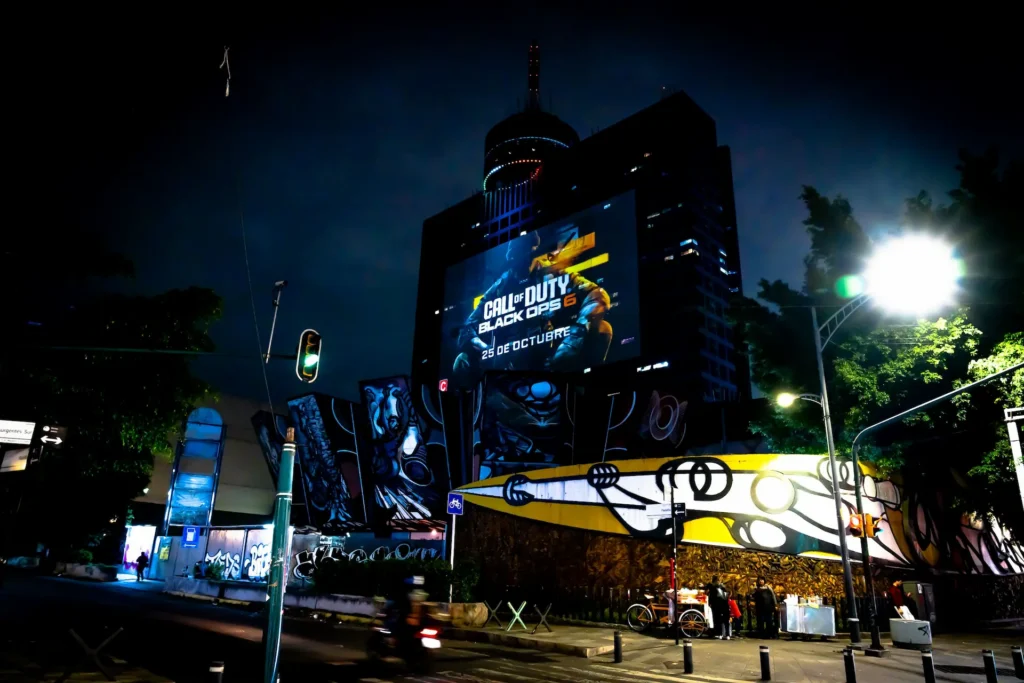
There is no neighborhood in Mexico City where a projection campaign hits harder than Centro Historico. We are talking about 500-year-old baroque stone facades spanning city blocks, plazas so wide that a single projection can reach audiences hundreds of meters away, and streets that push tens of thousands of pedestrians past the same corner every single night. When our team at AGM scouts Mexico City for projection locations, Centro always comes up first. The building scale alone puts it in a category of its own.
The historic center of Mexico City sits on land that was once Tenochtitlan, the Aztec capital. The Spanish built their city directly on top of it, which is why the colonial architecture here feels so dense and continuous. These are not scattered landmark buildings surrounded by modern infill. The entire district, covering roughly 9 square kilometers in the Cuauhtemoc borough, is composed primarily of colonial-era construction, much of it stone and plaster on massive footprints. For projection work, that density of large flat surfaces is everything.
This piece covers the specific buildings, streets, and audience conditions that make guerrilla projections in Centro Historico Mexico City one of the highest-impact media placements on the continent.
The Zocalo: One of the World’s Largest Public Squares as a Projection Environment
The Plaza de la Constitucion, known as the Zocalo, measures roughly 240 meters on each side, making it one of the largest urban public squares on earth. Buenos Aires has the Plaza de Mayo. Paris has the Place de la Republique. Mexico City has the Zocalo, and in terms of raw scale, it dwarfs most comparable civic spaces.
What matters for projection work is not just the size of the plaza but the buildings that surround it. The Zocalo is enclosed on all four sides by major architectural structures, each offering its own projection character.
On the north side sits the Catedral Metropolitana de Mexico, one of the largest cathedrals in the entire Western Hemisphere. Its baroque facade stretches 59 meters wide with towers reaching 57 meters in height. The facade is a textured mix of gray tezontle stone and carved limestone details, all of which catch projected light in different ways. At distance from the center of the plaza, the cathedral reads as a single massive canvas. The textural detail of the carved baroque ornamentation gives projected imagery a dimensional quality that flat concrete walls simply cannot produce.
On the east side of the Zocalo sits Palacio Nacional, the seat of the Mexican federal executive government and home to Diego Rivera’s famous murals inside. The building spans an entire city block, roughly 200 meters wide and five stories tall. That is approximately 1,000 square meters of nearly continuous facade facing the plaza. Palacio Nacional was built over the former palace of Moctezuma II, and much of the current structure dates to 1692. Its red tezontle stone facade is one of the most recognizable surfaces in Mexico.
The Zocalo is surrounded by over 800 linear meters of facade from major civic and religious buildings, producing a projection-ready enclosure that can carry simultaneous multi-surface campaigns at city-block scale.
Catedral Metropolitana: Scale, Texture, and Projection Light
We spend a lot of time thinking about how materials behave under projection. The Catedral Metropolitana’s facades offer one of the most varied surface studies available anywhere in Centro. The baroque front facade has deep carved relief in the stone, columns, niches, and sculptural elements that create shadow and depth when lit from projection angles. Projected content on this surface does not look like it’s on a flat wall. It looks like it’s built into the architecture.
The side facades along Calle Moneda and the north side along the plaza perimeter are flatter and more regular, providing cleaner surfaces for typographic or photographic projection content where the building texture should read as backdrop rather than active element.
Mexico City’s cultural programming has a long history of using the Catedral Metropolitana as a projection backdrop. The Festival de Mexico en el Centro Historico, which runs annually and draws hundreds of thousands of attendees, has featured projection art on the cathedral facade. The Noche de Museos events, which open museums across the city on the last Tuesday of each month, have used Zocalo facades including the cathedral for public light installations. This history means the general CDMX public is already conditioned to look up at the cathedral expecting to see something.
Palacio Nacional: The East Flank of the Zocalo
Palacio Nacional’s long eastern facade gives a projection campaign something that almost no other urban location in Mexico offers: a flat, continuous, warm-toned stone surface at human scale and city-block length simultaneously. At 200 meters wide and 15 meters tall to the roofline, this is a projection canvas you can read from the opposite side of the Zocalo, nearly 200 meters away, or from right across the street on Calle Moneda.
The building’s use as an active government facility makes it an interesting environment for campaigns positioned around civic identity, national culture, or heritage. Brands that want to claim a relationship with Mexico’s history and identity will find no more direct architectural statement than placing their campaign on the east face of the Zocalo.
Calle Madero: 750 Meters of Pedestrian Density
Running west from the Zocalo’s northwest corner to Eje Central Lazaro Cardenas, Calle Madero is one of the most trafficked pedestrian streets in all of Latin America. At roughly 750 meters long and closed to vehicle traffic, Madero pushes enormous crowd volumes all day and into the evening.
The buildings lining Madero are predominantly colonial-era structures from the 16th through 19th centuries, with some early 20th century additions. Their facades are a mix of carved stone, plastered masonry, and iron balcony details. Building heights average four to seven stories. The street corridor is relatively narrow for the crowd volumes it carries, which means pedestrian attention is naturally drawn upward to building facades simply to navigate the space.
This is the Corredor Cultural of Centro. Madero has historically been home to cultural events, temporary art installations, and public programming that treats the street itself as a venue. During the Festival de Mexico en el Centro Historico and other major cultural programming periods, Madero’s buildings have served as the backdrop for everything from projection art to large-format print installations.
Calle Madero handles an estimated 100,000 to 150,000 pedestrians on peak weekend days, making it one of the highest-density foot traffic corridors in any Latin American city center.
For AGM campaigns, Madero is particularly useful because the pedestrian movement is slow and directionless. People are not commuting through a transit hub; they are strolling, shopping, eating, taking photos. Dwell time is high. A projection running on a Madero facade for 90 minutes during evening hours will be seen repeatedly by the same people who return to the street multiple times.
Torre Latinoamericana and the Glass vs. Stone Projection Question
At the intersection of Calle Madero and Eje Central Lazaro Cardenas stands Torre Latinoamericana, Mexico’s first skyscraper. Built in 1956 and standing 182 meters tall with 44 floors, it was the tallest building in Latin America at completion. Its glass curtain wall was a technological statement at a time when most Centro buildings were still colonial masonry.
Torre Latinoamericana is important to understand as a projection surface because it illustrates exactly why glass towers are difficult. Glass reflects rather than absorbs projected light. A 10,000-lumen projector hitting glass will scatter the beam and produce a washed-out, double-image effect rather than a clean projection. The colonial stone and plaster surfaces around it absorb light and hold the image. The difference is immediately visible to any observer standing at the corner of Madero and Eje Central at night.
What Torre Latinoamericana does offer is context. Its illuminated tower at night provides a backdrop that makes ground-level and mid-rise projections on surrounding colonial buildings read as part of a larger visual composition. The contrast between the lit modernist tower and the dark baroque surfaces around it creates a natural focus point that draws the eye toward whatever projection is running on the adjacent buildings.
Palacio de Bellas Artes: Marble, Projection Light, and Cultural Alignment
The Palacio de Bellas Artes sits at the western end of Calle Madero where it meets Eje Central, and it is among the most distinctive projection surfaces available in all of Mexico City. The building’s exterior is clad in white Carrera marble from Italy, chosen by architect Adamo Boari when construction began in 1904. The Art Nouveau lower sections and Art Deco dome and upper structure create an unusual architectural hybrid that reads differently from street level versus distance.
Marble behaves differently under projection than any other building material we work with. It has a slightly specular surface that catches projected light and appears to glow from within. Projected imagery on Bellas Artes has a luminous, almost three-dimensional quality that flat concrete or rough plaster walls cannot replicate. This is why cultural events in Mexico City have repeatedly returned to Bellas Artes as a projection backdrop. The building essentially amplifies the light.
The dome structure adds another dimension. Dome projections require careful placement of projector positions to avoid keystoning and distortion, but when executed properly, the curved surface creates a sense of the projection wrapping around the architecture rather than sitting on top of it. AGM’s operators have experience working with curved architectural surfaces in major markets, and Centro’s domes, including those at Bellas Artes and several churches throughout the historic core, represent some of the most visually compelling projection canvases in the region.
Bellas Artes marble reflects projected light with a luminous quality no concrete wall can match. Brands that need to signal cultural seriousness in CDMX should understand what it means to run a campaign on that surface.
The Avenida Juarez runs west from Bellas Artes along the southern edge of Alameda Central park, providing a secondary projection corridor connecting Centro to Doctores and Colonia Guerrero. The buildings along Juarez include a mix of early 20th century commercial structures and mid-century government buildings, with facades generally less dramatic than Madero but still substantial.
Plaza Santo Domingo and the Colonial Arcade Buildings
Three blocks north of the Zocalo, Plaza Santo Domingo is one of the few colonial-era plazas in Centro that has survived largely intact. The plaza is flanked on its west side by the Portal de los Evangelistas, an arcade of colonial arches housing a continuous row of traditional scribes and printers who have operated in the same location for generations. The arcade buildings present a photogenic series of arch openings that create natural framing elements for projection work.
The Templo de Santo Domingo, dating to 1736, faces the plaza with a baroque facade made of gray and red stone. The church’s two-tower silhouette and richly carved stone facade represent the same projection surface qualities as the Catedral Metropolitana but at smaller scale and in a far less crowded environment. Brands that need Centro’s architectural identity without the full Zocalo footprint will find Plaza Santo Domingo more accessible and more intimate.
The surrounding blocks between Santo Domingo and the Zocalo are home to some of the most intact colonial street fabric in the city. Streets like Republica de Brasil, Republica de Argentina, and Donceles carry buildings with wide flat stone facades, some five stories or taller, that offer straightforward high-quality projection surfaces without architectural complexity. These streets run through Centro’s bookshop district, generating steady evening pedestrian traffic from students, academics, and culture-seekers.
Day vs. Night: Two Completely Different Audience Profiles
Centro Historico is unusual among Mexico City colonias because its audience composition changes so dramatically between day and night that the two windows represent essentially separate campaign environments.
During daylight hours, Centro runs on tourist and worker traffic. The Zocalo area and Calle Madero draw heavy volumes of domestic and international tourism, particularly from mid-morning through late afternoon. The government buildings around the Zocalo generate steady foot traffic from workers in the surrounding offices and ministries. Street vendors, informal market activity, and the commercial streets east toward La Merced add a working-class CDMX layer that is absent from Roma Norte or Polanco entirely. Daytime projection is not typically feasible at most Centro locations due to ambient light, but early evening activations starting around 7 PM catch the tail of tourist activity and the transition into nightlife.
After 9 PM, the audience concentrates around the entertainment corridors: Regina Street running from Eje Central toward the east is lined with bars, cantinas, and restaurants that draw a younger, arts-adjacent crowd. Mesones and Uruguay streets carry similar nightlife energy. This is not the polished bar scene of Condesa. The Centro nightlife audience is more diverse, more local, more eclectic. Projection campaigns here reach a demographic that Roma Norte bar campaigns miss entirely.
| Time Window |
Primary Audience |
Best Projection Zones |
Campaign Fit |
| 7 PM – 9 PM |
Tourists, commuters, early dinner crowd |
Madero corridor, Zocalo perimeter |
Brand awareness, travel, culture |
| 9 PM – 11 PM |
Nightlife crowd, young CDMX locals |
Regina, Mesones, Uruguay |
Entertainment, F&B, music releases |
| 11 PM – 2 AM |
Late nightlife, hospitality workers |
Bar corridors east of Eje Central |
Nightlife, alcohol brands, events |
La Merced and the Eastern Edge of Centro
The Mercado de La Merced, located on the eastern edge of Centro near Circuito Interior, is the largest traditional market in Mexico City and one of the largest in Latin America. The surrounding barrio carries a character entirely distinct from the Zocalo and Madero zones. La Merced is a working market district, dense with vendors, warehouses, and street commerce operating around the clock.
Buildings in the La Merced zone tend toward utilitarian late 19th and early 20th century commercial construction, with wide warehouse facades and loading areas that produce large flat projection surfaces with no architectural ornamentation. For brands targeting working-class CDMX consumers or that want to position away from the tourist corridor, the La Merced periphery offers Centro’s scale without Centro’s cultural center premium positioning.
The foot traffic in La Merced is different from Madero in character but comparable in volume. Market workers, vendors, and shoppers create dense pedestrian movement during day and evening hours. The audience here reaches deep into Mexico City’s working population in a way that even the Zocalo does not.
Gran Hotel Ciudad de Mexico: The Ornate Iron Facade on the Zocalo
On the south side of the Zocalo, the Gran Hotel Ciudad de Mexico presents one of the most photogenic building facades in all of Centro. Built in the late 19th century as the Centro Mercantil department store, the building’s exterior is characterized by a continuous iron and glass arcade on the ground floor, elaborate pressed metal and masonry upper floors, and a roofline of ornate iron cresting. The interior holds one of the most famous Art Nouveau stained glass ceilings in the Americas, designed by Jacques Gruber.
The facade’s iron and ornamental masonry exterior reflects projected light in a complex, multi-surface way. Unlike flat stone walls, the iron arcade and decorative elements create highlights and shadows within the projection itself, giving campaigns on this surface a dimensional quality that stops pedestrians. The building’s location directly on the Zocalo puts projection work on its facade in direct sightlines from across the entire plaza.
Centro vs. Roma Norte vs. Polanco: Honest Comparison
When brands come to AGM asking where to run their Mexico City projection campaign, Centro Historico, Roma Norte, and Polanco come up most frequently. They are not interchangeable. Each delivers a different audience, a different architectural character, and a different campaign positioning.
Roma Norte is Mexico City’s creative and cultural colonia, home to design studios, galleries, high-profile restaurants, and a young affluent local audience. Buildings in Roma are primarily three to five story Porfirian-era townhouses and early 20th century residential buildings. Facades are relatively small, typically 10 to 20 meters wide. The projection experience in Roma is intimate, neighborhood-scale. The audience skews strongly toward upper-middle-class CDMX residents, creatives, and expats.
Polanco is the luxury commercial district. Buildings here include both early 20th century apartment blocks and modern glass towers. The glass towers on Campos Eliseos and Presidente Masaryk have the same glass reflection problem as Torre Latinoamericana. The older Polanco residential buildings offer better projection surfaces but are generally smaller than Centro’s civic and religious architecture. The audience is upscale, but concentrated in specific blocks around Masaryk.
Centro Historico operates at a completely different building scale than either. A single block of Calle Madero puts more projection canvas in front of more people than three Roma Norte side streets combined. The architectural drama of baroque churches and colonial palace facades is available nowhere else in the city. The trade-off is that Centro requires deeper local operator knowledge to navigate specific neighborhoods, and audience demographics are more varied and less predictable than the defined zones of Roma or Polanco.
Centro Historico’s building facades regularly reach heights of 15 to 25 meters, producing projection canvases 3 to 5 times taller than typical Roma Norte residential structures. Scale alone makes Centro the dominant projection environment in Mexico City.
Cultural Festival Windows in Centro Historico
Mexico City’s calendar provides several high-value windows when Centro Historico audiences reach their peaks and the neighborhood’s cultural programming creates natural context for projection campaigns.
The Festival de Mexico en el Centro Historico runs each spring and draws hundreds of thousands of attendees to concerts, theater, and public performances centered on the Zocalo and its surrounding plazas and streets. The festival’s use of Centro’s public spaces as performance venues means large crowds are already standing still and looking at buildings for extended periods.
Noche de Museos runs on the last Tuesday of every month. More than 100 museums across Mexico City open their doors for free, and Centro Historico, which contains a high concentration of the city’s major museums, draws large night crowds on these evenings. Pedestrian traffic on Calle Moneda, Republica de Chile, and the streets around the Zocalo increases significantly.
The annual Zocalo cultural programming includes concerts, art installations, and public exhibitions that draw millions of visitors per year to the plaza itself. Some of the largest public gatherings in Mexican history have taken place at the Zocalo, and cultural events here regularly draw five- and six-figure crowds to a single location. Running a projection campaign in Centro during any of these windows means ambient audience volume is already at its highest possible levels.
Working the Corredor Cultural on Madero
Calle Madero’s official designation as a Corredor Cultural is not just administrative. The street has a genuine history as a site for public art and cultural intervention. The pedestrian corridor treatment that closed Madero to vehicles was itself a major urban design project completed around 2010, transforming one of the busiest commercial streets in the city into a public cultural amenity.
Since the pedestrianization, Madero has developed a permanent street performance culture. Musicians, dancers, living statues, and visual artists work the corridor every day and into the night. This ambient creativity makes Madero audiences more receptive to unexpected visual events. A projection appearing on a building facade along Madero lands differently than the same projection in a transit hub because the audience is already in a mode of watching things happen.
The buildings between the Zocalo and Bellas Artes along Madero vary in age, style, and material. Colonial stone buildings sit alongside early 20th century commercial facades, all of which have been maintained or restored to some degree given the street’s cultural designation. Projection surface quality along Madero is consistently high.
Why Centro Requires Specialized Operator Knowledge
Centro Historico is not a single neighborhood in the way that Roma Norte or Condesa reads as unified. Within the roughly 9 square kilometers of the historic center, there are distinct zones with different audiences, different building ownership, different levels of formal and informal activity, and different relationships between street-level activity and building facades.
The Zocalo perimeter is heavily surveilled and carries significant symbolic weight in Mexican civic life. The streets immediately north of the Zocalo through Santo Domingo feel more like a traditional colonial neighborhood. The streets east toward La Merced shift rapidly toward working-class market culture. The entertainment corridors around Regina and Mesones have their own rhythms tied to bar and restaurant schedules. Madero is tourist-facing in a way that no other street in Centro is.
AGM’s Mexico City network includes operators who have run campaigns in all of these zones. We know which blocks have consistent pedestrian flow after midnight, which facades have the building geometry to support large-format projection at ground level without setup complications, and which zones deliver which audience profiles. That local knowledge is what separates a Centro projection campaign that generates real impact from one that puts light on a wall nobody sees.
Frequently Asked Questions
What makes Centro Historico Mexico City ideal for guerrilla projection campaigns?
Centro Historico offers building facades that no other colonia in Mexico City can match in scale. The Zocalo alone is surrounded by buildings spanning hundreds of meters of continuous flat surface. Colonial-era stone and plaster facades absorb and reflect projected light differently than modern glass or rough concrete, producing vivid, high-contrast imagery even at large throw distances. Combined with the pedestrian density of Calle Madero and 24-hour foot traffic from tourists, workers, and nightlife, Centro gives projection campaigns an audience that never stops.
How large are the projection surfaces at the Zocalo?
The Zocalo (Plaza de la Constitucion) is one of the largest public squares on earth, roughly 240 meters on each side. The buildings surrounding it, including Palacio Nacional on the east (which spans an entire city block, approximately 200 meters wide) and the Catedral Metropolitana on the north (59 meters wide with a 57-meter height to its towers), offer projection surfaces measured in thousands of square meters. These are among the largest architectural projection canvases available anywhere in Latin America.
How does Palacio de Bellas Artes work as a projection surface?
Bellas Artes presents an unusual projection scenario because of its white Carrera marble exterior. Unlike concrete or plaster, polished marble reflects light with high brightness and a slight specularity, meaning imagery appears luminous and almost backlit at low lumen outputs where other surfaces need more power. The building’s Art Nouveau dome and Art Deco lower facades also provide architectural texture that gives projected content a three-dimensional quality. Cultural events in Mexico City have historically used Bellas Artes as a projection surface precisely because of this visual character.
What is the audience demographic for Centro Historico projection campaigns?
Centro Historico draws the widest audience demographic of any colonia in Mexico City. During the day, the area sees heavy office worker and government employee traffic, significant tourist volume (both domestic and international), and a constant commercial street market presence. After dark, particularly around the Regina, Mesones, and Uruguay corridor, the audience shifts toward a younger, nightlife-oriented crowd. This gives projection campaigns in Centro the ability to reach completely different audiences simply by adjusting activation timing.
How does Centro Historico compare to Roma Norte and Polanco for projection campaigns?
Centro offers building surfaces on a fundamentally different scale than Roma Norte or Polanco. Roma Norte buildings are primarily three to five stories with facades measured in meters; Centro buildings run five to twenty stories with facades measured in tens of meters. Polanco offers modern towers but glass curtain walls reflect rather than accept projection well. Centro’s stone and plaster colonial architecture creates natural projection screens that require less setup and produce more dramatic results. The trade-off is that Centro requires deeper local operator knowledge to execute well in specific zones.