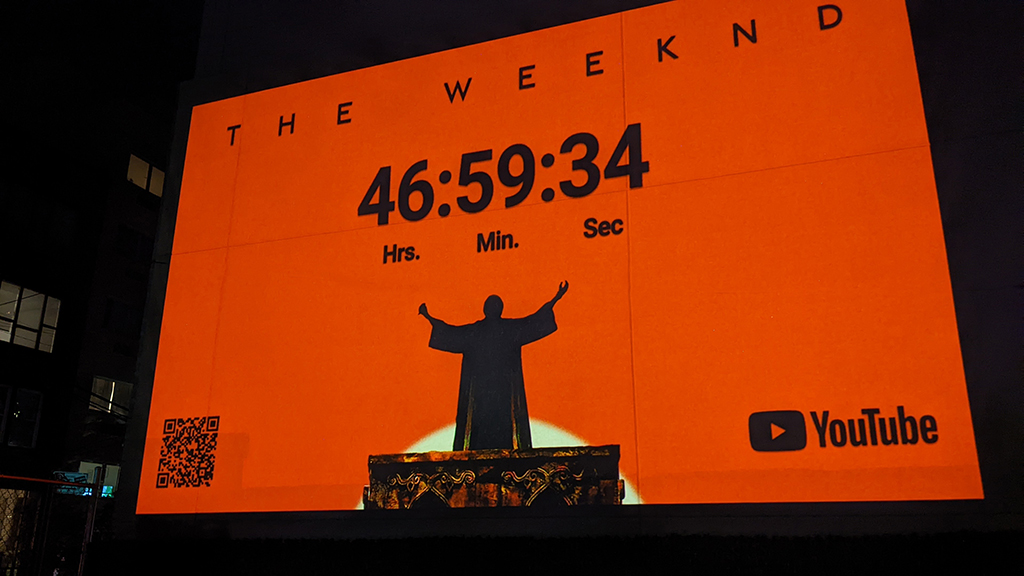
Chapultepec Park is one of the great arguments for Mexico City as a guerrilla advertising environment. Covering 686 hectares in the middle of the city — larger than Central Park, larger than Hyde Park, comparable in scale to Berlin’s Tiergarten — the park sits at the intersection of some of Mexico City’s highest-value advertising corridors. Paseo de la Reforma approaches from the east. Avenida Constituyentes runs along the southern boundary. Avenida Ejército Nacional borders the north. And on Sundays, hundreds of thousands of Mexico City residents and tourists fill the park, its surrounding streets, and the commercial zones nearby.
For projection advertising, the Chapultepec zone presents a specific opportunity that differs from any other area in CDMX. The buildings that line the park’s perimeter face a massive open green space — they are visible not just from the sidewalk directly in front of them but from hundreds of meters away, across the park’s open grass and lake areas. A projector aimed at a Constituyentes-facing building face is readable from inside the park itself, reaching audiences who are relaxed, unhurried, and visually receptive in a way that commuters on a busy boulevard are not.
AGM has worked the Chapultepec zone extensively, both for event-adjacent campaigns tied to Auditorio Nacional shows and for standalone weekend brand activations. The mechanics of projection advertising here are different enough from the residential colonia approach that they deserve their own treatment. This is what we have learned.
Bosque de Chapultepec: Scale, Sections, and Audience Flow
The park is divided into three sections — Primera Sección, Segunda Sección, and Tercera Sección — each with distinct character and audience patterns. Understanding how visitors move through and around these sections determines where projection campaigns produce the most concentrated impressions.
Primera Sección: The Core
The Primera Sección is the park’s heart — the oldest and most visited portion, containing the Lago de Chapultepec, the Castillo de Chapultepec on its volcanic hill, the Museo Nacional de Antropología on the Reforma approach, and the Museo de Arte Moderno. This section draws the densest Sunday crowds, including the families with children who rent rowboats on the lake, the visitors queuing for Chapultepec Castle, and the foreign tourists making the obligatory anthropology museum visit.
Sunday traffic in the Primera Sección is enormous by any measure. The paths around the lake, the approach roads to the castle, and the open grass areas host a continuous human flow from roughly 8am through 6pm. This extended Sunday window — combined with the park’s free admission on Sundays — makes Chapultepec’s immediate perimeter one of the highest foot-traffic advertising environments in Latin America on a weekly basis.
Zoologico de Chapultepec: Free Admission, Millions of Visitors
The Zoologico de Chapultepec occupies the northern edge of the Primera Sección and is one of the oldest zoos in the Americas. Its origins trace to a royal menagerie maintained by Aztec rulers long before the Spanish colonial period, with the modern facility formally established in 1923. Free admission to the zoo on all days drives year-round attendance that most paid attractions cannot match: annual visitor estimates range from four to five million, placing it among the busiest free zoos in the world.
For projection campaigns, the zoo generates a specific audience dynamic around the park’s core. Zoo visitors typically enter from the Reforma side, spend two to three hours inside, and exit back through the same corridor — meaning the perimeter buildings on Reforma and Constituyentes encounter these visitors twice in a single day. A campaign running on any weekend day catches zoo families both arriving in the morning and dispersing in the afternoon, effectively doubling the impression window without any repositioning of equipment.
Feria de Chapultepec: The Amusement Anchor
The Feria de Chapultepec is a full amusement park — roller coasters, water rides, carnival attractions — operating within the park’s boundary in the Segunda Sección. It draws Mexico City families with children from across the metropolitan area and, unlike the park’s free institutions, is a ticketed destination. That distinction matters for campaign planning: Feria visitors are committed for the day rather than passing through casually, which means they spend more time in the park and produce more sustained pedestrian flow along the surrounding streets.
The Feria’s Sunday evening egress, from roughly 5pm to 7pm, produces a dense family stream along Constituyentes that is distinct in character from both the morning cultural crowd and the Auditorio event-night audience. Parents with tired children — slow-moving, receptive to ambient imagery — flow toward Metro stations and parking along the southern park boundary during this window. It is one of the most family-concentrated projection moments available anywhere in the Chapultepec zone.
Segunda and Tercera Secciones
The Segunda Sección draws a different crowd than the Primera: overwhelmingly local Mexico City families — residents of Miguel Hidalgo, Polanco, and the western colonias — who use it as a genuine neighborhood recreational space rather than a tourist destination. International visitors are sparse here. The working demographic is middle-income families looking for free or low-cost weekend activities, and the Papalote Museo del Niño — the children’s science museum at the heart of the Segunda Sección — is the major audience driver. Papalote draws an estimated 400,000 to 500,000 visitors annually, the great majority of them families with children under twelve. Weekend days at Papalote concentrate family traffic along the Segunda’s access roads and the Constituyentes approach in a pattern that is worth understanding for campaigns targeting household and parenting categories.
The Tercera Sección, furthest west, is genuinely local territory: joggers, dog walkers, and cyclists from the surrounding colonias using it as a community greenway. Tourist penetration here is minimal. The audience in the Tercera is the most neighborhood-rooted demographic in the park system — useful context for hyper-local brand work, but generally outside the priority zone for campaigns chasing concentrated impressions.
Chapultepec Park covers 686 hectares — roughly 10 times the size of the Place de la Concorde in Paris. It receives an estimated 15 million annual visitors, making it one of the most-visited urban parks on the planet.
Paseo de la Reforma: The Approach Corridor
Paseo de la Reforma is one of the great urban boulevards of the Americas — a wide, tree-lined avenue commissioned by Emperor Maximilian in the 1860s and modeled after the grand Parisian boulevards. The stretch of Reforma between the Ángel de la Independencia monument and the park entrance at Chapultepec is particularly significant for advertising because it functions as a processional route into and out of the park.
On Sunday mornings and afternoons, this stretch of Reforma closes to vehicles and becomes a bicycle-pedestrian corridor — one of the Ciclotón events that make Mexico City’s boulevard system a genuine public space. Cyclists and pedestrians fill the boulevard for kilometers, creating an audience that is moving slowly, outdoors, and visually available in a way that no other Mexico City corridor produces.
Buildings on the Reforma Approach
The buildings lining Reforma in the Chapultepec approach zone are primarily modern commercial and residential towers — tall, glass-and-concrete structures that are less useful as projection surfaces than the older stucco buildings in residential colonias. However, the lower-rise buildings at the park entrance itself, the structures near the Auditorio Nacional, and the facades on Constituyentes facing the park create a different set of projection opportunities along the park boundary.
Museo Nacional de Antropología: The Cultural Anchor
The Museo Nacional de Antropología sits on Reforma just before the park entrance — one of the most architecturally significant museum buildings in Latin America, designed by Pedro Ramírez Vázquez and opened in 1964. The museum’s central courtyard, anchored by the famous umbrella-column that pours a sheet of water, is iconic. But for projection planning, the building’s exterior — particularly the long blank wall faces on the museum’s Reforma-adjacent sides — represents a significant surface opportunity.
The museum draws approximately two million visitors annually. International tourists, Mexican school groups, and cultural consumers from across CDMX pass through its orbit regularly. Projection campaigns near the museum entrance and on the surrounding Reforma approaches capture this culturally engaged audience at a moment when they are primed for visual experience.
The Museo Nacional de Antropología is consistently cited as one of the top five most visited museums in Latin America, with attendance of roughly 1.8 to 2 million visitors per year across its galleries.
Tamayo Museum and Museo de Arte Moderno
Two additional major cultural institutions sit within the park’s Primera Sección: the Museo Rufino Tamayo and the Museo de Arte Moderno. Both are within easy walking distance of the Reforma entrance and draw art audiences that overlap with but differ from the anthropology museum crowd. The area around these institutions, particularly on weekend afternoons after museum closings (around 5pm), sees pedestrian dispersal toward the park exits and the Reforma corridor — another defined projection window.
Chapultepec Castle and the Hilltop Silhouette
Castillo de Chapultepec sits atop a 65-meter volcanic promontory at the western end of the Primera Sección — a dramatic position that makes the castle’s silhouette visible from much of the surrounding city and from the Reforma corridor for kilometers to the east. Originally built as a military academy and later serving as an imperial residence, the castle is now a museum and one of Mexico City’s most visited historic sites, drawing over a million visitors annually to its hilltop galleries and terraces.
The castle itself is not a projection surface in the conventional sense — its elevated position and the distance from surrounding buildings make it more appropriate as a projection target for specialized large-scale spectacle events with high-powered equipment. What the castle contributes to everyday projection strategy is something subtler: its visual dominance over the entire park floor creates a natural compositional anchor for any campaign running in its vicinity. Projection campaigns positioned near the castle base — on the approach roads and the structures at the promontory’s foot — benefit from the castle’s presence as a backdrop. Audiences looking toward a projected image at ground level will frequently have the castle’s illuminated mass in the upper frame of their view, giving the campaign a sense of place and scale that no urban street setting can replicate. That ambient association with one of Mexico City’s most recognizable silhouettes is a background benefit that comes at no extra cost to a well-positioned campaign.
The Chapultepec Fountain: A Choke Point at the Park Entrance
The Chapultepec Fountain at the park’s main eastern entrance off Reforma functions as one of the park’s primary orientation and informal gathering points. On Sundays, the fountain plaza is in constant use — vendors, families, groups regrouping before splitting toward the zoo, the lake, and the castle approach road. Traffic through this plaza is dense and slow-moving precisely because it is a convergence point rather than a through-corridor.
Projection surfaces visible from the fountain plaza catch visitors at the moment of highest attention in a typical park visit: they have just entered, they are still deciding where to go, and they are not yet absorbed in another activity. That combination of physical convergence and mental openness is difficult to find in a typical urban projection environment, where audiences are almost always mid-transit when they encounter the campaign. The fountain plaza is the opposite — a place where people stop, look around, and orient themselves. That behavioral pause is exactly the dwell-time condition that makes projection imagery stick.
Auditorio Nacional: The Event-Night Campaign Window
The Auditorio Nacional sits on Reforma at the main entrance to Chapultepec — Mexico’s largest concert venue, with a capacity of approximately 10,000 to 22,000 depending on the configuration. It hosts the country’s major touring concerts, theatrical productions, and award ceremonies. Any week that the Auditorio has a significant event is a week when the Chapultepec projection zone concentrates its most affluent, culturally engaged audience into a defined geographic radius.
Pre-show traffic on Reforma and Constituyentes builds from roughly 6pm onward for evening events. Post-show dispersal produces a concentrated pedestrian flow from approximately 10pm to midnight. These two windows are the projection sweet spots on Auditorio event nights. The audiences leaving a major concert or theatrical performance are in a heightened emotional state — they have just experienced something — and brand encounters in this post-event window carry a specific kind of resonance.
“Post-show crowds outside the Auditorio Nacional are among the most brand-receptive audiences we work with anywhere in Mexico City — they are emotionally open, in groups, and moving slowly toward their transportation.”
Projection Placement for Event-Night Campaigns
For Auditorio event nights, AGM positions projectors on the buildings along Constituyentes between the park entrance and Ejercito Nacional, as well as on structures along the Reforma approach. The pedestrian dispersion pattern from the Auditorio spreads east along Reforma (toward Metro Auditorio on Line 7), south along Constituyentes, and into the adjacent Polanco streets. A single projector positioned on a high-traffic corner in this zone can reach a substantial fraction of the departing audience in a single night.
Avenida Constituyentes: The Southern Park Boundary
Avenida Constituyentes runs along the southern boundary of the park from the roundabout at Reforma west through the park’s full length. This is a major vehicular thoroughfare — six lanes in sections — and the buildings that front Constituyentes on the south side of the street face directly across to the park’s southern boundary wall and the park itself beyond it.
For projection campaigns, the geometry of Constituyentes is unusual and worth understanding. A projector positioned in the park itself — near the boundary wall — can throw content onto the Constituyentes-facing building facades across the street, with the park interior as the “backstage” area for the operation. More conventionally, projectors on the south side of Constituyentes aim back at the north side of the street, using the park-facing building faces as surfaces.
Either configuration creates an impression field that reaches both vehicular traffic on Constituyentes and the pedestrian flow along the park boundary — a combination of audience types that is relatively rare in Mexico City projection work.
Building Stock on Constituyentes
The buildings along Constituyentes facing the park include a long stretch of mid-century residential blocks, institutional structures, and commercial mixed-use properties extending roughly two kilometers from the Reforma roundabout westward. Surface quality varies block by block: some facades are freshly painted stucco in neutral tones that read cleanly on camera, while others carry years of accumulated signage, murals, or texture that reduces projection contrast.
The most productive Constituyentes surfaces for projection are typically the party walls — the end walls of residential buildings at block breaks, which tend to be larger, cleaner, and more uniformly colored than the primary street-facing facades. These walls are also structurally independent, which simplifies the access relationship compared to a building’s main commercial frontage. A two-kilometer stretch of park-facing Constituyentes offers more raw surface inventory than most Mexico City corridors: the issue is not finding surfaces but identifying which specific walls deliver the combination of visibility, pedestrian proximity, and surface quality that makes projection imagery readable from both the sidewalk and the park interior across the street.
Antara Fashion Hall and the Polanco-Chapultepec Overlap
The Antara Fashion Hall sits on Ejercito Nacional in Polanco, immediately adjacent to the northern edge of the Chapultepec zone. Antara is a premium retail complex anchored by luxury fashion brands, a cinema complex, and high-end restaurants — the kind of environment that attracts Mexico City’s upper-income consumer consistently throughout the week and heavily on weekends.
For projection campaigns, Antara’s value is in the evening retail and dining audience on Ejercito Nacional. This corridor carries affluent shoppers and diners to and from Antara and the surrounding Polanco streets. Buildings on Ejercito Nacional facing toward the park have large facades and consistent evening pedestrian traffic. Campaigns here reach a premium consumer demographic that is distinct from the broad family audience in the park but geographically proximate.
The Polanco-Chapultepec corridor on Ejercito Nacional and Masaryk Avenue consistently ranks among Mexico City’s highest-income consumer corridors, with retail spend per square meter comparable to the most premium shopping districts in the city.
Lago de Chapultepec and the Family Audience
The Lago de Chapultepec in the Primera Sección is one of the park’s most popular destinations — particularly for families with young children who rent rowboats and pedalboats on the lake. The lake’s perimeter paths draw a relaxed, unhurried audience that is perhaps the most receptive projection target anywhere in the Chapultepec zone.
Buildings visible from the lake’s eastern perimeter — the structures on Reforma near the park entrance — have a line-of-sight advantage: they are visible to the hundreds of people on the lake’s paths and in the boats on the water simultaneously. This creates an audience situation unlike anything available in the urban colonia environment, where projection is almost always a moving-pedestrian-past-a-fixed-surface encounter.
At the lake, the audience is stationary. They are sitting in a boat, or walking slowly on a path, or eating at a lakeside vendor stall. A projected image on a visible building face in this context gets longer dwell time per person than virtually any other Mexico City projection scenario.
Campaign Architecture for Chapultepec Zone
The Chapultepec zone is large enough that a single campaign night can target multiple sub-zones with different projectors running simultaneously. AGM’s typical structure for a Chapultepec area campaign:
| Sub-Zone |
Primary Surface |
Audience |
Best Night/Time |
| Reforma approach (east) |
Buildings near Auditorio on Reforma |
Concert-goers, tourists, commuters |
Event nights, 7pm-midnight |
| Constituyentes (south boundary) |
Park-facing mid-century buildings |
Park visitors, cyclists, families |
Sunday afternoon, 4pm-8pm |
| Ejercito Nacional (north boundary) |
Commercial facades near Antara |
Polanco shoppers, luxury consumers |
Friday/Saturday evenings |
| Lago de Chapultepec perimeter |
Reforma-facing park entrance structures |
Families, tourists, weekend visitors |
Sunday midday and afternoon |
| Museo de Antropología adjacent |
Reforma-facing museum-area buildings |
International tourists, cultural consumers |
Weekend afternoons at museum close |
Running multiple nights across these sub-zones builds complete coverage of the Chapultepec audience spectrum — the family visitor, the luxury consumer, the concert-goer, and the cultural tourist.
Projection Geometry: Park-Facing Buildings and Long Sightlines
The open space of the park creates projection sightlines that are impossible in the dense urban grid. In a typical CDMX colonia, a pedestrian can see a projected image from roughly one to three blocks away before buildings, trees, and street furniture interrupt the sightline. On Constituyentes facing the park, or on Reforma facing the park entrance, a projected image is visible from much farther — potentially 200 to 400 meters across open green space.
This long sightline changes the scale calculation for projectors. Larger throw distances require more powerful equipment to maintain image brightness. AGM uses higher-lumen projectors in the Chapultepec zone than in the residential colonia environment, specifically because the visibility advantage of the open park sightlines is only realized if the image is bright enough to read cleanly at extended distances.
Frequently Asked Questions About Guerrilla Projections Near Chapultepec Mexico City
What is the best projection zone near Chapultepec Park for brand campaigns?
The Paseo de la Reforma corridor leading to the park entrance, particularly the buildings on Constituyentes facing the park boundary, are the highest-traffic projection zones in the Chapultepec area. The Auditorio Nacional on Reforma at the park entrance is also a natural focal point, as its surrounding streets fill with concert-goers on event nights.
How many people visit Bosque de Chapultepec on a typical weekend?
Chapultepec is consistently cited as one of the most visited urban parks in the world, with estimates of 15 to 20 million annual visitors. On peak weekend days — particularly Sundays when the park is most heavily used by Mexico City families — foot traffic through the park and on surrounding streets reaches hundreds of thousands of people.
Can guerrilla projection campaigns target the Auditorio Nacional audience in Chapultepec?
Yes. The Auditorio Nacional hosts concerts and events most weekends and several weeknights throughout the year. Pre-show and post-show pedestrian movement on Reforma and Constituyentes creates defined projection windows of 60 to 90 minutes with a dense, focused audience. Event-night campaigns near the Auditorio are among the most measurable in terms of time and audience composition.
How does Antara Fashion Hall factor into projection planning near Chapultepec?
Antara is a luxury retail complex in Polanco immediately adjacent to the Chapultepec zone. Its evening pedestrian traffic on Ejercito Nacional and surrounding streets is high-income and brand-aware. Projection campaigns on the buildings bordering Antara can reach a premium consumer audience that overlaps with but is distinct from the broad family audience in the park itself.
What makes Chapultepec projection campaigns different from other Mexico City locations?
The unique factor in Chapultepec is the park boundary effect: buildings along Constituyentes and Reforma face a massive open green space rather than the dense urban fabric typical of other projection zones. This means projections on these buildings are visible from inside the park’s perimeter paths, creating an unusual dynamic where outdoor audiences — people in a relaxed, receptive state — encounter the projection imagery.