These are the tactics we use in the field, not the ones we read about in case studies. Here is what each one requires, where it works, and what it costs.
Guerrilla marketing tactics exist on a spectrum from the genuinely surprising to the forgettably generic. We have been on both ends of that spectrum. Early in our operations, we ran campaigns that checked the guerrilla box on paper but did not earn the attention that the format promises. Over time, we figured out why some tactics work and some do not, and the answer is almost always in the specifics: the exact location, the exact surface, the exact time of day, the exact creative, the exact audience that was there when the installation went up or the team hit the street.
This guide is a practitioner’s breakdown of the guerrilla marketing tactics we run most frequently at American Guerrilla Marketing. We cover what each tactic is, where and when it works, what it does not work for, and what brands need to bring to make it successful. No buzzword lists. No high-level framework slides. Just the work.
Sidewalk stenciling is our most frequently deployed tactic for event-adjacent campaigns, launch activations, and neighborhood-level awareness campaigns. We cut custom stencils from Mylar sheet material, mix chalk-based paint to the correct consistency for the target surface, and deploy overnight teams to install across the agreed location list.
The process is fast and scalable. A four-person crew can install 20 to 30 stencil locations in a five-hour overnight window in a concentrated geographic zone. A six-person crew on two concurrent routes can cover 40 to 50 locations in the same window. We have covered entire borough footprints in a single night when the campaign required it.
Where Stencil Campaigns Work Best
The best stencil locations are approach routes to specific destinations. Not random high-traffic sidewalks, but the specific sidewalks that the target audience walks to get somewhere they are going. The 7th Avenue and 8th Avenue sidewalks on the Madison Square Garden approach between Penn Station and the arena. The Flatbush Avenue corridor between Atlantic Terminal and Barclays Center. The Broadway and Bedford Avenue routes in Williamsburg between the L and G train stations and the concert venues on Kent Avenue.
Stencils work on surfaces with enough texture and grime to hold chalk paint without spreading. Fresh, very smooth concrete absorbs inconsistently and blurs edges. Weathered, slightly roughened pavement gives better edge definition and holds the paint longer. We do a surface test before committing to any new location type we have not worked before.
Stencil field note: We cut every stencil in-house. Third-party stencil fabrication introduces a quality control gap between the design approval and the final print, which can result in edge quality issues that affect the legibility of fine text or complex linework. For any design with text under 2 inches in height or linework thinner than 1/8 inch, in-house cutting is the only way to guarantee the final impression matches the approved design.
Tactic 2: Poster and Flyer Distribution
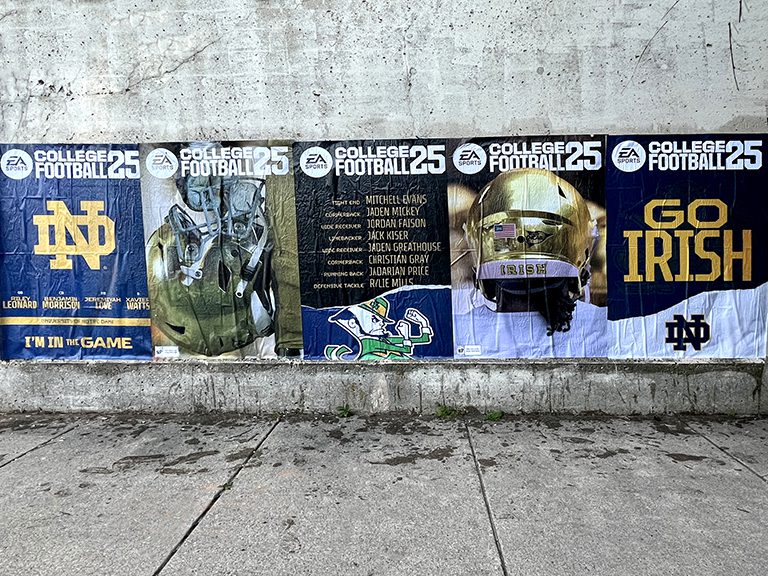
Poster distribution is one of the oldest guerrilla marketing tactics in urban advertising. It is also one of the most durable. When posters are placed correctly, on the right surfaces, at the right height, in the right density relative to the neighborhood, they generate consistent impression counts over their lifespan with a fraction of the production cost of traditional OOH placements.
We run poster campaigns in two modes. Street runs place posters on available public surfaces: construction hoarding, telephone infrastructure, utility boxes, and other sanctioned street-level locations. Venue and retail placement puts posters in bathrooms, backstage hallways, record stores, skate shops, coffee shops, and the other physical environments where the target audience spends time indoors.
Venue Placements
Venue placements are the higher-quality end of poster distribution. A poster in the bathroom of a venue where a band is playing reaches an audience that is already primed for that band’s brand. A poster in the record section of a shop on Bedford Avenue reaches an audience with a demonstrated interest in physical music. Context makes every impression more efficient.
We maintain placement relationships with hundreds of venues, shops, and cultural spaces across our primary markets. Our team knows which spaces accept placements for which genres and categories, and we build placement lists based on audience match rather than just geographic coverage.
Tactic 3: Projection Advertising
Projection advertising is the highest-visual-impact tactic in our toolkit. We position commercial-grade projectors rated at 20,000 lumens or above, aimed at building facades, bridge faces, or other large vertical surfaces, and run brand content from dusk through the agreed campaign window. The resulting image at 40 to 80 feet scale on a dark building face is genuinely impossible to ignore from a street-level vantage point.
We run projection campaigns with two primary use cases. Launch moments create a single high-impact visual event: a product debut, a show announcement, a release date drop. The campaign runs for one to three nights and generates photography and social content that carries the campaign online for days after the physical activation ends. Sustained campaigns run projection over a longer window, cycling through multiple building locations in a city to cover different neighborhoods and audience pockets.
Best Projection Locations in New York
In New York, the building faces we return to most frequently for projection campaigns are on Washington Street in the Meatpacking District between Little West 12th and Gansevoort Streets. The buildings on that corridor face west, which means the evening light does not wash out the projection, and the density of nightlife and retail on those blocks guarantees a significant foot traffic audience through 11 PM on any night of the week.
The warehouse district walls on Kent Avenue in Williamsburg facing the waterfront park have become increasingly popular for music and culture brand projections. The audience walking the waterfront at night is heavily skewed toward the creative and music-engaged demographics that those brands target, and the wall scale on those buildings allows for content at architectural scale.
Tactic 4: Mural Advertising
Murals are the permanence play in guerrilla marketing tactics. A painted mural on a high-visibility wall is a brand presence that does not need to be renewed weekly. It builds recognition over time rather than disappearing after a campaign window. For brands looking to establish a long-term presence in a specific neighborhood or city, mural advertising is the most cost-efficient format calculated on an impression-per-dollar basis over a full year of exposure.
We plan mural campaigns by starting with neighborhood selection. The neighborhood has to match the target audience in demographic character. The mural wall has to face the right direction for visibility. The surrounding built environment has to give the mural enough visual clearance to be seen from a meaningful distance. And the neighborhood has to have an organic photography culture that will generate ongoing social posts from the installation over its lifespan.
Mural Production Process
After wall selection and owner coordination, we begin surface preparation. Old paint, rust, moisture damage, and previous murals all need to be addressed before the new mural goes down. We prime all surfaces with exterior-grade primer appropriate for the substrate material. The muralist works from a full-scale digital reference, typically projected at scale onto the wall surface in a preliminary session to establish the grid and proportion before hand painting begins. Final seal coat goes on after the paint cures, typically seven to ten days after the last paint application.
Tactic 5: Street Team Activations
Street teams put brand representatives in direct contact with the target audience. This is the highest-engagement tactic in the guerrilla toolkit because it creates actual human interaction, more than a visual impression. A well-briefed street team member having a genuine conversation with a potential customer at a festival entrance or outside a concert venue is doing something no other format can replicate.
We staff street teams from a vetted network of field representatives in every major market we operate in. Representatives are trained on the brand and product before going into the field, given a clear deployment protocol, and equipped with whatever materials the campaign requires: samples, literature, branded merchandise, or simply the ability to represent the brand in conversation.
Tactic 6: Ambient and Environmental Advertising
Ambient advertising integrates a brand message into a physical environment in a way that uses the environment itself as part of the creative. The technique requires a specific relationship between the brand message and the physical context. A coffee brand whose messaging appears on the paper sleeve of a coffee cup in a cafe is ambient. A streaming platform whose brand mark appears as the only lit element on a dark urban wall is ambient. The environment is more than the backdrop; it is part of the execution.
Ambient tactics require more creative development time than straightforward format execution, but when they work, they generate a level of audience engagement that standard placements cannot achieve. The audience does more than see the message; they experience the moment the message and its environment click together.
Tactic
Speed to Deploy
Duration
Budget Range
Best Use Case
Sidewalk Stencil
7 to 14 days
1 to 3 weeks
From $2,855 (5 stencils)
Launch activations, event approach
Poster Distribution
5 to 10 days
2 to 6 weeks
$1,500 to $5,000
Event promotion, awareness
Projection Advertising
5 to 7 days
1 to 5 nights
$3,500 to $12,000/night
PR moments, launches
Mural
3 to 6 weeks
1 to 5 years
$8,000 to $40,000
Brand authority, long-term presence
Street Team
1 to 3 weeks
1 to 3 days/deployment
$3,000 to $15,000
Sampling, direct engagement
Ambient / Environmental
2 to 5 weeks
Varies
$5,000 to $25,000
Brand storytelling, creative campaigns
How We Match Tactics to Campaign Goals
The biggest planning mistake in guerrilla marketing is tactic selection before goal definition. A brand that needs sustained neighborhood presence chooses differently from a brand that needs a single high-impact PR moment. A brand targeting 18 to 25 year olds in SoHo chooses differently from a brand targeting 35 to 45 year olds in Midtown. The tactic has to match the goal, the audience, and the geography.
Our campaign planning process starts with the goal and works backward to format. We ask what success looks like at the end of the campaign window: exposures, social sharing, press mentions, direct engagement, brand recall. Each of those success metrics points to different tactical choices. Impression volume points to scale: large murals, wide stencil coverage, high-traffic poster routes. Social sharing points to visual surprise: projection, ambient, stunts. Direct engagement points to human presence: street teams, sampling, experiential builds.
Planning principle: We never recommend a tactic before we understand the goal. If a client comes to us saying they want a street team because they saw one for another brand and liked it, we ask what they are trying to achieve. Sometimes the answer confirms that a street team is right. Sometimes it reveals that stenciling on the approach routes to their target event would deliver better results at lower cost. Format should always follow function.
Combining Tactics for Maximum Impact
The most effective campaigns we run use multiple tactics in combination. A single format covers one mode of audience engagement. Multiple formats cover several modes at the same time and create the sense of a brand presence that is everywhere in a specific geography at a specific moment in time.
A typical combination campaign for a music release might layer a mural in the primary target neighborhood, stenciling on the venue approach routes in the week of the show, a poster run in cultural and music-adjacent venues across the market, and a street team at the show entrance on the night of the event. Each tactic hits the target audience at a different moment in their pre-show day. Together, they create a campaign that feels like the artist or label took over the neighborhood for a week.
Tactic Selection by Brand Category
The question we hear most often in first briefing calls is: which tactic is right for my brand? The honest answer is that it depends on the specific category, the specific audience, and the specific moment in the brand’s lifecycle. But those dependencies are not vague. They follow patterns we have observed across hundreds of campaigns.
Music Releases and Tour Launches
Music campaigns get the most out of venue-adjacent tactics timed to specific dates. The stencil and poster run in the week before a show or album release, deployed on the approach routes to the relevant venues and in the neighborhoods where the fan base is concentrated, creates a physical announcement that the media buy cannot produce. The fan who walks past the stencil outside the L train station feels like something real is happening in a way that a Spotify pre-save link does not produce.
Projection is the go-big tactic for music. A building-scale image on a warehouse wall in Williamsburg or on the side of a venue building on the night of a release creates a visual moment that fans photograph, share, and remember. We have seen projection campaigns for music releases generate more organic Instagram exposures in 48 hours than the label’s paid social budget generated in the preceding two weeks.
Streetwear and Sneaker Drops
Streetwear and sneaker brands need saturation tactics in specific neighborhoods. The target audience for a streetwear drop lives in a concentrated geography, and the campaign needs to be inescapable in that geography in the days before the drop. Stencils on every approach route to the target blocks, posters in the shops and venues the audience frequents, and street team presence outside the drop location on the day of the release create a physical event out of what would otherwise be just another product launch.
The creative for streetwear campaigns has to be fluent in the visual language of the street. It cannot look like corporate advertising dropped into a street context. It has to look like it belongs on the walls where it appears. That requires designers with genuine cultural fluency in the streetwear and sneaker space, not just commercial graphic design competence.
Food and Beverage Launches
Food and beverage campaigns work best when the tactic creates a trial opportunity rather than just an impression. Sampling and street team deployments in high-traffic food environments, markets, transit hubs adjacent to the target neighborhood, and festival perimeters put the product directly in the hands of the target audience. The physical product trial is a more powerful conversion tool than any awareness format.
Poster and stencil campaigns for food and beverage work best when they are hyper-local and context-specific. A campaign for a new coffee product that saturates the blocks around the coffee shops and transit corridors of a specific neighborhood reaches the audience at exactly the moment they are thinking about their coffee choice. Location relevance makes the format work harder for food and beverage than for category-agnostic placements.
Seasonal Tactic Adjustments
Guerrilla marketing tactics perform differently across seasons, and the best campaign plans account for those variations rather than ignoring them. The physical conditions that affect format longevity, the audience behaviors that affect impression timing, and the social media dynamics that affect amplification all shift significantly across the year.
Summer is the strongest season for most guerrilla tactics in northern US cities. Pedestrian volumes are highest, outdoor time is longest, and social media sharing of outdoor content peaks. Stencils last longer in dry summer conditions than in winter wet. Street teams can operate for longer windows in warm weather. The entire physical advertising environment is more favorable from May through September in New York, Chicago, and Boston than at any other time of year.
Winter requires format adjustments. In cities with significant precipitation, paper-based formats are shorter-lived and require more frequent refreshing to maintain campaign presence. Stencil installations on exposed horizontal surfaces are more vulnerable to precipitation damage. The tactics that hold up best in winter are the most durable: murals on sheltered surfaces, indoor venue placements, and enclosed transit environments.
Fall is the optimal window for pre-holiday consumer campaigns and for campaigns targeting the entertainment industry. The October through December window sees the highest concentration of new product launches, film and streaming releases, and concert tours, which means the competition for attention is intense but the audience is also in a peak consumption mindset. Campaigns that land in mid-October to mid-November have the runway to build awareness before holiday purchase decisions are made.
Season
Best Tactics
Challenges
Priority Markets
Spring (Mar-May)
Stencils, murals, street teams
Variable weather in North
NYC, Chicago, Boston
Summer (Jun-Aug)
All formats, festivals, projections
Competition for wall inventory
All markets
Fall (Sep-Nov)
Posters, stencils, street teams
Rain increasing in North
All markets, heaviest in NYC
Winter (Dec-Feb)
Indoor venues, murals, projections
Precipitation, reduced foot traffic
Miami, LA, Austin
Frequently Asked Questions
What are the most effective guerrilla marketing tactics today?
The most effective guerrilla marketing tactics in 2026 are the ones designed with organic social sharing in mind. Projection advertising, large-scale murals in high-foot-traffic neighborhoods, street team activations at events, sidewalk stencil campaigns on approach routes, and live experiential stunts all generate strong real-world impact and organic online amplification.
How do I choose the right guerrilla marketing tactic for my campaign?
Format selection depends on four factors: your target audience and where they move, your campaign window and timeline, your budget, and your primary goal. Brand awareness favors high-visibility formats like murals and projection. Direct engagement favors street teams. Launch events favor stencils and poster campaigns on approach routes. We help clients match tactic to goal before any production begins.
How much do guerrilla marketing tactics cost?
Costs range from around $1,500 for a basic poster distribution run to $50,000 or more for a full multi-format campaign across multiple markets. Most single-city campaigns using one or two formats land in the $5,000 to $20,000 range. We build custom proposals for every client based on their specific market, format, and timeline requirements.
Can guerrilla marketing tactics work for small businesses?
Yes. The street-level formats that make up most guerrilla marketing work at any budget scale. A small business in a specific urban neighborhood can run a focused stencil or poster campaign for $2,000 to $5,000 and generate meaningful local awareness. The format scales up for national brands and down for local ones without losing its effectiveness.
What guerrilla marketing tactics generate the most press coverage?
Tactics that are visually dramatic and contextually surprising generate the most press attention. Large-scale projection on a well-known building, a major mural in a high-profile neighborhood, and live performance stunts in unexpected public locations have the strongest track record of editorial pickup in advertising trade and local news publications.
How do guerrilla marketing tactics differ from traditional advertising?
Traditional advertising buys space in a designated advertising environment: billboards, transit cards, digital placements. Guerrilla tactics create advertising in non-designated spaces. The difference is in the audience’s relationship to the message: in traditional media, they expect advertising. In guerrilla formats, they encounter it without expecting it, which changes the quality of the impression.
How long does it take to run a guerrilla marketing campaign?
Timeline varies by format. A sidewalk stencil or poster campaign can be planned and installed in 7 to 14 days from brief to field. A mural installation takes 3 to 6 weeks. Experiential activations typically require 4 to 8 weeks of planning. We work within client timelines and flag early if a requested format requires more lead time than the campaign window allows.
Does AGM document guerrilla marketing campaign installations?
Yes. Every installation is photographed with GPS timestamp documentation. Clients receive a full photo report within 24 hours of each field deployment. For multi-location campaigns, we provide location-by-location documentation so clients can verify every placement.