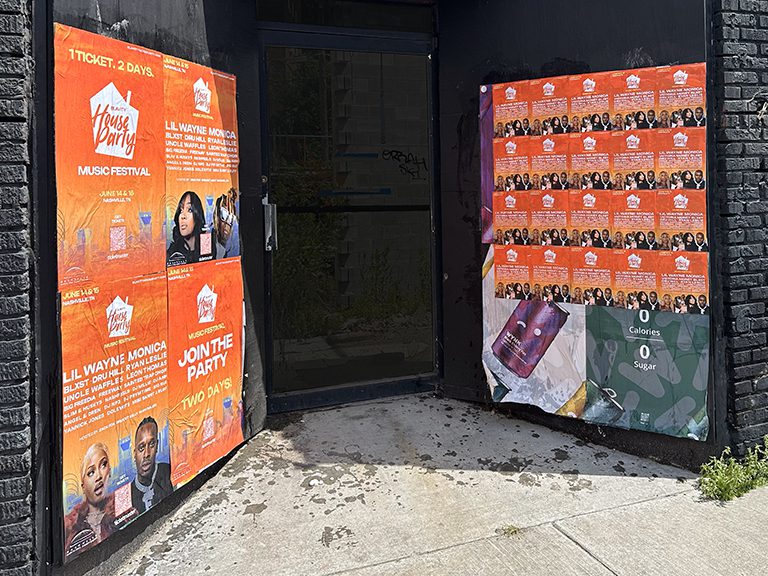
Everything a brand needs to know about guerrilla marketing, from the core philosophy to the specific formats, neighborhoods, and execution standards that produce real results.
Guerrilla marketing is advertising built around a fundamental insight: creativity is worth more than budget. When a brand uses unconventional tactics, unexpected locations, and genuine creative intelligence to reach its audience, it creates a kind of impact that the largest conventional media budgets cannot buy. The name comes from guerrilla warfare, where smaller forces achieve disproportionate results through unconventional tactics and strategic precision rather than raw scale.
We run guerrilla marketing campaigns for brands across the United States. We put work on the streets of New York, Los Angeles, Chicago, Miami, and every other major market where physical advertising presence creates the cultural credibility and community connection that no digital channel can replicate. This is the complete guide to guerrilla marketing from a team that has been executing it in the real world for over a decade.
The Definition and Philosophy of Guerrilla Marketing
Guerrilla marketing was defined and named by Jay Conrad Levinson in his 1984 book of the same title. Levinson wrote for small businesses that could not afford to compete with larger brands in conventional advertising channels. His core argument was that imagination, knowledge, time, and energy could substitute for advertising spending if deployed with enough creativity and strategic precision.
Forty years later, the philosophy is as relevant as ever. Conventional advertising channels, particularly digital, are more saturated, more expensive, and more subject to avoidance behaviors than they have ever been. Ad blockers, skip buttons, and the general human tendency to ignore things we encounter repeatedly in the same contexts have degraded the effectiveness of most conventional advertising formats significantly. Guerrilla marketing sidesteps all of this by appearing where the audience does not expect advertising, using formats that demand attention rather than competing for it within a crowded channel.
The philosophical commitment that underlies good guerrilla marketing is earning attention rather than buying it. Every decision in a guerrilla campaign, the choice of format, the selection of location, the development of creative, the timing of the campaign, should serve the goal of creating a genuine human reaction in a real physical space. If the campaign does not do that, it is not guerrilla marketing. It is just advertising that happens to be unconventional in some technical sense.
The Core Tactics of Guerrilla Marketing
Large-Format Street Print
The most widely practiced and reliably effective guerrilla marketing tactic is large-format print advertising placed on walls, fences, construction barriers, and other surfaces at street level in high-traffic urban locations. The scale creates visual presence that smaller-format advertising cannot achieve. The street-level placement creates proximity and intimacy with the audience that billboard-height advertising cannot match. And the locations, chosen for their cultural resonance and demographic alignment, ensure that the campaign reaches the right people in the right context.
We print at scales from 24×36 inches up to full building-side coverage. We use wheat paste application for large-scale placements that need to stay up through weather over an extended campaign run. We select paper weights, inks, and finishes appropriate for the specific climate and location of each placement. Installation is executed by professional crews who produce clean, precise work that represents the brand correctly every time.
Street Team Activations
Human-powered activations place brand representatives in direct contact with the target audience in physical spaces. These activations can be straightforward sampling and distribution programs or complex scripted experiences that create brand moments in public spaces. The human element creates personal connection that print advertising cannot replicate and that digital advertising cannot approach. When a knowledgeable, genuine brand representative gives someone a product sample on a street they love in a neighborhood they identify with, the brand has created a relationship, not just an impression.
We recruit, train, and brief every street team ambassador we deploy. The briefing covers the brand story, the product specifics, the target audience profile, and the specific talking points relevant to the location and time of day. A team that understands what they are representing creates real conversations. That quality of engagement is what produces the recall and advocacy that makes street teams worth the investment.
Ambient and Environmental Advertising
Ambient advertising integrates brand messaging with the physical environment in ways that feel native to the space rather than imposed on it. A coffee brand that places advertising on the cups at a coffee shop, or a fitness brand that places messaging on the benches at a popular running route, is using ambient advertising to reach an audience in the precise context where their product is most relevant. The best ambient advertising is so well integrated that the audience engages with it before they recognize it as advertising, which is both a creative achievement and a strategic advantage.
Building Projections
Building projections are the most spectacular guerrilla format available. A high-lumen projector throwing brand content onto a major building facade in a dense urban neighborhood creates an event that people stop to watch and photograph. The social documentation generated by a well-placed, well-designed projection is consistently among the highest of any guerrilla format we run. A single night of projection in SoHo or the Arts District in Los Angeles can generate hundreds of organic posts and reach a digital audience many times larger than the foot traffic at the location.
Event-Based Activations
Coordinated activations in public spaces create brand moments that generate both direct audience engagement and organic social content. A well-designed brand activation in a busy public space attracts attention, creates a crowd, and generates documentation. The compounding social dynamic of a crowd forming around a brand moment is part of the mechanism: each person who stops to watch makes the activation more visible to the next person walking by.
Tactic
Primary Strength
Audience Engagement
Social Amplification
Large-Format Print
Scale, visual impact
Passive but memorable
High in active social zones
Street Teams
Personal connection, trial
Direct and personal
Moderate via ambassador networks
Ambient Advertising
Context relevance, surprise
Discovery-driven
High if concept is novel
Building Projections
Spectacle, memorability
Stops foot traffic completely
Very high
Event Activations
Concentrated impact
Participatory or observational
High with good creative
Guerrilla Marketing by Industry
Guerrilla marketing applies across industries, but the specific approach varies meaningfully based on the category, the audience, and the commercial goal. Here is how we think about it for the industries we work in most frequently.
Music and Entertainment
Music and entertainment brands have been using guerrilla marketing tactics longer than almost any other category. The cultural alignment between street advertising and music culture makes the format feel native rather than imposed. Release campaigns, tour announcements, and streaming service promotions all benefit from street presence that creates urgency and cultural moment around a specific time and event. We have executed dozens of music and entertainment campaigns in New York and Los Angeles that built genuine pre-release buzz through concentrated neighborhood presence in the days leading up to a drop.
For a music release in New York, the most effective zone is the Lower East Side combined with Williamsburg. Rivington Street between Orchard and Essex, Orchard Street between Houston and Delancey, and Bedford Avenue in Williamsburg from the train station to the waterfront cover the music-culture-dense blocks of both neighborhoods. A postering campaign concentrated on these blocks in the week before a release creates saturation in exactly the community most likely to care about and amplify the release.
Fashion and Streetwear
Fashion brands have a natural alignment with guerrilla marketing because the format itself communicates cultural awareness. Where a brand chooses to advertise in the physical world is itself a signal. A fashion brand that appears on the walls of Bushwick or the side streets off Fairfax Avenue in Los Angeles is saying something about itself that a billboard on the BQE or a banner on a website does not say. The medium is part of the message in ways that are highly specific to guerrilla formats.
Streetwear brands in particular benefit from postering in the corridors where streetwear culture is most concentrated. In Los Angeles, that is the Fairfax and Melrose intersection. In New York, it is Lafayette Street in SoHo between Prince and Houston, and the Bedford Avenue corridor in Williamsburg. In Chicago, it is the Milwaukee Avenue corridor in Wicker Park between Damen and Division.
Food and Beverage
Food and beverage brands use guerrilla marketing primarily for trial generation. The street team sampling format is the most direct path from brand awareness to first-hand product experience, and the most effective food and beverage campaigns we run combine sampling at high-traffic transit hubs with postering in the retail neighborhoods where the product is sold. The person who samples at Grand Central in the morning and sees a poster in their neighborhood that afternoon has two touch points before they reach the store. That repetition moves trial intent toward purchase.
Tech and Apps
Tech and app brands use guerrilla marketing to create tangible, physical presence in a world where their product is entirely digital. The projection campaign is the signature format for tech launches because it creates a spectacular, photograph-worthy event that is inherently shareable. A well-executed projection launch in a major cultural neighborhood in New York or Los Angeles generates organic content that functions as a third-party endorsement: real people sharing a real thing they really saw, not paid distribution of brand-produced assets.
AGM Field Note: The most consistent complaint we hear from brands that have tried guerrilla marketing without AGM is that the locations were wrong. Generic boards in wrong neighborhoods. Wrong time of day for the format. No coordination between creative and placement. Location intelligence is not a secondary concern. It is the primary driver of whether a campaign works.
Guerrilla Marketing by City: Where We Operate
New York City
New York is the most varied and most demanding guerrilla marketing environment in America. The density of the city means that the difference between the right block and the wrong block is genuinely large. Our primary zones in New York are: SoHo (Broadway from Houston to Canal, Prince Street, Spring Street), Williamsburg (Bedford Avenue from the waterfront to the L train stop, Metropolitan Avenue), the Lower East Side (Orchard, Rivington, Delancey, Bowery), the Flatiron District (23rd Street, 5th Avenue, Madison Square Park), and Bushwick (Flushing Avenue, Wyckoff Avenue, the Morgan L train area).
Los Angeles
Los Angeles requires market-specific knowledge because the pedestrian density that makes guerrilla marketing work is concentrated in specific corridors. Our primary zones: the Fairfax District (Melrose Avenue between Gardner and La Brea, Fairfax Avenue between Melrose and Oakwood), Abbot Kinney Boulevard in Venice, the Arts District in Downtown LA (Traction Avenue, Mateo Street, Santa Fe Avenue), Silver Lake (Sunset Boulevard between Fountain and Silver Lake Boulevard), and the Hollywood and Highland corridor.
Chicago
Chicago’s primary guerrilla zones are Wicker Park (Milwaukee Avenue between Damen and Division, North Avenue corridor), River North (Ohio Street, State Street, Hubbard Street), Pilsen (18th Street between Halsted and Damen, the Cermak and Halsted intersection), and Logan Square (Milwaukee Avenue between Kedzie and Sacramento). Chicago’s weather requires seasonal campaign planning: summer activations run outdoors, and winter campaigns shift to transit and interior-adjacent placements.
Miami
Miami’s guerrilla marketing is anchored by Wynwood (Northwest 2nd Avenue and 25th Street, the gallery district blocks), South Beach (Lincoln Road pedestrian mall, Ocean Drive at night), Brickell (Brickell Avenue, Southeast 8th Street, Brickell City Centre area), and the Design District (NE 2nd Avenue and 40th Street). Wynwood is the highest-density brand-activation zone in the city: the walls, the foot traffic, and the social documentation culture make it the default first choice for brands entering the Miami market.
Guerrilla Marketing for Brand Launches: The Complete Playbook
Brand launches represent the most time-sensitive and highest-stakes use of guerrilla marketing. A new brand entering a market has one chance to make a first impression, and the quality of that impression shapes the subsequent trajectory of the brand’s relationship with its target community. Guerrilla marketing is particularly well-suited to brand launches because it creates the kind of physical, unexpected, community-embedded brand encounter that generates genuine curiosity about something new.
The playbook for a brand launch guerrilla campaign starts three to four weeks before the launch date with a tease postering run in the target neighborhoods. The tease uses strong visual creative that signals quality and intentionality without revealing the full brand. The tease phase creates a pre-existing visual presence in the community before the brand officially launches, so the launch does not feel like an announcement from a stranger. It feels like a reveal from something the community has already been paying attention to.
Launch week brings the reveal: full brand postering replacing or supplementing the tease, a street team deployment at the highest-foot-traffic locations in the target neighborhoods, and a documentation campaign that captures the full scope of the launch presence for digital amplification. The street team creates direct human encounters with the new brand at the moment of launch, which is the most efficient single conversion mechanism available: a person who samples or directly interacts with a new brand on launch day is more likely to seek it out subsequently than a person who only sees its advertising.
Post-launch, a sustained presence program maintains the brand’s street-level visibility in the neighborhoods where it launched. The most critical period for a new brand is the six to eight weeks following launch, when the initial attention fades and the brand needs to maintain enough presence to build habitual recognition rather than being forgotten. Monthly postering refreshes with updated creative, combined with periodic street team reactivations, sustain the presence that the launch built.
What Guerrilla Marketing Is Not
Clarity on what guerrilla marketing is requires clarity on what it is not. These distinctions matter because the term gets applied loosely to tactics that share the unconventional label but differ fundamentally in approach and outcome.
Guerrilla marketing is not stunt marketing. A stunt is designed primarily to generate press coverage through spectacle. Guerrilla marketing is designed to create genuine brand encounters with a target audience in a physical environment. The two can overlap, but they are built for different goals and measured differently.
Guerrilla marketing is not ambient advertising by definition, though ambient is one of its tactics. Ambient advertising is specifically advertising that is integrated into the physical environment. Guerrilla marketing is broader: it includes ambient, but also street teams, projections, postering, and other formats that are not necessarily environmental integrations.
Guerrilla marketing is not always cheap. The format originated as a low-budget alternative to conventional media, and it can still be executed at modest budgets. But large-scale guerrilla campaigns across multiple cities with complex production requirements are substantial investments. The value proposition is not that guerrilla is cheap. It is that guerrilla delivers a quality of brand encounter and cultural impact that conventional advertising cannot, at any price.
Measuring Guerrilla Marketing Effectiveness
Guerrilla marketing effectiveness is measured differently than conventional advertising. We do not use paid media metrics like CPM or GRP because they are designed for broadcast channels and do not translate meaningfully to street-level campaigns. We use metrics that reflect the actual mechanisms through which guerrilla marketing works.
Brand recall surveys measure how many people in the target demographic recall the brand after the campaign ran in their market, compared to a baseline measurement before the campaign. Awareness lift, the delta between pre-campaign and post-campaign brand recognition, is the primary performance metric we track and report on for every campaign.
Organic social volume measures the amount of unprompted photography and sharing that a campaign generates. This is a direct signal of creative quality and placement relevance: campaigns that generate high organic social volume are resonating with the audience. We track hashtags, location tags, and direct brand mentions during and immediately after campaign windows to capture this signal.
For sampling campaigns, trial conversion rate measures the percentage of people who accept a sample and then purchase. We track this through promotional codes, landing pages, or retail sales data in the weeks following a sampling activation. This metric connects the street-level activity directly to commercial outcome.
AGM Field Note: Brands that try to apply traditional media measurement to guerrilla campaigns will always be disappointed. The metrics are different because the mechanism is different. A brand encounter on the street creates a different kind of impression than a display ad. Measuring it with CPM logic misses what the format actually delivered.
Guerrilla Marketing Production Standards
The production quality of a guerrilla marketing campaign is the single most visible variable in determining whether the campaign enhances or diminishes the brand it is representing. A campaign that executes a strong creative concept with premium production, installed cleanly by a professional crew on the right surfaces in the right neighborhoods, sends an unmistakable signal about the brand’s commitment to quality. A campaign that shortcuts production because guerrilla is supposed to be scrappy produces the opposite signal.
We produce all guerrilla marketing materials at outdoor advertising standards. Paper weights appropriate for weather resistance in the specific climate of each market. UV-resistant inks that maintain color accuracy in direct sunlight, which matters significantly in southern markets and at elevation. Finishes appropriate for the installation method: matte finishes for paste-based installations, laminated finishes for mechanical board placements that need maximum durability. We test all materials at actual output scale before production runs begin, which catches color shift, legibility issues, and contrast problems that are not visible at screen or proof scale but emerge at full campaign size.
Installation quality is equally important and equally non-negotiable. A perfect poster applied carelessly, at an angle, with visible bubbles, or with paste visible beyond the print edges, reflects poorly on the brand regardless of the creative quality of the image. Our installation teams are trained and managed to the same standards of care that a professional printing operation applies to its craft. Every placement looks as good in person as it does in the pre-campaign approval, or it is replaced.
For street team campaigns, production standards apply to all ambassador-facing materials: the briefing documents, the uniforms or branded apparel, the sampling materials, and any printed distribution items. A street team that looks well-organized and professionally presented signals brand investment. A team in mismatched clothing with off-brand materials signals the opposite, and the audience reads that signal instantly.
Guerrilla Marketing and the Cultural Credibility Advantage
The single outcome of guerrilla marketing that is most difficult to replicate through conventional advertising is cultural credibility. Cultural credibility is the perception that a brand is genuinely present in and engaged with the cultural spaces that define its target audience’s identity. It cannot be purchased through media placement. It has to be earned through authentic presence in the right places, at the right times, with creative that demonstrates real knowledge of and respect for the culture.
Brands that run consistent street-level campaigns in culturally specific neighborhoods over time build a kind of credibility with those neighborhoods’ communities that no amount of digital advertising or broadcast media can substitute for. The person who has seen a brand on the walls of Bushwick every month for a year has a relationship with that brand that the person who has only ever seen it in a social media feed does not. The street-level relationship is physical, repeated, and embedded in the context of the places the person actually cares about. That is a qualitatively different kind of brand relationship.
The cultural credibility advantage compounds over time. A brand that enters a market with a concentrated, well-executed campaign creates an initial impression. A brand that maintains presence in that market with regular campaign refreshes over months and years becomes part of the neighborhood’s visual environment. At that point, the brand has something that competitors cannot buy even with larger budgets: genuine community familiarity. The neighborhood feels like it knows the brand, because it has been living alongside it on the walls and streets for long enough to develop a real impression.
We build sustained presence programs for brands that understand this mechanism and want to invest in it deliberately rather than treating guerrilla marketing as a one-off campaign format. The sustained presence approach requires a consistent planning and execution discipline that we manage from the client’s brief through to monthly execution and reporting. The brands that invest in this approach consistently report that it becomes one of their most defensible competitive advantages in the markets where they sustain it.
The AGM Difference: What We Bring to Every Campaign
When a brand is evaluating guerrilla marketing agencies, the questions they ask most often are about process and accountability. Who actually does the work? How do we know the campaign ran as planned? What happens when something goes wrong in the field? These are the right questions, and we have specific answers to all of them.
We do not subcontract. Every campaign we run is executed by our own field teams in each market. We have crews in New York, Los Angeles, Chicago, Miami, and other major markets who work with us regularly, who are trained to our standards, and who are accountable to us for the quality of every placement they make. When a campaign runs under the AGM name, every person in the field is our person. That direct accountability is what makes consistent execution quality possible across campaigns that span multiple markets and multiple formats.
We document everything. Every installation is photographed with GPS coordinates and date stamps before the team moves on. Street team activations are documented with crew photography throughout the day. The documentation package is delivered to the client before the next business day in every market. We do not estimate what ran. We show exactly what ran, exactly where, exactly when.
We report honestly. When a campaign element underperforms, we say so and explain why. When a placement was not as strong as expected because the foot traffic at that location was lower than the scout suggested, we document that and use it as intelligence for future campaigns. Our clients trust our reporting because they know it reflects what actually happened, not what we wish had happened.
Frequently Asked Questions
What does guerrilla marketing mean?
Guerrilla marketing means using unconventional, often street-level tactics to create brand awareness and engagement without relying on conventional paid media channels. The term was coined by Jay Conrad Levinson in 1984 to describe the approach of achieving outsized marketing results through creativity and strategic precision rather than budget scale.
What are the main types of guerrilla marketing?
Large-format street print, street team activations, ambient advertising, building projections, event-based activations, stencil and chalk graphics, and brand-wrapped vehicles are the most common guerrilla marketing formats. Each serves different campaign goals and works best in different contexts and locations.
Is guerrilla marketing only for brands with small budgets?
No. The guerrilla approach was originally developed for small budgets, but today it is used by brands at every scale because it delivers outcomes, specifically cultural credibility and organic social amplification, that conventional advertising cannot provide regardless of the budget.
How does guerrilla marketing generate organic social reach?
Compelling physical advertising gets photographed and shared by the people who encounter it. In high-traffic, socially active urban neighborhoods, a strong campaign can generate hundreds of organic posts within days, reaching audiences far larger than the physical foot traffic at the placement location.
What cities does AGM operate in?
We operate in New York, Los Angeles, Chicago, Miami, Atlanta, Austin, Houston, Boston, Seattle, San Francisco, and other major markets across the United States. Contact us to discuss availability in your target city.
How long does it take to plan and execute a guerrilla marketing campaign?
Most campaigns move from brief to installation in two to four weeks. Complex campaigns with multiple markets or custom fabrication elements can take longer. We advise on realistic timelines for each specific scope during the initial strategy conversation.
How does AGM measure guerrilla marketing results?
We track brand recall through surveys with the target demographic, organic social mentions and sharing volume, and client-provided commercial data where available. We deliver post-campaign photography documenting every placement and honest reporting on what the campaign achieved.
Can guerrilla marketing work alongside a digital advertising campaign?
Yes, and the combination is typically more effective than either element alone. Physical guerrilla campaigns create awareness and organic content. Digital campaigns capture and convert that awareness. Together, they create a more complete funnel than either channel in isolation.
How much does a guerrilla marketing campaign cost?
Investment varies based on format, market, scale, and duration. Contact us at (646) 776-2770 or [email protected] for a custom quote based on your goals and budget.