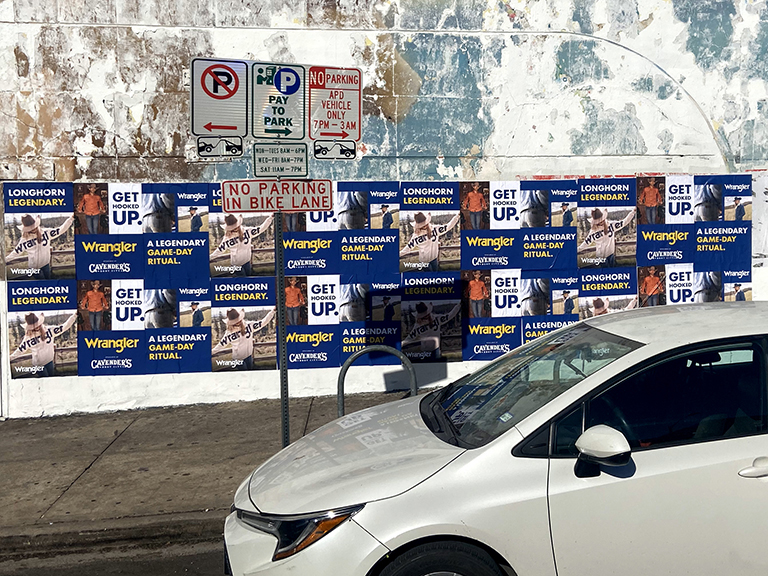
The campaigns people remember from guerrilla marketing are not the ones with the biggest budgets. They are the ones where the creative idea was sharp enough to stop someone in the middle of their routine, surprising enough to make them photograph it, and clever enough that the photograph spread beyond the people who were physically there. That multiplication effect, from physical activation to organic social sharing to earned media coverage, is what separates campaigns that prove the format from campaigns that merely run it.
Street-level marketing works because it reaches people in the actual environments where they live, commute, work, and spend time. Unlike digital advertising, which appears on screens that people have learned to mentally block, guerrilla campaigns exist in the physical world where those learned filters do not apply in the same way. A message stenciled on the sidewalk in front of your morning coffee shop, a poster campaign that appears in the precise neighborhood where your target demographic lives, a brand ambassador who gives you something you actually want while you are waiting for the train, these encounters register differently than a display ad or a promoted post.
Our team at American Guerrilla Marketing has run hundreds of street-level campaigns across 50-plus U.S. markets. This guide draws on that experience to explain what makes guerrilla marketing campaigns work, what the best-performing campaign types look like in practice, and how the planning and execution decisions that most brands underestimate are actually what determine whether the campaign delivers.
What Separates Campaigns That Work From Campaigns That Run
The single clearest distinction between guerrilla campaigns that produce results and campaigns that burn through a budget without producing them is specificity. Campaigns built around a precise understanding of where the target audience is, when they are there, and what context they are in when they encounter the brand consistently outperform campaigns built around vague geographic categories and standard format packages.
Generic is invisible. A poster that could exist anywhere does not tell the audience anything about why the brand belongs in their specific neighborhood. A street team with no clear reason for being there and no compelling offer to make does not earn the right to the audience’s attention. The brands that win with guerrilla campaigns are the ones that committed to specificity at every level of the planning process.
The Importance of Location Intelligence
Guerrilla marketing is fundamentally geographic. The question that drives every decision is not “what do we want to say?” but “where is our audience, and what do we know about how they are moving through that space?” A campaign that answers that question precisely, then builds the format, creative, and timing around the answer, has a structural advantage over every campaign that starts from the format and works backward to a location.
We spend significant time on route analysis before we recommend specific deployments. Which intersections actually concentrate the target demographic? At what times? From which direction are they approaching? What is the sightline to the placement from the angle of highest foot traffic? Those questions have specific answers, and those answers determine whether the campaign reaches the audience or misses them by half a block and a half hour.
Campaign Type: Product Launch Street Saturation
Product launches benefit from street saturation campaigns that create a sense of ubiquity in the launch market. When a brand appears on poster surfaces, on sidewalks, on LED trucks, and through direct street team interaction across a defined geographic zone in a concentrated time window, it creates the impression of momentum and significance that builds social energy around the launch.
How We Execute Launch Saturation
For a new product entering a market, we typically combine poster placements in the highest-footfall corridors of the target neighborhood, sidewalk stencils on approach routes to key retail and dining destinations, and street team activations at transit nodes and high-dwell-time locations. The combination creates multiple touchpoints with the same audience across a short time window, which accelerates brand recognition faster than any single format could achieve alone.
Documentation of the launch campaign, with GPS-tagged photos from every deployment location and timestamped installation records, creates content assets the brand can use in its own digital channels to amplify the street-level presence beyond the physical audience.
Campaign Type: Event-Adjacent Market Presence
Brands that want to associate their identity with a major cultural event without paying official sponsorship fees use guerrilla campaigns to create presence in the event corridor, transit approaches, and surrounding hospitality districts. Done well, this approach can achieve the recall benefits of event association at a fraction of the cost of inside-the-gate sponsorships.
Route Ownership Strategy
The key to event-adjacent campaigns is owning the route, not the venue. The audience flows to and from the event through specific transit nodes and pedestrian corridors that can be mapped in advance. Concentrating campaign resources at those choke points creates more direct audience engagement than diffuse presence across the general neighborhood.
We have run this type of campaign at major music festivals, sporting events, film premieres, and cultural moments across dozens of markets. The pattern holds: the transit node and approach corridor deployments consistently outperform generic neighborhood coverage when measured by direct engagement per crew hour.
Campaign Type: Neighborhood Seeding for Consumer Brands
Consumer brands launching in a new city market, or expanding within an existing market to reach a demographic they have not previously engaged, use neighborhood seeding campaigns to build physical presence before investing in broader awareness channels. The logic is that a brand that has visible physical presence in the specific neighborhood where the target audience lives is perceived as locally relevant in a way that digital-only brands cannot replicate.
Why Neighborhood Fit Matters More Than Neighborhood Prestige
The most common mistake in neighborhood seeding campaigns is selecting the most prestigious neighborhood rather than the most relevant one. A fitness brand entering a new city does not belong in the Financial District because that is the most famous neighborhood. It belongs in the neighborhoods where its target customer base actually concentrates for fitness-related activities, which in most cities means specific residential corridors, proximity to running routes, and gym cluster areas.
We identify those concentrations through audience research rather than intuition. Where does the target demographic live and rent in this city? What are their daily movement patterns? Which neighborhoods do they spend weekends in? Those answers determine where the seeding campaign runs.
Campaign Type: Direct Response Activation With Measurable Conversion
Not all guerrilla campaigns are about awareness. When the campaign objective is a direct response, such as trial, subscription, or store visit, we build conversion mechanisms into the campaign from the start rather than hoping that awareness leads to action on its own.
Building Conversion Into Street-Level Work
Branded QR codes on poster placements link directly to campaign-specific landing pages. Street team interactions include a specific call to action with a clear offer. LED billboard trucks display short URLs or offer codes that create traceable conversion signals. Those mechanisms connect the physical campaign to measurable digital behavior, which produces the downstream data that justifies the investment and informs the next campaign.
We track QR scan rates, URL redemption rates, and offer conversions as standard campaign metrics when direct response is the objective. Those metrics, combined with physical reach documentation, create a complete performance picture that goes beyond impression estimates.
What the Best Campaigns Have in Common
Looking across hundreds of campaigns our team has executed, the ones that produced the strongest results share a consistent set of characteristics. None of them are particularly surprising, but the frequency with which brands skip them in pursuit of a faster or cheaper campaign is striking.
They Started With the Audience, Not the Format
The strongest campaigns were built around a precise understanding of the target audience’s movement patterns and behavioral context before any format decision was made. The format selection was a downstream output of audience analysis, not a starting assumption.
They Had Creative That Worked in the Actual Environment
The creative ideas that performed were designed for the specific environment where they ran: the sightline, the light conditions, the pedestrian speed, the surrounding visual context. Creative concepts that were adapted from other formats or designed in isolation from deployment environment consistently underperformed.
They Were Executed With Operational Discipline
On-time installation, proper placement at the right height and location, crew behavior that represented the brand professionally, and documentation systems that captured the work accurately, all contributed to the measurable difference between strong execution and weak execution. Campaigns that cut corners on operational discipline paid for those shortcuts in performance.
They Were Documented and Measured
The campaigns that produced the most durable returns were the ones where the documentation was treated as seriously as the execution. GPS-tagged photos, route logs, and crew records created the foundation for recap reports that proved the investment and funded the next campaign.
Running Guerrilla Campaigns at Scale
We deploy guerrilla marketing campaigns at national scale for brands that need consistent presence across multiple markets simultaneously. Our central operations in Industry City, Brooklyn coordinate creative standards, production quality, and documentation protocols while local crews execute in each individual market.
That structure is what allows us to run a 20-market campaign with the same quality standard across all 20 markets rather than the patchwork of execution quality that typically results from assembling local vendors market by market. Contact our team at (646) 776-2770 to discuss how a national guerrilla campaign would be structured for your specific objectives.
Frequently Asked Questions
What makes a guerrilla marketing campaign effective?
Effective guerrilla marketing campaigns combine a creative idea that is surprising or contextually clever, precise targeting of the right audience in the right location, production quality that makes the work look intentional rather than cheap, and execution discipline that delivers the campaign as planned. The strongest campaigns also generate earned media coverage that extends the campaign’s reach far beyond the physical audience.
What are the best formats for guerrilla marketing campaigns?
Street teams, poster campaigns, sidewalk stencils, LED billboard trucks, projection advertising, and ambient media installations are all used in guerrilla marketing campaigns. The right format depends on the campaign objective, the target audience, the geographic environment, and the production budget available.
How do guerrilla marketing campaigns generate earned media?
Guerrilla campaigns earn media coverage when the activation is visually distinctive, contextually surprising, or generates genuine public reaction. People photograph memorable street-level moments and share them on social platforms. Local press covers unusual public brand activations. Marketing industry publications feature clever examples. Those secondary audiences can multiply the campaign’s reach many times over.
Are guerrilla marketing campaigns only for large brands with big budgets?
No. Guerrilla marketing originated as a low-budget approach for smaller brands that could not compete in traditional media on equal financial footing. The format remains accessible to brands at many budget levels because creative quality and execution precision matter more than raw spending in determining campaign effectiveness.
How does AGM approach campaign planning for guerrilla marketing?
We start with audience and geography analysis before selecting formats. We identify where the target audience moves, at what times, and in what state of receptivity, then build the campaign around those insights. Creative concepts are evaluated against the specific deployment environment before being recommended. All campaigns include GPS-tracked documentation and proof of performance.
How long does it take to plan and execute a guerrilla marketing campaign?
Standard guerrilla marketing campaigns require 4-8 weeks from brief to launch, depending on format complexity, permitting requirements, and production timelines. Rush timelines are sometimes possible but typically involve compromises in format quality or placement selection. Major event-adjacent campaigns should start planning 8-12 weeks out.