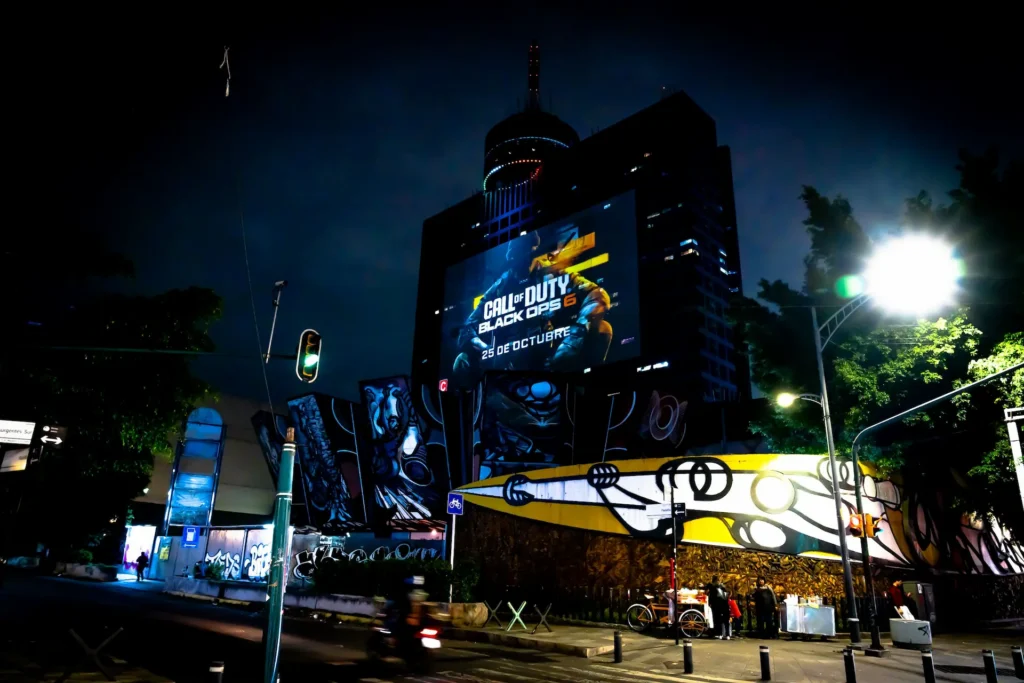
Mexico City does not operate at a human scale. It operates at a civilizational one. Twenty-two million people share a valley floor that was once an Aztec lake, and they move through it at all hours across a street grid that was designed, destroyed, rebuilt, and redesigned across five centuries of layered history. For campaign planners working in guerrilla projection advertising, that scale and that history are not obstacles. They are the point. When your brand image hits the side of a 1920s Art Deco apartment building on Álvaro Obregón or fills the stone face of a colonial arcade in Centro Historico, it is not just occupying space. It is entering a conversation that has been going on for hundreds of years.
At AGM, we have spent years building an operator network across Latin America, and Mexico City is one of the markets we return to most. Every engagement teaches us something new about how this city receives brand communication in public space. This guide is the distillation of that field experience. We will walk you through why CDMX is structurally suited for projection campaigns at a level that most cities in Latin America cannot match, which neighborhoods serve which campaign objectives, what the building stock looks like district by district, how the city’s altitude affects your equipment decisions, and what seasonal rhythms should shape your calendar.
If you are planning a projection campaign anywhere in the Federal District or the broader Metropolitan Zone, this is where you start.
Why Mexico City Is a Projection Market Like No Other
Most major cities have one or two neighborhoods where guerrilla projection advertising makes real sense. The density is right, the architecture creates the right surfaces, the foot traffic is high enough to justify the setup, and the cultural environment makes the audience receptive. Mexico City has eight of those neighborhoods, and they are connected by major arteries that carry enormous pedestrian volume every night of the week.
The city’s physical structure creates natural projection corridors in a way that flat, sprawled cities like Los Angeles or Monterrey simply cannot. The colonias of the central city were built dense and tall relative to street width, which means projections that originate from across an intersection or from the back of a van parked on a side street are hitting surfaces that are architecturally framed. Buildings on either side of a narrow street function like the walls of an outdoor theater. When you project onto one of them, the people walking below are already inside the experience before they consciously register what they’re looking at.
The city also has an unmatched diversity of architectural surfaces within short distances of each other. In a six-block walk through Roma Norte, you pass early 20th-century Porfirian townhouses, mid-century concrete apartment blocks, converted warehouse facades, brutalist residential towers from the 1970s, and contemporary mixed-use buildings with glass and concrete. Each of those surface types interacts with projected light differently, and a skilled projection team can read a block in minutes and identify the three or four surfaces that will deliver the best image quality and audience sight lines.
Urban Density and Foot Traffic
Mexico City’s central colonias generate foot traffic volumes that rival the most commercially dense neighborhoods in any global city. The Paseo de la Reforma corridor handles millions of daily movements. Calle Madero in Centro Historico is a fully pedestrianized street that, on a weekend afternoon, looks less like a street and more like a slow-moving river of people. Even in residential-leaning colonias like Condesa, the combination of parks, restaurant clusters, and nightlife venues means that a Thursday night at 10 PM can deliver audiences of thousands on a single block.
For projection campaigns, foot traffic density is the core variable. A high-quality projection on a poorly trafficked street is a tree falling in the woods. In CDMX, finding high-traffic surfaces is never the problem. Managing which surfaces you prioritize, given the abundance of options, is.
The Architecture of Projection Surfaces
Mexico City’s building stock spans five centuries, which gives campaign planners an extraordinary range of surface types. Colonial-era structures in Centro Historico and Coyoacan have stone and stucco facades that are typically broad, flat, and light-colored, qualities that make them among the best natural projection screens you will find anywhere in the world. A 30,000-lumen projector aimed at the side wall of an 18th-century colonial building can fill an area the size of a movie theater screen with an image that remains fully legible even under ambient streetlight.
Art Deco buildings in Condesa have smooth plaster and concrete surfaces with enough flat area between ornamental details to create high-quality projection windows. The geometric ornamentation on these buildings can also serve as a feature in 3D mapping work, where the projection is designed to play with the building’s physical form rather than treat it as a blank screen.
Warehouse conversions and brutalist concrete buildings in Roma Norte and Doctores offer the largest uninterrupted flat surfaces in the city. A blank concrete wall on the back of a converted warehouse on Calle Sonora or near the Viaducto can span 20 meters wide and 15 meters tall. At that size, a single projection becomes a landmark-scale event.
Mexico City’s central urban area covers approximately 1,485 square kilometers with a population density of over 5,900 people per square kilometer in the colonias that matter most for projection campaigns — making it one of the densest urban environments in the Western Hemisphere.
The Key Neighborhoods: A Zone-by-Zone Overview
Each major district in Mexico City has its own projection strategy. The architecture, the audience, the traffic patterns, and the brand environment all differ in ways that matter for campaign planning. Here is how we read each zone.
Roma Norte
Roma Norte is Mexico City’s creative epicenter. The colonia is bounded by Avenida Chapultepec to the north, Insurgentes to the west, and runs south through a dense grid of streets including Álvaro Obregón, Orizaba, Sonora, Colima, and Durango. The building stock is a dense mix of Porfirian-era townhouses, converted warehouses, mid-century concrete apartment buildings, and newer mixed-use structures.
The audience in Roma Norte skews young, internationally connected, and culturally curious. Artists, chefs, musicians, tech workers, architects, and an enormous population of international residents from Europe, North America, and South America all share this colonia. They are exactly the kind of audience that does not just notice a projection campaign. They film it, share it, and assign meaning to it. Thursday through Saturday nights are peak windows, with foot traffic on Álvaro Obregón and Orizaba running dense from 8 PM well past midnight.
Condesa
Adjacent to Roma Norte and sharing some demographic overlap, Condesa is the Art Deco district of Mexico City. It is centered on two elliptical parks — Parque Mexico and Parque España — with the circular Avenida Amsterdam running around Parque Mexico like a moat. The buildings around both parks are concentrated examples of 1930s and 1940s Art Deco residential architecture, with smooth stucco and concrete facades, horizontal banding, and ornamental detailing that plays beautifully with projection light.
Condesa’s residential character means the rhythm of the colonia is different from Roma Norte. It is quieter on weeknights, hits its stride Thursday through Saturday, and runs heavily on a restaurant-and-café economy. The audience skews slightly older and more affluent than Roma Norte, typically in the 28-45 range, with strong representation from Mexico City’s professional and business class alongside a large foreign-national residential population.
Polanco
Polanco is Mexico City’s luxury district. Avenida Presidente Masaryk, the tree-lined main commercial artery, draws comparisons to Rodeo Drive in Beverly Hills and Via Montenapoleone in Milan. The building stock here is taller and more varied than in Condesa or Roma Norte, with a mix of luxury residential towers, international hotel flags, and upscale retail buildings lining wide, well-lit streets.
For projection campaigns, Polanco offers wider street geometry and taller buildings, which changes the projection geometry significantly. You are working with distances of 30-50 meters from projector to surface in many cases, which requires higher-lumen equipment but also allows for larger image scales. The audience is Mexico’s highest-net-worth demographic. This is where you run campaigns for luxury automotive, premium spirits, international fashion houses, private banking, and ultra-premium hospitality.
Centro Historico
The historic center is in a category of its own. The Zocalo, officially called the Plaza de la Constitucion, is one of the largest public plazas in the world, surrounded on three sides by buildings of extraordinary historical and architectural significance: the Catedral Metropolitana to the north, the Palacio Nacional to the east, and Portales de Mercaderes to the west. These buildings have some of the largest flat architectural facades in the entire city.
The scale of Centro Historico projection work is fundamentally different from the colonias. You are not projecting onto apartment buildings or warehouse walls. You are projecting onto structures that are 100 to 200 meters wide and 20 to 40 meters tall, with facades that function as natural IMAX screens. The Mexican government has used these same surfaces for major public light shows, most recently for the Tenochtitlan 700th anniversary celebrations in 2025, where nightly projections on the National Palace facade ran for weeks.
Coyoacan
Coyoacan, in the south of the city, carries a very different energy from the northern colonias. It is the city’s bohemian heart, home to the Frida Kahlo Museum, the Leon Trotsky Museum, and a dense cluster of plazas and colonial streets centered around the Jardín Centenario and Plaza Hidalgo. The architecture is colonial-era and early Republican, with low-rise buildings and cobblestone streets that create an intimate scale unlike anywhere else in the Federal District.
Projection campaigns in Coyoacan tend to be more intimate in scale and more art-forward in their positioning. The audience here is strongly local, culturally engaged, and highly literate in visual art. Brands in the arts, culture, music, and food and beverage categories tend to perform best in this environment.
Zona Rosa and Reforma
Zona Rosa, the international commercial district adjacent to Reforma, handles some of the highest pure pedestrian volume in the city. The Paseo de la Reforma itself is one of the great urban boulevards of the Western Hemisphere, a 14-kilometer diagonal cutting through the city from the Zocalo to Santa Fe, lined with major corporate towers, international hotels, and cultural institutions including the Museo Nacional de Antropología and the Monument to the Revolution.
Reforma campaigns can reach massive audience volumes but require more logistics investment due to the boulevard’s scale. The Angel de la Independencia roundabout and the Diana Cazadora fountain area are two of the most heavily photographed public spaces in Mexico, making them powerful locations for campaigns with earned media objectives.
The Paseo de la Reforma handles an estimated 500,000 daily person-trips in its central segment between Chapultepec Park and the Zocalo, with a significant share of that volume occurring during evening and nighttime hours when projection advertising is most effective.
How Mexico City’s Altitude Affects Projection Technology
At 7,350 feet above sea level, Mexico City sits higher than Denver, Colorado. That altitude has real and measurable effects on projection equipment performance, atmospheric light behavior, and what you can expect from a given lumens-to-surface-area calculation.
Air Clarity and Light Travel
The most significant advantage of high altitude for projection work is air clarity. At 7,350 feet, the atmosphere is approximately 22% thinner than at sea level. There is less water vapor, less particulate matter, and less overall atmospheric haze in the air column between your projector and your surface. This translates directly into sharper images, better color saturation, and longer effective throw distances.
In coastal cities like Veracruz or even Los Angeles, humid sea air scatters projector light and reduces the effective contrast of projected images at distances over 30 meters. In Mexico City, those same 30-meter projections arrive at the surface with noticeably less degradation. For large-format work on Centro Historico facades, this matters enormously. We have run projections across the full width of the Zocalo, 240 meters, with image quality that would simply not be achievable at sea level.
Equipment Cooling Considerations
The same thin air that improves light travel also affects how projectors cool themselves. Most professional projectors use air-cooled designs that rely on moving ambient air through the lamp or laser module. At altitude, the thinner air provides less cooling capacity per cubic foot of airflow, which means high-output projectors can run warmer at altitude than they do at sea level.
Modern laser projectors in the 20,000-lumen and above class handle altitude better than older xenon lamp projectors because laser light sources generate less heat overall. For extended Mexico City deployments of three or more hours, we use only laser projectors and schedule brief cooling breaks between content loops when running in warmer months.
Seasonal Light and Dark Conditions
Mexico City sits at approximately 19 degrees north latitude, which means it is closer to the equator than most major US or European cities. The practical effect is that sunset times are more consistent year-round than at higher latitudes, varying from around 6:00 PM in December to around 8:00 PM in July. This consistency makes projection scheduling more predictable throughout the year than it would be in, say, New York or London.
Mexico City’s latitude of 19.4°N means sunset never varies by more than two hours across the entire calendar year, giving projection campaign planners a reliable deployment window that does not shift dramatically by season.
Seasonal Strategy: When to Plan Your Mexico City Campaign
Mexico City has a well-defined dry season and wet season, and that cycle has direct implications for outdoor projection planning.
The Dry Season: November Through May
The dry season in CDMX runs from roughly November through late May, with the most reliably clear nights between December and early April. During this period, you can plan outdoor projection campaigns with high confidence that weather will not interrupt your deployment window. Humidity is low, nights are often brilliantly clear, and the atmospheric conditions for projection are at their best.
November is a particularly strong month for campaign investment because of Dia de Muertos. The week surrounding November 1-2 brings some of the largest public gatherings in the city’s annual calendar. Major brands have used projection advertising during this period to embed their messaging within one of Mexico’s most culturally resonant moments. The visual vocabulary of ofrenda colors, marigold yellows, and skull iconography translates readily into projection content for brands with appropriate cultural credibility.
Festival Season: March Through May
The spring festival season brings major live music, theater, and arts programming that drives large audiences into the colonias and Centro Historico on nights that might otherwise be midweek lulls. The Festival de Mexico and affiliated programming have historically concentrated events in Centro Historico and the Reforma corridor, with outdoor stages and performances in the Zocalo drawing tens of thousands of people on programming nights.
Brands in the music, entertainment, beer, spirits, and fashion categories see strong engagement during the festival season because they are reaching audiences who are already in a heightened, socially activated state. A projection campaign that lands during a major festival weekend in Centro Historico or Roma Norte benefits from an audience that is primed for discovery and surprise.
Rainy Season: June Through October
The rainy season in Mexico City is not what most people picture when they think of tropical wet weather. Rain in CDMX typically arrives in the afternoon or early evening, with showers concentrated between 4 PM and 8 PM during peak rainy months of June, July, and August. By 9 PM, skies are often fully clear and nights remain warm. The practical implication is that projection campaigns starting at 9 PM or later can execute successfully even during the rainy season if the deployment window is planned around the afternoon shower pattern.
September and October are transitional months where the rain pattern begins to shift later and lighter. October is typically manageable for outdoor projection with good weather monitoring and a flexible deployment start time. Our operators always carry waterproof covers for equipment and build contingency windows into campaigns executed during the June-October period.
| Month |
Weather Conditions |
Campaign Notes |
| November–February |
Dry, clear, cool nights |
Peak conditions; Dia de Muertos activation window in November |
| March–May |
Dry, warming, some early showers |
Festival season; high cultural programming activity |
| June–August |
Afternoon rains, clear evenings possible |
Viable with late-start deployment (9 PM+); equipment protection required |
| September–October |
Transitional, improving through October |
Flex scheduling recommended; October Dia de Muertos prep window |
Audience Profiles by Zone
Understanding who is walking the street at the moment of projection is as important as understanding the building surface you are projecting onto. Mexico City’s major colonias serve meaningfully different demographic populations, and campaign content that resonates in one zone can land flat in another.
Roma Norte and Condesa: The Creative Class
The combined Roma-Condesa market is Mexico City’s densest concentration of creative-class consumers. This includes designers, architects, filmmakers, musicians, chefs, journalists, writers, gallery owners, and the enormous international expatriate community that has chosen these colonias as a base. This audience has high cultural literacy, high visual sophistication, and strong brand awareness. They are not naive consumers. They will notice if a campaign is genuinely clever and they will dismiss one that is not.
For brands, this means creative execution matters more in Roma Norte and Condesa than raw scale. A tight, well-executed 90-second projection loop on a single building on Calle Orizaba, if it lands with the right creative energy, will generate far more organic content sharing and word-of-mouth than a technically impressive but creatively hollow campaign in a higher-traffic zone.
Polanco: High-Net-Worth and Corporate
Polanco’s audience is Mexico’s highest-income residential population combined with corporate executives, international business travelers, and the luxury shopping and dining visitor traffic that Masaryk generates on weekends. This audience responds to projection campaigns that reflect quality, exclusivity, and sophisticated production values. Rough or deliberately lo-fi aesthetics that work well in Roma Norte can read as off-brand in Polanco. Production quality signals are read closely in this zone.
Centro Historico: High Volume, Mixed Profile
Centro Historico draws Mexico City’s most diverse audiences. On a weekday, the streets around Madero and the Zocalo are dominated by office workers, government employees, and commercial traffic from the many markets and retail corridors of the historic center. On evenings and weekends, the demographic shifts toward tourists, both domestic and international, cultural visitors, families from the wider Metropolitan Zone, and a younger nightlife crowd gravitating toward the bar and mezcaleria scene along the northern streets of the Corredor Cultural.
The enormous volume and diversity of the Centro audience means that projection campaigns here operate more like broadcast media than targeted activations. You are reaching everyone, not a specific tribe. This favors brands with wide awareness objectives, major entertainment releases, governmental or civic campaigns, and large consumer brands at the national or international scale.
During major events like Dia de Muertos, the Zocalo and its surrounding streets can draw over 200,000 people in a single evening, making Centro Historico the highest single-location projection audience opportunity in Latin America.
What Makes CDMX Different from Other Latin American Projection Markets
We run projection campaigns across Latin America. Bogota, Buenos Aires, São Paulo, Lima, Santiago. Each city has its own advantages and constraints. Mexico City sits at the top of the regional market for projection advertising for several specific reasons that are worth spelling out for brands deciding where to allocate their Latin American out-of-home budget.
Architectural Diversity at Scale
No other Latin American capital combines the architectural diversity of Mexico City’s surface types with the sheer quantity of available surfaces. Buenos Aires has extraordinary European-style facades in Palermo and Recoleta, but the city’s zoning has limited building heights in ways that cap projection scale. São Paulo has scale and density but the brutalism that dominates the city’s architecture creates surfaces that are more uniform and less visually interesting as projection canvases. Bogota’s historic La Candelaria is beautiful but geographically constrained.
Mexico City offers colonial stone, Art Deco plaster, modernist concrete, mid-century glass, and contemporary mixed-use building all within the same kilometer in the central colonias. That range means a multi-site campaign can run in genuinely different visual environments within a single city without ever leaving the densest central districts.
Cultural Receptivity
Mexico City has one of the most sophisticated street-art and public visual culture traditions of any city in the Americas. Muralism, born here with Diego Rivera, David Alfaro Siqueiros, and José Clemente Orozco, established a cultural norm in which large-scale public imagery is not incidental to the city’s life but central to it. That tradition continues through the contemporary murals that cover hundreds of facades in Roma Norte, Doctores, and Tepito, through the Noche de Museos programming that brings projection art into the streets monthly, and through the Zocalo’s long history of hosting major public spectacles and visual events.
An audience raised on this visual culture is not just tolerant of projection advertising. They are actively primed to engage with it. They pause. They look. They photograph. They share. The earned media multiplier on a well-executed Mexico City projection campaign is consistently higher than what we see in markets with less visual culture history.
The Operator Network
Mexico City has a mature and capable production infrastructure for projection campaigns. Camera operators, projection technicians, location scouts, security coordinators, and content production teams all exist here at a quality level that matches what you would find in New York or Los Angeles. That depth of local talent means that AGM can execute campaigns in CDMX with the same production discipline we bring to any major US market, rather than improvising around capability gaps.
Building Types and Surface Characteristics
Every experienced projection team develops an intuitive sense for reading buildings. It is part observation, part physics, and part accumulated field experience with what the camera captures versus what the human eye sees live. Here is how we assess the major surface types in CDMX.
Colonial Stone and Stucco Facades
The colonial-era buildings of Centro Historico and Coyoacan are among the best natural projection surfaces you will find anywhere. Their facades are typically wide, minimally ornamented above the ground floor, and finished in light-colored stucco or dressed stone that reflects light efficiently. The textural warmth of these surfaces actually benefits projection by adding depth to the image. Colors read richly and shadows register with a visual complexity that glass or smooth concrete cannot match.
The primary challenge with colonial facades is geometry. Many are not perfectly flat. Settlement over centuries has introduced slight bowing and warping into surfaces that look flat from street level but reveal their imperfections when you project a hard-edged graphic. Experienced projection teams pre-map these surfaces with test projections to adjust for geometry before the final content plays.
Art Deco Plaster and Concrete Buildings
The Art Deco buildings of Condesa, built between approximately 1920 and 1950, offer flat plaster and poured-concrete surfaces that are nearly ideal for projection. The smooth finish reflects cleanly, the lighter colors that dominate 1930s and 1940s exterior aesthetics maximize brightness, and the buildings are typically 4-10 stories tall, giving good vertical scale for a medium-throw projector.
The ornamental detailing on Art Deco facades, the stepped cornices, horizontal fins, geometric reliefs, can be used as features in 3D mapping work where the content design incorporates the building’s physical form. When done well, this creates a stunning effect where the projected content appears to physically emerge from or interact with the building’s architecture.
Industrial and Warehouse Walls
The former industrial buildings of Roma Norte, particularly in the blocks south of the Eje 1 Norte and throughout the Doctores colonia, offer the city’s largest uninterrupted flat surfaces. Painted or unpainted concrete block and poured concrete walls on warehouse conversions can run 15-20 meters wide and 10-15 meters tall. These walls function as blank screens in the purest sense, with no architectural ornamentation to work around or incorporate.
Industrial surfaces are best for content that benefits from maximum scale and maximum brightness. Brand imagery, typographic campaigns, and large-format product presentations all translate well onto warehouse walls. The surface texture, slightly rough concrete versus painted stucco, affects the apparent resolution of the projected image, with smoother surfaces delivering crisper results at any given projector output level.
Contemporary Glass and Steel Buildings
Modern glass curtain wall buildings present both challenges and opportunities. Glass surfaces are highly reflective and produce a distinctive double-image effect as the projection bounces off the glass before reaching the opaque backing. This effect can be aesthetically interesting at night, creating a ghost-image quality that some creative treatments use deliberately. But for campaigns where brand clarity and legibility are the priority, glass surfaces typically require higher projector output to overcome the reflectance losses.
The best contemporary surfaces in Mexico City are those where glass curtain walls alternate with opaque concrete or metal panel sections. The Torres Reforma, the Punto Polanco development, and the corporate towers along Insurgentes all have hybrid facade compositions that offer workable projection surfaces between and around their glass sections.
Logistics: Operating a Campaign in CDMX
Mexico City’s street life runs late. Projectors in the back of a van parked on a side street are not unusual sights in the colonias at 11 PM. The culture of outdoor events, markets, and late-night commercial activity means that production activity on the street does not draw the kind of immediate attention it might in a quieter city. That is a practical advantage for projection campaigns that need to set up quietly and operate without disrupting street flow.
Vehicle-Based Operations
Most projection campaigns in Mexico City’s colonias operate from the back of a Sprinter-type cargo van or a flatbed truck with a generator. The van setup allows the team to move between locations, test surfaces from a parked position, and demobilize quickly if conditions change. For larger-format work in Centro Historico or Polanco, we often use a larger flatbed with a hydraulic crane lift that allows the projector to be raised above street furniture and parked vehicles for a cleaner throw angle.
Scouting and Pre-Production
Every Mexico City projection campaign in our network begins with a dedicated scouting session that covers both the daytime visual environment (to assess surface condition and geometry) and a nighttime walk to assess ambient light levels, competing light sources, and sight lines. The ambient light environment in Polanco, for example, is significantly brighter than in Coyoacan, and a projector output that produces a vivid image in one colonia may look washed out in another.
Pre-production scouting for a single-night activation typically takes two days of field work. Multi-night or multi-site campaigns involve longer pre-production windows to ensure that every selected surface performs as expected on the night of deployment.
Frequently Asked Questions
What makes Mexico City ideal for guerrilla projection advertising?
Mexico City combines dense urban canyons, dramatic colonial and modernist architecture, massive nighttime foot traffic in multiple districts, and a culturally sophisticated audience that responds strongly to visual experimentation. The city’s high altitude produces unusually clear air that benefits projection quality, and the cultural history of large-scale public visual art — from the muralism movement forward — means that audiences here are actively receptive to projection as a medium rather than simply noticing it.
Which neighborhoods in Mexico City are best for guerrilla projection campaigns?
The top neighborhoods vary by campaign objective. Roma Norte and Condesa deliver the best combination of creative-class audience and architectural surface quality for brand activation campaigns. Polanco is the right zone for luxury and premium-tier brands reaching high-net-worth consumers. Centro Historico delivers the largest raw audience volumes and the most dramatic architectural surfaces for major brand awareness or cultural events. Coyoacan works well for campaigns with a strong arts or local culture positioning.
How does Mexico City’s altitude affect projector performance?
At 7,350 feet above sea level, the thinner atmosphere reduces atmospheric haze and light scatter, which means projected images travel farther and arrive at the surface with better sharpness and color saturation than at sea level. On the equipment side, the thinner air provides less cooling capacity, so high-output projectors require closer monitoring during extended deployments. We use laser projectors for all Mexico City campaigns because they manage heat more efficiently than older xenon lamp systems.
What time of year is best for projection campaigns in Mexico City?
The dry season from November through May offers the most reliable outdoor conditions. November specifically combines excellent weather with the Dia de Muertos foot traffic surge, making it the highest-value single month in the CDMX projection calendar. The spring festival season in March and April brings heightened cultural activity and large outdoor audiences. The rainy season from June through September is workable for campaigns that deploy after 9 PM, when the typical afternoon showers have cleared.
What building surface types work best for guerrilla projections in Mexico City?
Colonial-era stone and stucco facades in Centro Historico and Coyoacan are among the best natural projection surfaces in the world due to their scale, flat geometry, and light-reflective finish. Art Deco plaster buildings in Condesa offer smooth, well-proportioned surfaces that are ideal for medium-scale brand campaigns. Industrial warehouse walls in Roma Norte and Doctores provide the largest uninterrupted flat surfaces for maximum-scale work. Each surface type requires different projector placement and output levels, which is why surface scouting is a non-negotiable part of every campaign we execute in CDMX.