July 6, 2026
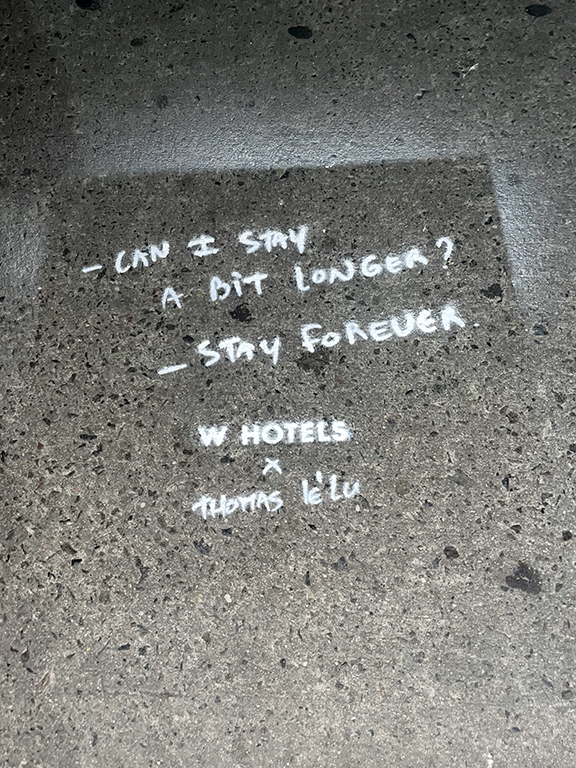
A stencil cut from your artwork. Chalk-based paint sprayed through it onto the sidewalk. Thousands of impressions per location before the next rain washes it away. That is chalk stencil advertising in its simplest form, and it is one of the most targeted, cost-effective formats in outdoor marketing.
Chalk stencils put your brand at foot level in exactly the spots where your audience is already slowing down: transit entrances, event venue doors, retail corridors, campus pathways, and busy crosswalks. Unlike a billboard, they do not ask people to look up. They are already there when people look down. The format is temporary by design, which is precisely what makes it practical for brands, event sponsors, and campaigns that need to move fast across multiple markets.
This guide covers everything you need to run a chalk stencil campaign: what the medium actually is, how it differs from paint stencils and hand-drawn chalk, how to design for it, where it performs best, what it costs, and how it plays out city by city across New York, Los Angeles, Chicago, and Miami.
Chalk stencil advertising works like this: a stencil is cut from your approved artwork, usually from durable mylar or a similar film material. A field team then places the stencil flat on the sidewalk surface and applies chalk-based spray paint through the open cutout. The result is a crisp, flat graphic impression at ground level that reproduces your brand mark, message, or design exactly as intended.
The paint used in professional chalk stencil campaigns is water-soluble chalk-based spray, not crayons, not chalk sticks, and not latex house paint. It goes on looking like paint and reads from a distance the same way paint does. The difference is chemistry: chalk formulations are water-soluble and do not bond permanently to concrete or asphalt. When rain falls or a cleaning crew washes the pavement, the material dissolves and runs off without leaving a lasting mark.
This distinguishes chalk stencil advertising from three closely related formats:
Chalk stencils sit in a specific and useful position: they look finished and professional, they reproduce your brand accurately at scale, and they disappear on their own without cleanup crews or permit-required removal processes.
The obvious answer is legality, but that only tells part of the story. Here is the fuller picture of why chalk stencils get chosen over permanent paint for certain campaigns.
Permanent paint on public sidewalks requires a permit in virtually every major U.S. city, and those permits are difficult to get for commercial advertising purposes. Chalk-based media occupy a different legal category in many municipalities because they do not constitute a permanent alteration to the surface. The water-solubility is key: a city like Los Angeles treats temporary chalk markings differently than it treats spray paint. The practical result is that chalk stencil campaigns can reach public sidewalks, plazas, and transit-adjacent areas where paint would require permits that either do not exist or take months to secure.
Chalk stencils are the format of choice for event marketing because the timeline matches. You want impressions before and during the event, and you want the surface clean after. A chalk stencil deployed 48 hours before a product launch or concert will still look sharp during the activation window, and rain or a post-event wash will clear it without remediation costs. Paint campaigns around events require cleanup agreements with venue operators, which adds cost and complexity.
Some of the best sidewalk real estate sits in front of venues, retail stores, and properties with multiple tenants. Property managers who would never approve paint often say yes to chalk-based media because the request is low-risk. The finish date is built into the material itself. This opens up location inventory that is simply unavailable to permanent format campaigns.
A campaign targeting five cities with 50 locations per city can be planned, permitted, and executed faster with chalk than with paint. The footprint is cleanable, the liability is lower, and the operators handling execution can work across a wider range of surface types and property relationships.
Some brands want the chalk aesthetic specifically: it reads as street-level and approachable, not corporate. For product launches, album drops, app activations, and pop-up retail, the texture of chalk-on-concrete telegraphs “you discovered this” rather than “you were served this.” That distinction matters to audiences that actively reject traditional advertising formats.
The same design rules that apply to paint stencil work apply to chalk, but with one important addition: chalk fades faster than paint, which means the design needs to be bolder from the start to hold up across its full lifespan.
Concrete and asphalt are mid-gray to dark gray. White or light-colored chalk applications are your highest-contrast option. If your brand uses dark colors, use them as background fills and add a white or yellow primary message layer. A chalk impression that blends into its surface on day one will be invisible by day three.
Chalk stencils are viewed at a glance, usually by someone walking at 3 miles per hour. The design needs to read in under two seconds. If it requires more than three seconds to understand, it will not perform. Focus on a single visual element: wordmark, product name, event name, or one clear graphic. Add a very short callout (URL, date, or hashtag) only if it fits cleanly at a secondary size.
Paint stencils work fine at 18 inches. Chalk stencils should run at 24 to 36 inches minimum for most applications, and 36 to 48 inches for high-traffic locations where the surface wears faster. Larger applications start with more material on the surface, which means they hold their appearance longer before reaching the point where they look faded out.
Stencil design requires bridges: the thin connections that hold the stencil’s negative space together. Letters like “O,” “A,” “D,” and “P” need bridges to keep the internal cutout from falling out of the stencil sheet. In chalk stencil design, bridges should be at least 3mm wide to hold up under spray application pressure. Thin bridges on chalk stencils break faster than they do on paint stencils because chalk spray is applied in quick passes rather than slow, controlled coats.
Minimum stroke weight for legible chalk stencil work is 4mm at 24-inch output size. At smaller output sizes, increase stroke weight proportionally. Tight letterspacing will fill in as overspray closes the gaps between characters. Open letterforms and generous tracking hold better.
Submitting artwork in the right format saves rounds of revision and keeps your production timeline clean. Here are the specs AGM works with for chalk stencil campaigns:
| Spec | Requirement |
|---|---|
| File format | Vector: AI, EPS, or SVG. PDF accepted if vector paths are preserved. Raster files (JPG, PNG) are not accepted for stencil cutting. |
| Color mode | Spot color (Pantone) or CMYK. RGB is converted during proofing. Chalk spray is available in a standard range; Pantone matches are confirmed at proofing stage. |
| Minimum stroke weight | 4mm at intended output size. Scale artwork to output dimensions before checking. |
| Bridge width | 3mm minimum for enclosed counters (e.g., interiors of O, D, A, P, B, R). Wider is better for chalk application. |
| Output sizes | 24″ x 24″ standard. 36″ x 36″ recommended for high-foot-traffic locations. Custom sizes available up to 48″ x 48″ for single stencil; larger footprints use tiled stencil sets. |
| Color layers | Each color is a separate stencil pass. Single-color applications are most efficient. Two-color applications are achievable but add production time. Three-color is available for large-format anchor placements. |
| Bleed/safety margin | Keep critical elements 1″ from edge of stencil frame to account for registration variation on uneven surfaces. |
If you are working from a brand standards file, submit the primary lockup (wordmark only, no background) in the largest vector format you have. AGM’s production team will adapt it for stencil output, including adding bridges where needed and checking stroke weights at output scale.
Chalk spray is available in white, yellow, red, blue, green, black, orange, and pink as standard options. Custom Pantone matching is available for an upcharge and requires a 5-business-day sample approval window before production runs. For most campaigns, white on dark concrete is the highest-visibility combination and requires no custom color work.
Not every sidewalk is created equal. These are the surface types and location categories where chalk stencil advertising consistently delivers the most impressions and the longest useful lifespan.
The approach corridors to concert venues, arenas, stadiums, and convention centers funnel foot traffic through a predictable path. Everyone walking to the event crosses the same 200-foot stretch. A chalk stencil placed 30 to 60 feet before the entrance gets seen by nearly 100% of attendees. This is one of the highest CPM (cost per thousand impressions) values of any outdoor format.
Shopping streets with high pedestrian density, such as Melrose in Los Angeles, Wicker Park in Chicago, the South Beach retail strip in Miami, and the Meatpacking District in New York, produce consistent daily traffic across a campaign’s full lifespan. Foot traffic in these areas is measurable (many have publicly available pedestrian count data), which allows for precise impression estimates when planning spend.
The zone within 20 feet of a subway entrance, bus stop, or commuter train exit is some of the most viewed pavement in any city. People approach slowly, look down to navigate stairs or level changes, and stop to check their phones. Dwell time in these zones is higher than open-sidewalk locations. Chalk stencils placed here are seen by the same commuters repeatedly across multiple days.
Campus walkways and plaza areas are ideal for chalk stencil work because the audience is concentrated, foot traffic patterns are predictable, and campus facilities teams generally manage their own permissions for chalk-based media. Many campuses actively distinguish between chalk (allowed in designated areas) and paint (prohibited). Apps, streaming services, and CPG brands targeting the 18-to-24 demographic run chalk stencil campaigns on campuses specifically because the format matches the environment.
Horizontal concrete is the best surface for chalk stencil work. It is flat, porous enough to hold chalk well, and common in every deployment market. Asphalt holds chalk but absorbs some spray, which slightly reduces definition. Brick pavers work but require more spray passes to fill gaps. Avoid polished stone, marble, or smooth tile surfaces: chalk does not bond well, application quality drops, and lifespan is significantly reduced.
Chalk stencil campaigns are priced per location, with economies of scale built in at higher quantities. Here is how cost structures typically work for professional campaign execution through AGM:
| Campaign Scale | Typical Location Count | What’s Included |
|---|---|---|
| Single market, targeted activation | 25 to 75 locations | Stencil production, street team deployment, location mapping, photo documentation |
| Multi-neighborhood blitz | 75 to 200 locations | Above, plus multi-day deployment windows, neighborhood-specific targeting |
| Multi-market national campaign | 200+ locations across 3+ cities | Above, plus city-by-city targeting strategy, coordinated deployment timing, consolidated reporting |
Chalk stencil campaigns are priced based on market, location count, and any custom color or oversized format requirements. To get a specific quote for your campaign, contact AGM directly or call (646) 776-2770.
Compared to paint stencil campaigns, chalk campaigns typically carry lower per-location costs in markets where chalk does not require a permit. The savings come from reduced permitting complexity and the fact that post-campaign cleanup is not a billable line item since the medium handles its own exit. Where permits are required for chalk (see the city-by-city section below), costs adjust accordingly.
The sidewalk stencils service page covers the full range of stencil formats AGM runs, including paint-based options for campaigns that need longer lifespan or a different surface profile.
AGM runs chalk stencil campaigns in New York, Los Angeles, Chicago, Miami, and markets across the U.S. Get a quote for your campaign, ask about current availability, or just start a conversation about what the format can do for your brand.
The honest answer: it depends on weather, surface, and foot traffic. But here are the practical ranges you can plan around.
| Condition | Expected Lifespan |
|---|---|
| Dry weather, low foot traffic (residential, campus) | 10 to 14 days |
| Dry weather, moderate foot traffic (retail corridor) | 5 to 10 days |
| Dry weather, heavy foot traffic (transit entrance, event approach) | 3 to 5 days |
| Rain within 24 hours of deployment | 1 to 3 days; may require re-application |
| Re-applied on same surface after rain | Restarts full lifespan cycle |
The specific chalk formulation matters. Professional chalk spray products used in advertising applications are engineered to last longer than standard chalk crayons, but they are still water-soluble. A light drizzle will dull the surface. A hard rain will wash the application down significantly. Summer heat in a city like Miami accelerates surface drying, which can actually extend lifespan by reducing the moisture that would otherwise break down the chalk bond.
For campaigns tied to a specific event or launch date, plan deployment 48 to 72 hours before activation and budget for a re-application if there is a rain event in the forecast window. AGM’s production teams can schedule touch-up runs in most markets.
For campaigns without a hard end date, the natural fade of chalk stencils works in your favor: the impression degrades gradually rather than disappearing all at once, which keeps it readable for longer than the numbers above suggest. A 10-day-old chalk stencil in dry conditions is still readable; it just looks more weathered than it did on day one.
Chalk stencil campaigns run differently depending on the market. Here is what you need to know about the four most common targets.
New York is both the highest-value and the most regulated market for chalk stencil work. NYC Administrative Code Section 10-117 prohibits making marks of any kind on public property without permission. In practice, chalk-based media that is clearly water-soluble and temporary is treated differently than paint by enforcement, but the legal framework does not carve out an exception the way some other cities do. The most practical path is working through property owners for private sidewalk and plaza access, which is abundant in commercial corridors like SoHo, the Meatpacking District, Midtown around Madison Square Garden, and Brooklyn neighborhoods like Williamsburg and DUMBO. Private property chalk campaigns in New York are fully compliant and offer some of the best pedestrian density in the country.
Surfaces: NYC concrete is generally excellent for chalk work. Subway entrance approaches are high-value but require transit authority contact for above-ground surfaces. The typical 24″ x 24″ stencil runs 3 to 7 days in standard Manhattan foot traffic conditions.
Los Angeles is more permissive than New York for public sidewalk chalk in many neighborhoods. The city’s treatment of water-soluble chalk as distinct from graffiti makes it possible to run campaigns on public sidewalks in many commercial districts without a formal commercial permit. Areas like Melrose, Silver Lake, Venice, and Downtown LA near Staples Center (now Crypto.com Arena) are common chalk stencil targets. Surface conditions in Los Angeles favor longer lifespan: the dry climate means less rain-related degradation, and many LA sidewalks get cleaned less frequently than NYC sidewalks, which adds a few days of useful life.
Note that LA’s municipal regulations differ from city to city in the metro area: West Hollywood, Santa Monica, and Culver City each have their own rules. Always confirm local ordinances before deployment.
Chicago offers strong chalk stencil opportunities in Wicker Park, Wrigleyville, the Loop, and River North. The city does not have a blanket prohibition on water-soluble chalk for commercial use in the way that NYC’s code is written, though property owner access is still the most defensible approach for larger campaigns. Weather is the primary operational factor: Chicago’s spring and fall seasons are ideal for chalk campaigns (moderate temperatures, drier stretches), while winter deployments are difficult due to snow and cold affecting chalk adhesion, and summer can bring sudden heavy rain that cuts campaign lifespan short. Plan around the window between April and June or September and October for best results.
Miami is one of the best chalk stencil markets in the country for event-driven campaigns. The combination of year-round outdoor activity, a dense events calendar (Art Basel, Ultra Music Festival, Formula 1 at the Miami Grand Prix), and a pedestrian culture in areas like Wynwood, Brickell, and South Beach creates natural inventory for chalk campaigns. The primary challenge is Miami’s rain pattern: afternoon thunderstorms from June through September can cut chalk lifespan to 24 to 48 hours. Plan deployments for morning installation and early-week timing to avoid weekend rain risk. Wynwood in particular is a strong market because the neighborhood’s street art culture means branded chalk stencils are contextually expected rather than intrusive.
The choice between chalk and paint is not a matter of which is better. It is a matter of which fits your campaign requirements. Here is a framework for making the call:
| Factor | Choose Chalk | Choose Paint |
|---|---|---|
| Campaign duration needed | Days to 2 weeks | 2 weeks to 6 months+ |
| Surface access | Public sidewalks, event approaches, private property with chalk approval | Private property with paint approval, owned surfaces |
| Permit requirements | Generally lower; many markets allow chalk on public surfaces | Always required for public surfaces; typically requires property owner sign-off |
| Campaign type | Product launches, events, pop-ups, album drops, app activations | Evergreen brand presence, retail permanent location, long-run campaigns |
| Post-campaign cleanup | None required (fades naturally) | May require removal at campaign end |
| Weather sensitivity | High; rain affects lifespan | Low; paint bonds to surface |
| Visual quality | Excellent on day 1; degrades gracefully | Excellent throughout lifespan; can look worn over months |
| Cost per location | Generally lower where no permit required | Generally higher due to material cost and cleanup potential |
For a campaign anchored to an event or specific launch window, chalk is almost always the right call. For a campaign meant to build sustained presence over a full quarter or longer, paint gives you the staying power chalk cannot. Many AGM clients run both within the same campaign: chalk for the pre-launch buzz phase, paint for permanent placement in key anchor locations. The sidewalk stencil design guide covers design considerations for both formats in more detail.
Chalk stencils use a cut template and chalk-based spray paint, not chalk sticks. The stencil is placed flat on the pavement, and a field technician sprays chalk paint through the cutout to produce a precise, branded impression. Hand-drawn chalk uses crayons or chalk markers applied by hand, which cannot be reproduced consistently across multiple locations. Chalk stencils deliver a finished, professional result that matches your brand standards every time.
Under dry conditions with moderate foot traffic, most chalk stencil applications last 5 to 10 days. In low-traffic areas with no rain, they can hold for 10 to 14 days. Heavy foot traffic locations like transit entrances may show visible wear in 3 to 5 days. Rain is the biggest variable: a significant rain event within the first 48 hours can dramatically reduce lifespan, but re-application restarts the clock.
Legality depends on the city, the specific surface, and whether it is public or private property. In many cities, water-soluble chalk on public sidewalks is treated differently from permanent paint, but rules vary. Working with property owners to secure private sidewalk or plaza access is the cleanest approach in markets with strict public surface regulations like New York. AGM’s team handles permitting research and property contacts as part of campaign planning.
Vector files are required for stencil cutting: AI, EPS, SVG, or vector-preserved PDF. Raster formats (JPG, PNG, PSD) are not accepted because they do not produce clean cut lines. Submit your artwork at the intended output size with a minimum stroke weight of 4mm. AGM’s production team reviews artwork for stencil-specific issues (thin bridges, fine details that will not survive spray application) and returns a proof for approval before cutting.
Yes. Event venue approaches are one of the best applications for chalk stencils. The combination of concentrated foot traffic, a defined activation window, and the format’s natural exit (it fades without cleanup) makes it a natural fit. For high-profile events, deploy 48 to 72 hours before the event date to allow for full application across all locations and to catch early-arriving audience members. Venues with multiple entrances benefit from stencil placement at each approach point.
The two formats are not in competition. Digital advertising delivers reach across a broad audience, most of whom are not in your target geography at the time they see the ad. Chalk stencils reach a geographically precise audience, specifically the people who are physically near your launch location or event venue during the active campaign window. The combination of both often outperforms either alone: digital builds awareness, chalk delivers location-based reinforcement at the moment of highest purchase intent.
Standard color options include white, yellow, red, blue, green, black, orange, and pink. White on concrete produces the highest contrast and is the most-used option for brand campaigns. Custom Pantone matching is available and requires a 5-business-day sample approval before production runs. For most campaigns, keeping to one or two colors is both more cost-effective and more visually readable on pavement surfaces.
In some cases, yes. Polished concrete floors in retail stores, pop-up spaces, and event venues can accept chalk-based spray, and the temporary nature is a benefit in those contexts as well. Surface type matters: chalk does not adhere well to smooth tile, polished marble, or sealed epoxy floors. AGM can assess specific interior surfaces on request. The most common indoor application is polished concrete in retail or experiential environments.
Chalk stencil advertising gives brands a format that is hard to ignore, fast to deploy, and built to exit on its own terms. The medium has a specific job: high-impact, location-precise, temporary impressions at the exact places where your audience is already moving. When the design is right and the placement is right, a chalk stencil campaign outperforms most of what you can buy at the same price point in outdoor advertising.
If you are planning a campaign and want to understand what chalk stencils can do in your specific markets, get in touch with AGM or call (646) 776-2770. The team will walk you through location options, deployment timing, and what to expect from the format in your target cities.
AGM operates in New York, Los Angeles, Chicago, Miami, and markets across the U.S. Whether you need 25 locations for a single event or a 300-location national launch, the team handles everything from artwork review through deployment and photo documentation.
Ready to Run Your Campaign?
Call us or email us. We’ll tell you exactly what we can do in your market and what it costs.
American Guerrilla Marketing — Los Angeles
Street-level campaigns in Los Angeles and nationwide. Wheatpasting, LED trucks, street teams, and more.
(646) 776-2770
July 15, 2026
July 15, 2026
July 15, 2026
July 15, 2026
July 15, 2026