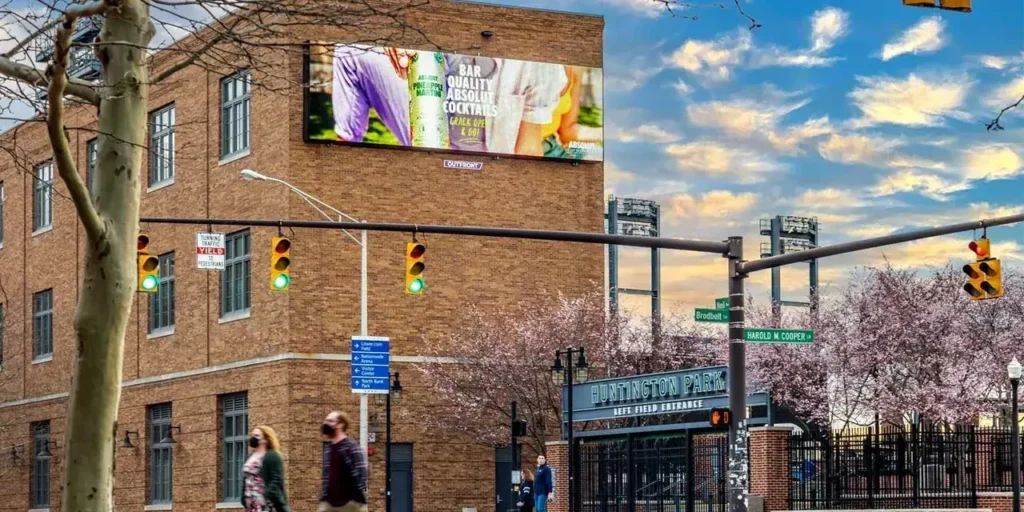
Columbus Ohio does not get the attention it deserves from national advertisers, and that is genuinely good news for the brands that do show up here. While budgets concentrate on New York, Los Angeles, and Chicago, Columbus has grown into one of the most commercially dynamic metros in the Midwest — with a young, educated consumer base, major corporate headquarters, a flagship state university with 60,000 students, and a retail and restaurant scene that consistently punches above the city’s population weight.
The billboard landscape in Columbus reflects this growth. Highway inventory along I-70, I-71, and the outer belt is strong and well-trafficked. The city’s walkable neighborhoods — particularly Short North, German Village, and the Brewery District — support a robust street-level advertising environment that rewards brands willing to go beyond the highway board. And Columbus’s status as a frequent test market for national retail and consumer brands means that outdoor advertising infrastructure here is well-developed and competitively priced.
This guide covers everything brands need to know about billboard advertising in Columbus Ohio — from the best locations and formats to cost benchmarks, guerrilla alternatives, and how to build a campaign that actually penetrates this market rather than just adding to its visual noise.
Columbus Ohio’s Outdoor Advertising Geography
Columbus is a sprawling Midwestern city organized around a strong downtown core and radiating corridors that connect to major suburbs. Understanding the city’s geography is the first step toward understanding where outdoor advertising delivers and where it underperforms.
Highway Corridors and Interstate Traffic
The major highway corridors — I-70 (running east-west through downtown), I-71 (northeast corridor), I-270 (the outer belt that circles the metro), and I-670 (connecting downtown to the airport) — carry the heaviest vehicle counts and the most highway billboard inventory. These corridors are appropriate for broad-reach campaigns targeting the Columbus metro as a whole, and for brands that want to capture commuter traffic from the suburbs.
The I-70 and I-71 interchange near downtown is among the most trafficked intersections in the state, with some of the city’s highest-visibility billboard inventory. Boards in this zone command premium rates but deliver impression volumes that justify the investment for brands with broad reach objectives.
Short North and the Arts District
The Short North Arts District along High Street north of downtown is Columbus’s premier walkable retail and dining corridor. High foot traffic, a young adult demographic, heavy weekend activity from Ohio State students and young professionals, and a cultural environment that celebrates creativity and local brands make the Short North one of the best environments in the city for street-level advertising.
Wheatpasting campaigns and sidewalk stenciling in the Short North deliver exceptional engagement because the neighborhood’s creative culture means consumers actually look at and respond to interesting visual advertising. Generic billboard creative lands flat here; unexpected, well-designed guerrilla placements generate social sharing and organic buzz.
Ohio State University Campus Corridor
The OSU campus area — particularly along High Street from the campus south through the Short North — is one of the densest youth consumer environments in the Midwest. Sixty thousand students, plus faculty and staff, plus the massive alumni community that remains in Columbus after graduation, create a consumer concentration that few Midwestern markets can match.
Outdoor advertising targeting the OSU demographic needs to fit the environment and the audience. Intrusive or corporate-feeling creative falls flat; authentic, culturally fluent creative generates strong engagement. Street team activations and experiential programs are particularly effective here because students are highly social, heavily present on campus, and responsive to direct engagement.
Columbus Billboard Formats and Pricing
Columbus’s outdoor advertising market offers a range of formats at price points that are significantly below comparable inventory in coastal metros. This cost efficiency makes Columbus an ideal market for brands that want to test outdoor advertising at scale or build sustained presence without coastal market budgets.
Static Highway Billboards
Standard static highway billboards in the Columbus market range from $1,200 to $6,000 per month depending on location, traffic count, and availability. The most premium inventory — high-traffic I-70 and I-71 boards near downtown — approaches the upper end of that range. Surface street boards in commercial corridors are available at more accessible price points while still delivering meaningful impression volumes.
Digital Billboard Inventory
Digital billboard inventory in Columbus has grown substantially as operators have invested in upgrading static boards. Digital boards enable creative flexibility, shorter minimum commitment periods, and the ability to daypart advertising — running different creative at different times of day. Columbus digital boards typically range from $2,000 to $12,000 per month for full ownership, with share-of-voice options available at lower investment levels.
Mobile LED Billboards
For brands that need targeting flexibility — the ability to move their advertising to specific neighborhoods, events, or times of day — mobile LED billboard trucks offer precision that static boards cannot. We deploy mobile LED units in Columbus for event-based campaigns, competitive conquesting, and neighborhood-specific activations. The OSU football season and Columbus Blue Jackets and Crew SC game windows are particularly strong deployment opportunities for mobile LED campaigns.
Why Columbus Is a Guerrilla Marketing Stronghold
Columbus has specific characteristics that make it one of the strongest markets in the Midwest for guerrilla marketing tactics. The combination of a large young adult population, walkable urban neighborhoods, active local food and entertainment scenes, and a culture of civic pride and local brand loyalty creates fertile ground for street-level campaigns.
The Short North Wheatpasting Environment
The Short North’s independent retail and art gallery culture means that interesting visual advertising is contextually appropriate in a way that it is not in suburban commercial corridors. Wheatpasting in the Short North does not feel out of place — it fits the aesthetic of a neighborhood that celebrates creative expression and independent culture. Brands that design their posting creative to fit this environment consistently see stronger engagement than brands that adapt suburban or national creative without modification.
German Village and Brewery District
German Village and the Brewery District are premium Columbus neighborhoods for brand ambassador campaigns and targeted outdoor placements. These areas attract an affluent, design-conscious consumer demographic with strong local buying habits. Brand ambassador programs in these neighborhoods — particularly around the many independent restaurants, bars, and specialty retailers — deliver high-quality consumer engagement with purchase-ready demographics.
Columbus as a National Test Market
Columbus has long served as a national test market for consumer brands, retail concepts, and restaurant chains, in part because its demographic diversity and Midwestern values make it a reliable proxy for broader national consumer behavior. This test market function means the city has strong advertising infrastructure and media vendor relationships that support sophisticated campaign execution — even for brands that are new to the market.
Building an Integrated Columbus Outdoor Campaign
The most effective Columbus outdoor campaigns combine multiple formats and channels in a coordinated strategy that creates consistent brand presence across the consumer journey — from the highway commute to the neighborhood walk to the event environment.
Launch Sequence for New Market Entry
For brands entering the Columbus market for the first time, we recommend a sequenced launch approach: highway outdoor first to build broad awareness, followed by neighborhood-specific wheatpasting and stenciling to establish street-level presence, followed by a street team or pop-up activation to create direct consumer engagement. This sequence builds awareness before the direct engagement phase, making every street-level interaction more effective because the brand is already familiar.
Event-Based Campaign Opportunities
Columbus’s major events — the Arnold Classic, the Columbus Marathon, the Columbus Arts Festival, and every Ohio State home football game — create concentrated windows of high-value consumer density that smart brands exploit with targeted outdoor and guerrilla activations. Planning campaign timing around these events significantly improves impression quality and audience engagement relative to non-event periods.
Columbus Outdoor Advertising: What the Data Says
Columbus’s outdoor advertising market is well-researched by the Outdoor Advertising Association of America (OAAA) and supported by traffic measurement data from the Ohio Department of Transportation. These resources give media planners reliable impression delivery data for campaign planning and post-buy measurement.
Traffic Count Data and Impression Delivery
Ohio DOT traffic count data, combined with audience measurement tools from providers like Geopath, enables accurate impressions-based planning for Columbus billboard campaigns. The I-70 and I-71 interchange near downtown generates daily vehicle counts exceeding 150,000, making boards in this zone among the highest-volume impression delivery vehicles in the state. Surface street boards in commercial neighborhoods like the Short North generate lower vehicle counts but higher pedestrian exposure rates that traffic count data does not fully capture.
Audience Quality vs. Impression Volume
The most important insight in Columbus outdoor planning is that raw impression volume does not always predict campaign outcomes. A highway board with 100,000 daily impressions may deliver lower brand recall than a well-placed wheatpasting board in the Short North with 5,000 daily impressions, if the Short North audience is more closely aligned with the brand’s target consumer profile and more receptive to the brand message in that context. Audience quality is always the more important variable.
Frequently Asked Questions
How much do billboards cost in Columbus Ohio?
Columbus Ohio billboard costs range from $1,200 to $10,000 per month depending on location, size, and format. Highway boards along I-70 and I-71 command higher rates. Surface street boards in Short North, German Village, and the Ohio State University corridor are available at competitive rates.
What are the best billboard locations in Columbus Ohio?
Top Columbus billboard locations include the I-70 and I-71 interchange near downtown, the Short North Arts District, the Ohio State University campus corridor, Easton Town Center, and the Polaris corridor in the north suburbs.
Are digital billboards available in Columbus Ohio?
Yes. Digital billboard inventory in Columbus has expanded significantly. Digital boards are available along major highway corridors and in commercial districts, offering flexible scheduling, creative rotation, and the ability to update messaging in real time.
What guerrilla marketing tactics work well in Columbus Ohio?
Wheatpasting, sidewalk stenciling, street team activations, and mobile LED billboard trucks all work effectively in Columbus. The Short North, German Village, and the OSU campus area are particularly receptive to creative street-level marketing.
Does American Guerrilla Marketing operate in Columbus Ohio?
Yes. We execute campaigns in Columbus and across the Midwest through our national network of vetted local vendors and installation crews. Contact us at (646) 776-2770 to discuss your Columbus campaign.
Why is Columbus Ohio a strong market for outdoor advertising?
Columbus is Ohio’s largest city and one of the fastest-growing metros in the Midwest. Its combination of a large state university, thriving tech sector, diverse neighborhoods, and major retail corridors creates a consumer base that responds strongly to high-quality outdoor and guerrilla marketing.