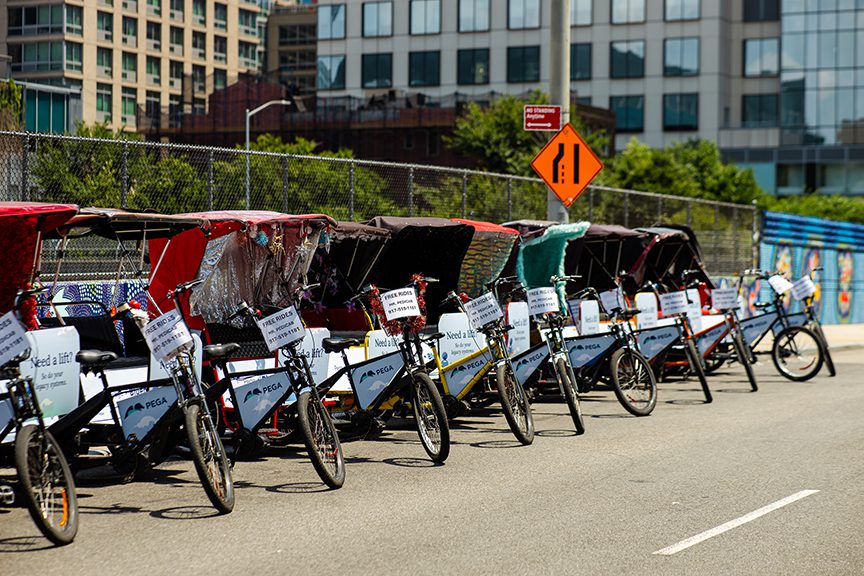
Ads on bikes are a guerrilla marketing format built for cities. They move through parks, campus paths, waterfront greenways, outdoor markets, and neighborhood corridors where no truck, no bus, and no billboard can follow. The format puts brand messages directly into the environments where urban consumers spend their leisure time, their commute time, and their social time.
We are American Guerrilla Marketing, and we have planned and deployed ads-on-bikes campaigns for consumer brands, entertainment launches, local businesses, and major national companies across New York, Chicago, Los Angeles, Miami, Boston, and dozens of additional markets. This guide covers everything: how bike ads work operationally, what formats exist, how to build effective creative, where the format delivers strongest, and what a properly planned campaign looks like from day one through final reporting.
If your audience lives in a city, this format can reach them in a way that digital ads and traditional media cannot. The question is whether you build the campaign strategically or waste the opportunity on poor route planning and weak creative. We focus on the strategic version.
Before we get into the operational details, it is worth explaining why ads on bikes exist as a format and what problem they solve that other formats cannot.
Traditional out-of-home advertising, billboards, transit ads, vehicle wraps, is anchored. A billboard is static. A wrapped bus runs a fixed route. Neither can reach a crowd gathering in the middle of Central Park on a Saturday afternoon or operate along the Chicago Lakefront Trail on a weekend morning. Vehicle-based advertising in most cities is restricted from exactly the environments where the most desirable urban consumers spend the most time.
A bicycle solves this access problem. It can go where pedestrians go. It is light, quiet, maneuverable, and culturally appropriate in environments where a commercial truck would be jarring. It carries a brand message into the most sought-after environments in urban America and operates in those environments without requiring special access, without disrupting the experience of the people in the space, and without drawing the kind of negative attention that intrusive advertising can generate.
The result is a format that delivers genuine competitive advantage through access. Not through scale alone, but through being the only advertising present in premium environments at premium moments.
AGM Field Note: Parks, greenways, campuses, and outdoor markets are restricted zones for vehicle advertising and open zones for bike advertising. Every time a brand runs ads on bikes in these environments, they are the only advertiser present. That exclusivity is not a side benefit. It is the core value proposition of the format.
How Ads on Bikes Work
The operational structure of an ads-on-bikes campaign is straightforward. An advertising display, printed or electronic, is mounted to a bicycle. A trained rider operates the bike along pre-planned routes through target areas during specific deployment windows. Everyone within visual range who looks toward the bike sees the ad.
The planning that makes this simple structure work is where the real expertise lives. Which routes? At what times? With what message? Which format? How many bikes? How do we adjust if conditions change? How do we capture and report results? These questions require strategic answers, not just logistical ones. We work through all of them before a single bike rolls out the door.
Pre-Campaign Planning
We start every campaign by building a clear picture of the target consumer’s geography in the target market. Where do they live? Where do they go on weekends? Which parks, which corridors, which markets and events? We map the target audience’s physical behavior in the city and use that map to design routes that place the bike ads in front of the right people at the right times.
Route Development
Routes are built around high-density windows for the target audience. We account for time of day, day of week, event calendars, seasonal patterns, and the specific characteristics of each location. A route that performs well on a Tuesday lunchtime near a commercial district is not the same route we build for a Saturday morning park campaign. Every deployment window gets its own route plan.
Execution and Field Management
We deploy with field supervisors who monitor bike positions, maintain communication with riders throughout the shift, and adjust when real-time conditions require it. Weather changes, crowd pattern shifts, unexpected event conflicts: the field team handles all of these in real time rather than discovering them in an end-of-day debrief.
Reporting
GPS route data, photo documentation, field supervisor reports, and digital tracking from QR codes or short URLs feed into a complete campaign report. We deliver this report to every client at the end of the campaign with enough detail to evaluate performance and inform future planning.
Types of Bike Ad Formats
Ads on bikes come in multiple formats, each suited to different campaign objectives and deployment environments. Choosing the right format for the specific campaign is part of the strategic work we do in planning.
Billboard Bikes with Printed Panels
The most common and most cost-effective format. A large double-sided printed panel mounted vertically to the bicycle frame, visible from a distance in both directions of travel. Best for brand awareness campaigns where simplicity, readability, and cost efficiency are priorities. The panel uses high-resolution printing and should be designed for maximum legibility at a distance: bold colors, minimal copy, dominant logo.
LED Display Bikes
An electronic display mounted to the bicycle showing video, animation, or rotating messages. LED bikes generate dramatically more attention than static panels because moving imagery on a moving vehicle creates a compounding visual stimulus that is extremely difficult to ignore. Best for product launches, event activations, campaigns with a social content generation goal, and any situation where the brand needs people not just to see but to react.
Cargo Bikes with Sampling Stations
A cargo bicycle with exterior brand panels and an interior product storage compartment operated by a brand ambassador who displays the brand and distributes samples simultaneously. This format converts bike advertising from a pure awareness play into a direct trial mechanism. The rider brings the brand to the consumer and puts the product in their hands in a single motion. Best for food, beverage, and CPG brands that need trial as much as awareness.
Backpack Rider Bikes
A rider wearing a large branded backboard or A-frame display riding a standard bicycle through high-traffic areas. The backboard functions as the ad panel and is visible from behind, above, and to the sides. This format is highly mobile and effective in very dense environments where a mounted bike panel might be harder to maneuver.
Format
Primary Objective
Ideal Environment
Relative Cost
Billboard Bike (Printed)
Brand awareness
Parks, greenways, corridors
Low-medium
LED Display Bike
Launch, attention, social sharing
Dense urban, evening events
High
Cargo Bike with Sampling
Trial, conversion
Markets, festivals, neighborhoods
Medium
Backpack Rider Bike
Mobility, crowded spaces
Dense pedestrian zones
Low-medium
Creative Strategy for Ads on Bikes
Bike ad creative requires a fundamentally different approach than print, digital, or traditional out-of-home design. The constraints are strict and non-negotiable. Work within them and the format delivers. Ignore them and the ad is invisible.
The Three-Second Rule
On a moving bike in a busy environment, a viewer typically has two to four seconds to register the ad as the bike passes. Everything in the creative must be readable, recognizable, and memorable in that window. Not somewhat readable. Not mostly recognizable. Completely, instantly clear. This single constraint eliminates most bad creative decisions immediately.
Copy: Less Than Five Words
Five words is our maximum for bike ad copy and we frequently push for fewer. A slogan, a call to action, a product name: one of these, not all of them. If the viewer can read and retain the copy in a two-second moving encounter, it is the right amount of copy. If they have to slow down or stop to read it, the creative has failed.
Color: Bold and High-Contrast
Urban environments are visually noisy. A bike ad that uses muted, sophisticated colors gets lost against the visual complexity of a park, a market, or a busy commercial street. Bold color choices with high contrast between elements are not a creative preference in this format. They are a functional requirement. We have seen beautiful, tasteful bike ads disappear in the field. Bold ones stop people.
Logo: Dominant
The logo should be the largest and most prominent element on the panel. If someone sees the bike for two seconds, they should leave with the brand name and visual identity. Everything else is secondary. A viewer who remembers the brand but not the copy is a success. A viewer who remembers the copy but not the brand has learned nothing useful for the campaign.
AGM Field Note: We review bike ad creative at full scale before approving production every time. Creative that works at screen size frequently loses legibility at bike panel size in an outdoor environment. Testing at scale is not optional in this format. It is the only way to know what you are actually deploying.
Where Ads on Bikes Perform Best: Market-by-Market Analysis
The value of ads on bikes varies by city, by neighborhood within each city, and by the specific environments where the bikes operate. Here is how we think about the format market by market.
New York City
New York is the strongest market for ads on bikes in the United States. The park system, the cycling infrastructure, the waterfront greenways, and the density of desirable consumer demographics in accessible outdoor environments make New York the flagship market for the format. Central Park, the Hudson River Greenway, the Brooklyn waterfront, Prospect Park, the High Line, and the major outdoor markets all provide premium bike ad corridors that reach exactly the audiences most consumer brands target.
Weekend deployments in New York’s parks are particularly productive. Saturday and Sunday mornings in Central Park alone reach hundreds of thousands of people. The audience is relaxed, engaged with their physical environment, and predisposed to noticing and remembering interesting things they encounter outdoors. Bike ads thrive in this mental context.
Chicago
Chicago’s Lakefront Trail and the Riverwalk are the two most productive bike ad corridors in the market. The Lakefront Trail carries millions of users annually along an 18-mile lakeside route. The Riverwalk through downtown serves the office, tourist, and resident population in a premium urban environment. Millennium Park serves as an anchor zone for campaigns targeting the downtown demographic. Summer weekends on the lakefront are among the most productive windows in the Midwest for any outdoor advertising format.
Los Angeles
The Venice Beach boardwalk and the Santa Monica to Malibu coastal corridor are the premier zones for ads on bikes in Los Angeles. On weekends, the ocean-adjacent pedestrian environment from Santa Monica through Venice carries enormous crowd density across a broad demographic spectrum. This is one of the few locations in Los Angeles where the geography concentrates a diffuse, car-centric population into a walkable, bikeable, high-dwell environment.
Miami
South Beach and the Art Deco Historic District are the strongest zones for bike ad campaigns in Miami. The flat terrain, the pedestrian-friendly streets, the tourism-driven crowd density from November through April, and the year-round operating conditions make Miami one of the most productive bike ad markets in the country by volume per deployment day.
Boston
Boston’s Esplanade along the Charles River, the Emerald Necklace park system, and the waterfront areas near Seaport and Fort Point are strong bike ad zones. The university-dense demographics of Cambridge and Allston make campus-adjacent routes in Boston particularly valuable for brands targeting students and young professionals.
Washington DC
The National Mall, the Rock Creek Park trail, and the Anacostia Riverwalk Trail provide the primary bike ad corridors in Washington DC. The Mall draws enormous tourist and local crowds year-round. The monuments and museums create high-dwell zones where pedestrians are standing and seated rather than moving, which increases viewing time for bikes operating through those areas.
Combining Ads on Bikes with Other Guerrilla Formats
Ads on bikes are most powerful when deployed as one component of a coordinated guerrilla campaign rather than as a standalone format. The combination of bike coverage in approach corridors with direct consumer engagement at key locations creates a layered brand experience that single-format campaigns cannot achieve.
Bikes Plus Street Teams
Our most frequently recommended combination. The bike covers the broad approach areas, generating brand awareness as people move toward or through a target zone. The street team operates at specific high-traffic points within that zone, creating direct interactions with consumers who have been primed by the bike. The street team contact feels more familiar because the brand has already registered. Street team rates run from $389.99 per six-hour shift for a standard member up to $589.99 per shift for a premium member.
Bikes Plus Brand Ambassadors
Similar to the street team combination but with ambassadors who have more specific brand expertise and a deeper product presentation capability. Ambassador rates follow the same structure: $389.99 standard, $489.99 professional, $589.99 premium per six-hour shift. The bike generates broad awareness, the ambassador creates depth of engagement at close range.
Bikes Plus Product Sampling
Cargo bikes can integrate sampling directly, but standard billboard bikes can also be paired with separate sampling stations or product demo setups at specific locations along the route. The bike drives traffic to the sample station. The sample station converts that traffic into product trial. The two elements work together to move consumers from unaware to experienced in a single activation.
Bikes Plus Social Content
LED display bikes are natural content generators. A distinctive, well-designed LED bike in a photogenic urban environment generates organic social sharing from bystanders. We plan LED bike routes specifically for environments where photography and sharing are natural behaviors: parks, waterfronts, events, and any location where people habitually document their experience. The content created by bystanders extends the campaign reach beyond the direct audience of the bike itself.
Budget and Planning Framework for Bike Ad Campaigns
Bike advertising is accessible at a range of budget levels. The cost scales with the number of bikes, the format type, the number of deployment days, the complexity of routes, and whether field management is included. Here is how we typically structure the planning conversation.
A single-bike, single-day deployment in a major market with field management and a printed panel ad is the entry point. Multi-bike programs running for multiple days with LED displays, field supervisors, and integrated sampling capabilities are on the other end of the range. Most effective campaigns fall somewhere between: two to five bikes, three to seven days, printed or LED depending on objective, with at least one layer of street-level engagement.
We build budgets based on specific campaign goals, not on hypothetical scenarios. When you call us, we will ask about your objective, your target market, your timeline, and your budget range. We will recommend a campaign structure that fits all four. If the budget does not support the objective, we will say so and propose an alternative that does what the budget allows effectively.
The Difference Between Good and Great Bike Ad Campaigns
We have planned enough bike ad campaigns to know what separates the ones that generate strong results from the ones that are forgettable. It comes down to a few specific variables.
Route precision. Great campaigns are built on routes that put the bikes in exactly the right place at exactly the right time. This requires real knowledge of the target market’s physical geography, not assumptions. We do this work in pre-production, not in the field on deployment day.
Creative discipline. Brands that accept simplified creative consistently outperform brands that insist on maximum message content. The format has a specific creative grammar. Work with it and it performs. Work against it and the ad disappears.
Rider quality. Our riders are briefed on the brand, the campaign goals, and the routes. They handle public interactions professionally. They report accurately. A poorly briefed, unmotivated rider is not an asset on a deployment day. Our recruiting and training standards exist because rider quality directly affects campaign quality.
Integration with other tactics. Standalone bike campaigns perform. Bike campaigns integrated with street teams, ambassadors, or sampling perform at a meaningfully higher level. The additional investment in a second tactic is almost always worth the compounding effect on results.
Start Your Ads-on-Bikes Campaign
We handle strategy, creative review, route planning, rider recruitment, field management, and reporting. You tell us who you want to reach, where they spend their time, and what you want them to know about your brand. We figure out how to put your message in front of them in the most effective format and environment available.
We work with national consumer brands, regional businesses, entertainment companies, and local retailers. We have done single-day activations and multi-month programs. We have deployed in two cities and in twenty. The structure scales. The strategic approach stays the same regardless of program size.
Building a Yearlong Ads-on-Bikes Program
Brands that maintain consistent bicycle advertising presence across an entire outdoor season build meaningfully stronger brand recognition in their target markets than brands that run a single activation and stop. A yearlong ads-on-bikes program creates the repeated brand contacts that form durable brand memory in the target consumer community.
Here is how a yearlong program typically structures in a northern market like New York or Chicago. Spring launch in April or May, timed to the return of warm weather and the return of park and greenway pedestrian traffic. Summer intensification in June through August, with the heaviest deployment weeks timed to major outdoor events, peak park usage, and the outdoor market season. Fall continuation through September and October before weather-driven reduction. Winter hiatus or minimal digital-supplement activity until the spring relaunch.
In warm-climate markets like Miami or Los Angeles, a yearlong program runs more consistently through all four quarters with adjustments for summer heat and peak tourist season. The program structure adapts to the specific market’s seasonal patterns rather than following a single national template.
Yearlong programs develop in effectiveness over time. Consumers who see the brand consistently in the same environments over multiple months develop higher baseline brand recognition than those who encounter the brand once in a single deployment window. This compound awareness effect is one of the most valuable and least discussed benefits of sustained outdoor advertising programs. We see it in recall data from markets where we have run sustained programs and it is consistent enough to be a meaningful part of our recommendation for brands with multi-season campaign objectives.
Ads on Bikes for Event Marketing
Event marketing is one of the strongest specific use cases for ads on bikes. A major outdoor event, a summer music festival, a charity run, a food and wine celebration, concentrates exactly the right demographic in exactly the right outdoor environment on a specific and predictable date. Deploying ads on bikes in the days leading up to, during, and immediately following a major event creates brand presence at the moment of maximum audience concentration.
Pre-event deployments in the neighborhoods surrounding a venue build brand recognition among the audience that is already planning to attend. Day-of deployments at and around the event location catch the arriving and departing audience at the moments of maximum social engagement. Post-event deployments capture the afterglow of the event experience when consumers are in an elevated, socially open mood that makes them particularly receptive to brand encounters.
We plan event-adjacent ads-on-bikes programs specifically around the event’s geography, the expected audience movement patterns, and the specific venues and locations where the audience will be concentrated during each phase of the event period. Event-adjacent bike advertising is one of the highest-value applications of the format and one where the combination of precise timing and premium access environment delivers an outsized return on the deployment investment.
Pairing event-adjacent bike advertising with a street team at the event itself creates the full-coverage program: bikes handle the approach corridors and the surrounding neighborhoods while the street team handles direct engagement inside the event perimeter. The combination reaches the event audience before, during, and after the event across multiple touchpoints that together create a comprehensive brand presence.
The Reporting Process for Ads-on-Bikes Campaigns
Every ads-on-bikes campaign we run produces a comprehensive post-campaign report delivered within five business days of the final deployment. Here is what that report includes and why each element matters.
GPS route data shows exactly where each bike was deployed, for how long, and at what times. This data verifies that the campaign ran as planned and gives the client a geographic record of where their brand was present during the deployment period. We do not ask clients to trust that the bikes went where we said they would. We show them.
Field photography documents the bikes in action in the target environments. These photos serve both as verification of deployment and as visual assets that capture the brand in the premium outdoor environments the campaign was designed to reach. Many clients use field photography from bike advertising campaigns in their own marketing materials.
Field supervisor reports provide qualitative observations from the people who were in the field during the deployment: which locations generated the most visible consumer response, what public interactions occurred, any notable conditions that affected deployment, and any observations about creative performance in the actual deployment environment.
Digital performance data from any QR codes, short URLs, or promotional codes included in the creative provides direct measurement of consumer actions taken in response to the ads. This data connects the physical brand contact to a measurable digital outcome and allows comparison of different creative messages or deployment locations based on actual consumer response behavior.
Frequently Asked Questions
Are ads on bikes legal in all cities?
In most U.S. cities, yes. A bicycle with an advertising display operates under standard bicycle traffic rules. We plan routes to comply with all local bicycle access guidelines, including restrictions on certain pedestrian zones, indoor spaces, and vehicle-restricted areas. We handle the research on local operating rules for every market we deploy in.
How do you handle inclement weather?
We monitor weather throughout every campaign. Light rain typically does not stop a deployment when riders are properly equipped. Severe weather, unsafe heat, or dangerous conditions result in postponement and rescheduling. Rider safety is the non-negotiable priority on every activation day.
What is the minimum number of bikes needed for an effective campaign?
A single bike on a well-chosen route in a high-density environment can be effective, particularly for small or highly localized campaigns. For neighborhood saturation or major event coverage, two to five bikes operating coordinated routes in the same zone create a brand presence that feels pervasive rather than occasional. We recommend at least two bikes for most awareness campaigns.
Can we use our own creative on the bike panels?
Yes. We produce the panels to your specifications and your creative. If you have an existing creative team, we provide the technical specifications for panel production. If you need creative development, we can connect you with resources. We review all creative at full scale before production to confirm legibility in the field.
How much lead time is needed to launch a campaign?
For standard printed panel campaigns, two to three weeks of lead time covers route planning, creative production, and rider scheduling. LED display campaigns may require additional lead time depending on display availability. For campaigns during peak periods, four to six weeks is safer. We can sometimes accommodate faster turnarounds depending on market and format availability.
Do you offer multi-market bike ad campaigns?
Yes. We operate nationally and have fielded multi-market campaigns in two to ten cities simultaneously. Multi-market programs are coordinated centrally through our project management team with local execution partners in each market. We maintain consistent creative standards, route quality, and reporting across all markets.
Can bike ads be integrated into a larger guerrilla marketing program?
Absolutely, and this is how we typically recommend deploying them. Bike ads work exceptionally well as the broad awareness layer in a multi-tactic campaign that also includes street teams, brand ambassadors, or product sampling. Each format reinforces the others and the combined effect consistently outperforms any individual tactic alone.
What deliverables do we receive at the end of a campaign?
We provide GPS route data, field photographs documenting deployment, field supervisor logs, and digital performance data from any QR codes or URLs included in the creative. The full campaign report is delivered within a few business days of the final deployment day.
Is bike advertising more effective than social media advertising for urban audiences?
They serve different functions. Social media advertising delivers your message to urban consumers on their screens with targeting precision. Ads on bikes deliver your message in their physical environment in a context that is impossible to scroll past or block. The two formats are complementary, not competitive. Running both during the same campaign period in the same market compounds the effect of each.
How do ads on bikes compare to transit advertising in terms of cost and reach?
Transit advertising typically reaches very large numbers of daily commuters on fixed routes at moderate cost per contact. Ads on bikes reach smaller but highly targeted audiences in premium access environments at a cost structure that is competitive for the specificity of access provided. The two formats are not direct substitutes. Transit advertising is broad reach on fixed infrastructure. Bike advertising is precise access to specific environments. Both have a place in a comprehensive out-of-home strategy.