
November 20, 2026
Guerrilla Marketing Campaign: A Field Guide From the Crew
Almost everything written about running a Guerrilla Marketing campaign is written by people who have never installed one.
You can tell. The articles talk about creativity, surprise and disruption. They do not talk about what happens when the paste freezes, when the wall you scouted has been power washed and repainted since you last saw it, or when a crew of three has ninety minutes left before street cleaning and eleven surfaces to go.
I have done the second kind of work for years. This is a field guide from that side of it.
What follows is how a campaign actually gets built and run: the planning that matters, the formats and what each one is genuinely good at, crew structure, timing, surfaces, weather, the grey area around permissions, and the long list of things we talk clients out of.
If you are briefing a campaign, this should tell you what questions to ask. If you are running one, it should save you a few bad nights.
What a guerrilla campaign actually is, stripped of the romance
Guerrilla marketing means putting a message in physical public space outside the bought media system. That is the whole definition.
It is not inherently clever. It is not inherently cheap. Plenty of guerrilla campaigns are expensive and dull, and plenty of conventional media buys are sharper than anything on a street corner.
What it is, reliably, is high frequency in a defined geography. You pick an area where your audience physically exists and you saturate it, so the same people see the same message repeatedly over a period of weeks on their normal routes.
That repetition is the mechanism. Not surprise. Surprise happens once. Repetition is what makes a name feel familiar by the time a launch lands.
Everything in this guide follows from that. Frequency in a tight geography, executed on real surfaces, maintained over a run.
The formats, and what each one is honestly for
Wheatpasting & Poster Campaigns. Paper and paste on flat vertical surfaces. The workhorse. Best total surface time per shift of anything we run, scales well, reads from across a street. Needs flat, non-porous surfaces and a dry curing window.
Snipe Advertising. Smaller format posted on poles, boxes and street furniture at eye level. Dense and repetitive. Good for areas where large flat walls are scarce.
Sidewalk Decals & Stencils. Ground level graphics where people stand still. Lower reach than posters but much better dwell time, because people waiting at a light look down. Entirely dependent on surface prep.
Projection Advertising. Light on a building at night. The highest impact per minute of anything in this list, and it exists only while the projector runs. A campaign tactic for a specific night, not a run.
LED Trucks & Mobile Billboards. A moving screen on a planned route. The only format that reaches drivers at scale, which matters enormously in car cities and barely at all in a dense walking neighbourhood.
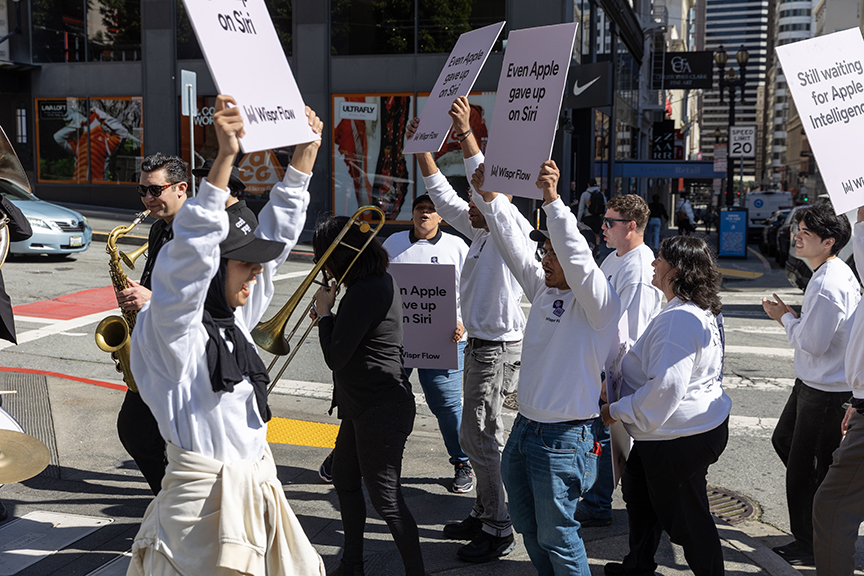
Street Teams & Experiential. Humans in branded gear, handing out, talking, sampling, collecting. The only format that produces a conversation, and the one with the lowest total reach per shift.
Most campaigns that work use two or three of these. Ambient coverage for frequency, with one format that creates a moment or a conversation.
Planning: the part that decides whether it works
Campaigns fail in planning far more often than they fail in execution.
Start with geography, not with creative. Name the specific corridors where your audience walks or drives. Not "Brooklyn". Bedford Avenue in Williamsburg. Not "Chicago". Milwaukee Avenue through Wicker Park. Not "Austin". South Congress and East Sixth.
Tight geography is the whole game. A campaign spread across an entire metro delivers one impression to a great many people, which is worth very little. The same campaign concentrated into four corridors delivers eight impressions to a smaller number of the right people, which works.
Then scout. Someone physically walks the corridors and photographs surfaces. Not Street View, which is routinely years out of date and will show you hoarding that came down two summers ago. A real walk, at the hour the campaign will be seen and at the hour it will be installed, because those are different conditions.
Then build the route. Surfaces get ordered into an install sequence that minimises driving, keeps the crew moving in one direction and fits inside the available window.
Then size the print run against that route, with a surplus. Paper gets damaged in transit, surfaces turn out to be unusable, and a crew that runs out of material mid route has wasted the night.
Then set the maintenance schedule. A poster run is not a one-time install. Sheets get torn, covered, weathered. Refresh passes are part of the plan or the campaign degrades in week two.
Crew reality: who is out there and for how long
A standard poster install crew is two to four people. One driver who stays with the vehicle and handles material, two installers working as a pair, and on larger routes a second pair.
Pairs matter. One person pastes the surface and sets the sheet, the other smooths it out and watches the street. Solo installs are slower and sloppier and I avoid them.
Shifts run roughly five to seven hours overnight. Install windows are generally late evening through pre-dawn, after the sidewalk crowd thins and before street cleaning, delivery trucks and the morning commute arrive.
The exact window shifts by neighbourhood. A nightlife corridor is still busy at 2am and quiet at 5am. A commercial district is empty by 11pm and starts loading in at 5am. We set start times per corridor, not per city.
Decal crews move faster than poster crews because there is no curing time, but they spend more of the shift on surface prep. Sweeping and cleaning pavement is most of a decal install.
Projection is two or three people: an operator, a spotter who watches sightlines and the street, and usually a driver. It runs during the hours the surface is dark and the audience is present, which is a narrow band.
Street teams run opposite hours entirely, in daylight or at venue door time, four to six people on a shift of four to six hours.
The tired hours are real. Output drops after about five hours of physical install work in the cold. We plan routes so the hardest surfaces come early while the crew is sharp.
Surfaces: what holds and what wastes your money
This is where campaigns quietly fail.
Good poster surfaces are flat, non-porous and vertical. Construction hoarding and plywood barricades are the best surface in any city. Smooth painted walls, utility boxes and clean concrete also work.
Bad poster surfaces are rough stucco, raw brick with deep mortar lines, anything with a heavy texture, anything dusty, anything oily, and anything that was recently sealed. Paste needs continuous contact. Texture breaks the bond, the sheet balloons, wind gets underneath, and it is gone.
Good decal surfaces are smooth poured concrete, swept clean and fully dry. Bad decal surfaces are aggregate, brick pavers, cracked pavement, broom-finish concrete and anything with road film on it. A decal on an unprepped pavement lifts at the corners within days.
Projection needs a large, flat, light-coloured surface and genuine darkness. Ambient light from streetlights, storefronts and passing traffic is the constraint, not projector power. We scout projection surfaces after dark, always, because a wall that looks perfect at noon can be unusable at 9pm.
Vinyl on glass and metal is the one format where the surface is almost always cooperative, which is why window and box work is so consistent.
The honest version: a mediocre design on an excellent surface outperforms a brilliant design on a bad one. Every time.
Weather, by season, and what it does to a run
Cold. Paste thickens and cures slowly below roughly freezing. Material gets brittle, hands stop working, and install speed drops hard. Winter campaigns in northern cities need longer windows and smaller routes per night.
Rain. We do not install into wet surfaces and we do not install if rain is forecast inside the curing period. A freshly pasted sheet caught by rain before it sets comes off in a sheet. Clients who insist on a fixed install date regardless of forecast get told no.
Heat and sun. UV fades ink fast on south facing surfaces. In sun-heavy cities, exposure decides lifespan more than material does. Heat also softens pavement adhesive behaviour, and a decal laid on hot pavement can be a problem.
Wind. Dry hard wind lifts a partially cured edge and shreds a sheet overnight. Coastal and desert wind patterns move install windows.
Humidity. High humidity slows curing. A summer night in a humid city needs more cure time than the same job in a dry one.
Freeze-thaw. In northern winters, water gets into pavement, freezes, and lifts anything adhered to it. Decal runs through a hard freeze cycle are shorter than clients expect, and I say so before we quote them.
A run that holds well in one climate for several weeks can hold for a fraction of that elsewhere. Anyone who quotes you a universal lifespan number has not worked in enough cities.
Permissions, ordinance and removal: the grey area
This is the part of the field guide people most want a clean answer on, and there is not one.
Posting, decal placement and projection in public space sit in a grey area. Rules vary by municipality, sometimes between neighbouring cities in the same metro. Enforcement is inconsistent and depends on surface ownership, local ordinance, how a department is staffed, and whether anyone complains.
I will not tell you that something is legal or illegal. That is a question for your own counsel and it turns on the specific surface, the specific city and the specific ordinance.
What a professional crew controls is exposure, and we control it in four ways.
Permission. We work from property owner permission wherever we can get it. Construction sites, private hoarding, vacant frontage, business walls with an owner who agrees. A signed permission from the person who owns the surface changes the entire character of the situation.
Surface choice. Private surfaces over public ones. We stay off historic facades, residential buildings, active storefront windows, religious property and anything that will upset a neighbour.
Removal. Posters come down at the end of a run. Decal material gets lifted and the surface cleaned. A crew that leaves its mess behind poisons a corridor for every campaign that follows, including our own.
Documentation. Photographs of every install, the surface condition, and the state after removal. If anyone ever asks what we did and where, there is a record.
Street team activations with a physical footprint on public property are a different category and generally go through proper permitting with the relevant city, with lead time built into the schedule. Activations on private property run on the owner's say-so and move much faster.
What goes wrong, and when we push back
Here is the list I have accumulated the hard way.
The client wants the entire metro covered. We cut it to three or four corridors and go deep. Spread is the single most common way to waste a campaign.
The client picked surfaces from a desk. Street imagery is old. The hoarding is down, the wall is repainted, the lot is now a building. We scout before we commit.
The client wants a fixed install date through a storm forecast. We move the window. Installing into rain is throwing material away.
The client wants tiny type. If it cannot be read from across a street at a glance, it is not outdoor creative. Posters get read in about two seconds by someone in motion.
The client wants a QR code as the only mechanic. On a wall poster at a distance, scan rates are poor. On a decal underfoot where someone is standing still, it can work. Placement decides it, not the code.
The client wants projection on a wall nobody has seen at night. We scout after dark or we do not quote it.
The client wants decals on textured pavement because the location is good. It will lift. We find smooth concrete nearby or use a different format on that block.
The client wants a one-night install with no refresh. We build maintenance passes in. Without them, the campaign is visibly degraded within a couple of weeks.
The client wants us to post on something that is obviously somebody's home or small storefront. We decline. There is no version of that which ends well.
Creative that survives contact with the street
The creative brief for outdoor work is different from a screen brief, and most agencies hand us files built for a screen.
A poster is read by someone in motion, at distance, usually at an angle, often in bad light. You get about two seconds. That constraint should drive every decision in the file.
One idea per sheet. Not three. If there is a headline, a sub-headline, a product shot, a date, a logo and a QR code all competing, the viewer takes nothing away.
Type big enough to read across a street. The test I use is simple: print it small, put it on the floor, stand up and look at it. If you cannot read it standing, it will not read from a sidewalk.
High contrast. Dark on light or light on dark. Mid-tone on mid-tone disappears under streetlight and in flat overcast daylight, which is the condition most of these campaigns live in.
Design for repetition, not for a single look. The same audience is going to see this sheet a dozen times over a run. Two or three variants that share a visual system hold attention far better than one sheet repeated, and they make a corridor feel like a campaign rather than a single stray poster.
Account for tiling. Large formats get installed as multiple sheets. If the artwork has fine detail crossing a seam, that detail will not line up perfectly on a cold wall at 3am. Keep critical elements away from the seams.
Remember the sheet will weather. Edges lift, sun fades, somebody tears a corner. Artwork that still reads at seventy percent condition is better outdoor creative than something that only works pristine.
Measuring a guerrilla campaign without lying about it
The measurement conversation is where a lot of operators start inventing numbers, and I will not.
What you can verify: install counts, photographed and geotagged. Surfaces covered. Route completion. Refresh passes made. For street teams, samples distributed, conversations held, signups collected. For decals and any scannable mechanic, actual scans.
What you cannot verify: impression counts. Anyone handing you a precise impression figure for a poster run has modelled it from traffic estimates. Models have their uses. They are not measurement, and they should never be presented as if they were.
What correlates in practice: branded search lift in the campaign geography during and after the run, direct traffic changes in those zip codes, and for anything with a location, foot traffic at that location.
I would rather give a client a small verified number with photographs attached than a large confident one that falls apart under a question.
Putting a campaign together: a working sequence
Define the audience and the geography. Three or four corridors, named street by street.
Scout them on foot, at both install hour and audience hour. Photograph every candidate surface.
Choose formats. Ambient for frequency, one format for the moment or the conversation if the brief needs one.
Pursue permission on the best surfaces. The ones you get change the campaign.
Design for distance. Big type, high contrast, one idea.
Print with surplus.
Build the route in install order. Hard surfaces first.
Install in the right window, in a dry forecast, with a crew in pairs.
Document everything as you go.
Run maintenance passes through the campaign.
Remove at the end and photograph the cleaned surfaces.
That is the whole job. There is no secret to it beyond doing each of those steps properly, which most operations do not.
Frequently asked questions
What makes a guerrilla marketing campaign work?
Frequency inside a tight geography. The mechanism is the same audience seeing the same message repeatedly on their normal routes over weeks, not a single clever moment. Campaigns that concentrate on three or four corridors consistently outperform the same effort spread across a metro, because spread delivers one impression to many people instead of many to the right ones.
How long does a poster or decal campaign last?
It depends on climate and surface far more than on material. Dry climates give longer runs because rain is not cycling material loose. Sun exposure fades ink on south facing surfaces. Freeze-thaw cycles lift pavement adhesives in northern winters. Surface prep decides decal lifespan. We plan refresh passes rather than promising a universal number.
Is this kind of campaign allowed?
It is a grey area that varies by municipality, sometimes between neighbouring cities in one metro, and enforcement is inconsistent. It turns on surface ownership, local ordinance and permission. We reduce exposure by securing property owner permission, favouring private surfaces, committing to removal and photographing every install. We do not give legal advice.
What time of night do crews install?
Generally late evening through pre-dawn, after the sidewalk thins and before street cleaning and morning deliveries. The exact window is set per corridor, since a nightlife street is busy at 2am while a commercial district empties by 11pm. Shifts run roughly five to seven hours with crews working in pairs.
Which format should I start with?
For most briefs, Wheatpasting & Poster Campaigns is the right base layer because it gives the most surface time per shift and reads from across a street. Add Sidewalk Decals & Stencils where people stand still, an LED truck if the audience drives, and a street team only when the mechanic genuinely needs a conversation.
Can you measure the results honestly?
We verify what is verifiable: photographed and geotagged installs, surfaces covered, refresh passes, samples handed out, conversations, scans. We do not hand over precise impression counts, because those are modelled from traffic estimates rather than measured. Branded search and direct traffic changes inside the campaign geography are the useful correlating signals.
Request a campaign quote
If you are planning a guerrilla marketing campaign, come with the audience, the geography you think matters, the launch date and what you need people to do. We will scout the corridors, tell you which surfaces are real, which formats carry the weight, and which part of the plan we would cut.
Most campaigns we build start with Wheatpasting & Poster Campaigns as the base layer and add from there.
Request a campaign quote and we will scope it against real surfaces, real install windows and real weather.

Ready to Run Your Campaign?
Call us or email us. We’ll tell you exactly what we can do in your market and what it costs.
Related Services
Explore similar advertising solutions offered by American Guerrilla Marketing.
American Guerrilla Marketing — Los Angeles
Street-level campaigns in Los Angeles and nationwide. Wheatpasting, LED trucks, street teams, and more.
(646) 776-2770
Related Articles
-
Guerrilla marketing meaning: How It Actually Works
November 20, 2026
-
Boulder Projection Advertising: Corridors, Permissions and
November 20, 2026
-
Combining Guerrilla and Traditional OOH Campaigns
November 20, 2026
-
Guerrilla Marketing Ideas: How It Actually Works
November 20, 2026
-
Experiential Marketing Companies: How It Actually Works
November 20, 2026