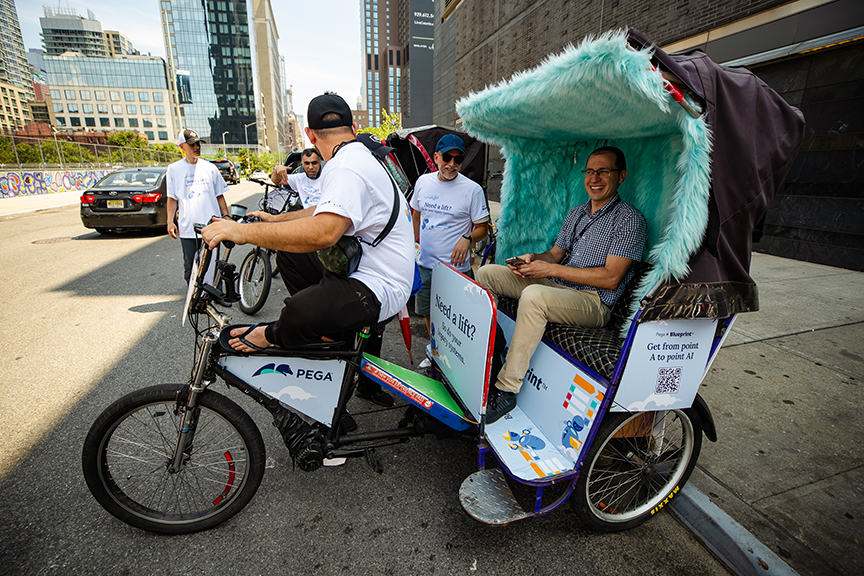
Advertise on a Bike | American Guerrilla Marketing
When you advertise on a bike, you are choosing a format that prioritizes access over scale and precision over volume. A billboard bike moving through a farmers market, a park, or a college campus reaches a specific audience in a specific environment at a specific moment. It does not reach every person in a zip code indiscriminately. It reaches the people in the places your brand cares about, when those people are at their most open and engaged.
We are American Guerrilla Marketing. We plan and execute bike advertising campaigns as part of larger guerrilla marketing programs for brands across the United States. We have deployed billboard bikes in Central Park, on the Chicago Lakefront Trail, along the Venice Beach boardwalk, and at events ranging from small neighborhood markets to major multi-day festivals. We bring strategic thinking to every campaign, not just logistics.
This guide explains what it means to advertise on a bike, what the format requires to work well, where it performs best, and how to build a campaign that delivers genuine results rather than an expensive ride through the park.
The most common reason brands come to us for bike advertising is access. They want to reach urban consumers in environments where other advertising formats either cannot operate or operate at a disadvantage. Parks. Greenways. Campus paths. Farmers markets. Waterfront promenades. These are the spaces where the most desirable urban consumer demographics spend their leisure time, and they are spaces where a bicycle can go and a truck cannot.
A second reason is context. A brand message delivered to someone sitting on a park bench on a Saturday morning reaches a person who is relaxed, alert, and engaged with their surroundings. A brand message delivered through a phone screen reaches a person who is already filtering through dozens of competing messages. The park encounter is not necessarily more common, but it is qualitatively different in a way that matters to memory and to attitude toward the brand.
A third reason is differentiation. Most brands are not running bike ads. The format is common enough to have a production infrastructure behind it, but uncommon enough in most markets that a well-designed bike ad stands out as something worth noticing and worth sharing. That novelty is a real asset, particularly for launches and new market entries where first impression matters most.
AGM Field Note: We have deployed bike ads in environments where they were the only mobile advertising format present for an entire day. A farmers market, a park event, a waterfront festival: in all of these settings, the bike ad operates with zero direct competition for attention from other mobile outdoor formats. That situation is increasingly hard to achieve in any other advertising channel.
The Mechanics of Advertising on a Bike
The core mechanics are simple. An advertising display is attached to a bicycle. A rider operates the bike on a planned route. People who see the bike see the brand message. The planning, creative development, and execution behind that simple structure is where the real work happens.
Choosing the Right Display Format
The display format shapes the creative approach, the production process, the deployment logistics, and the overall campaign budget. Here are the main options:
Printed Panel Displays: Large format printed panels mounted to the bicycle frame. Double-sided to cover both directions of travel. The most common and most budget-accessible format. Best for brand awareness campaigns with straightforward visual messaging.
LED Screen Displays: Electronic panels showing video, animation, or rotating messages. More expensive to produce and operate than printed panels. Significantly more attention-generating in the field. Best for launches, events, and campaigns with a digital content component.
Rider-Worn Displays: A-frame boards, backboards, or branded vests worn by the rider rather than mounted to the bike frame. More mobile and maneuverable than frame-mounted panels in extremely dense environments. Works well in crowded event settings where a large frame-mounted panel would be difficult to navigate.
Sampling-Integrated Cargo Bikes: Cargo bikes with both exterior advertising panels and interior product storage. The rider distributes samples along the route. Combines advertising and direct trial generation in a single format. Premium execution at higher cost than pure advertising formats.
Route Planning
Route planning is the most consequential strategic decision in a bike ad campaign. The right route is one that puts the bike in front of the target audience at the times when that audience is present in the highest concentrations. That requires knowing the audience’s geography, not just their demographics.
We research where the target consumer spends time in each market: which parks, which corridors, which markets, which events. We cross-reference that geography with time-of-day patterns, day-of-week patterns, and event calendars. We build routes around the specific windows when the target audience is most concentrated and most accessible.
A route planned without this research is a bike riding through streets. A route planned with this research is a targeted media placement in human geography.
Rider Selection and Training
The rider is part of the brand experience. In environments where bike ads generate public interest, which is frequently, the rider is the first point of human contact between the brand and the consumer. We recruit experienced urban cyclists who are comfortable with the equipment, knowledgeable about the brand, and capable of handling public interactions with professionalism and warmth. We train every rider on the campaign brief before deployment day.
The creative for a bike ad is not a scaled-up version of a social media post or a condensed version of a print ad. It is its own format with its own requirements, and those requirements are strict.
Viewing Time Is Short
A person on the sidewalk who sees a billboard bike approaching has a viewing window of two to five seconds for the moving bike. If the bike is stationary at a light or stopping point, they may have longer. But the design must work in the two-to-five-second window because most encounters will be exactly that short. Everything in the creative has to be processed and retained in that window.
Copy Volume Is Minimal
We enforce a five-word maximum on bike ad copy. That is not a guideline. It is a production standard we apply to every campaign we execute. Longer copy does not get read in a two-second moving encounter. It gets skipped. The energy that goes into crafting longer messages in this format is energy wasted. Five words, maximum. Three is better. One is sometimes best.
Color Is Functional
Color in bike advertising is not an aesthetic choice. It is a visibility tool. High contrast, bold, saturated colors are more visible at distance and in motion than subtle, muted palettes. We test color choices at the scale and in the light conditions of the actual deployment environment before approving production. A color palette that fails this test does not get produced.
The Logo Is Not Decoration
In most advertising contexts, a logo anchors a design that communicates several things simultaneously. In bike advertising, the logo is the primary payload. If someone registers the logo and nothing else in a passing encounter, the ad has done its job. We size and position logos accordingly: dominant, prominent, immediately recognizable from a distance.
AGM Field Note: We turn down creative that does not meet our bike ad standards. Not because we want to be difficult, but because we have seen poorly designed bike ads fail in the field and we know what works. When a client sends us creative with eight lines of copy and a complex, detailed illustration, we go back with a redesign recommendation before production. The conversation takes an extra day. The campaign performs because of it.
When Bike Advertising Makes Sense and When It Does Not
Bike advertising is not the right format for every brand or every objective. Being clear about when it works and when it does not is part of how we give clients useful strategic advice.
Good Fit: Urban Consumer Brands with Specific Geographic Targets
Consumer brands that know their target demographic is concentrated in specific urban environments, particular neighborhoods, parks, or event-driven gatherings, are the strongest candidates for bike advertising. The format delivers on precise geographic and demographic targeting. If you can name where your consumer is on a Saturday morning, we can put a bike there.
Good Fit: Product Launches in New Markets
Bike advertising generates novelty attention. A new product or brand entering a new city market benefits from the heightened noticeability of the format in that market. The combination of a distinctive format with a new brand message creates a first impression that is harder to achieve through standard advertising channels.
Good Fit: Event Support and Activation
Events that draw large, targeted crowds to accessible outdoor locations are natural fit situations for bike ad campaigns. A bike ad operating at or near a major outdoor event reaches the exact audience that event has already done the work of concentrating.
Less Ideal: Campaigns Requiring Broad, Undifferentiated Coverage
If the goal is maximum raw coverage across a large geography without demographic specificity, transit advertising, digital out-of-home, or traditional out-of-home formats may serve better. Bike advertising is precision access, not saturation coverage. When the campaign objective requires saturation over precision, the format is a poor fit.
Less Ideal: Product Categories That Cannot Be Communicated Simply
Products or services that require extended explanation to generate meaningful consumer interest are difficult to advertise on a bike. The format supports brand recognition and simple value propositions. Complex messaging requires more time and context than a moving bike format provides.
Advertising on a Bike in New York: Specific Zones and Timing
New York is our home market and the market where we have the most experience deploying bike ad campaigns. Here is how we plan campaigns in New York specifically.
The Weekend Park Strategy
The most productive window for bike advertising in New York is weekend mornings in Central Park and Prospect Park. Between 8 a.m. and 1 p.m. on Saturdays and Sundays, these parks draw enormous crowds from the surrounding boroughs. The parks close portions to vehicle traffic on weekends, creating pure pedestrian and cycling zones. A bike ad operating in these parks during weekend mornings reaches a dense, relaxed, highly engaged audience with no vehicle competition for attention.
The Waterfront Strategy
The Hudson River Greenway, the East River waterfront in Brooklyn, and the waterfront parks in Queens carry heavy pedestrian and cycling traffic on both weekday and weekend schedules. The greenway is particularly strong for reaching working-age urban professionals during commute-adjacent hours. We plan greenway routes around the sections with the highest pedestrian density rather than simply riding the full length.
The Market Strategy
New York’s farmers markets and outdoor food markets draw concentrated crowds of the urban consumer demographic that most brands target. Union Square Greenmarket on Saturdays and Wednesdays, the Smorgasburg markets in Williamsburg and the World Trade Center, and the various neighborhood markets across Brooklyn and Queens all create high-density windows of exactly the right audience in a pedestrian-first environment where no vehicle advertising can operate.
The Campus Strategy
New York has more major universities within its borders than almost any other city in the world. Columbia, NYU, Fordham, Brooklyn College, City College, St. John’s, and dozens more create campus environments with dense concentrations of the 18-to-28 demographic. Bike ads on or adjacent to these campuses during academic-year weekday mornings reach this demographic in their native environment in a way that vehicle-based formats cannot replicate.
Advertising on a Bike: The Activation Day
What does an actual bike advertising deployment day look like? Here is the structure of a typical activation.
Pre-deployment: The field supervisor meets riders at the staging location. Bikes are equipped and inspected. Creative panels are verified to be mounted correctly and securely. Riders are briefed on routes, key locations, timing, and how to handle public interactions. The client is notified of deployment start.
First three hours: Riders execute routes, moving through planned corridors and key locations. The field supervisor tracks positions and communicates with riders throughout. Photo documentation begins immediately. Any issues with routes, panels, or conditions are identified and addressed in the first hour.
Mid-shift: The field supervisor checks in with all riders, reviews photo documentation, and assesses whether route adjustments are needed based on real-time conditions. In event-based campaigns, the team adjusts positioning to track crowd movements through the venue.
Final hours: The team executes the planned close-of-shift positions, which are often the highest-density zones based on afternoon crowd patterns. Riders return to the staging location. Panels are packed and equipment is inventoried. Field reports are completed.
Post-deployment: GPS data is compiled. Photos are organized and captioned. Field reports are drafted. QR code and URL data is pulled if applicable. The full report is assembled and delivered to the client within a few business days.
Combining Bike Advertising with Street Teams and Ambassadors
We almost always recommend adding at least one ground-level tactic to a bike ad campaign. The bike generates broad corridor awareness. A street team or brand ambassador at a specific location within that corridor converts that awareness into direct consumer contact.
The street team works from $389.99 per six-hour shift at the standard tier up to $589.99 per shift for a premium team member. Brand ambassador rates follow the same structure with a professional tier at $489.99 per shift that adds deeper product expertise and reporting capabilities.
The combination of a bike generating corridor awareness and a team at a fixed point creating personal interactions is consistently more effective than either format alone. The consumer who encounters the street team after already registering the bike brand has moved from unaware to recognition in a matter of minutes. The team interaction at that point is not a cold introduction. It is a familiar one. That changes how the consumer responds to the outreach.
Talk to Us About Advertising on a Bike
We are a working agency. We build campaigns, execute them in the field, and report on results. If you want to explore whether bike advertising is right for your brand and your market, call us and we will have a direct, honest conversation about it. No pitch decks. No unnecessary complexity. Just a clear discussion of what the format can and cannot do for your specific situation.
Building a Program That Delivers in the Real World
The gap between a field marketing program that delivers genuine results and one that generates an expensive activity report with nothing to show for it comes down to three variables: strategic clarity in the brief, professional quality in the execution, and honest accountability in the reporting. When all three are present, field marketing programs create meaningful, measurable brand outcomes. When any of the three is missing, the budget gets spent without proportional returns.
We start every program engagement with a strategic conversation, not a price negotiation. We need to understand the brand deeply enough to make genuinely useful strategic recommendations. That means understanding the product, the target consumer, the competitive environment the brand operates in, the specific market we are activating in, and the specific outcome the client needs the program to produce. Without that understanding, we can execute tactics competently but we cannot build a program that is strategically sound.
Professional execution is what we are known for and what we protect as the foundation of every client relationship we have. Our field teams are trained, briefed, supervised, and held to clear performance standards. We do not deploy teams without field management. We do not finalize programs without creative review. We do not accept sample quality that does not represent the brand accurately. We do not allow route drift without field supervisor intervention. These standards exist because field marketing quality is the only thing that determines whether a program generates genuine consumer impact or generates the appearance of activity.
Honest reporting is the accountability mechanism that makes the whole system function. We deliver reports that tell clients what actually happened: where the program was strong, where it was weak, what we did to address problems when they arose, and what we recommend for the next program cycle based on what we learned. We do not optimize our reports for optics. We optimize them for usefulness. A client who gets an honest, useful report from a program that underperformed in specific areas can make better decisions with that information than a client who gets a glowing report that conceals what went wrong.
Field Marketing Program Economics: Getting Value from Your Investment
Field marketing programs are an investment, and like any investment, they require a clear-eyed view of what they return relative to what they cost. Here is how we think about the economics of field marketing across the main program types we execute.
Street team programs generate a specific type of value: direct, human-scale brand encounters with the target consumer in the physical environments where they spend their time. The cost of a six-hour shift with a trained, briefed, supervised street team member running from $389.99 at the standard tier to $589.99 at the premium tier reflects the cost of a professional who represents your brand competently in every interaction they conduct during that shift. The return on that investment is the number and quality of direct brand encounters generated during the shift and the downstream brand recognition and purchase consideration that those encounters produce over time.
Sampling programs generate a different type of value: direct product trial among the target consumer in contextually appropriate environments. The cost of a sampling program includes specialist staffing, sample production and logistics, equipment, field management, and reporting. The return is measured in trial volume, purchase intent lift, retailer velocity data, and long-term brand adoption among the consumers who had a positive first product experience. For brands with genuinely strong products, the ROI on well-executed sampling programs is among the highest in the marketing mix.
Mobile advertising programs, including billboard bikes, LED display bikes, and vehicle-based advertising, generate the value of brand presence in premium access environments. The cost reflects the unique access value of the format: being in Central Park, on the Lakefront Trail, at a major outdoor market is not the same as being on a commercial street. The premium access environment is what the format delivers and what justifies the investment relative to static or vehicle-restricted formats.
Across all program types, the most reliable way to maximize return on investment is to be specific about the objective, design the program specifically to achieve that objective, execute at a professional standard, and measure against the specific outcome the program was designed to produce. Generic programs generate generic results. Specifically designed, professionally executed programs generate the specific outcomes they were built for.
Common Questions We Get from Brands Starting Field Marketing Programs
We have introductory conversations with brands evaluating field marketing programs every week. Here are the questions we hear most often and the honest answers we give.
“How much does a field marketing program cost?” It depends entirely on the scope. A two-person street team for one week in one market is a modest investment. A twenty-city sampling program with twenty specialists per market and full field management is a significant one. We size programs based on objectives and build budgets based on the specific scope required to achieve them. We do not have a standard package price because no two programs are the same.
“How do I know if field marketing will work for my brand?” We evaluate fit based on the brand, the product, the target consumer, and the specific objective. For consumer brands with genuinely strong products targeting specific urban demographics in environments where field marketing operates effectively, it almost always works when it is executed at quality. For brands where the fit is less clear, we say so and recommend whether a test program or a different approach makes more sense.
“How do you ensure the team represents our brand appropriately?” Through recruitment based on genuine product-audience fit, thorough pre-deployment training, active field management throughout every shift, and honest performance reporting that holds teams and supervisors accountable for quality. We have multiple layers of accountability built into every program precisely because brand representation quality is the non-negotiable foundation of field marketing value.
“What if we are not happy with the results?” We have a direct conversation about it. We review the program data together, assess what worked and what did not, and make a recommendation about how to adjust the next program cycle to address the shortcomings of the current one. We do not tell clients that disappointing results are an inherent limitation of the format. We assess whether the issue was strategic, creative, or executional and address it specifically in the next program design.
Frequently Asked Questions
How do I know if my brand is right for bike advertising?
If your target consumer spends time in urban outdoor environments, particularly parks, waterfronts, markets, or campuses, and if your brand message can be communicated with a bold visual and minimal copy, bike advertising is likely a good fit. We are happy to evaluate your specific situation and tell you honestly if we think the format serves your goals.
What cities do you deploy bike advertising in?
We operate in all major U.S. markets including New York, Chicago, Los Angeles, Miami, Boston, Washington DC, San Francisco, Philadelphia, Atlanta, and Seattle among others. We can accommodate multi-market campaigns with coordinated execution across cities.
How long does it take to produce bike ad panels?
Standard printed panels typically take five to seven business days from approved artwork to finished production. LED display bikes may require additional lead time depending on display availability and configuration. We coordinate all production within the campaign timeline.
Can we change the creative during a multi-week campaign?
Yes. Panel swaps are feasible between deployment weeks in a multi-week campaign. We need the new creative at least five to seven business days before the swap date to allow for production. Creative changes during an ongoing campaign are a way to test messaging variations or adapt to evolving campaign priorities.
How do bike ads perform compared to digital advertising for brand awareness?
They are fundamentally different mechanisms. Digital advertising reaches consumers on screens with demographic targeting but in an environment saturated with competing messages. Bike advertising reaches consumers in their physical environment with no digital competition, in a context that tends to generate stronger attention and memory formation. Most campaigns benefit from both formats running simultaneously rather than one replacing the other.
Do bike ads get photographed and shared on social media?
Well-designed bike ads in visually interesting environments absolutely get photographed and shared. LED bikes in particular generate significant social content from bystanders. We plan routes with this in mind and design creative that is photogenic as well as legible. The organic content created by bystanders extends campaign reach beyond the direct audience of the bike itself.
What is the typical duration for a bike ad campaign?
Duration ranges from a single day at a major event to multi-week ongoing programs. For neighborhood awareness campaigns, we recommend a minimum of five to seven days to allow enough repeated brand contact to build recognition. For event-specific campaigns, one to three days timed around the event are typical. We discuss optimal duration based on the specific campaign objective during planning.
Can I see a report of where the bikes went after the campaign?
Yes. GPS route data is part of every campaign report we deliver. You will see the specific routes the bikes operated, the times they were in each zone, and the field photos that document the deployment. We do not ask you to take our word for campaign execution. We show you.
Is there a minimum spend for bike advertising?
We do not have a fixed minimum, but we do have a practical minimum below which a campaign cannot be executed with the quality standards we maintain. A single bike, single day, with field management, printed panel, and reporting has an associated cost. We discuss the specific numbers when you contact us with your campaign parameters.