Wall Posting: Outdoor Poster Advertising on Authorized Surfaces | AGM
Wall posting puts your message at eye level on the streets your audience walks every single day. No buying a schedule. No bidding on placement. Scout the right streets, post on the right surfaces, and your message is there every time they walk by.
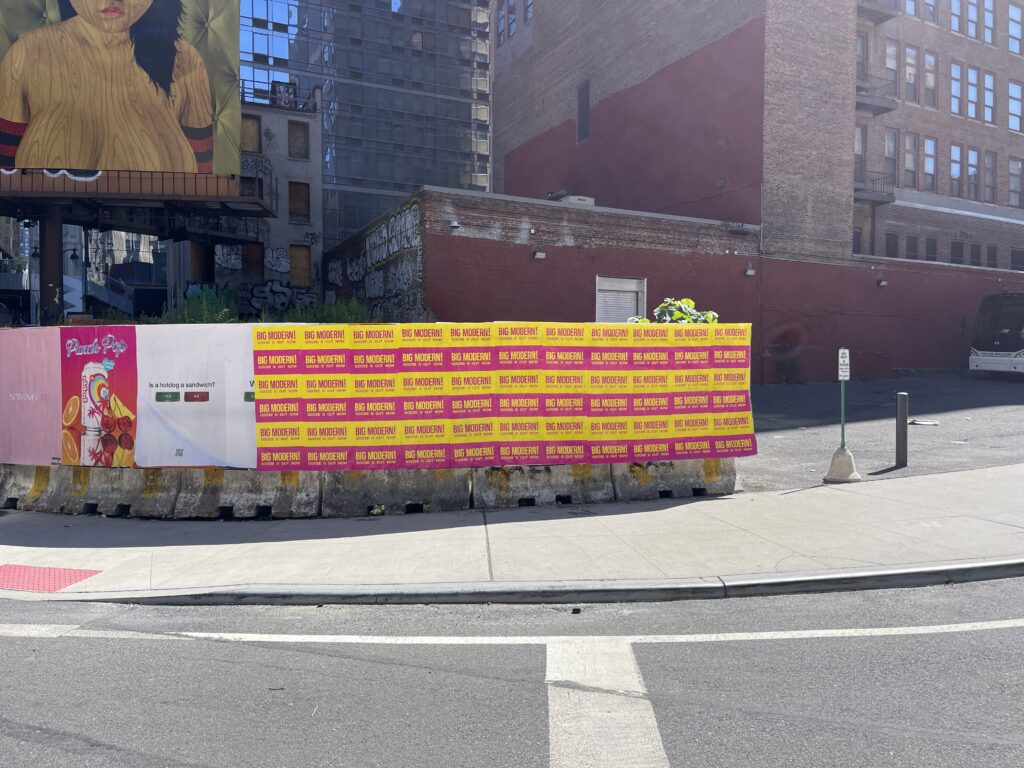
Wall posting is a street-level outdoor advertising format that places printed posters directly on high-traffic urban surfaces at pedestrian eye level. Construction barriers, scaffolding columns, utility boxes, building walls, and fenced surfaces in high-foot-traffic neighborhoods — these are the canvas. The posters are affixed using wheatpaste or adhesive and positioned to intercept the natural pedestrian flow on the most-walked streets in the target area.
The format operates on a simple principle: repetition builds familiarity, and familiarity drives action. A poster on the daily commute route of someone who fits the target audience gets seen five times a week for two to three weeks. That is ten to fifteen separate exposures for one placement. Multiply that by the number of placements in the campaign, and the cumulative familiarity generated by a well-placed wall posting campaign is substantial relative to the cost of production and execution.
At American Guerrilla Marketing, wall posting is one of our core street-level services. We have run campaigns across all five New York City boroughs for entertainment brands, consumer products, local businesses, events, and startups. We scout neighborhoods before execution, build fully customized placement maps, and handle all production and placement logistics. This guide covers how the format works, how to design for it, how we build a placement strategy, and what to expect from a campaign.
Wall posting creates neighborhood-level visual presence by placing posters at the eye-level locations pedestrians naturally look as they move through the urban environment. Unlike billboard advertising, which positions messages above the sight line and requires conscious upward attention, wall posting operates in the natural pedestrian visual field. The viewer does not have to change their orientation or interrupt their movement to encounter the poster. It meets them where they are already looking.
The campaign is built around concentration and frequency rather than maximum geographic spread. Distributing 400 posters across a single neighborhood produces dramatically higher per-individual frequency than distributing 400 posters across ten neighborhoods. The person who walks past a poster on their morning commute, sees it again on their lunch break, and encounters it a third time on the way home has experienced three separate exposures in a single day. That accumulation of exposures is what creates the familiarity that drives follow-through.
The placement strategy is built around the pedestrian corridors that specific target audiences actually use. We do not use statistical averages. We conduct on-foot scouting of every neighborhood before a campaign to identify the specific streets, blocks, and corner positions where the target audience is most concentrated. A placement on the most-walked block in a neighborhood produces many times more target audience exposures than a placement on a parallel block one street over that sees lower foot traffic volumes.
Wall Posting Surfaces: What Works and Why
Not every wall is an effective posting surface. The quality of a placement is determined by foot traffic volume, surface condition, poster longevity at that specific surface, and visibility angle to the pedestrian flow. We evaluate all four factors during scouting and select the surfaces that score highest on the combination, not just on one dimension.
Construction Barriers
Construction barriers are the highest-value wall posting surface in New York City. Active construction projects create extensive flat wooden or metal panel surfaces that face the sidewalk at pedestrian eye level, run for half a block or more in dense neighborhoods, and typically persist for months or years. The surface holds paste exceptionally well, the viewing angle is ideal for pedestrians on the adjacent sidewalk, and the barrier context means pedestrians walk close to the surface rather than across the street. A well-placed poster on a construction barrier in a high-foot-traffic neighborhood is one of the most cost-effective outdoor placements available.
Scaffolding
Scaffolding creates linear street-level surface area along the full length of a building under renovation or repair. Multiple scaffolding placements along a single run create frequency within a single block — a pedestrian walking the full length of a scaffolded building passes three or four poster placements in rapid succession. This concentrated repetition within a single viewing distance can register more strongly than spaced placements at the same total quantity.
Utility Boxes and Signal Cabinets
Utility boxes and signal cabinets at street corners are compact, eye-level surfaces positioned at the highest-traffic point on a block: the intersection. A pedestrian at a crosswalk waiting for the light faces the utility box directly. The viewing time at a crosswalk is 15 to 30 seconds — long enough to read a complete headline, a supporting line, and a QR code or phone number. Corner utility boxes are among the most valuable small-format placement surfaces in an urban campaign.
Building Walls
Building walls at pedestrian level are appropriate for wall posting where the surface condition, material, and context are suitable. Smooth stucco and brick walls in commercial areas, particularly on non-retail-facing sides of buildings where there is no storefront competition for visual attention, can carry larger-format posters effectively. Wall surfaces require more care in paste application than barrier panels but can hold placements for longer periods when the surface is in good condition.
AGM Field Note — Scout Before You Place: We never execute a wall posting campaign without an on-foot scout. Maps and satellite imagery identify potential surfaces but do not reveal the actual foot traffic patterns, the condition of the surface, or what competing posters are already present. A surface that looks ideal on a map may turn out to face away from the primary pedestrian direction, or may already be so saturated with competing posters that a new placement will be covered in 48 hours. The scout is where the placement quality is actually determined. We budget at least half a day of scouting per neighborhood before any execution begins.
Poster Formats for Wall Posting Campaigns
Wall posting campaigns use multiple poster sizes depending on the surface type, the campaign objective, and the visual scale needed to communicate the message effectively in each specific placement environment.
Small-Format: 9×12 and 11×14 Inches
Small-format posters are used for tight placements on utility boxes, scaffolding columns, and narrow barrier panels where larger formats do not fit or would look disproportionate relative to the surface. These formats are read at close range — two to five feet — and deliver their message at pedestrian walking pace with the viewer at normal sidewalk proximity to the surface. The small format allows higher placement density: more placements per linear foot of surface, more placements per campaign budget.
Mid-Format: 18×24 and 24×36 Inches
Mid-format posters carry more visual weight and can be read at greater distance — five to fifteen feet — making them appropriate for open wall surfaces, wide barrier panels, and scaffolding runs where the poster has more open space around it. At this scale, the design can carry more content without losing legibility: a larger image, a sub-headline, or additional supporting detail in the body copy. Mid-format is the most common format for wall posting campaigns that prioritize visual impact alongside reach.
Large-Format: Multi-Panel
Large-format placements spanning multiple barrier panels or covering extended wall surface create a visual statement that operates at a scale beyond typical street-level advertising. These placements attract attention from across the street and down the block, creating a visual anchor in the neighborhood that registers on a single exposure and is difficult to miss over repeated encounters. Large-format placements are typically used for high-priority campaign launches, entertainment or cultural events, or brands for whom the visual scale is part of the brand message itself.
Format
Best Surface
Readable Distance
Campaign Role
9×12 inch (snipe)
Utility boxes, narrow panels
2–5 feet
High-density street saturation
11×14 inch (jumbo snipe)
Barrier panels, scaffolding columns
3–8 feet
Corridor frequency, broader corridors
18×24 inch
Open barrier panels, wall sections
5–15 feet
Visual weight, mid-range viewing
24×36 inch
Open walls, large barrier sections
10–30 feet
Visual dominance, cross-street visibility
Multi-panel large-format
Extended barrier runs, building walls
30–100+ feet
Visual anchor, brand statement
Designing for Wall Posting
Wall posting design is governed by the same core constraint as every street-level format: the viewer is in motion, the viewing time is limited, and the visual environment is competing for attention. Design for the two to four seconds of walking-pace attention the poster realistically gets, not for the extended viewing time of someone who has already stopped to read it.
Maximum Contrast
The poster has to separate visually from its background: the surface it is posted on and the urban environment surrounding it. High contrast between the poster’s primary elements and the background is the first requirement. Black on yellow, white on black, red on white — combinations that are visible in variable outdoor lighting and against the visual noise of commercial urban streets. Pastel palettes, gradient backgrounds, and low-contrast compositions disappear against urban visual noise. High contrast is not a stylistic preference; it is a functional requirement for street-level posters.
Short, Specific Headline
Five words or fewer for the primary headline. At walking pace and street-level scale, more than five words does not get read completely — the viewer categorizes the design as “too much” and moves on without processing it. Every word in the headline must earn its place by contributing directly to communication of the offer or the call to action. Words that are present to complete a sentence grammatically but do not add meaning are candidates for removal. “Best pizza in Brooklyn” delivers. “Experience the very best Brooklyn has to offer in artisanal pizza” does not.
One Call to Action
One call to action. Not three. Not two. One. A URL, a phone number, or a QR code — choose the single most actionable response mechanism for the target audience and make it the clearest element on the poster after the headline. Multiple calls to action create decision paralysis in a two-second viewing window. The viewer who might have scanned a QR code decides not to when they also have to choose between a URL, a phone number, and a social media handle. Remove the choice. Make the action obvious.
Hierarchy and White Space
Wall posting posters need clear visual hierarchy. Headline dominates. Call to action is clearly secondary but visible. Everything else is supporting detail. White space — areas of the poster with no content — is not wasted space. It gives the eye a place to rest and makes the primary elements stand out more clearly against their surroundings. Designs that fill every square inch of the poster surface often communicate less effectively than designs that use 60 percent of the surface and leave the rest open.
AGM Field Note — Test at Scale: Before finalizing a wall posting design for production, we print a test poster at the intended size and pin it to a wall. We step back to the distance a pedestrian would be when they first encounter it on the street — typically 5 to 15 feet for mid-format, 30 to 50 feet for large-format — and assess whether the headline registers immediately, the call to action is clear, and the visual contrast holds against a real surface rather than a screen. Designs that look strong on a laptop screen consistently look different when pinned to a wall at actual viewing distances. The physical test eliminates surprises at production scale.
Campaign Planning: From Brief to Street
A wall posting campaign moves from client brief to execution in two to three weeks. The process involves a brief intake, neighborhood scoping, scouting, placement map development, design review, production, and execution. Understanding the full sequence helps clients plan campaign timing correctly and ensures the campaign is ready to launch on schedule.
Brief and Scope
The brief covers target neighborhoods, target audience, campaign objective, desired poster format, quantity, and timeline. We use this information to build the initial campaign scope — which neighborhoods, which formats, how many placements, what combination produces the best frequency within the budget. For campaigns with existing design assets, we review the files for print readiness and flag any issues before going to production.
Scouting
Scouting happens after the brief is confirmed and before any production. We walk the target neighborhoods on foot, photograph candidate surfaces, assess foot traffic patterns at different times of day, and note any competitive poster saturation that would reduce placement longevity or visibility. The scout results in a placement map that identifies specific surfaces, addresses, and format assignments for the campaign.
Production and Execution
Production covers printing and paste preparation. Execution is the physical placement of posters at all planned locations. For a campaign of 400 to 800 placements in a concentrated neighborhood area, execution typically takes one to two days. We provide post-execution documentation including location photography and a placement summary confirming coverage as planned.
Wall Posting in the Context of a Broader Campaign
Wall posting creates neighborhood-level visual presence and builds familiarity through repeated exposure. It is an awareness-building format, not a conversion-capture format by itself. The best results come from combining wall posting with conversion-capture formats that reach the audience after awareness has been established.
Community board tear-off tab posters and take-one flyer displays in the same neighborhood serve as conversion-capture formats. A resident who has walked past the wall posting campaign on their commute for two weeks arrives at their neighborhood laundromat already familiar with the offer. When they see the tear-off tab poster on the community board, the familiarity significantly reduces the hesitation to pull a tab. The wall posting did the awareness work. The community board format captures the lead. Together they produce a better conversion rate than either format alone.
Hand-to-hand flyer distribution can function as a third layer that reaches people in transit mode who may not have a regular route past the wall postings or regular access to the community boards where the tab posters are placed. Distribution creates high contact volume on the distribution day. Wall posting creates sustained frequency between distribution events. Community board formats capture ongoing motivated leads. The three layers together address the full spectrum of audience contact modes: active distribution, passive street presence, and self-selected community board engagement.
Who Uses Wall Posting
Wall posting is used by a wide range of clients whose target audience is concentrated in specific New York City neighborhoods and who benefit from repeated visual presence in those neighborhoods over a two-to-four week campaign window. Entertainment brands use it to build pre-release or pre-event momentum in the neighborhoods where their audience lives. Consumer product brands use it to establish neighborhood-level visual presence when entering a new market. Local businesses use it to build name recognition in their immediate trade area. Musicians, artists, and event producers use it to drive attendance by reaching the audience in the places they move every day.
The common thread is geographic concentration. Wall posting is most cost-effective when the target audience is identifiable and geographically concentrated. The more focused the target area, the higher the per-individual frequency the campaign generates at a given placement quantity. For brands with a genuinely national or city-wide audience reach that is not concentrated in specific neighborhoods, other formats at greater scale are more appropriate. For brands with a clear neighborhood-level target, wall posting in that specific neighborhood is one of the highest-frequency, most cost-efficient street-level formats available.
Wall Posting Across New York City’s Five Boroughs
Each of New York City’s five boroughs has distinct characteristics that affect wall posting strategy, surface availability, and the audience profiles that campaigns reach. Understanding these distinctions helps build placement maps that are calibrated to the specific audience and corridor dynamics of each area rather than treating the city as a uniform environment.
Manhattan
Manhattan’s high-density commercial and residential neighborhoods produce the highest pedestrian foot traffic volumes of any borough. SoHo, the Lower East Side, Chinatown, Harlem, and Washington Heights are among the strongest wall posting markets. Construction is constant in Manhattan, creating a continuously refreshed supply of construction barrier surfaces in high-foot-traffic corridors. The concentration of pedestrians in Manhattan means that a well-placed poster on a major commercial street in SoHo will accumulate more individual exposures per day than the same poster on a comparable street in most other parts of the city.
Brooklyn
Brooklyn is the most active wall posting market for consumer brands, entertainment, and local services targeting young adult audiences. Williamsburg, Bushwick, Crown Heights, Park Slope, and Bed-Stuy are all strong markets with active street-level advertising cultures and high community board engagement. Brooklyn neighborhoods tend to have dense residential populations with high neighborhood-investment levels, which means that a brand recognized from street-level posters tends to be discussed and referred within the community more actively than in lower-density neighborhoods.
Queens
Queens offers access to diverse, dense neighborhood audiences that are often underserved by street-level advertising campaigns. Astoria, Jackson Heights, Flushing, Jamaica, and Ridgewood are among the most productive Queens markets. The linguistic and cultural diversity of Queens neighborhoods means that campaigns with multilingual creative or culturally specific messaging can reach audiences with very high relevance per contact. The surface availability in Queens is strong in commercial corridors, with significant construction activity in many neighborhoods generating quality barrier panel placements.
The Bronx
The Bronx is one of the most cost-effective wall posting markets in New York City because competition for street-level surface space is lower than in Manhattan and Brooklyn, while pedestrian foot traffic in the borough’s commercial corridors is substantial. Fordham Road, the Grand Concourse, and the Southern Boulevard corridor in the South Bronx are high-foot-traffic streets with strong wall posting surface availability. For brands specifically targeting Bronx audiences, the market offers high frequency at lower production cost than comparable coverage in Manhattan.
Staten Island
Staten Island’s lower population density and car-dependent geography make it a less typical market for pedestrian-oriented wall posting. However, the borough’s transit corridors near the Staten Island Ferry terminal and along Victory Boulevard see concentrated pedestrian traffic during commute hours that can support a targeted campaign at lower cost than comparable pedestrian-level coverage elsewhere in the city.
Maintaining Poster Longevity in the Field
A wall posting campaign’s effective reach is partly a function of how long posters remain visible and intact after placement. Placements that survive three weeks deliver three times the cumulative exposure of placements that last only one week at the same location. Maximizing longevity is therefore a meaningful campaign optimization lever that operates at the production and placement level rather than at the design level.
Paper stock selection directly affects field longevity. Heavier-weight coated papers — 80 lb gloss text and above — resist moisture absorption significantly better than uncoated papers. Moisture is the primary cause of premature poster failure in outdoor and semi-outdoor NYC conditions. A poster that absorbs humidity and begins to curl, wrinkle, or separate from the surface fails visually before it fails physically. The additional cost of heavier coated stock per unit is typically $0.05 to $0.15 per poster, which is negligible relative to the placement and production cost of the campaign as a whole.
Paste application technique affects surface adhesion and resistance to competing posters. A thorough, even paste application that covers the full back surface of the poster, with a top coat of paste applied over the face of the posted poster, creates a surface bond that is significantly more resistant to peeling, curling, and being covered by competitors. The top coat also adds a degree of weather protection to the paper face. Corners and edges are the highest-risk areas for peeling — ensure full coverage at these points on every placement.
Surface selection is the most important longevity variable. Construction barrier panels, which are replaced and repainted periodically but otherwise remain stable, offer better longevity than street furniture surfaces that are subject to regular cleaning, repainting, or removal by city maintenance crews. Smooth, flat surfaces hold paste better than rough or textured surfaces. Shaded surfaces protected from direct sunlight and rain exposure last longer than fully exposed surfaces in the same weather conditions.
Frequently Asked Questions
What is wall posting?
Wall posting is a street-level outdoor advertising format that places printed posters on high-traffic urban surfaces including construction barriers, scaffolding columns, utility boxes, and building walls at pedestrian eye level. Posters are affixed using wheatpaste or adhesive and positioned to intercept foot traffic on the most-walked streets in a target neighborhood.
What poster sizes are used in wall posting campaigns?
Wall posting campaigns use a range of formats. Small-format posters (9×12 or 11×14 inches) work on utility boxes and tight barrier panels. Mid-format posters (18×24 or 24×36 inches) provide more visual weight on open wall surfaces. Large-scale formats can span multiple panels for maximum visual impact in high-traffic corridors.
How long do wall posting campaigns typically run?
Most wall posting campaigns run two to four weeks, which is the typical active lifespan of a well-placed poster in New York City before weather, competing posters, or surface wear reduces its impact. Campaigns with specific event windows can be planned to peak during the highest-relevance period. Ongoing campaigns replenish placements on a rolling cycle.
What neighborhoods does AGM cover for wall posting?
We run wall posting campaigns across all five New York City boroughs. Commonly targeted neighborhoods include SoHo, the Lower East Side, Williamsburg, Bushwick, Astoria, Crown Heights, Harlem, Washington Heights, and the South Bronx. Placement maps are custom-built per campaign based on the client’s target audience and geographic focus.
How is a wall posting campaign different from a snipe campaign?
Snipe campaigns use small-format posters (9×12 or 11×14 inches) for tight street-level placements at high density along specific corridors. Wall posting campaigns may include both small-format and larger-format placements, operating at a broader visual scale. Both formats place posters at pedestrian eye level in high-traffic locations; the distinction is primarily in poster size and the visual scale of the campaign presence.
How do you design an effective wall posting poster?
Effective wall posting design requires maximum contrast, a short bold headline of five words or fewer readable at walking pace, and one clear call to action. At larger formats, more visual complexity is possible, but the core rule holds: a pedestrian has two to four seconds to process the poster while moving. The headline and call to action must register in that window.
What surfaces are used in wall posting campaigns?
Primary surfaces include construction barriers (plywood or metal panels adjacent to active construction), scaffolding columns and panels, utility boxes and signal cabinets at street corners, and building walls where surface access and conditions are appropriate. We scout every market in advance to identify the highest-quality surfaces in the target corridor.
Can wall posting be combined with other outdoor formats?
Yes. Wall posting works well alongside hand-to-hand flyer distribution, community board tear-off tab posters, and larger format outdoor placements. Street-level wall posting creates neighborhood saturation and frequency that builds familiarity. Community board formats capture the motivated leads who are ready to act. Both together cover the full range from awareness to conversion.
How does AGM scout wall posting locations?
We conduct on-foot neighborhood scouting before every campaign. The scout identifies the specific streets, intersections, and surfaces with the highest foot traffic from the client’s target audience, assesses surface quality and longevity potential, and maps the optimal placement route for the campaign quantity. Placement maps are shared with clients and adjusted based on client input before execution begins.
How do I get started with a wall posting campaign?
Call (646) 776-2770 or email [email protected] with your target neighborhood, campaign timeline, and any design files or messaging you have. We will scope the campaign, build the placement map, walk you through production and execution, and confirm the full plan before anything goes on the street.