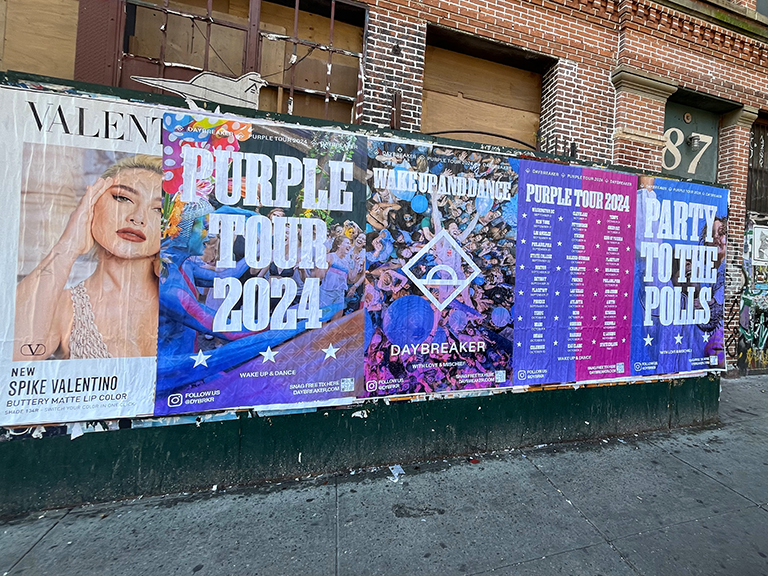
Flyposting costs are not mysterious, but they’re also not standardized in the way that a programmatic digital buy is. The price you pay depends on the city, the operator, the number of locations, the poster format, the timeline, and a handful of other variables that make it genuinely difficult to give a useful number without specifics. This guide gives you the framework for thinking about flyposting costs in 2026 — real ranges, the variables that move prices up or down, and what to watch for in quotes to make sure you’re comparing apples to apples.
The short version: a basic single-city campaign in a major US or UK market costs $3,000-$8,000 USD at the entry level; mid-scale campaigns run $10,000-$30,000; large-scale or multi-city launches can reach $50,000-$150,000 or more. But the more useful number is the cost per location, because that’s what lets you compare different proposals and make informed decisions about where to spend your budget.
Here’s how the math works, and what it means for planning.
The Basic Cost Components
Every flyposting campaign has two distinct cost elements: operator fees (the posting labor and surface access) and print production (the physical posters themselves). Sometimes these are bundled into a single quote; sometimes they’re quoted separately. Understanding both is necessary to budget accurately.
Operator Fees
Operator fees cover surface access rights (the cost of using licensed surfaces, often including a component for the site landlord agreement) and the labor of the posting crew. In most markets, operator fees are quoted on a per-location basis, with volume discounts at higher quantities. In 2026 rates for major US markets:
- New York City: $25-$45 per location for standard single-sheet posting
- Los Angeles: $20-$35 per location
- Chicago, Boston, San Francisco: $20-$40 per location
- Secondary US markets (Austin, Nashville, Portland): $15-$25 per location
In the UK, rates are typically quoted in GBP:
- London (central boroughs): £20-£40 per location
- London (outer boroughs): £15-£25 per location
- Manchester, Birmingham, Bristol: £15-£25 per location
- Edinburgh, Glasgow: £15-£22 per location
These are per-location rates for standard single-sheet posting. Large-format multi-sheet installations are quoted differently — typically as a unit rate for the installation rather than a per-sheet rate.
Print Production
Print costs depend on format size, paper stock, quantity, and turnaround time. For standard flyposting formats on a 70-80gsm uncoated stock:
- Standard single-sheet (approximately 24×36 inches): $1.50-$3.50 per unit at print runs of 200-500
- Quad-crown UK format (30×40 inches): $2.00-$4.50 per unit at similar runs
- Four-sheet (40×60 inches): $4.00-$8.00 per unit
Rush print premiums of 25-50% apply when turnaround is under 72 hours. Specialty stocks (fluorescent, textured, weatherproof) add 30-80% to base print cost. Print quantities typically need to exceed the posting count by 10-15% to account for damage in transit and crew backup stock.
For a typical 200-location single-sheet campaign in a major US city: operator fees run $5,000-$8,000, print production on 250 posters runs $500-$900, and proof-of-posting documentation is included. Total campaign cost: $5,500-$9,000. This is a useful baseline for initial budget planning in major US markets.
City-by-City Cost Comparison
| City |
100 Locations |
300 Locations |
600 Locations |
| New York City |
$3,500-$5,500 |
$9,000-$14,000 |
$18,000-$28,000 |
| Los Angeles |
$2,500-$4,500 |
$7,000-$12,000 |
$14,000-$22,000 |
| London (Central) |
£2,500-£4,500 |
£7,000-£12,000 |
£14,000-£24,000 |
| Chicago |
$2,500-$4,000 |
$6,500-$11,000 |
$13,000-$20,000 |
| Mexico City |
$1,500-$3,000 |
$4,000-$8,000 |
$8,000-$15,000 |
These figures include operator fees. Print production is additional unless specifically bundled. Ranges reflect the difference between entry-level operators and premium operators with documented surface networks and full proof-of-posting capability.
What Drives Costs Up
Timing and Rush Premiums
Rush campaigns — anything requiring posting within 72 hours of brief confirmation — carry premiums of 25-40% over standard rates. The premium reflects the operator’s need to prioritize your campaign over existing scheduled work and to source and deliver crew on short notice. If you can give four to six weeks’ lead time, you avoid this entirely.
Large-Format Installations
Multi-sheet installations that create a single large image from eight, twelve, or sixteen poster sheets require more labor per location, more paste, and careful crew coordination to align the sheets correctly. These typically cost 3-5x the rate of a standard single-sheet location. When a brand needs a specific large-format hoarding for a key location, the installation labor can be significant — but the visual impact usually justifies it.
Overnight-Only Posting
Some operators have access to surfaces that require overnight posting — early-morning installation before business hours. This is common in heavily pedestrianized areas where daytime crew work is impractical. Overnight crew rates are typically 25-50% higher than daytime rates. For campaigns where timing is critical (everything posted before a launch date), overnight posting is often the only way to guarantee a specific morning roll-out.
Campaign Duration and Refresh
A campaign running for four weeks with a two-week refresh at the midpoint costs significantly more than a one-time posting of the same location count. Refresh campaigns typically cost 60-75% of the original posting cost, because some labor (surface preparation, paste application) is repeated but at reduced scale since some original posters may still be in reasonable condition.
Multi-City Simultaneous Execution
Running the same campaign across New York, Los Angeles, Chicago, and London simultaneously requires coordination across multiple operator partners, centralized proof-of-posting collection, and often a project management premium. Multi-city campaigns typically cost 10-20% more per city than single-city campaigns because of the coordination overhead.
What Reduces Costs Without Reducing Effectiveness
The most effective cost reduction is geographic concentration. A campaign of 200 locations concentrated in three neighborhoods in a single borough will almost always outperform 200 locations scattered across eight neighborhoods in four boroughs — because the concentrated campaign creates the visual saturation that makes the format work, while the scattered campaign creates isolated impressions with no cumulative effect. This means you can often reduce location count and cost without reducing campaign impact.
Standard poster formats are significantly cheaper to produce than custom sizes. If your creative can be adapted to the operator’s standard format (rather than requiring custom sizing to fit specific surfaces), the print savings are meaningful at any volume.
Four-to-six weeks of lead time eliminates rush premiums, allows the operator to optimize their surface selection for your specific geographic and audience requirements, and gives time for proper print production without expedite fees.
The most common mistake in flyposting budgeting is treating location count as the primary metric. 300 locations in the wrong neighborhoods is a worse investment than 100 in the right ones. Budget for quality of placement, not just quantity.
How to Evaluate a Quote
When you receive a flyposting proposal, check these things before accepting it:
- Is print included or separate? Get both numbers before comparing quotes from different operators.
- What does “location” mean? Is it a single-sheet posting or a panel? Some operators quote panels (which may be multiple sheets) as a single location.
- Are surfaces licensed and documented? Ask for confirmation and, for any large campaign, ask for a sample of documentation.
- Does it include proof-of-posting? GPS-tagged photography at every location should be standard. If it’s not included, ask why and whether it can be added.
- What are the refresh/extension rates? Know the cost of adding two weeks to the campaign before you commit, so you’re not negotiating from a weak position later.
- What is the liability if a location is removed? Does the operator replace removed postings, or does the responsibility fall on you?
Line-Item Flyposting Cost Breakdown
The most useful way to understand flyposting costs isn’t through ranges — it’s through a line-by-line breakdown of what you’re actually paying for. Here’s what a real mid-scale flyposting campaign costs in 2026, broken down to the individual cost center.
Scouting Day
Before a campaign executes, an operator needs to confirm that surfaces in the proposed location plan are available, in usable condition, and accessible. A scouting day for a 200-location London campaign typically runs 4-6 hours of field time, sometimes with a vehicle. Cost: £150-£300 for the scouting time, sometimes folded into the overall quote, sometimes billed separately. For campaigns where the client has specific location requirements — a particular street, proximity to a specific venue — scouting may need to happen twice (once for initial planning, once for final confirmation close to posting date).
Print Production
In the UK, A0 lithograph printing (841 x 1189mm on 90gsm uncoated stock) runs approximately £0.80-£2.50 per sheet at runs of 200-500, depending on printer, run size, and current paper costs. Digital print on the same format runs £1.80-£4.00 per sheet — faster turnaround but higher unit cost. B1 format (707 x 1000mm) prints at slightly lower unit cost due to smaller sheet area. In the US, a standard 24×36 inch poster on 80lb uncoated stock runs $1.20-$3.50 per unit at similar quantities. A4-print-on-demand from local printers is the wrong way to produce flyposting stock — the paper is too light and the sizes are wrong.
Paste Crew — 2 Operators, 3-5 Hours Overnight
A posting crew of two people working a 3-5 hour overnight window is the standard unit. Crew labor in London runs £120-£200 per person per session; in New York it’s $150-$250 per person. Add vehicle hire or fuel costs — typically £40-£80 per night in London, $50-$100 in New York. A single overnight session covering 60-80 locations in London: crew labor £240-£400, vehicle £50, paste materials £15-£25. Total crew cost per overnight: £300-£475.
Documentation
GPS-tagged photography at every location, processed into a proof-of-posting report, is either included in the operator fee or billed as a £50-£150 add-on depending on the operator. Don’t skip this. The documentation is how you verify the campaign executed as specified and have evidence for internal reporting.
Refresh Cycle
A two-week campaign with one refresh at the midpoint requires a second posting crew run covering locations where posters have weathered, been removed, or been obscured. Refresh campaigns cost 50-70% of the original posting cost per refreshed location, because some preparation work is already done but crew labor, paste, and transport are repeated. For a 200-location campaign in London, a single refresh run costs roughly £800-£1,400 in crew and materials.
Full cost breakdown for a 200-location, 4-week campaign in London including one refresh: print (240 sheets A0 at £1.40 avg) £336 + crew for 3 overnight sessions £900-£1,400 + documentation £100 + scouting £200 + operator margin and surface access fees £1,800-£3,000. Total: approximately £3,300-£5,000 + VAT. This is a real mid-market London campaign cost, not a minimum or a maximum.
How to Set a Flyposting Budget That Actually Works
Budget planning for flyposting is most useful when structured around three campaign scales: minimum viable, mid-range, and saturation. Each has a specific logic.
Minimum Viable Campaign (50 Sites)
Fifty locations is the floor for a flyposting campaign that creates any meaningful visual presence. Below 50, the campaign is too scattered to build the density that makes the format work. At 50 locations concentrated in one or two neighborhoods — say, the Seven Dials area for a theater production, or Bedford Avenue in Williamsburg for a music release — you create genuine poster presence for the specific audience you’re targeting. Budget: $2,500-$4,500 in major US markets, £1,800-£3,500 in London. This includes print and one overnight crew session.
Mid-Range Campaign (150-200 Sites)
This is the working scale for most single-city campaigns. At 150-200 locations, you can cover two or three neighborhoods thoroughly — the theater district plus Shoreditch and Brixton, or Williamsburg plus the Lower East Side and Bushwick — and create enough visual density that people encounter the campaign multiple times over the course of a week. Budget: $8,000-$18,000 in major US markets, £5,000-£12,000 in London. Mid-range campaigns typically include scouting, print, two overnight crew sessions, and proof-of-posting documentation.
City Saturation (400+ Sites)
Four hundred or more locations across a major city constitutes city saturation — the campaign is visible in essentially every neighborhood where your target audience is present. At this scale, flyposting functions as an ambient medium: the campaign follows the audience wherever they go in the city, rather than reaching them in specific concentrated areas. This is the scale used for major film releases, large touring productions, and national brand launches. Budget: $30,000-$80,000 in major US markets, £20,000-£50,000 in London. Multi-city simultaneous execution at this scale requires centralized coordination and adds 10-20% to per-city costs.
“Budget for 150 locations done right before you budget for 400 done badly. The number that matters isn’t how many sites you post — it’s how many of those sites are actually right for your audience and your creative.”
What’s Not in Your Quote: Hidden Costs to Check For
Flyposting quotes can omit costs that brands don’t know to ask about. Here are the items that most frequently appear as surprises on invoices from operators who don’t front-load everything in their initial proposal.
Paste and materials. Some operators quote crew labor only and bill paste, buckets, and brushes separately. This is minor in absolute terms — materials for a 200-location campaign run £25-£50 — but the omission signals a quote that may have other unbundled items.
Travel and parking. London campaigns in areas with limited parking or congestion charge zones may incur additional vehicle costs that some operators bill separately. Clarify whether the operator quote includes all transport costs for the posting crew.
Second-copy print allowance. Posting crews need backup posters for damaged copies and last-minute location additions. A 10-15% overprint is standard. Ask whether your print quote includes this overprint allowance or whether you’ll be billed separately for extra copies.
Refresh posting after weather damage. If a posting is damaged by rain or wind within the campaign period, does the operator refresh it at their cost or yours? This is especially relevant for London campaigns in autumn and winter. Get this in writing.
At AGM, our campaign quotes include a line-by-line breakdown of all cost components. We’d rather answer every cost question upfront than have a conversation about an unexpected invoice line after the campaign has run.
How Buyers Compare Flyposting Costs in 2026
Cost-focused searches are bottom-of-funnel. People searching flyposting cost are usually already considering the format and want to know what changes the quote. The pages that tend to rank well use pricing frameworks, not vague language. They break the budget into print, posting labor, scale, geography, format, and documentation. That is how buyers evaluate proposals internally, so that is how the content needs to behave.
The most useful way to estimate cost is to separate fixed decisions from variable ones. Fixed decisions include whether you are running one city or several, whether the creative is one size or multiple sizes, and whether the campaign requires overnight coordination to hit a launch date. Variable decisions include final location availability, poster count, and the replacement rate for blocked or unusable surfaces.
Budget levers that move pricing the fastest
- Coverage density: 50 posters spread thinly feels different from 50 posters concentrated in three neighborhoods.
- Format size: larger sheets increase print cost, transport complexity, and install time.
- Speed: rush printing and short lead times almost always raise total cost.
- Reporting depth: basic photo recaps cost less than GPS-tagged proof of posting organized location by location.
- Market complexity: London, New York, and Los Angeles require different logistics than smaller, easier-to-cover cities.
Search results also show strong interest in value, not just price. People want to know what a cheap quote is missing. That usually means weak neighborhoods, no replacement plan, low-quality paper, thin documentation, or unrealistic timelines. A lower number is only useful if it still buys real street presence.
If you are comparing estimates, line them up by poster count, neighborhoods, size, turnaround, and proof-of-posting standard. Once those five things are matched, you can tell whether the quote is genuinely competitive or just incomplete.
Frequently Asked Questions
How much does a flyposting campaign cost in 2026?
A basic single-city flyposting campaign with 100-200 locations typically costs $3,000-$8,000 USD including print and operator fees. Mid-scale multi-neighborhood campaigns run $10,000-$25,000. Large-scale city-wide or multi-city campaigns for major releases range from $25,000 to $100,000+. Costs vary by city, operator tier, and whether large-format installations are included.
What drives flyposting campaign costs up?
The main cost drivers are: number of locations, city (London and New York carry premium rates vs. secondary markets), poster format and size (large-format multi-sheet installations cost 3-5x standard single-sheet rates), timing (rush campaigns cost 25-40% more), duration with refresh postings, and multi-city simultaneous execution which carries coordination premiums.
Is print included in flyposting quotes?
Not always — and this is the most common source of quote comparison confusion. Some operators quote posting fees only; others bundle print. Always clarify whether your quote includes print production, and if not, get a separate print estimate based on your format, quantity, and stock requirements before comparing proposals.
How does flyposting cost compare to digital advertising?
On a pure CPM basis, flyposting in high-traffic urban areas can be competitive with mid-tier digital display advertising. But the comparison misses the point — the value of flyposting isn’t just reach, it’s the physical presence, recall rates, and cultural positioning that digital formats don’t generate. The budgets are complementary, not interchangeable.
Are there ways to reduce flyposting campaign costs without reducing effectiveness?
Yes. Geographic concentration — fewer locations in the right area rather than scattered locations across a broader area — often delivers better results per dollar. Standard poster formats cost less than custom sizes. Giving operators four to six weeks of lead time avoids rush premiums. And reducing refresh frequency in favor of a single well-executed initial posting often makes sense for shorter campaign windows.