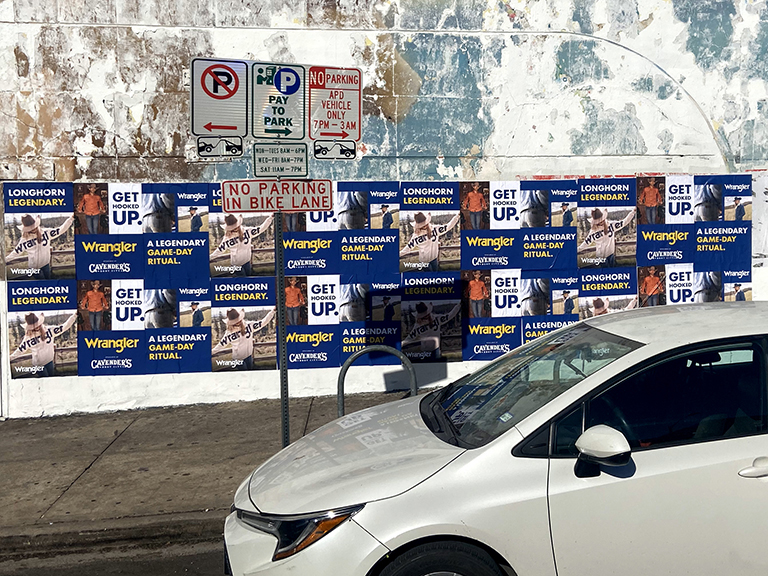
Fashion lives at the intersection of physical and digital culture, and flyposting exists exactly at that intersection. A well-placed campaign in the right neighborhood — on the right wall, on the right street, in front of the right kind of pedestrian — creates the kind of street-level cultural presence that fashion brands have always needed but that digital advertising alone can’t provide. People photograph street campaigns. They share them. They talk about what they saw walking to work. The campaign generates conversation that extends far beyond the people who walked past the poster.
This is particularly acute for the drop-culture fashion market. When a brand releases a limited item with a specific drop date, building anticipation in the physical world — not just the digital one — changes the nature of the event. A poster that appears on a Shoreditch hoarding or a Melrose Avenue wall two weeks before a drop creates neighborhood-level buzz that contributes to the queuing, the social media build-up, and the sell-out velocity that makes drops work as marketing events.
This guide covers how fashion brands — from streetwear labels to luxury houses — use flyposting campaigns, what separates effective fashion poster campaigns from generic advertising, and how to match your campaign to the specific audience and cultural environment you’re targeting.
Fashion’s Relationship with the Street
Fashion has always had a complicated, productive relationship with street culture. The styles that dominate runways in Paris and Milan often originate in the streets of East London, Brooklyn, and Tokyo. Street credibility has monetary value in fashion because the audience — particularly the early-adopter, trend-setting demographic that determines what everyone else eventually wears — makes purchasing decisions partly on the basis of cultural authenticity.
A brand that exists only in paid media — Instagram feeds and Google display — has a fundamentally different cultural positioning than a brand whose campaign is visible on the actual streets of the neighborhoods where the relevant audience lives. The street campaign says: we are part of this world, we belong here, we’re not just advertising to you from the outside.
This is why Supreme’s entire marketing philosophy has been built around physical presence — the store queues, the limited drops, the street-level visibility — rather than traditional advertising spend. And why Stüssy, Palace, Off-White, and dozens of other streetwear brands with strong cultural credibility use street poster campaigns as a primary visibility tool.
The fashion streetwear market has grown to exceed $185 billion globally, driven primarily by the 18-35 demographic. This audience consistently identifies physical cultural presence — seeing a brand in the actual neighborhoods they frequent — as a significant factor in brand trust and purchasing decision-making.
Streetwear and Independent Labels
Streetwear flyposting campaigns are typically concentrated, neighborhood-specific, and designed with the aesthetic sensibility of the specific subculture the brand operates in. A campaign for a Japanese-influenced streetwear label looks different from a campaign for a South London rap-adjacent brand, and the neighborhood placement is equally specific.
New York streetwear campaigns concentrate in SoHo — specifically the corridor around Spring Street, Prince Street, and the surrounding blocks where the streetwear retail ecosystem is concentrated — and in Williamsburg, where the demographic overlap between streetwear consumers and the arts/music community is highest. The Lower East Side adds additional streetwear credibility as the historic center of New York skate culture.
London streetwear campaigns live primarily in Shoreditch — around Brick Lane and the retail cluster on Redchurch Street — and to a lesser extent in Soho and around the Carnaby Street area, which has been a fashion destination since the 1960s. Brixton adds a UK urban fashion dimension for brands with credibility in that cultural space.
Los Angeles streetwear geography centers on the Fairfax Avenue corridor, which is home to Supreme’s LA flagship, Kith, a dozen independent streetwear retailers, and the authentic skateboard culture that underpins much of the streetwear market. Melrose Avenue adds a slightly more upscale but still street-credible alternative.
Luxury Fashion and the Street Poster Tension
Luxury fashion brands using flyposting creates a productive tension: high-fashion imagery at street level, in neighborhoods that are more associated with counterculture than with the boutiques of Mayfair or the Upper East Side. This tension can be a feature, not a bug.
A Balenciaga campaign in Shoreditch, or a Prada campaign in Silver Lake, deliberately borrows cultural credibility from the neighborhood’s street culture. The luxury brand is saying: we understand this world, we’re present in it, our positioning extends beyond the traditional luxury advertising channels. This approach is specifically effective for luxury brands trying to reach younger affluent consumers who are uncomfortable with traditional luxury marketing signals but responsive to cultural credibility.
The design requirements for luxury flyposting are specific: the quality of the imagery needs to be high enough to justify the luxury positioning in a physically rough context. Luxury brands often use large-format installations — multi-sheet posters on major hoardings — to ensure the campaign maintains its scale even in challenging posting environments.
Drop Campaign Strategy
Drop culture has specific timing requirements that flyposting is well-suited to serve. The ideal structure for a drop campaign using flyposting:
Teaser phase (2-3 weeks before the drop): Minimal information posters — brand identity, ambiguous visual, drop date only. These create anticipation and neighborhood conversation without revealing the full campaign. The audience in the know understands what’s coming; the broader audience becomes curious.
Announcement phase (1 week before the drop): Full campaign imagery, item detail, drop date and channel. The transition from teaser to announcement creates its own moment — overnight refresh posting that appears on a specific morning, revealing the campaign’s full creative.
Drop morning: Some brands time an overnight refresh or new poster placement for the morning of the drop, creating a real-world event that mirrors the digital drop announcement. The poster going up on drop morning in the neighborhoods around the store or pickup location creates a visual anchor for the day’s events.
The best drop campaigns I’ve worked on treat the poster campaign as a character in the drop story — not just an advertisement for the drop, but a physical artifact of the event itself. People photograph the posters and share them as part of the drop experience, which means the poster extends the event into the social media conversation rather than just preceding it.
Collection Launch vs. Drop: Different Campaign Structures
A seasonal collection launch is different from a drop in terms of timing, scale, and information density. A collection launch is about communicating the visual identity and aesthetic direction of an entire season’s work — the campaign imagery needs to capture a mood, a direction, a vision. A drop is about a specific item and a specific moment.
Collection launches typically run longer campaigns with more locations, because the goal is sustained visibility through a selling season rather than a single moment of concentrated attention. Fashion week periods — London Fashion Week, New York Fashion Week, Paris Fashion Week — are natural anchors for flyposting campaigns that establish a brand’s visual presence around the events that define the industry calendar.
Running flyposting during London Fashion Week in the Shoreditch/Soho zone and around the Somerset House venue (which hosts many LFW events) creates presence at exactly the moment when press, buyers, and industry attend the city in concentrated numbers. The equivalent in New York is the weeks around NYFW in September and February, with posting in SoHo and around the main show venues.
Design Requirements for Fashion Flyposting
Fashion campaigns for street posting need to pass two tests: does it stop someone walking at normal pace, and does it look like it belongs on this wall in this neighborhood?
The first test is about visual impact. Fashion photography is often designed for editorial contexts — magazine pages, lookbooks, website banners — where the viewer is already engaged and can spend time with the image. Street posters work differently. The image needs to read in under two seconds: strong contrast, clear focal point, typography that holds at distance. Fashion brands that adapt their editorial imagery for street posting without reconsidering these basics often end up with posters that look beautiful close-up but fail at street level.
The second test is about authenticity. A fashion poster that looks generically corporate — could be an ad for any category of consumer product — doesn’t benefit from the cultural environment of the street the way a campaign with specific visual character does. The best fashion flyposting campaigns have a designed identity that reads as belonging to the neighborhood: rough edges where appropriate, deliberate graphic choices that align with the culture the brand is communicating with.
International Campaign Coordination
Fashion brands running international launches — for a collection that drops simultaneously in New York, London, Paris, and Tokyo — need coordinated flyposting across all markets. The creative is typically consistent (or has market-specific variants), the drop date is simultaneous, and the posting needs to be up in all cities before the same morning.
American Guerrilla Marketing coordinates international campaigns through our partner operator network, managing briefing, print logistics, and proof-of-posting documentation across markets from a single point of contact. For brands running global drops, this eliminates the complexity of managing separate operators in each city.
The Fashion Flyposting Crew: How Overnight Installations Work for Drop Campaigns
Fashion drop campaigns live and die by the reveal moment. The product doesn’t exist publicly until it does — and when it does, it needs to be everywhere simultaneously. Overnight flyposting is the physical media format that replicates this logic in the real world. The crew posts between midnight and 5am so that, at sunrise, the campaign is fully live across every target neighborhood. There’s no gradual rollout. The drop happened.
AGM’s operators run fashion flyposting campaigns as coordinated overnight sessions — two to three person crews working from a vehicle, covering pre-identified location clusters in sequence. For a fashion drop campaign targeting the Fairfax/Melrose corridor in LA and Williamsburg’s Bedford Avenue in New York, two crews running simultaneously in their respective cities can post 60-80 locations per market in a single overnight window. By the time the brand’s social media posts go live in the morning, the street campaign is already documented and verified through GPS-tagged proof-of-posting photography.
The alignment of physical and digital reveal is something we’ve engineered deliberately in fashion campaigns: the brand’s Instagram posts at 8am, the email to the list goes out at the same time, and the street posters have been up since 3am. The audience that sees the Instagram post then walks past the poster an hour later on their way to a coffee shop. That layered contact — phone screen then physical wall — builds recall and urgency in a way that either format alone doesn’t produce.
We’ve run flyposting campaigns for fashion labels doing drops in London, New York, and LA simultaneously. The organic social photography generated by Shoreditch and Fairfax postings — where the street-style audience treats poster documentation as content — consistently extends reach 30-50% beyond the directly posted locations.
Neighborhood Selection for Fashion Flyposting: Where the Audience Actually Is
Fashion flyposting works when the neighborhood selection reflects the actual geography of the target audience — not just where there is available wall space. Here’s a market-by-market breakdown of where fashion campaigns concentrate and why.
London: Shoreditch is the primary market for streetwear and independent labels — specifically the Brick Lane corridor, Curtain Road, and the streets around Boxpark. This neighborhood’s audience is fashion-active, culturally engaged, and heavily present on visual social media. Brixton (Coldharbour Lane, Atlantic Road) reaches a younger, music-and-fashion audience with strong style credibility. For luxury or premium fashion crossover, the Seven Dials area of Covent Garden (WC2) and Carnaby Street in Soho reach a higher-spending pedestrian audience that bridges high street and premium fashion.
New York: The Fairfax/Melrose parallel in New York is Williamsburg’s Bedford Avenue and the surrounding side streets (North 7th, Berry Street, Wythe Avenue). This is the streetwear and emerging designer audience’s primary neighborhood. The Lower East Side (Orchard Street, Ludlow Street) carries a slightly more downtown-art-adjacent audience with strong fashion credibility. SoHo (Prince Street, Spring Street, Broadway) reaches the tourist fashion audience as well as the professional creative buyer — a different audience from Williamsburg but relevant for brands with premium positioning.
Los Angeles: The Fairfax/Melrose corridor is non-negotiable for any fashion campaign in LA. The concentration of fashion retail (vintage, streetwear, luxury consignment), the proximity to high schools like Fairfax High that seed trends into the youth market, and the stylist and buyer community that works in this area makes it the single most valuable fashion flyposting location in the US. Silver Lake’s Sunset Blvd near Mohawk is a secondary location for labels with music-fashion crossover positioning.
Format matters for fashion flyposting more than in almost any other category, because the audience is visually trained and evaluates print quality as a proxy for brand quality. A poster printed on cheap lightweight stock looks cheap on the wall, regardless of what the image is. Fashion campaigns should use minimum 90gsm uncoated stock for A0 (841 x 1189mm) and B1 (707 x 1000mm) formats — heavier than standard because the material quality is part of the impression. The paste coat over the poster face also needs to be applied cleanly, because a streaky or uneven paste job on a fashion poster reads as sloppiness that reflects on the brand.
Why Fashion Flyposting Content Wins When It Talks About Credibility, Not Just Reach
Search results around fashion poster campaigns consistently emphasize cultural relevance. That is not accidental. Fashion buyers are rarely searching for the cheapest impressions. They are searching for how a street campaign shapes perception around a drop, a collection launch, or a market entry. The pages that perform best talk about audience alignment, photography value, and the way posters travel into mood boards and social feeds.
For fashion brands, location is part of the creative. A strong wall in Shoreditch, SoHo, Williamsburg, or Fairfax is not just a media placement. It becomes evidence that the brand belongs in that scene. That is especially true for streetwear, contemporary labels, and emerging luxury brands trying to feel present without looking overproduced.
The fashion campaign decisions that matter most
- Choose neighborhoods with style influence, not just pedestrian count. The right 10 blocks outperform the wrong 100.
- Build around one image. Fashion posters need instant recognition from across the street and inside a phone camera frame.
- Time the run to the drop. Too early and the poster feels like editorial wallpaper. Too late and the heat has already moved online.
- Document cleanly. Fashion teams use street photos for internal recaps, buyer conversations, and social edits.
Common H2 patterns in the search results include launch timing, campaign inspiration, neighborhood targeting, and examples of brands using street posters well. That tells us the searcher wants tactical guidance with a point of view. They want to know where the audience actually is and what kind of visual language feels credible there.
Our rule is that fashion flyposting should make the brand look inevitable, not desperate. The campaign should feel like an extension of a real world people already want to be part of. When that happens, the poster does more than announce a drop. It signals taste, access, and momentum.
That is also why recap photography matters so much for fashion campaigns. The poster is not only being measured by who walks past it. It is being measured by how well it photographs in context, how well it fits the surrounding neighborhood aesthetic, and whether the campaign imagery still feels expensive once it leaves the wall and enters decks, social edits, and internal reporting. Fashion teams notice that difference immediately.
Frequently Asked Questions
Why do fashion brands use flyposting?
Fashion brands use flyposting to establish credibility in specific cultural neighborhoods, to reach the early-adopter audience that shapes fashion trends, and to create physical presence around drops and launches that generates social media amplification and press coverage. The format positions the brand as part of the street culture rather than advertising to it from the outside.
Which neighborhoods are best for fashion flyposting in New York?
SoHo and the surrounding streets for established brands with high-fashion positioning. Williamsburg and the Lower East Side for streetwear and independent brands. The Fairfax/Meatpacking District equivalent areas for luxury and lifestyle adjacency. Match the neighborhood to the specific brand’s cultural positioning — the wrong neighborhood for your brand is worse than no campaign.
What neighborhoods work for fashion flyposting in London?
Shoreditch and Soho for streetwear and contemporary fashion. Notting Hill for premium lifestyle brands. Brixton for urban fashion. Dalston for fashion targeting the arts and nightlife crowd. The Seven Dials area of Covent Garden for mainstream fashion campaigns reaching both local and tourist audiences.
How does flyposting fit into a drop campaign strategy?
Flyposting works best as a teaser and announcement tool. Minimal teaser posters two to three weeks before the drop date build neighborhood anticipation. Full campaign posters one week out announce the drop. An overnight refresh on drop morning creates a real-world event that mirrors the digital announcement and generates social sharing from people who “discovered” the campaign before the drop goes live.
Should luxury fashion brands use flyposting?
Yes, selectively. Luxury brands using flyposting is specifically effective when the positioning is deliberate — a high-fashion campaign placed in street-level context in culturally credible neighborhoods creates a productive tension between exclusivity and street credibility. This approach works for brands trying to reach younger affluent consumers who are uncomfortable with traditional luxury advertising but responsive to cultural authenticity.