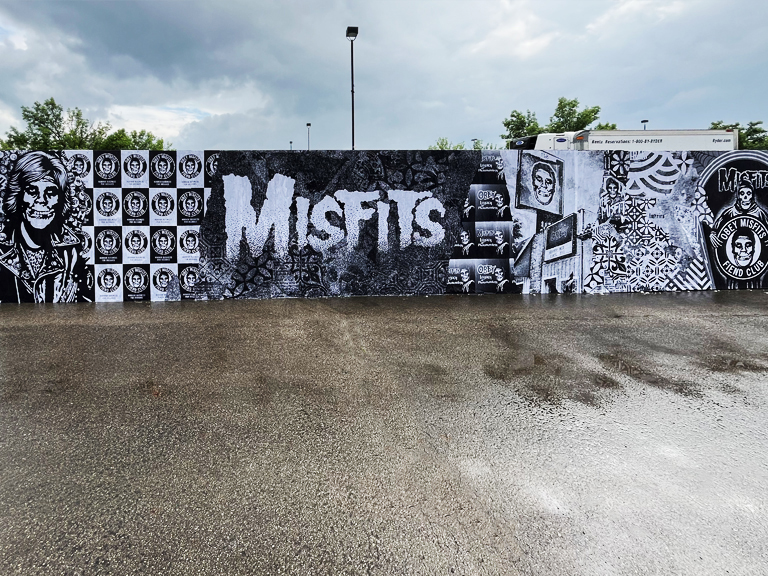
Concert promotion has always lived on the streets. Before streaming, before social media, before digital advertising existed, the way you told a city about an upcoming show was by putting paper on walls. That tradition persists because it works differently from every other promotional channel available to touring artists and venues — and in ways that have only become more valuable as digital promotion became saturated.
Flyposting for concert promotion puts your show in front of the people who go to shows, in the neighborhoods where they live, at the eye-level moment when they’re moving through the city and open to discovering something worth attending. It also creates the kind of organic social content — photographs of striking posters in recognizable neighborhoods — that can spread further than the physical campaign itself.
American Guerrilla Marketing executes concert promotion flyposting campaigns for touring artists, venues, promoters, and labels across 50+ U.S. markets. Our team handles everything from location scouting to installation to GPS-tagged documentation, so you have proof of performance for every city on the campaign.
Why Street Campaigns Still Matter for Concert Promotion
Spotify, Instagram, and YouTube handle digital reach. A Spotify pre-save campaign, a targeted Instagram ad, a YouTube video premiere — these tools reach fans efficiently. But digital promotion has a specific weakness: it reaches people who already know the artist. Flyposting reaches people who don’t know the artist yet, and it does so in the physical environment where music culture lives.
A poster in a record store window or on a music venue corridor wall creates a context that digital promotion can’t reproduce. It says: this show is happening in your neighborhood, at a place you know, and it matters enough for real-world presence. That signal carries credibility that a served digital impression can’t replicate, because it’s embedded in the physical fabric of music culture rather than delivered by an algorithm.
The other reason street campaigns remain effective is precisely because they’re unexpected. A potential concertgoer who has been scrolling past ads for the show for two weeks may notice nothing until they encounter the poster on a wall between their apartment and their coffee shop. Physical surprise is a differentiator that becomes more valuable as digital saturation increases.
Concert Promotion Campaign Formats and Scale
Not every concert promotion campaign looks the same. The right approach depends on the venue size, the artist’s current market profile, the promotional timeline, and the city’s posting landscape.
Club and Small Venue Shows
For shows in venues up to 500 capacity, a concentrated neighborhood campaign works most effectively. Rather than spreading posters across a wide geographic area, we concentrate placements in the specific blocks and corridors where the show’s potential audience is densest. For a rock or indie show, that means music venue corridors, record stores, coffee shops, and residential areas with the right age and taste demographic. For a hip-hop show, it means targeting neighborhoods with strong hip-hop cultural presence.
Volume for small venue campaigns typically ranges from 50 to 200 posters in a single market, concentrated to create genuine saturation in a defined geographic zone. The goal is to reach the same person from multiple angles — poster on the way to work, poster near the venue, poster near the record store — to build the impression of ubiquity that makes people take the show seriously.
Theater and Mid-Size Venue Shows
Theater-scale campaigns (500 to 3,000 capacity) benefit from broader geographic coverage while maintaining neighborhood concentration in the key zones. We extend the zone from the immediate neighborhood to adjacent areas, covering more ground while still prioritizing the highest-value locations within each neighborhood. Campaign volume typically ranges from 200 to 500 posters in a single market.
Arena and Stadium Shows
For major headliner campaigns at arena or stadium scale, the approach combines heavy neighborhood concentration with broader visibility — key intersections, transit corridors, and major commercial areas that reach the mass market audience the show requires. Volume runs significantly higher, and we often coordinate multi-phase campaigns: an early announcement wave followed by a final push two to three weeks before the show date to re-engage the market and drive last-minute ticket activity.
Geographic Strategy for Concert Flyposting
Location selection within each city follows the audience’s geography, not just available posting inventory. Different artists, different genres, and different venue types call for different neighborhood mixes.
Music Venue Corridors
Every major city has established music venue corridors — streets with high concentrations of clubs, bars, and entertainment venues where concertgoers regularly move. These are the highest-value locations for any concert promotion campaign regardless of genre, because the foot traffic consists disproportionately of people who attend live music. In New York, that means the Bowery, the Lower East Side, and Williamsburg. In Chicago, it means Wicker Park, Logan Square, and Lincoln Park. In Los Angeles, Silver Lake and East Hollywood.
Record Stores and Music Retail
Independent record stores remain among the highest-quality micro-targeting locations for concert promotion. Their foot traffic skews exactly toward the engaged music fan who attends shows. Posters near record stores, in store windows (with owner permission), or on walls visible from store entrances carry implicit endorsement from the cultural authority of the store itself.
Transit Entry Points
Subway and transit entry points near venues, and in neighborhoods where the target demographic concentrates, offer high-frequency exposure. People passing through the same transit entry multiple times per week see a campaign repeatedly — frequency that reinforces the show date in memory in a way that single-exposure placements can’t achieve.
University Areas
For shows with young adult audiences, university neighborhoods and campus-adjacent commercial areas offer both high foot traffic and concentrated demographic targeting. A single well-chosen posting zone near a university campus can reach thousands of potential concertgoers moving through the area daily.
Tour Campaign Coordination: Running Multiple Cities
For touring artists, the challenge is executing consistent street campaigns across multiple markets on different show dates while maintaining the visual and quality standards that make the campaign effective in each city.
Our tour coordination model works market by market on the tour routing schedule:
- Each market is scouted two to four weeks before the show date
- Print production for each city is coordinated in advance to ensure delivery lead time
- Installation is timed to the show date — typically launching three to four weeks out, with a possible second-phase push in the final week
- Documentation from each market is consolidated into a unified tour campaign report for label and management review
We manage the full logistics chain for tour campaigns, which allows artist management and labels to treat street promotion as a single contracted deliverable rather than a city-by-city vendor problem.
Timing: When to Launch a Concert Flyposting Campaign
Timing is one of the most impactful decisions in concert promotion flyposting. Launch too early and the campaign loses momentum before the show. Launch too late and there isn’t enough time to build awareness among uncommitted potential attendees.
Standard Timeline: Three to Six Weeks Out
For most club, theater, and mid-size venue shows, launching three to six weeks before the event date gives the campaign time to build genuine awareness while maintaining urgency as the date approaches. This window allows potential ticket buyers who see the campaign early to make a decision, buy tickets, and mention the show to friends who might also attend.
Phase Campaigns for Major Shows
For arena shows and major headliners, a two-phase approach often produces better results than a single installation. Phase one launches six to twelve weeks before the show with an announcement-style campaign focused on building awareness. Phase two launches two to three weeks before the show with a ticket urgency message — “limited tickets remaining” or similar — to drive final conversions among people who’ve been considering attending.
Day-of Activation
For select campaigns, we add a day-of street team component: brand ambassadors positioned near the venue and in adjacent neighborhoods on show day, creating buzz among pedestrians who may not have been planning to attend. Day-of activations work best for shows with remaining ticket inventory and venues in high-traffic urban locations where spontaneous attendance is possible.
Targeting the Right Audience in Each Market
Concert flyposting works because it reaches the right people in the right environment — fans in the neighborhoods and corridors where they already move. The difference between a campaign that sells tickets and one that generates impressions without action is almost always the precision of audience-location matching. Here is how we approach targeting in each major market type:
College Town Targeting
College towns have concentrated, predictable audiences for certain genres and shows. The student population in cities like Boston, Ann Arbor, Madison, and Austin creates reliable foot traffic on specific routes — between campus and the commercial strip, between the strip and the venue corridor, between the venue area and residential neighborhoods. A poster campaign on these corridors reaches the same students multiple times per week from a modest number of well-placed installations.
College-market concert campaigns benefit from campus-adjacent placements near the coffee shops, bars, and retail corridors that students use most heavily. The timing window matters enormously: campaigns that launch in the first few weeks of the semester reach a population that’s actively forming habits and discovering new entertainment options. Early-semester timing for fall shows and late January for spring shows are the highest-value launch windows in college markets.
Major Market Targeting for Touring Shows
In major markets like New York, Los Angeles, and Chicago, the audience for any given genre or artist is dispersed across a wide geographic area rather than concentrated in a single neighborhood. Effective concert promotion in major markets requires neighborhood selection based on where the specific artist’s audience lives, not just where convenient posting inventory is available.
For an indie rock show at a mid-size New York venue, the relevant audience concentrations are Williamsburg, the Lower East Side, and East Village. For a hip-hop show at the same venue, the relevant concentrations may be different neighborhoods entirely. For a prestige jazz or classical performance, the residential neighborhoods around the Upper West Side and Park Slope have higher concentrations of the relevant audience than the music venue corridors that work for rock and pop campaigns.
Our neighborhood-to-genre mapping in major markets reflects actual audience geography, not just available posting inventory. The result is campaigns that reach the fans most likely to attend rather than the people most convenient to poster at.
Mid-Size Market Targeting
Mid-size markets — cities like Nashville, Portland, Denver, Minneapolis, Richmond, and Pittsburgh — have distinct music cultures and venue ecosystems that determine which neighborhoods carry the campaign for which shows. In Nashville, the East Nashville neighborhood concentrates the independent music community; the Broadway honky-tonk corridor reaches a different (tourist-heavy) audience. In Portland, the Alberta Arts District and the Mississippi Avenue corridor are the primary targeting zones for indie and roots music campaigns.
Our network covers 50+ U.S. markets, including the mid-size markets where touring artists increasingly prioritize their campaigns as major market costs have risen. We have established location networks and crew relationships in each market so campaigns outside the top five cities receive the same execution quality as the primary markets.
Concert Campaign Creative: What Works on Walls
Concert promotion creative has a long tradition and an established visual language that works for a specific reason: it’s been tested by a century of practical use. The conventions of concert poster design — artist name, venue, date, supporting acts, visual imagery — communicate a complete information set to a potential attendee in a format they’ve learned to read quickly.
Within those conventions, the creative decisions that most affect campaign performance:
Hierarchy of Information
Artist name should dominate the poster. Date and venue are secondary. Supporting acts are tertiary. A potential attendee scanning the wall at walking speed processes the hierarchy from largest to smallest. If the headliner’s name isn’t the first thing they see at a distance, the campaign loses them before they’ve had a chance to engage. A common mistake in concert creative is treating the date as equally important to the artist name — it isn’t, because a fan who doesn’t know who the artist is won’t care about the date, and a fan who knows and cares about the artist will stop and look for the date once the artist name catches them.
Venue Name and Neighborhood Reference
Venue names carry cultural associations that matter in music communities. “Bowery Ballroom” means something specific to New York music fans. “The Troubadour” means something specific to Los Angeles music fans. A show at a venue with strong cultural associations benefits from leading with the venue name alongside the artist name — both establish that the show is worth attending at the cultural context level before the potential attendee has processed any other information.
Visual Imagery
Concert posters that use artist photography consistently outperform text-only or abstract design posters when the artist has existing visual recognition. A fan who doesn’t immediately recognize the artist name may recognize their face, creating a second chance to capture attention. For newer artists without strong visual recognition, a compelling graphic or typographic treatment that generates genuine aesthetic interest can substitute for recognition value — the goal is to arrest the pedestrian’s gaze long enough for them to read the headline.
Concert Flyposting and Social Media Amplification
Well-executed concert flyposting campaigns generate organic social media content that extends reach far beyond the physical campaign. Fans who encounter show posters in their neighborhoods frequently photograph and share them — particularly when the poster design is strong and the location creates a compelling image.
Artist management and labels increasingly factor social media amplification into campaign planning: coordinating the campaign launch with a social media push from the artist’s own accounts to create a simultaneous physical-and-digital moment that maximizes the attention window. When the artist posts “posters going up in [city] tonight” and fans wake up to find their neighborhood covered, the earned media generation from that combination can significantly exceed the organic reach of either channel alone.
Our team can coordinate photo delivery with your marketing timeline so you have campaign imagery ready for social use at launch, and we can time installation to align with planned artist social posts for maximum coordination.
Integrating Flyposting with the Full Promotional Mix
Flyposting is most effective as part of a coordinated promotional approach rather than a standalone tactic. Concert promotion campaigns that combine street presence with complementary tactics generate compounding returns:
- Street team promoters working music venue corridors and record store areas to distribute handbills, create awareness, and generate ticket link sharing in parallel with the poster campaign
- Sidewalk stencil campaigns near the venue and in key neighborhood zones adding a horizontal dimension to the vertical poster presence
- Mobile LED billboard trucks routing through music neighborhoods on the weekend of the show for final-push visibility
- Venue-area guerrilla activations on show day to create buzz and capture social media content in the hour before doors
Proof of Performance: Documentation for Labels and Management
When a record label is funding a tour’s promotional campaign, or when management is evaluating the effectiveness of market-by-market spending, proof of performance documentation is essential. Our GPS-tagged photo documentation provides the specific evidence of what ran, where, and when that reporting requirements demand.
Every placement in every market receives a GPS-tagged photograph with timestamp. Our post-campaign reports are organized by city, neighborhood, and placement location so reviewers can assess coverage quality in each market at a glance. For tour campaigns spanning many cities, we provide a consolidated report covering the full campaign alongside individual market breakdowns.
Frequently Asked Questions
How early before a concert should flyposting campaigns launch?
For most shows, we recommend launching three to six weeks before the event date. This gives the campaign enough time to build awareness among potential ticket buyers before demand peaks. For major arena or stadium shows, eight to twelve weeks of street presence creates sustained awareness throughout the promotional window.
What neighborhoods should concert flyposting campaigns target?
Target neighborhoods where the artist’s audience concentrates — music venue corridors, record stores, coffee shops, and residential areas with high density of the target age and taste demographic. We map the audience geography in each city before building the location plan.
Does flyposting still work in the streaming era?
Yes, and in some ways it works better. Physical concert posters create a form of social proof and local presence that digital promotion doesn’t replicate. A poster on a wall in a music neighborhood tells fans the show matters enough for real-world presence. It also generates organic social media content when fans photograph and share the campaign.
Can AGM handle concert tours across multiple cities?
Yes. We execute tour-wide street campaigns with sequential city-by-city or simultaneous multi-market launches. Each market gets its own location scouting, installation crew, and documentation package. We consolidate reporting across the full tour for label and management review.
What poster format works best for concert promotion?
11×17 and 24×36 are the traditional concert poster formats with the highest recognition factor in music venues and neighborhoods. Larger 27×40 and multi-panel formats work well for headliner campaigns that need maximum street presence in high-traffic corridors.
How do I get proof the posters went up?
AGM provides GPS-tagged photo documentation of every placement with timestamps. You receive a complete campaign report showing each location, the installation date and time, and a photograph of the posted material.