By Millie Phillips, Campaign Architect at American Guerrilla Marketing
What You Find When You Search for Guerrilla Marketing Prices
Most of what you’ll read online is either outdated or vague. Blog posts from 2019 quoting “$500 to $5,000” ranges, articles that conflate DIY flyering with full campaign execution, marketing consultants who have never actually priced a street team. It’s a mess.
The reality is that guerrilla marketing pricing is format-specific, market-specific, and volume-dependent. A 100-poster wheatpaste run in Manhattan costs what it costs because labor, permitting context, logistics, and documentation in New York City are what they are. The same campaign in a secondary market will price differently. Neither is better or worse. They’re different operations.
This guide covers real numbers from a real guerrilla marketing agency. American Guerrilla Marketing has run over 500 campaigns across the United States. The pricing here reflects what a professional, GPS-documented, fully executed campaign actually costs in 2025 and 2026. There are no ballpark figures designed to get you on a call. There are no vague ranges with asterisks. Just the actual numbers.
Professional guerrilla marketing campaigns in major U.S. markets typically run between $4,500 and $15,000+ per format per campaign window, depending on volume and market.
What Drives the Cost of a Guerrilla Marketing Campaign
Before you look at a price table, you need to understand what variables move the number. There are five of them.
1. Market
New York City, Los Angeles, Chicago, Miami, and San Francisco cost more than secondary markets for specific, traceable reasons. It’s not a prestige markup. It’s operational reality.
In New York City, a wheatpaste campaign spans a city of 8 million people across five boroughs. A crew working a 100-poster run might cover the Lower East Side, Williamsburg, and Bushwick in a single night. That requires experienced operators who know which surfaces hold for two weeks, which blocks carry surface competition from other vendors, and how to move efficiently when you’re working midnight to 6 AM. That operational knowledge is priced into the crew rate.
Surface competition is a real cost factor in Tier 1 markets. In SoHo, desirable wall inventory is genuinely finite. Construction hoardings on Broadway between Houston and Canal, the long walls on Mercer Street and Wooster, surfaces along Prince Street and Spring Street all get worked by multiple operations. Placement strategy matters more in competitive markets because the difference between a premium surface and a marginal one affects both exposure and organic documentation rates.
Crew labor rates in New York and Los Angeles reflect what it costs to employ skilled people in those cities. A professional crew working a night shift in Manhattan earns more than the same crew configuration in Atlanta or Philadelphia. For a 100-poster campaign requiring 6 to 8 hours of active execution across multiple neighborhoods, that labor differential adds meaningful cost to the final number.
For out-of-market campaigns, travel is a factor too. Agencies running crews into less-networked tertiary markets include travel and lodging in the rate. Markets like Atlanta, Nashville, Philadelphia, and Austin have established local crew networks that keep costs lower than genuinely remote markets of similar size.
The practical bottom line: a 100-poster wheatpaste run in Manhattan or Los Angeles costs more than the same volume in Atlanta, Austin, or Denver. Not because the execution standard differs, but because the city does.
2. Format
Not all street advertising is the same. A 24×36 wheatpaste poster costs less per unit than a 48×72 format. Sidewalk stencils involve a different production and application process than decals. LED trucks involve vehicles, operators, and fuel. Guerrilla projections involve equipment rental, setup, and nighttime crews. Each format has a different cost structure. You can’t compare an apples-to-apples number across formats.
3. Volume
Volume matters in both directions. Fewer placements cost less in absolute dollars but more per unit. Higher volume brings the per-unit cost down. A 200-poster wheatpaste run doesn’t cost twice what a 100-poster run costs, because fixed logistics costs get distributed across more placements. The breakpoints matter, and knowing them helps you plan a budget that makes sense.
4. Campaign Duration
Wheatpaste campaigns are typically structured as two-week runs. Stencils are more permanent. LED trucks are priced hourly with minimum commitments. Projections are priced per night. Duration affects cost in two ways: the actual execution window and how long the impression exposure lasts. A stencil placed at a high-traffic intersection generates impressions for weeks or months. An LED truck generates impressions for the hours it operates.
5. Creative Production
AGM pricing covers placement, logistics, documentation, and execution. It does not automatically include graphic design or print production unless you’ve discussed that with the team. If you bring print-ready files, you’re in good shape. If you need design and production, that’s a separate line item. Some campaigns need it. Others don’t. Know which camp you’re in before you request a quote.
Wheatpaste Posters
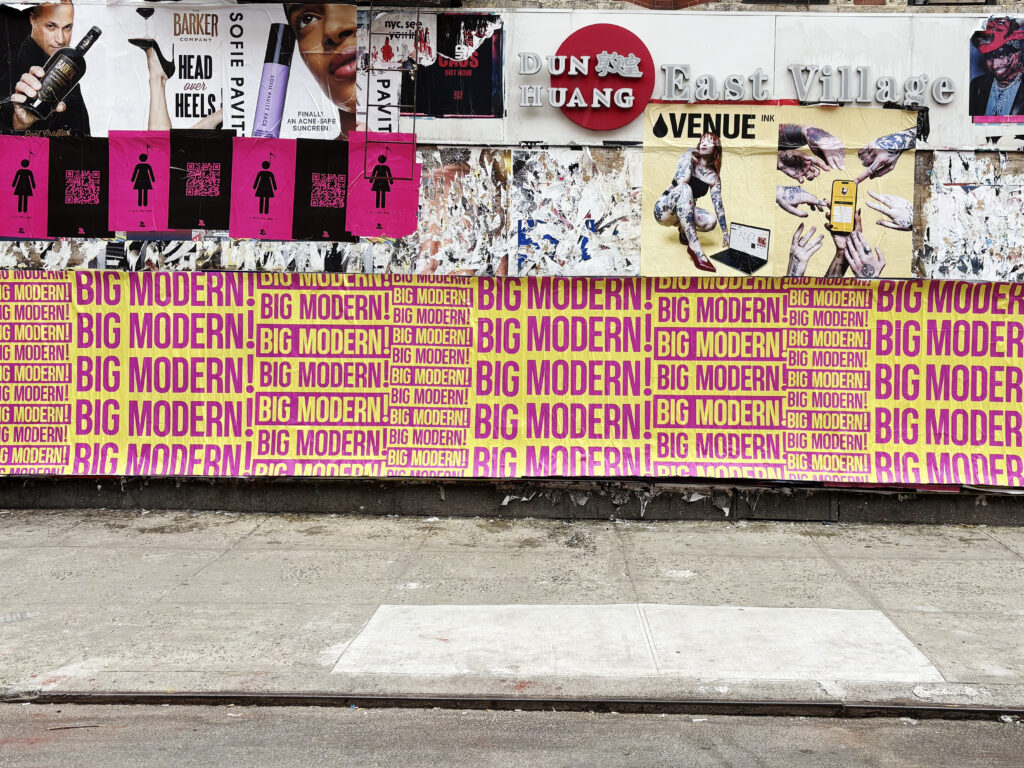
Wheatpaste is the core format of street advertising. Large-format posters are adhered to approved surfaces using a water-based paste. They weather like printed paper, typically lasting two weeks before degradation. They photograph extremely well and generate organic social documentation when executed in high-visibility locations.
| Format |
Volume |
Campaign Price |
Duration |
| 24×36 inches |
100 posters |
$4,500 |
2-week campaign |
| 24×36 inches |
200 posters |
$5,500 |
2-week campaign |
| 48×72 inches |
100 posters |
$10,500 |
2-week campaign |
| 48×72 inches |
200 posters |
$13,500 |
2-week campaign |
The 48×72 format is approximately four times the surface area of a 24×36. It commands attention from a distance, photographs with more visual impact, and works particularly well in areas where you’re competing for attention against other signage. For brand launches and product drops, the larger format tends to outperform on social documentation.
Snipes
Snipes are small-format prints, typically placed at eye level on poles, door frames, and utility surfaces. They work at scale. The value of a snipe campaign is saturation. Hundreds of placements across a target neighborhood creates an omnipresence effect. The brand shows up everywhere. The audience can’t ignore it.
| Format |
Volume |
Campaign Price |
| 9×12 inches |
400 snipes |
$4,500 |
| 9×12 inches |
800 snipes |
$5,500 |
| 11×14 inches (Jumbo) |
400 snipes |
$6,500 |
| 11×14 inches (Jumbo) |
800 snipes |
$7,500 |
Snipes work well for events, album drops, product launches, and restaurant openings because they can be deployed quickly and saturate a neighborhood in a 24-48 hour window. The 11×14 jumbo format adds visual weight if the brand identity benefits from more surface area.
Sidewalk Stencils
Sidewalk stencils are applied directly to pavement using water-based paint. They’re semi-permanent, lasting weeks to months depending on foot traffic and weather. They’re also highly targetable. You can place them at transit station exits, restaurant approaches, event entrances, or intersections that index well for your audience.
| Quantity |
Price |
| 5 stencils |
$2,855 |
| 10 stencils |
$3,231 |
| 20 stencils |
$3,989 |
| 50 stencils |
$6,982 |
| 100 stencils |
$11,999 |
Stencils are one of the better formats for events that have a fixed approach path. A festival, a product pop-up, or a restaurant grand opening can use stencils at key pedestrian entry points to create a bread-crumb effect, drawing foot traffic toward the destination.
Sidewalk Decals
Decals are printed adhesive graphics applied to pavement. They can carry more visual complexity than stencils, including full-color brand marks, QR codes, and dimensional art. They’re precise, photogenic, and effective for installations that need to stand out against plain concrete.
| Quantity |
Price |
| 5 decals |
$2,904 |
| 10 decals |
$3,404 |
| 20 decals |
$4,998 |
| 50 decals |
$8,709 |
| 100 decals |
$14,466 |
Guerrilla Projections
Projections take over building facades at night. They’re high-impact, highly visual, and generate significant organic social content when executed well. They’re event-grade activations, ideal for launches, campaign announcements, or one-night stunts designed to drive media coverage.
| Market |
Price |
| New York City |
$6,500 per night |
| Outside NYC |
$7,500 per night |
LED Trucks
LED trucks are mobile billboards. They drive the campaign to the audience rather than waiting for the audience to walk past a fixed placement. They’re ideal for events, launches, and high-density moments like concerts, sports events, or festivals where a stationary placement can’t capture every attendee.
| Vehicle Type |
Rate |
Minimum |
| 3D LED Truck |
$300/hr |
8-hour minimum |
| 32ft Hydraulic LED |
$300/hr |
Contact for minimum |
| 18ft XXL LED |
$275/hr |
Contact for minimum |
| 14ft Standard LED |
$250/hr |
Contact for minimum |
Sample Campaign Budgets: $5K, $15K, $30K, $50K+
Here’s what a realistic campaign looks like at different budget levels.
$5,000 Budget
At $5,000, you’re running one concentrated format in one market. The most direct path is 100 wheatpaste posters (24×36) for $4,500 or 400 snipes (9×12) for $4,500. Pick one. Wheatpaste is better for brand presence and visual impact. Snipes are better for saturation and frequency.
What that $5,000 looks like on the ground varies significantly by market. In Atlanta, Austin, or Nashville, 100 wheatpaste posters across two or three neighborhoods creates meaningful geographic coverage. In Manhattan or Los Angeles, the same count runs in one concentrated zone: one neighborhood, one purpose-built deployment. The poster count is identical. The geographic reach differs because the cities do.
For a first campaign in a secondary market, $5,000 in snipes is often the smarter move. Eight hundred snipes in Nashville’s East Nashville neighborhood or along Atlanta’s Little Five Points and Old Fourth Ward corridor creates the kind of omnipresence that makes a brand feel genuinely embedded in the local scene. That saturation effect is harder to achieve in denser Tier 1 markets at the same price point.
$15,000 Budget
At $15,000, you can combine formats or expand markets. Option A: Run 200 wheatpaste posters (24×36) in one market at $5,500, add 800 snipes for $5,500, and apply 10 sidewalk stencils for $3,231. Total: $14,231. Three formats running simultaneously in one city, hitting different audience touchpoints across a two-week window.
Option B: Run 100 wheatpaste posters (24×36) in two secondary markets for $9,000 total ($4,500 each), and supplement with a 400-snipe campaign in your primary market at $4,500. This gets you real presence in two cities for roughly the same price as a single-market wheatpaste plus snipe combination. For a brand targeting the Southeast or Midwest, that might mean Atlanta and Nashville running simultaneously. For a brand with both coasts in view, it might mean a Brooklyn deployment and a Los Angeles neighborhood push.
At $15,000 in New York City specifically, you’re running a focused single-market push: 200 wheatpaste posters in Brooklyn and Lower Manhattan ($5,500), or 100 large-format 48×72 posters in SoHo and the Meatpacking District ($10,500). That’s a visible campaign. It won’t cover the whole city. It will own a few neighborhoods deeply.
$30,000 Budget
At $30,000, you’re executing a multi-format, multi-market campaign. A 200-poster 48×72 wheatpaste run at $13,500, combined with 800 snipes at $5,500 and 20 sidewalk stencils at $3,989, comes to $22,989. Add a one-night NYC projection at $6,500 for a launch event and you’re at $29,489. That combination creates impressions across multiple formats with one high-impact moment driving earned media and organic social content on launch night.
Alternatively, this budget runs a two-city campaign at real scale. New York gets 100 large-format 48×72 posters in SoHo and Williamsburg ($10,500) plus a snipe layer at $4,500. Los Angeles gets the same: 100 large-format posters along Melrose and Silver Lake ($10,500) plus 400 snipes in the Fairfax corridor ($4,500). Total: $30,000. Two coasts, two format layers, coordinated deployment. For a national launch, that’s simultaneous street presence in the two markets that matter most to cultural momentum.
A $30,000 budget is also where rolling campaigns become practical. Some clients at this level run a first wave of posters, refresh placements mid-campaign, and add a stencil drop in the second week. Sustained presence across a four-week window rather than a single two-week push.
$50,000+ Budget
At $50,000 and above, you’re building a coordinated national street presence. A typical $50,000 campaign might run wheatpaste in five markets simultaneously, 100 posters at 24×36 per market ($4,500 each, $22,500 total), plus 800 snipes per market ($5,500 each, $27,500 total), landing at $50,000 for five-city coverage with two format layers in each. New York, Los Angeles, Chicago, Miami, and Atlanta running the same week creates the kind of national footprint that signals a serious investment to anyone who encounters the campaign in their city.
At this budget level, LED truck activations become viable add-ons for key market launch moments. A 3D LED truck at $300 per hour with an 8-hour minimum ($2,400) running the Sunset Strip in LA or circling Times Square in New York on launch night adds mobile reach on top of static placements. Some clients at this level run rolling campaigns across a 6-week window, refreshing poster placements every two weeks as materials weather and adding new stencil drops in markets showing strong engagement signals.
CPM Comparison: Street Marketing vs. Other Channels
CPM, or cost per thousand impressions, is the standard metric for comparing advertising formats. Here’s how guerrilla marketing stacks up against other common channels.
| Channel |
Average CPM |
Notes |
| Wheatpaste (100 posters, prime NYC location) |
$2 to $8 |
Based on pedestrian traffic data, 2-week duration |
| Snipes (800 placements, dense neighborhood) |
$1 to $5 |
High frequency, eye-level format |
| Programmatic digital display |
$2 to $10 |
Banner blindness reduces effective CPM |
| Social media paid (Meta) |
$7 to $20 |
Varies heavily by audience and seasonality |
| Traditional OOH billboard |
$5 to $30 |
Depends on market and format |
| Podcast advertising |
$18 to $50 |
Host-read mid-roll |
| TV (national cable) |
$10 to $25 |
Declining viewership affecting reach |
The CPM comparison doesn’t fully capture the value difference, though. A wheatpaste poster in SoHo generates organic social documentation when someone photographs it and shares it. A digital display ad does not. The earned media value attached to a well-placed street campaign adds a multiplier to the raw CPM number that traditional advertising channels don’t carry.
A 100-poster wheatpaste campaign in NYC generates an estimated 450,000 to 900,000 impressions over a 2-week window based on pedestrian traffic data at prime placement locations.
What Professional Guerrilla Marketing Pricing Covers
When you work with a professional agency like AGM, the campaign price isn’t just for putting something on a wall. Here’s what’s built into the rate.
Campaign Strategy and Placement Planning
AGM doesn’t randomly place posters. Every campaign starts with a placement strategy: which neighborhoods, which blocks, which specific walls or surfaces. That targeting is based on your audience profile, your goals, and the agency’s operational knowledge of the market. This is work that takes time and experience. It’s included in the campaign price.
Crew and Logistics
Execution requires professional crews who know how to work efficiently, maintain quality, and handle the logistics of a street campaign. In dense urban markets, that means coordinating multiple crews across geographic zones within a defined window. The operational infrastructure behind a campaign is not trivial.
GPS Documentation
Every AGM placement is GPS-documented. You receive confirmation photos with location data showing exactly where each poster, stencil, or snipe was placed. This is your proof-of-performance. It’s how you know the campaign ran as planned. Most street teams don’t provide this level of documentation. AGM does, on every campaign.
Campaign Reporting
After execution, you receive a campaign report with placement documentation, photo galleries, and location data. For ongoing campaigns, you get periodic check-in reports. This documentation is also useful for your own internal reporting, social content, and PR purposes.
What It Does Not Include
Design files and print production are typically separate. If you have print-ready artwork, you’re covered. If you need design and production, that’s a separate line item. Know which camp you’re in before you request a quote.
What Cheap Guerrilla Marketing Actually Costs You
Some campaigns get quoted at a fraction of professional rates. It’s worth knowing what that typically means in practice.
No GPS documentation: no confirmation photos, no location data, no way to verify the 100 posters you paid for actually went up. Street teams without accountability structures sometimes bill for placements that didn’t happen or ran in locations nothing like what was discussed. Without documentation, you have no recourse.
Print failures: posters printed on stock that doesn’t adhere properly, fades within days, or photographs poorly enough that campaign documentation is unusable. For brands where visual presentation matters, a bad print is worse than no poster.
Wrong surfaces: placement on surfaces that get removed within 24 hours, or in neighborhoods that don’t match the target audience. Geographic targeting requires local knowledge. Crews without it place materials where they can, not where they should.
No reporting: the campaign ran, presumably. You received nothing confirming it. No photos for social content, no data for internal reporting, no way to evaluate what actually happened. That’s not a cost savings. That’s a sunk cost.
Professional campaign pricing from an established agency includes the operational infrastructure behind every placement: GPS documentation, quality print standards, placement strategy built on local market knowledge, and reporting you can actually use. That infrastructure is what separates a documented, verifiable campaign from a bill for work you can’t confirm.
How to Get an Accurate Quote
A quote for a guerrilla marketing campaign requires five pieces of information. The more specific you are upfront, the faster you’ll get an accurate number back.
- Market or markets. Where do you want the campaign to run? One city? Multiple cities? Specific neighborhoods?
- Format preference. Wheatpaste, snipes, stencils, decals, projections, LED trucks, or some combination?
- Volume. How many posters, placements, or activations are you considering?
- Timeline. When does the campaign need to run? Is there a launch date driving the schedule?
- Creative status. Do you have print-ready files, or do you need design and production assistance?
You don’t need a finalized creative brief to start the conversation. You don’t need to know every detail. But the closer you are to answering those five questions, the more precise the quote will be. Vague briefs get range estimates. Specific briefs get actual pricing.
The fastest path to a quote is the contact form on the AGM website. The team typically responds within one business day for standard campaign inquiries, faster for time-sensitive launches.
Frequently Asked Questions
What is the minimum budget for a guerrilla marketing campaign?
The minimum entry point for a professionally executed guerrilla marketing campaign with AGM is around $4,500. That covers either 100 wheatpaste posters (24×36) or 400 snipes in a single market. DIY approaches can run lower, but they sacrifice GPS documentation, professional crew execution, and placement strategy.
Does the price include design and printing?
AGM’s campaign pricing covers execution, crew, logistics, placement strategy, and GPS documentation. Print production and graphic design are typically separate line items. Clients who bring print-ready artwork avoid the production cost. If you need design and print support, discuss that when requesting your quote so it can be included in the overall estimate.
How do you compare guerrilla marketing cost to digital advertising?
On a raw CPM basis, guerrilla marketing in high-foot-traffic urban markets often performs comparably to digital display and social advertising, typically landing between $2 and $10 CPM depending on the format and market. The key difference is that street placements generate organic social documentation and earn media coverage that digital ads don’t. The earned media multiplier makes the effective CPM better than the paid CPM suggests.
How quickly can a campaign be executed?
Most campaigns can be executed within 5 to 10 business days of a finalized brief and approved artwork. Larger or multi-market campaigns may require additional lead time for crew coordination. Time-sensitive launches, like a product drop or event-driven activation, can often be expedited. Contact the team with your timeline early so logistics can be structured around your date.
Do you work outside New York City?
Yes. AGM operates nationwide. Primary markets include New York City, Los Angeles, Chicago, Miami, Atlanta, Austin, Denver, Nashville, Philadelphia, Boston, San Francisco, Seattle, and many others. Secondary and tertiary market availability depends on crew networks. The best way to confirm availability in a specific market is to include it in your quote request.
What makes a guerrilla marketing campaign worth the cost vs. buying more digital ads?
Digital advertising is targeting the same people everyone else is targeting, on the same platforms, with the same formats. Street marketing creates physical presence in real environments where your audience lives, commutes, and socializes. It’s harder to ignore, harder to scroll past, and it generates the kind of organic social proof that paid digital inventory never will. For brands that need cultural presence, not just click-through, the street is where the budget actually works.