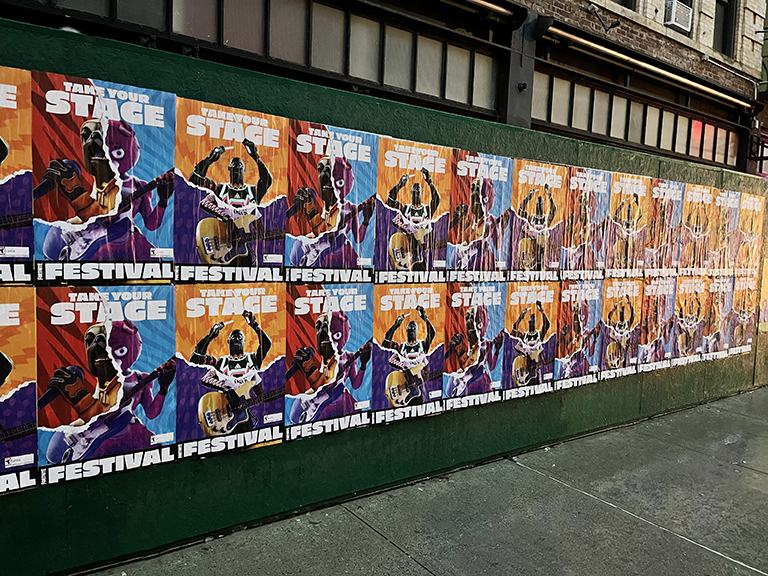
A product launch has one job: make the market feel like something worth paying attention to just arrived. Paid digital can build impressions. A well-planned street campaign builds the physical sensation that the brand has actually shown up. Those are not the same thing, and the difference in response is significant enough that the formats below consistently earn their place in launch budgets across consumer, entertainment, food and beverage, tech, and fashion categories.
The best guerrilla marketing tactics for product launches are not complicated in theory. They are complicated in execution because street-level work lives in real neighborhoods, on real timelines, with real logistics that digital campaigns never have to think about. What follows is a practical breakdown of which formats work, which combinations produce the most momentum, and how to avoid the planning mistakes that turn a strong launch concept into a weak result.
Our team at American Guerrilla Marketing has planned and deployed product launch campaigns across 50-plus U.S. markets. The patterns below come from campaigns that worked and from the lessons learned when campaigns needed adjustment.
Why Guerrilla Marketing Works Differently Than Digital During a Launch
Digital advertising during a product launch creates impressions in a feed. Guerrilla marketing creates physical presence in the real world where the audience already is. These are not competing channels. They are complementary modes of contact, and they create different types of memory.
Physical media works at launch because it concentrates visibility in the places that matter. A poster wave around a retail zone, a street team working the corridors near a launch event, or a sidewalk graphic at a transit entrance all create the sensation that the product is already in market. That sensation builds social proof before the sales data exists. For brands launching into skeptical categories or saturated shelves, that early physical credibility can meaningfully shift buyer behavior.
The Contact Advantage
Every brand wants to be seen. Guerrilla marketing at launch is one of the few formats where “seen” means a human being looked at your creative while standing on the same block, not while scrolling through content designed for someone else. That degree of physical presence is genuinely difficult to replicate with passive media. It is also genuinely difficult to ignore.
The Timing Advantage
Launch windows are tight. The period between “product revealed” and “product forgotten” is often measured in days for consumer brands. Street-level work can be deployed and documented within the same window that matters most, which means the campaign shows up at the same time the cultural conversation about the product is actually happening.
Format 1: Wheatpaste Poster Campaigns Around Launch Zones
Wheatpaste is one of the most consistent formats for product launches because it delivers repeated visual presence in the neighborhoods that matter most. A properly planned wheatpaste campaign hits multiple walls across a target district so the audience encounters the brand more than once on the same walk.
For product launches, wheatpaste works best when it is planned around actual retail locations, launch event venues, or the corridors where the target customer already spends time. The goal is not to paper an entire city. The goal is to make the right three blocks feel like the brand is already part of the neighborhood before the product officially exists in that market.
Teaser Posters vs. Reveal Posters
One of the most effective launch structures we deploy is a two-phase poster approach: teaser creative that raises curiosity before the launch date, followed by a second-wave reveal installation on or immediately before the launch day. The teaser wave builds anticipation. The reveal wave creates a physical announcement that the moment has arrived. When timed well, the combination generates earned attention beyond what either wave would produce alone.
How to Plan the Route
Route planning for launch poster campaigns should start with the audience behavior, not with the most visible walls. Identify where the target customer walks during the time window that matters, then build the route around those corridors. A coffee brand launching near campus areas needs different wall selection than a tech accessory brand launching near commuter hubs. The walls are the same type. The geography is completely different.
Format 2: Street Team Activations With Sampling
For products that benefit from trial, a street team activation paired with sampling is often the most direct conversion format available in guerrilla marketing. Street teams can handle the explanation, the handoff, and the response capture in a single interaction that no static media format can replicate.
Street teams work especially well for consumable products, tactile products, or anything that needs a “try it first” moment to overcome purchase hesitation. They also work well for categories where the product is genuinely new and people benefit from having someone explain what it is.
Building the Response Path
Every street team interaction should have a next step. Sampling alone creates a trial moment. Sampling paired with a QR code, an offer card, or a sign-up sheet creates a trial moment with a measurable downstream action. Our team always designs the response path before the activation goes live so attention has somewhere useful to go rather than evaporating after the handoff.
Team Briefing for Product Launches
Street team performance at launches depends heavily on briefing quality. Every team member needs to understand the product enough to answer real questions, the specific geography they are working, the response goal for each interaction, and the documentation standards the campaign requires. Poorly briefed teams can damage a launch impression. Well-briefed teams can accelerate it.
Format 3: Sidewalk Media at High-Foot-Traffic Corridors
Sidewalk stencils and sidewalk decals create ground-level brand presence in the literal space where foot traffic moves. For product launches, this format is most effective at transit entrances, retail doorways, event queues, and corridors near launch events where the audience will walk past repeatedly during the launch window.
Sidewalk media is inherently directional when placed well. Arrows toward a pop-up, a brand name at a retail entrance, or a message at an event checkpoint all create the sense that the brand is guiding the experience rather than just advertising from the side. That guidance-through-space is a unique property of ground-level media that overhead and wall formats cannot replicate.
Stencils vs. Decals for Launches
Stencils are faster to deploy and better suited to campaigns where the visual needs to feel organic to street culture. Decals offer a higher-finish look and better durability when the campaign needs to hold for several days or longer. For most product launches, stencils work well for overnight teaser placements while decals work better for retail or event environments where the brand needs a more polished presentation.
Format 4: LED Billboard Trucks for Launch Day Visibility
LED billboard trucks give product launches mobile visibility that static placements cannot provide. A truck running a launch-day route through the target neighborhood or event corridor can reach thousands of people across multiple blocks in a single day. The moving format also creates the sense that the campaign is following the audience, not waiting for them to find it.
For launch days specifically, LED trucks work well as a companion to static placements. The truck moves across the market while posters, decals, and street teams hold specific positions. The combination creates the feeling of full neighborhood presence even when the total placement count is modest.
Content for Launch Truck Creative
LED truck creative should be readable in two seconds. The launch message, the product name, and one call to action is usually the right amount. More information creates visual noise that moving-vehicle audiences cannot process. The goal is recognition and directional awareness, not detailed education. Save the detail for landing pages and in-person interactions.
Format 5: Pop-Up Activations as Launch Anchors
Pop-up activations give product launches a physical destination that all other campaign formats can point toward. When the poster wave, street team, sidewalk media, and LED truck all create arrows toward a single pop-up location, the campaign becomes a funnel rather than a spray. That architecture dramatically improves the ability to measure what the street-level work actually produced.
Pop-ups are especially useful for launches that need to create a “first experience” moment for media, influencers, and early adopters at the same time. The pop-up becomes a controlled environment where the brand can manage the introduction while all the street work drives the foot traffic that makes the event feel genuine.
Format 6: Projection Mapping for One-Night Spectacle
Projection advertising creates one-night visual moments that generate earned media far beyond what the projection itself reaches. For product launches, projection on a landmark building or event venue surface creates social content at scale: every person in the space becomes a potential documenter who shares what they saw.
Projection works best for launches in dense urban environments where a high-visibility surface exists near the event or activation. The window is short, which concentrates attention. The visual scale is difficult to ignore, which concentrates documentation. When the creative is strong enough to make the content worth sharing, a single projection night can generate social reach that extends far beyond the physical audience.
How to Match the Tactic Mix to the Launch Type
Not every product launch needs every format. The right combination depends on the category, the market, the budget, the timeline, and the specific business goal the campaign is designed to support.
Consumer packaged goods launches in retail-dense markets often benefit most from wheatpaste and sampling combinations because the audience needs repeated exposure and trial opportunity. Entertainment launches benefit most from visual-heavy formats like posters, projection, and LED trucks because the goal is cultural visibility before release. Tech launches benefit from street teams at relevant events because the audience needs explanation and the launch timing is often tied to a specific conference or release window. Food and beverage launches can use almost any format but tend to perform best when sampling is central because trial is the fastest path from awareness to purchase in that category.
Format Sequencing for Multi-Week Launch Campaigns
Product launches that span more than a single day benefit from a sequenced format approach rather than deploying everything at once. A sequenced campaign builds momentum across the launch window instead of concentrating all energy into a single day that quickly fades from physical and cultural memory.
A typical three-week launch sequence might open with a teaser poster wave in the first week, add street team sampling and sidewalk media in the second week as the product becomes available, and then run an LED truck and pop-up activation in the third week to close the launch window with a high-visibility event. Each phase builds on the awareness the prior phase created. Audiences who saw the teaser posters are primed to understand the street team context. Audiences who received samples are primed to recognize the pop-up event as a continuation of the campaign they already participated in.
Managing Creative Across Multiple Phases
Multi-phase campaigns require creative consistency across phases combined with visual evolution that signals progression. The brand mark, color system, and primary message should be consistent enough that someone who saw phase one recognizes phase three as the same campaign. But the creative should evolve enough that the second and third encounters feel like updates rather than repetition. A simple way to manage this is a core visual element that remains constant while supporting copy and imagery evolve to reflect the campaign phase: teaser, launch, and follow-up messages within a consistent visual framework.
Selecting the Right Agency Partner for a Product Launch Campaign
Product launch guerrilla campaigns require an agency partner with established market infrastructure rather than one that needs to build its operational capacity city by city. An agency that already has scouted locations, permit relationships, installation crews, and market-specific experience in the target cities can deploy faster, make smarter placement decisions, and avoid the operational surprises that come from working in unfamiliar territory.
The agency’s brief questions reveal a lot. A strong guerrilla marketing partner asks about the specific business goal before asking about the creative concept. It asks about the target neighborhood before suggesting formats. It asks about measurement requirements before discussing production specs. An agency that leads with format options before understanding the campaign objective is likely to produce a campaign that looks interesting but does not serve the actual launch goal.
What to Review Before Committing
Before committing to an agency for a product launch campaign, review their documentation from past campaigns in the target markets. GPS-verified photos, route maps, and clearly organized placement records show whether the agency executes at the quality level its pitch materials suggest. A portfolio of documented campaigns is more informative than a presentation of conceptual renderings. We deploy with full GPS-tracked documentation on every campaign and provide installation photo packages as standard deliverables.
Scaling From One Market to Multiple Markets
Most product launch guerrilla campaigns start in one or two primary markets and scale to additional markets as the launch phase extends. The scaling process requires the same scouting and planning discipline in each new market rather than simply replicating the original market’s plan. Different cities have different pedestrian patterns, different permit environments, and different neighborhood dynamics that affect which formats perform and where placements should be concentrated.
For brands launching across five or more markets simultaneously, a consistent campaign brief that specifies the target audience behavior, format mix, and measurement requirements gives field teams and market-specific crews the parameters they need to make good placement decisions without requiring central approval for every location. The brief is the playbook. The market-specific crews are the players who execute it with local knowledge.
Priority Market vs. Support Market Allocation
Multi-market launch campaigns typically designate two to three priority markets where the full format mix is deployed and a larger set of support markets where a lighter-touch activation creates presence without the same investment level. Priority markets get the poster wave, street teams, LED trucks, and pop-up activation. Support markets might get a focused poster and stencil run without the interactive elements. This allocation approach concentrates the campaign’s most intensive work where the business impact will be greatest while maintaining visible presence in secondary markets.
Building the Response Path Before the Campaign Goes Live
Every piece of street media needs to connect to a next step. A poster without a QR code, a URL, or a clear location call to action creates visual awareness that has no place to go. That is a significant efficiency loss for any campaign, but it is especially costly for launches where the business goal depends on awareness converting to something measurable.
Our team always designs the response path alongside the creative and the route. That means the QR destination is live before the campaign deploys, the offer code the street team hands out actually works, and the landing page reflects the specific market and campaign window rather than serving as a generic brand page.
Campaign-Specific Landing Pages
A campaign landing page built specifically for the launch market converts better than a homepage redirect. The page should confirm what the audience saw on the street, offer the next action clearly, and make it easy to complete that action in under thirty seconds. For launch campaigns, that next action is usually a purchase link, a waitlist sign-up, a sample request, or an event RSVP.
Documentation and Proof of Performance
One of the persistent challenges for product launch campaigns is proving that the street work actually happened and actually reached people. Our team approaches this with GPS-verified route documentation, timestamped photography of every installation, route maps showing exact placement locations, and head-count data from street team activations.
That documentation serves two purposes. First, it gives the marketing team and brand leadership visual evidence they can share internally and with stakeholders. Second, it provides the baseline data needed to compare this campaign to the next one. Campaigns that are well-documented get smarter over time because the team can see exactly what was placed where and tie that placement geography to the downstream behavior in those specific markets.
Brands that skip documentation typically cannot answer the question “did it work?” with anything more specific than “people seemed excited.” That is not a reporting framework. Document everything from the start.
Common Mistakes That Hurt Product Launch Campaigns
The most common mistake is treating launch guerrilla marketing as a scatter play rather than a concentrated push. Brands spread small budgets across too many formats, too many neighborhoods, and too long a timeline. The result is a campaign that is nowhere in particular rather than something that dominates one area during the critical window.
The second most common mistake is failing to align the street timeline with the launch event or retail availability date. Street media that appears after the product is already on shelves loses the teaser and anticipation benefit. Media that appears before a product is available for purchase creates frustration instead of momentum if there is no clear “coming soon” context in the creative.
The third mistake is creating outdoor creative that works on a design screen but fails at street scale. The format is brutal to small type, complex layouts, and subtle color distinctions. The creative needs to communicate in two seconds at ten feet. That constraint is not a design limitation. It is the design standard.
Frequently Asked Questions
What are the best guerrilla marketing tactics for a product launch?
The best tactics for product launches depend on the audience and market, but the highest-performing formats are wheatpaste poster waves around retail zones, street team sampling with QR capture, teaser placements the night before launch, LED truck visibility on launch day, and sidewalk media at key corridors. The format mix should match where the target audience is actually moving during the launch window.
How far in advance should a product launch campaign be planned?
Most product launch guerrilla campaigns should be planned at least four to six weeks in advance. That timeline accounts for permit research, creative production, location scouting, street team briefing, and material printing. Campaigns with multiple markets or complex installations may need eight to twelve weeks of lead time.
How do you measure guerrilla marketing results for a product launch?
Track campaign-specific QR scan rates, vanity URL visits, redemption codes from sampling, and branded search lift in the launch market during the campaign window. Combine those with photo documentation, route maps, and post-launch sales comparison by territory. The goal is to connect physical presence to measurable business behavior, not just count impressions.
What markets work best for product launch guerrilla campaigns?
Dense walking cities with active street culture perform best: New York, Los Angeles, Chicago, Austin, Miami, Seattle, and similar markets where the audience is moving on foot through the relevant neighborhoods. Market selection should follow the customer, not the budget. Concentration in the right two or three neighborhoods typically outperforms a scattered multi-city spread.
Can a guerrilla marketing campaign actually drive sales at launch?
Yes, when the campaign is designed to drive a specific next action. Street-level work that pairs visible media with sampling, QR codes tied to a launch offer, or directional content leading to a retail or pop-up location can produce measurable conversion. The key is building the response path before the campaign goes live so attention has somewhere useful to go.
Is guerrilla marketing legal for product launches?
Most guerrilla marketing formats are fully legal when properly permitted and placed on appropriate surfaces. Our team handles permit research, surface vetting, and compliance in every market where we deploy. Formats like street teams, LED trucks, and event-adjacent activations typically carry minimal regulatory complexity. Formats like sidewalk stencils or wheatpaste require market-specific research.