Strategy is the piece that most guerrilla marketing discussions skip. The conversations tend to focus on the creative formats, the clever executions, the examples that earned press coverage, and the tactical mechanics of what different campaign types look like in the field. That content is useful, but it leaves out the thinking that determines whether any of those formats actually produces results for a specific brand in a specific market with a specific set of objectives.
A guerrilla marketing strategy is the framework that connects the campaign’s formats and execution to the brand’s actual objectives. Without it, a campaign is an assortment of interesting tactical choices with no coherent logic connecting them to a business outcome. With it, every decision about format, location, timing, creative approach, and measurement has a reason that traces directly back to what the brand is trying to accomplish and who it is trying to reach.
Our team at American Guerrilla Marketing has built campaign strategies for brands across consumer goods, entertainment, technology, financial services, and political campaigns. We operate across 50-plus U.S. markets, which means we have tested strategic frameworks against real-world execution conditions in enough different contexts to know what holds up and what breaks down. This guide covers the strategic architecture we apply to every campaign we plan.
Step 1: Define the Objective With Specificity
The most common strategic failure in guerrilla marketing is a vague objective. “Build brand awareness” is not a campaign objective. It is a direction. A campaign objective is specific enough to determine what success looks like and to inform the format and location decisions that will either produce or fail to produce that outcome.
Specific guerrilla marketing objectives look like these: create 50,000 direct brand impressions among adults aged 25-35 in Brooklyn and Lower Manhattan within a two-week launch window; generate direct product trial with 10,000 target consumers in the Chicago market during the Lollapalooza event week; create organic social documentation of a brand moment at a specific cultural event that reaches the brand’s target audience through shares and coverage beyond the physical audience; establish visible brand presence in the SoHo and Williamsburg neighborhoods before a national digital campaign launches.
Those objectives are specific enough to tell us which formats to use, where to deploy them, when to time the campaign, and how to measure whether the campaign worked. A vague objective cannot do any of those things.
Aligning Objectives to the Business Context
Guerrilla campaigns serve different business contexts, and the strategy should reflect the specific context rather than a generic “awareness” or “engagement” framing. A brand launching in a new market needs a different strategy than a brand defending market share in an existing one. A product in a saturated category needs a different approach than a first-mover brand creating a new category. An entertainment brand promoting a specific release date needs a different structure than a consumer goods brand building long-term neighborhood presence.
We build campaign strategies by starting with the business context, identifying the specific role that street-level marketing can play in that context, and then designing the campaign around that role rather than around a format or an aesthetic preference.
Step 2: Map the Audience in Physical Space
Guerrilla marketing is fundamentally geographic, which means the audience analysis it requires is different from digital audience targeting. Instead of identifying demographic and behavioral segments within a platform’s data infrastructure, guerrilla audience analysis identifies where those segments physically are, at what times, and in what behavioral state.
Where Does the Audience Actually Go?
This question has specific answers for every target demographic in every major U.S. market. Young professionals in a specific income bracket in Brooklyn concentrate in specific neighborhoods, transit at specific stations, and patronize specific types of venues at specific times of day. Families in a suburban market move through specific retail corridors on weekends. Festival-going young adults concentrate at specific transit nodes during event weeks. Those specifics are what make guerrilla targeting precise rather than approximate.
We develop audience movement maps for target markets by combining demographic data with local knowledge, transit ridership patterns, and field observation. The goal is to identify the specific corridors, intersections, and time windows where the target audience is most concentrated and most accessible before making any format or location decisions.
The Behavioral Context Question
Where the audience is matters, but so does what they are doing when they are there. A professional commuting through a transit hub at 8 AM is in a different behavioral state than the same person having lunch with colleagues at noon. A festival attendee arriving at a venue is in a different state than the same person leaving after a full day. Understanding the behavioral context at each potential deployment location shapes the format and message decisions that follow.
Step 3: Select Formats Based on the Objective-Audience Match
Format selection follows from the objective and the audience mapping rather than preceding them. Once we know what we are trying to accomplish and where the audience actually is, the right formats become much more obvious.
High-Reach Awareness Formats
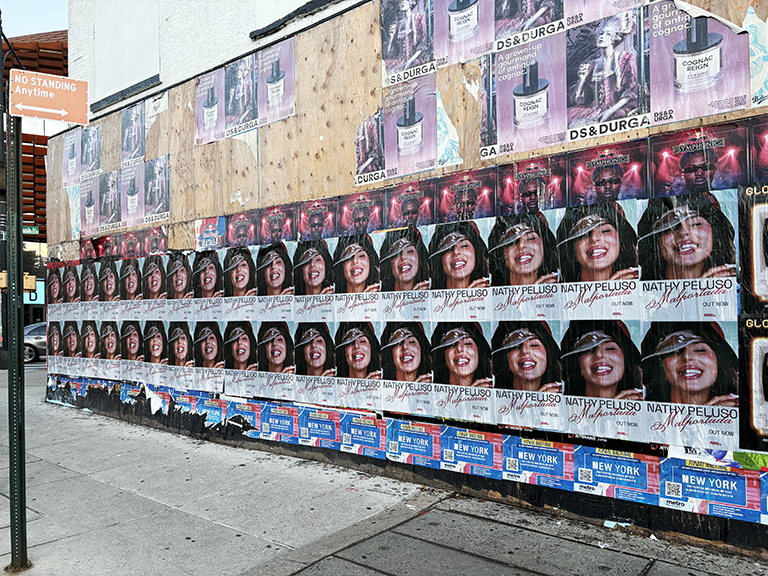
For campaigns where the primary objective is building visual brand familiarity across a defined geographic area, high-reach formats like poster campaigns, LED billboard trucks, and sidewalk stencils on high-footfall routes are the right choices. Those formats maximize impression volume per dollar spent and create the kind of repeated exposure that builds brand recognition over time.
High-Conversion Engagement Formats
For campaigns where the objective is direct consumer engagement, trial generation, or measurable conversion, street team activations and sampling campaigns are the right choices. Those formats trade reach for depth of interaction, creating fewer but more significant brand encounters per crew hour.
High-Amplification Visual Formats
For campaigns where the objective is generating social documentation and earned media coverage, projection campaigns and distinctive ambient installations are the right choices. Those formats trade reach and conversion efficiency for the potential of organic amplification that extends the campaign’s effective audience far beyond the people who were physically present.
Step 4: Build the Creative Strategy for the Physical Environment
Guerrilla marketing creative strategy must account for the specific physical environment where the campaign will run. A concept that is brilliant in a presentation can fail completely when it hits the street because the design does not read at distance, the sightlines at the specific surface are not what the brief assumed, or the message requires more engagement than a pedestrian moving at normal walking speed can give it.
Design From the Constraints of the Format
Every guerrilla format has physical constraints that should drive the creative brief from the start. A poster must communicate at street viewing distance and at pedestrian speed. A sidewalk stencil must be legible from above in limited colors. A street team interaction must deliver a meaningful brand moment in 30 seconds or less. An LED truck must be readable from moving vehicles and from varying angles. Creative briefs that ignore those constraints produce work that needs to be fundamentally redesigned after the first field test.
Context as Creative Input
The strongest guerrilla creative uses the specific context of the deployment location as part of the message. A poster that makes reference to the specific neighborhood where it is installed, a stencil that uses the sidewalk itself as a creative element, a street team interaction that acknowledges the specific moment the audience is in, all of these register differently than generic creative that could exist anywhere because they feel specifically designed for the moment rather than imported from a media plan.
Step 5: Plan for Execution and Documentation
Strategic planning that does not extend into execution planning produces campaigns that are strategically coherent but operationally compromised. The execution plan is where the strategy meets reality, and the gaps between them are where campaigns fail.
Production Timelines and Quality Standards
Every campaign format has production timelines that need to be planned backward from the campaign launch date. Poster materials require lead time for design, print, and quality inspection. Street team crews require advance scheduling, training, and briefing. LED truck campaigns require routing planning and creative optimization for the truck format. Those timelines cannot be compressed without compromising quality, and quality compromises in guerrilla marketing are visible to the audience in real time.
Permitting and Compliance Integration
Permit acquisition is part of execution planning, not an afterthought. We build permit timelines into the production schedule for every market where permits are required, and we identify format-market combinations that require advance authorization well before those deadlines pass. Compliance failures that shut down an active campaign are expensive in both direct costs and brand exposure.
Step 6: Build the Measurement Framework Into the Strategy
Measurement is not what happens after the campaign ends. It is built into the strategy at the planning stage, before any formats are selected or any creative is briefed. The question is not “how will we measure this?” after the campaign launches. The question is “what does success look like, and what evidence will prove it?” before the campaign is designed.
Proof of Execution Documentation
GPS-tagged photography, route logs, crew activity records, and distribution counts are the foundation of every campaign recap we produce. These are designed into the campaign’s operational protocol before launch, not assembled retroactively. Every crew member who works a campaign knows what documentation they are expected to produce and in what format.
Downstream Performance Integration
We work with clients to identify what downstream performance signals are available and can be attributed to the campaign: website traffic during the campaign window, retail velocity changes in the campaign market, social follower growth, offer redemption rates, or QR scan volumes. Those signals are identified in advance, and the measurement systems to capture them are put in place before the campaign launches.
Applying the Strategy Framework at Scale
The strategic framework described above scales from single-city campaigns to national multi-market programs. The logic is identical; the execution complexity increases with market count and format diversity. For national campaigns, we maintain the strategic coherence of the overall program while adapting execution details to each market’s specific audience patterns, regulatory environment, and operational conditions.
Our central operations at Industry City, Brooklyn coordinate strategy, creative standards, production quality, and documentation protocols across all markets. Local crews in each market execute against those standards rather than improvising independently. That structure is what allows us to run campaigns in 20 cities with the same quality benchmark in every one of them.
Contact our team at (646) 776-2770 to begin building a guerrilla marketing strategy for your brand. We will start with your specific objective and build the campaign structure from there.
Frequently Asked Questions
What does a guerrilla marketing strategy include?
A complete guerrilla marketing strategy includes a specific campaign objective, target audience analysis, geographic and temporal deployment mapping, format selection based on audience and objective alignment, a production and logistics plan, a compliance and permitting framework, and a measurement system that proves execution and documents results. Missing any of these elements compromises the campaign’s ability to deliver on its objectives.
How do you set objectives for a guerrilla marketing campaign?
Guerrilla campaign objectives should be specific and measurable: launch awareness in a defined market, drive trial among a target demographic, generate a specific number of direct consumer interactions, produce social documentation of a brand moment, or create event-adjacent brand association. Vague objectives like “build brand awareness” produce vague results and make it impossible to evaluate campaign performance.
How does audience analysis work for guerrilla marketing?
Audience analysis for guerrilla marketing focuses on where the target demographic is physically located, at what times, and in what behavioral context. Unlike digital audience targeting, which uses platform data, guerrilla audience analysis uses neighborhood demographics, foot traffic patterns, transit ridership data, and local knowledge to identify the specific corridors and time windows where the target audience is most accessible.
What is the role of creative strategy in guerrilla marketing?
Creative strategy in guerrilla marketing must account for the specific physical environment where the campaign runs, not just what looks good in a brief. Strong guerrilla creative is contextually relevant, readable at the appropriate distance and speed, distinctive enough to earn attention in a visually competitive environment, and designed for the specific constraints of the deployment format.
How should guerrilla marketing integrate with digital marketing?
Guerrilla marketing and digital marketing work best when they reinforce each other. Street-level campaigns create the physical moments and documentation that fuel digital content. Digital campaigns amplify the reach of physical executions beyond the immediate geographic audience. QR codes, branded URLs, geo-targeted social advertising, and influencer coordination all connect the physical and digital layers of an integrated campaign.
How do you build a guerrilla marketing strategy for multiple cities?
Multi-city guerrilla strategies require centralized creative management to maintain brand consistency and decentralized execution to adapt to each market’s specific audience patterns, regulatory environment, and operational conditions. AGM provides a single agency partner with established infrastructure across 50+ U.S. markets, which is the most efficient structure for national campaigns.